
Deepfake and AI likeness laws by country, as of October 2026
A plain-English tracker of the deepfake, voice-cloning and AI likeness laws in 17 jurisdictions, from the United States and the European Union to China, India, South Korea and Brazil. Every row links its source, carries its date, and is re-checked every month.
Deepfake laws now exist in most major economies. The US TAKE IT DOWN Act criminalizes AI intimate images, the EU AI Act requires AI disclosure and labels from August 2, 2026, Italy and France jail harmful deepfakes, and China, India and South Korea mandate labels. Every system turns on consent, which Idy's Executor Lock™ on Afterlife.ai™ records while you live.
On September 30, 2026, two courts on opposite sides of the world ruled on AI copies of real people on the same day. In Phoenix, the Arizona Court of Appeals vacated a manslaughter sentence because the trial judge had relied on an AI video of the man who was killed, a video his family built from his photos and voice recordings and scripted with words he never said (Fox 10 Phoenix, September 30, 2026). In Tokyo, the District Court held that unauthorized use of a voice actor's voice can infringe his publicity rights (IOL, September 30, 2026). A month earlier, a fake AI "final wish" recording of Dolly Parton circulated within a day of her death, and Snopes rated it Fake (Snopes, August 26, 2026).
The law is moving at the same speed as the technology, and it is moving in one direction. This tracker covers what is banned, what needs consent, what happens after death, who must label AI content and what the penalties are, country by country, with the date each rule took effect and a link to the source. It starts with a master table that answers the most common question in one place, then gives each jurisdiction its own section, and ends with what a person and a business should do about all of it this year.
By Chris Williams, founder of Idy, the company behind Afterlife.ai™ and Timeless AI™. Updated October 2, 2026. Last reviewed October 2, 2026.
Every law below asks first whether the person consented.
Put your answer on record today, in your own words.
Record your consent with a free PersonaDefinitions
Deepfake: realistic synthetic or manipulated image, video or audio of a real person, made with AI or editing tools, that people can mistake for the real thing.
Digital replica: a realistic computer-generated version of a person's voice or visual likeness, the term used in US federal and state bills.
Right of publicity: a person's right to control commercial use of their name, image, likeness, voice and other identifying traits. In many US states the right passes to heirs after death.
Synthetic content label: a visible notice or embedded marker that tells people an image, video, audio clip or text was generated or altered by AI.
Persona: the AI version of you that you build on Afterlife.ai™ while you are alive, from your own memories and your own cloned voice.
Executor Lock™: Idy's patent-pending system of named executors, Trusted Contacts, a verified death report and a sealed snapshot of your Persona that can never be changed.
What changed in the last 90 days (reviewed October 2, 2026)
September 30, 2026, United States: the Arizona Court of Appeals vacated a sentence because the judge relied on an AI video of the dead victim (Fox 10 Phoenix).
September 30, 2026, Japan: the Tokyo District Court held that unauthorized use of a performer's voice can infringe publicity rights (IOL).
September 14, 2026, New York: Manhattan District Attorney Alvin Bragg announced the seizure of twelve websites hosting non-consensual AI-generated intimate imagery, described as the largest such seizure to date (Wikipedia, Deepfake pornography).
August 2, 2026, European Union: the AI Act's Article 50 transparency duties began to apply (Baker Botts).
July 2026, United States: Public Citizen counted election deepfake laws in 31 states (Arizona Capitol Times, July 21, 2026).
July 16, 2026, Israel: a disclosure duty for deepfakes in election campaign material took effect (JFeed, August 11, 2026).
Which countries have deepfake laws?
Almost every large economy now has at least one law that reaches deepfakes, but very few have a single "deepfake law". Most countries regulate the harm the fake causes, so the rules sit inside criminal codes, election laws, privacy laws, copyright laws and new AI statutes. The pattern in 2026 is consistent across continents. Sexual deepfakes are crimes in a growing list of countries, election deepfakes are banned or must be labeled in many democracies, AI content must carry labels in the EU, China, India and South Korea, and commercial use of a person's face or voice needs that person's consent almost everywhere.
The master table below covers 17 jurisdictions. Each row gives what the law bans, the consent rule, the rule after death, the labeling duty, the penalty, the date in force and the source. A dash means the jurisdiction has no rule of that kind specific to AI, and the person must rely on general law such as defamation, privacy or fraud.
Jurisdiction | What is banned | Consent rule | After-death rule | Labeling or disclosure duty | Penalty | In force | Source |
|---|---|---|---|---|---|---|---|
United States (federal) | Publishing non-consensual intimate images, real or AI-generated (TAKE IT DOWN Act) | Consent of the person depicted | Bill only: NO FAKES Act would protect voice and likeness for 10 years after death, renewable to 70 | Platforms must remove reported images within 48 hours | Up to 2 years in prison, more where minors are involved | Signed May 19, 2025; platform duty from May 19, 2026 | |
United States (states) | Unauthorized commercial digital replicas; election deepfakes in 31 states; sexual deepfakes in many states | Consent for commercial use of voice and likeness | California 70 years; Indiana and Oklahoma 100 years; Tennessee while the likeness is used | Election ads must disclose AI in states with election laws; New York ads must disclose synthetic performers | California AB 1836: greater of $10,000 or actual damages; New York ads: $1,000, then $5,000 | Tennessee July 1, 2024; California Jan 1, 2025; New York Dec 11, 2025 and June 9, 2026 | |
European Union | Unlabeled deepfakes; AI that hides that it is an AI (AI Act Article 50) | Ministers' declaration: protection against replicas made without consent | - | Tell people they are talking to an AI; machine-readable marking; label deepfakes | Up to €15 million or 3% of worldwide turnover | August 2, 2026 (marking for existing systems by December 2, 2026) | |
Denmark | Sharing realistic AI imitations of a person's face, voice or body without consent | Consent of the person imitated | Bill: 50 years after death | - | Takedown through the EU notice-and-action system | Bill (cross-party agreement June 26, 2025) | |
Italy | Spreading AI-made or AI-altered images, video or voice without consent that can deceive and cause unjust harm (Penal Code art. 612-quater) | Consent of the person depicted | - | - | 1 to 5 years in prison | October 10, 2025 (Law 132/2025) | |
France | Publishing an AI montage of a person's image or words without consent, where the artificial nature is not obvious or stated (Penal Code art. 226-8) | Consent of the person | - | Stating that the content is artificial removes the offense | Up to 1 year and €15,000; 2 years and €45,000 online; heavier for sexual deepfakes | SREN law of May 21, 2024 | |
Germany | Publishing a person's picture without consent (Kunsturhebergesetz s. 22) | Consent of the person | 10 years after death, consent of spouse or partner and children, otherwise parents | - | Remedies under the statute and the general right of personality | In force for more than a century | |
Spain | Draft: recreating or modifying a person's appearance or voice with AI without permission | Consent; minimum age 16 to consent to use of one's image | - | Satire and fiction about public figures allowed if labeled as AI | Civil remedies (draft) | Draft approved by the cabinet January 13, 2026 | |
United Kingdom | Sharing intimate images that appear to show a person; creating or requesting a purported intimate image of an adult; supplying generators of such images | Consent of the person depicted | - | Platforms must take down non-consensual intimate images promptly (Crime and Policing Act 2026) | Criminal offenses | Creation offense February 6, 2026; Crime and Policing Act royal assent April 29, 2026 | |
China | Unlabeled AI content; clones without consent (draft); unauthorized AI voices (court ruling) | Consent of the person; voice rights cover an identifiable AI voice | Draft: recreating the dead needs family authorization; data law lets the person's own arrangement prevail | Visible labels and embedded metadata on all AI content | Draft: 10,000 to 200,000 yuan; court award of 250,000 yuan (2024) | Labels September 1, 2025; draft rules April 2026 | |
Japan | Unauthorized use of a performer's voice can infringe publicity rights (court ruling) | Consent of the performer | - | - | Publicity-rights claims in court; no AI-specific penalty | Tokyo District Court, September 30, 2026; AI Promotion Act passed May 28, 2025 | |
India | Unlabeled synthetic content on platforms; AI cloning of a person's voice and persona (court ruling) | Consent of the person (Arijit Singh ruling) | - | Prominent labels and permanent metadata; takedown in 3 hours (2 hours for intimate deepfakes) | Takedown duties on platforms; court injunctions | February 20, 2026; Bombay High Court July 26, 2024 | |
South Korea | Unlabeled generative AI and deepfakes; possessing or viewing sexual deepfakes | Consent of the person depicted | - | Notice or watermark; visible notice for the whole length of realistic deepfakes | Up to ₩30 million per labeling violation after a grace period; sexual deepfake crimes up to 7 years | AI Basic Act January 22, 2026; possession law September 26, 2024 | |
Singapore | Publishing, boosting or sharing deepfakes of election candidates during an election | Consent of the candidate | - | - | Individuals up to S$1,000 and/or 12 months; platforms up to S$1 million | Passed October 15, 2024; applied from the April 15, 2025 writ of election | |
Brazil | Deepfakes in election campaigns; AI used to alter a woman's image or voice in psychological violence | Consent of the person depicted | - | Clear notice on any other AI use in campaign material | Candidates can be barred or lose their mandate; criminal penalty up by half | Electoral court rules 2024; Law 15.123 April 24, 2025 | |
Israel | Undisclosed deepfakes in election campaign material | - | - | Prominent disclosure that the content is not authentic | Injunctions through the Central Elections Committee | July 16, 2026 | |
Canada | AI image generation that violated privacy law (regulator finding); AI intimate images (bill) | Consent under privacy law | - | - | Regulator findings; criminal amendment pending | Privacy Commissioner finding June 2026; Bill C-16 amended April 2026 |
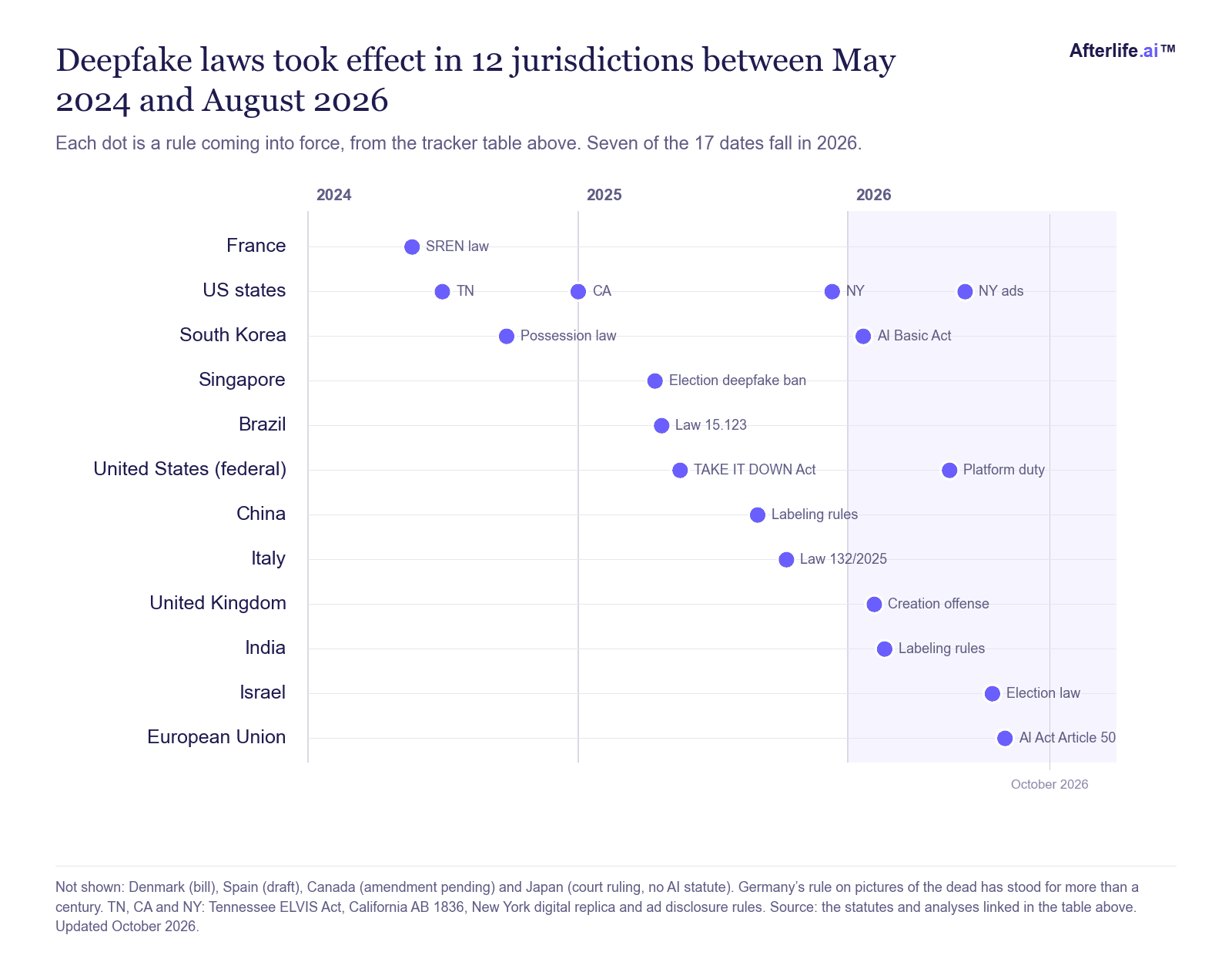
Read across the table and three facts stand out. Consent appears in every row that protects a person, from Italy's criminal code to China's draft rules on digital humans. The after-death column is the emptiest, which means that in most countries nobody has written down who speaks for your likeness when you are gone. And the labeling column is filling up fast, so any AI that talks as a person now needs to say plainly that it is an AI.
Is deepfake illegal in the US?
Yes for sexual deepfakes, election deepfakes in most states and unauthorized commercial replicas in a growing number of states, and the federal government is close to a general likeness right. The United States has no single federal deepfake ban, so the answer depends on what the deepfake shows, how it is used and where you live. The federal layer covers intimate images and robocalls today. The state layer covers elections, sexual content, commercial use and, in several states, the rights of the dead.
The TAKE IT DOWN Act was signed on May 19, 2025, after passing both houses by near-unanimous votes. It makes publishing non-consensual intimate imagery a federal crime whether the image is real or AI-generated, with up to two years in prison and harsher penalties where minors are involved. Covered platforms must remove an image within 48 hours of a victim's request and delete known copies, the Federal Trade Commission enforces the platform duty, and platforms had until May 19, 2026 to build their takedown process (Wikipedia).
The NO FAKES Act of 2026 (S.4591) would create a federal right in every person's voice and visual likeness, for private individuals as well as celebrities. The Senate Judiciary Committee advanced the bill by unanimous voice vote on June 18, 2026 (Holland & Knight, June 22, 2026), and it is not law yet. As introduced, the bill makes the right a property right that cannot be assigned during the person's life but can be licensed, that "shall not expire upon the death of the individual", and that passes to executors and heirs or by will. After death the right lasts 10 years, renewable in five-year periods while the heirs show authorized public use, up to 70 years after death. Statutory damages run to $5,000 per work for an individual, $25,000 per work for a business and up to $750,000 per work for a platform that ignores its takedown duties (S.4591 as introduced). For the full bill in plain English, read the NO FAKES Act explained.
The Federal Communications Commission ruled in 2024 that an AI-generated voice counts as "artificial" under the Telephone Consumer Protection Act, which gives people a private right of action against AI-voice robocalls (Declaratory Ruling FCC 24-17, cited in our state-by-state chapter). That ruling matters to every family, because the FBI counted $352 million in AI-related scam losses among Americans aged 60 and over in a year, with voice clones built from social-media and voicemail audio used to fake a grandchild in trouble, according to Fox News reporting on the FBI's Internet Crime Complaint Center (Fox News, June 11, 2026).
What are the deepfake laws by state?
A majority of US states now have at least one deepfake law, and the strongest likeness protections sit in Tennessee, California, New York, Illinois and Indiana. Public Citizen counted election deepfake laws in 31 states as of July 2026, up from 30 when Maryland joined in May (Public Citizen, May 13, 2026; Arizona Capitol Times, July 21, 2026). Those laws typically require disclosure of AI in political ads within a set window before an election and let a targeted candidate go to court for a fast takedown.
Eight states now name digital replicas in statute: Tennessee (ELVIS Act, in force July 1, 2024), California (AB 2602 and AB 1836, in force January 1, 2025), Illinois (HB 4875, January 1, 2025), New York (Civil Rights Law section 50-f and its 2025 amendments), Utah (SB 271, May 7, 2025), Arkansas (HB 1071, February 25, 2025), Montana (HB 513, January 1, 2026) and Washington (SSB 5886, June 11, 2026). Montana's right attaches whether or not a person ever commercially benefits from their likeness, and the right passes to executors and heirs. Every row, with its statute link, is in digital replica laws in every US state.
State | The rule that matters most for AI likeness | Since |
|---|---|---|
Tennessee | The ELVIS Act protects a person's voice, image and likeness against unauthorized AI use (Vanderbilt Law); the state's post-mortem right does not expire while the likeness keeps being used | July 1, 2024 |
California | AB 1836: a digital replica of a deceased personality in an audiovisual work or sound recording without prior consent costs the greater of $10,000 or actual damages, under a right that runs 70 years after death; AB 2602 voids contract terms that let a replica replace a performer's work, when set conditions are met (AB 1836; AB 2602) | January 1, 2025 |
New York | Consent from the rights holders before any commercial use of a deceased personality's name, voice or likeness or a digital replica of a deceased performer; ads must disclose synthetic performers, with penalties of $1,000 and then $5,000 (Office of the Governor) | December 11, 2025; disclosure June 9, 2026 |
Indiana and Oklahoma | Post-mortem right of publicity for 100 years after death; Indiana also covers signature, gestures, distinctive appearance and mannerisms (Wikipedia) | Long-standing |
Illinois and Nevada | AI may not provide therapy or mental-health decisions; AI for administrative tasks is allowed; fines up to $10,000 (Illinois) and $15,000 per violation (Nevada) (Illinois IDFPR; WSGR) | August 4, 2025; July 1, 2025 |
Digital-asset law sits beside likeness law, and it decides who can get into your accounts after you die. As of mid-2026, 47 states and the District of Columbia have adopted the Revised Uniform Fiduciary Access to Digital Assets Act (RUFADAA), which gives a service's own "online tool" priority over a will for digital assets in the states that follow it; the state-by-state list is in which states have adopted RUFADAA.
What does the EU AI Act Article 50 require?
Since August 2, 2026, Article 50 of the EU AI Act has required that people be told when they are interacting with an AI, unless that is obvious from the context. Providers of generative AI must mark synthetic audio, images, video and text in a machine-readable way, and anyone who publishes a deepfake must label it as artificially generated or manipulated. Systems already on the market before August 2 have until December 2, 2026 to meet the marking duty, and fines reach €15 million or 3% of worldwide annual turnover, whichever is higher (Baker Botts, September 2026; Cloud Security Alliance, July 29, 2026). The Act entered into force on August 1, 2024 and rolls out in stages to August 2, 2028.
Europe's governments have also written down the consent principle that sits underneath the transparency rules. Under the Danish Council presidency in the second half of 2025, ministers from every member state except Hungary, plus five other European countries, signed a declaration whose guiding principles include protecting citizens "against digital replicas of their personal characteristics without consent" (European Parliamentary Research Service, January 2026). For what Article 50 means for an ordinary person, read what EU AI Act Article 50 means for you.
Each Timeless AI™ Twin carries a badge that marks the chat as an AI twin, and when a visitor asks whether a person is typing, the twin says plainly that the visitor is talking with the owner's AI twin. A Persona on Afterlife.ai™ speaks only to the people the owner named, and those people always know they are talking with the owner's Persona.
What is Denmark's deepfake law?
Denmark has moved further than any other European country toward giving every person a right over realistic AI imitations of their own face, voice and body. A broad majority of Danish parties agreed the plan on June 26, 2025, and the bill adds a new section 73 a to the Danish Copyright Act (Lovguiden). It requires the imitated person's consent before such content is made available, excludes caricature, satire, parody and pastiche in principle, and uses the EU Digital Services Act's notice-and-action system for takedowns. The protection lasts 50 years after the person's death, and the Danish culture minister has said Ireland intends to follow (EPRS, January 2026).
The bill's status is the one detail to check before you rely on it. Danish government sources planned entry into force during 2026, and a legal summary updated in May 2026 reported that final parliamentary adoption was still pending (Global Law Experts, May 2026). We re-check the Folketing record every month and will mark the row as law on the day it passes. Whatever the date, the Danish design is the clearest statement yet of where European law is heading, because it treats your likeness as yours, for life and for half a century after.
What are the deepfake laws in Italy, France, Germany and Spain?
The four largest continental economies after the EU rules all protect a person's image and voice, and two of them jail people for harmful deepfakes. Italy and France act through criminal law, Germany through a picture-rights statute that is more than a century old, and Spain through a draft civil law aimed squarely at AI. Germany, Italy and France are among the biggest audiences for this tracker, so each gets its own answer.
Italy
Italy made harmful deepfakes a crime with a prison term of one to five years. Law 132/2025, the national AI statute, took effect on October 10, 2025 and added article 612-quater to the Penal Code, which punishes anyone who, causing unjust harm, spreads AI-generated or AI-altered images, video or voice without consent that are capable of deceiving people about their authenticity (CDS). The same law adds an aggravating circumstance for crimes committed with AI tools. Italy's data protection authority has also acted against an AI companion app, suspending Replika in February 2023 and fining its maker €5 million in May 2025 (PYMNTS).
France
France punishes a non-consensual deepfake with up to two years in prison and a €45,000 fine when it is published online. The SREN law (Loi n° 2024-449 of May 21, 2024) amended Penal Code article 226-8 so that publishing a montage of a person's image or words made by AI without consent, where its artificial nature is not obvious or stated, carries up to one year and €15,000, rising to two years and €45,000 through an online service (Village de la Justice). Article 226-8-1 adds heavier penalties for sexual deepfakes. France also moved fast during the Grok scandal, when ministers referred the content to prosecutors on January 2, 2026, and Paris prosecutors and Europol searched X's Paris offices on February 3, 2026 (Wikipedia).
Germany
Germany has protected a person's picture after death for more than a century. Section 22 of the Kunsturhebergesetz says a person's picture may be published only with that person's consent, and for 10 years after death only with the consent of the relatives, meaning the surviving spouse or partner and the children, or otherwise the parents (German federal law portal). German courts also recognize a general right of personality, set out by the Federal Court of Justice in its Marlene Dietrich decision (Wikipedia). The federal justice ministry said in March 2026 that its proposal for a dedicated criminal law on sexual deepfakes was ready to be presented (Wikipedia, Deepfake pornography).
Spain
Spain's cabinet approved a draft organic law on January 13, 2026 that treats recreating or modifying someone's appearance or voice with AI systems without their permission as an unlawful interference with their personal rights (ECIJA, January 28, 2026). The draft sets 16 as the minimum age at which a person can consent to the use of their own image, classes AI use of a person's image or voice for advertising or commercial purposes without consent as illegitimate, and allows creative and satirical uses involving public figures when the content is clearly labeled as AI. The draft went to public consultation and then to parliament, so it is written here as a draft until it passes.
Is deepfake illegal in the UK?
Yes for sexual deepfakes, which are now crimes to share, to create and to supply the tools for, but the UK still has no general right over your own image or voice. The Online Safety Act 2023 amended the Sexual Offences Act 2003 so that sharing an intimate image that shows or "appears to show" another person without consent is an offense, which covers deepfakes (Wikipedia, Deepfake pornography). Creating, or requesting the creation of, a purported intimate image of an adult became a crime on February 6, 2026, when section 138 of the Data (Use and Access) Act 2025 came into force (legislation.gov.uk, SI 2026/31).
The Crime and Policing Act 2026, which received royal assent on April 29, 2026, goes further. It criminalizes creating or supplying generators of purported intimate images, and it amends the Online Safety Act to put a duty on online platforms to take down non-consensually posted intimate images promptly (Wikipedia). Outside sexual content, a person in the UK relies on passing off, defamation and data protection law, and a March 2026 government report on copyright and AI said only that it will consider a digital replica right, with no timetable (Resultsense, August 10, 2026). For a UK reader, a record of your own consent made while you are alive does work the statute book does not yet do.
What are China's deepfake rules?
China regulates AI likeness more tightly than any other country, with mandatory labels, a court ruling on AI voices and draft rules on "digital humans". The Deep Synthesis Provisions have applied since January 2023, and the Measures for Labeling AI-Generated Synthetic Content, in force since September 1, 2025, require visible labels and embedded metadata on AI-generated text, images, audio, video and virtual scenes (Wikipedia, Regulation of AI). In April 2026 the Cyberspace Administration published draft rules that ban clones made without consent, allow recreations of the dead only with family authorization, require labels, and set fines of 10,000 to 200,000 yuan (AFP via TechXplore, April 19, 2026).
The courts have already applied these principles to voices. In April 2024 the Beijing Internet Court held that a voice-over artist's voice rights extend to an AI-generated voice that people can identify as hers, ruled that a company's copyright in her recordings did not include the right to license her voice to AI, and ordered the defendants to pay 250,000 yuan, about $34,500 (Beijing Internet Court). China's Personal Information Protection Law adds one more rule that every planner should know, which is that next of kin may exercise rights over a deceased person's data "except where the deceased has arranged otherwise before their death" (Article 49, DigiChina translation). A written decision made while alive outranks the family, even in the strictest system in the world.
What are the deepfake laws in India?
India now requires labels on all synthetic media and some of the fastest takedowns anywhere. The Ministry of Electronics and IT notified amendments to the IT (Intermediary Guidelines and Digital Media Ethics Code) Rules on February 10, 2026, in force from February 20, 2026 (Freshfields). "Synthetically generated information" must carry a prominent label and permanent provenance metadata. Platforms must remove content flagged by a court or the government within three hours, down from 36, and must remove non-consensual intimate imagery, including deepfakes, within two hours of a complaint.
Indian courts protect a person's voice from AI cloning as part of their personality rights. In Arijit Singh v. Codible Ventures, decided on July 26, 2024, the Bombay High Court granted the singer an interim injunction barring anyone from using his name, voice, vocal style and technique, mannerisms, image or signature without his consent, and the order expressly covered generative AI, voice-conversion tools, digital avatars and deepfakes (Columbia Global Freedom of Expression). Commentators call the order India's first AI voice-cloning personality-rights ruling, and it set the template that performers in India now use to protect their voices.
What does South Korea's AI Basic Act require?
South Korea's AI Basic Act took effect on January 22, 2026 and requires generative AI providers to tell users when AI is involved, through a visible notice or a machine-readable watermark. Realistic deepfakes must carry a visible notice for their whole length, and fines reach ₩30 million, about $20,000, per violation after a grace period of at least a year, to January 2027 (IAPP; PetaPixel, January 29, 2026).
South Korea also has some of the toughest criminal penalties for sexual deepfakes in the world, passed after a 2024 scandal over Telegram chat groups that targeted students and teachers. Police reported more than 800 deepfake sex-crime cases by the end of September 2024, against 156 in 2021, and on September 26, 2024 lawmakers made it a crime to possess or view sexually explicit deepfakes, with up to three years in prison or fines of up to ₩30 million, while raising the maximum sentence for creating them for distribution to seven years (Wikipedia, Deepfake pornography).
What about Japan, Singapore, Brazil, Israel and Canada?
These five countries show the range of approaches outside the EU, the US and China. Japan relies on courts and a light-touch AI statute, Singapore and Israel aim at elections, Brazil combines election rules with criminal penalties, and Canada has acted through its privacy regulator while a criminal amendment works through Parliament.
Japan
Japan has no dedicated deepfake statute, and its courts are filling the gap. On September 30, 2026 the Tokyo District Court held, in voice actor Kenjiro Tsuda's case against TikTok, that unauthorized use of a performer's voice can infringe publicity rights, while dismissing his request to remove 188 videos (IOL). The Act on the Promotion of Research, Development and Utilization of Artificial Intelligence Technologies, passed on May 28, 2025, imposes no direct penalties, and it authorizes the state to investigate serious misuse such as deepfakes, publish its findings and recommend corrective steps (Zelo). Japan is also where the national broadcaster NHK staged an AI recreation of the late singer Hibari Misora singing a new song on September 29, 2019, years before any of these rules existed (Japanese Wikipedia).
Singapore
Singapore bans deepfakes of election candidates for the length of an election. Parliament passed the Elections (Integrity of Online Advertising) amendment on October 15, 2024, and the ban applied from the writ of election on April 15, 2025 (Baker McKenzie, May 8, 2025). The law covers realistic content showing a candidate saying or doing something they did not, whether made with AI or with traditional editing, with fines of up to S$1,000 and up to 12 months in prison for individuals and fines of up to S$1 million for platforms. Parliament also passed the Online Safety (Relief and Accountability) Act on November 5, 2025, which creates an Online Safety Commission with powers to order removals for harms including intimate image abuse (Squire Patton Boggs, December 2025).
Brazil
Brazil punishes AI misuse both at election time and in criminal law. The Superior Electoral Court banned deepfakes in election campaigns in 2024, requires a clear notice on any other use of AI in campaign material, and allows candidates caught using deepfakes to be barred from running or to lose their mandate if elected (France 24). Law 15.123/2025, enacted on April 24, 2025, increases the penalty for psychological violence against women by up to half when the offense uses AI or any tool that manipulates the victim's image or voice, on top of a base penalty of six months to two years in prison and a fine (IAPP, May 7, 2025).
Israel
Israel requires disclosure of deepfakes in election campaigns. Amendment No. 43 to the Elections (Methods of Propaganda) Law took effect on July 16, 2026 and obliges anyone who publishes campaign material containing visual or audio content created or edited by digital means, that could be mistaken for authentic documentation, to include a prominent and explicit disclosure that the content is not authentic (JFeed, August 11, 2026). A party targeted by an undisclosed deepfake can petition the chairman of the Central Elections Committee for an injunction.
Canada
Canada has acted through its privacy regulator while Parliament works on criminal law. In June 2026, Canada's Privacy Commissioner found that the image generation in xAI's Grok violated Canadian privacy law, after users had asked the tool to alter photos of real women and girls into sexualized images (Wikipedia). Parliament amended Bill C-16 in April 2026 to cover AI-generated intimate images, and final passage is the date to watch.
Is it illegal to clone someone's voice?
Cloning your own voice is legal everywhere, and cloning someone else's voice without consent is increasingly illegal, especially for commercial use, fraud or sexual content. In the United States, Tennessee's ELVIS Act protects a person's voice against unauthorized AI use, California and New York require consent for commercial replicas of the dead, and the FCC treats AI voices in robocalls as "artificial" under federal law. China's Beijing Internet Court awarded a voice actor 250,000 yuan in 2024 over an AI voice built from her recordings, India's Bombay High Court barred AI cloning of Arijit Singh's voice in 2024, and Japan's Tokyo District Court recognized voice publicity rights in September 2026.
The safest approach for anyone is to clone only your own voice, keep the recording that proves the voice is yours, and decide in writing who may use your voice after you die. That is exactly how a Persona works on Afterlife.ai™, where you clone your own voice with your own consent and your Persona then speaks in that voice to the people you named. For practical steps, read how to protect your voice from AI cloning and how to prove a voice is really you.
Can someone make an AI of you after you die?
In most countries, yes, unless you or the law say otherwise, and the after-death rules vary more than any other part of this tracker. A few places protect a dead person's likeness for a long time, many protect it only for commercial use, and several have no specific rule at all. Large platforms have also patented ways to do this, including Meta's patent to simulate dead users, granted on December 30, 2025. The table gathers the after-death rules that apply to AI copies of a person.
Jurisdiction | Who controls your likeness after you die | How long |
|---|---|---|
California | Heirs and successors; consent needed for digital replicas of a deceased personality in audiovisual works and sound recordings | 70 years |
Indiana and Oklahoma | Heirs and successors | 100 years |
Tennessee | Heirs and successors | While the likeness keeps being used |
New York | Rights holders must consent to commercial digital replicas of deceased performers and personalities | 40 years, for people domiciled in New York |
Montana | Executors and heirs, whether or not the person used the likeness commercially in life | 20 years |
United States (NO FAKES bill) | Executors, heirs and licensees; the right can pass by will | 10 years, renewable to 70 |
Germany | Spouse or partner and children, otherwise parents, for pictures | 10 years |
Denmark (bill) | The protection continues after death | 50 years |
China (draft rules and data law) | Family authorization to recreate the dead; the person's own arrangement prevails over next of kin for data | Not limited |
United Kingdom, Japan, India, South Korea | No specific post-mortem AI likeness rule | - |
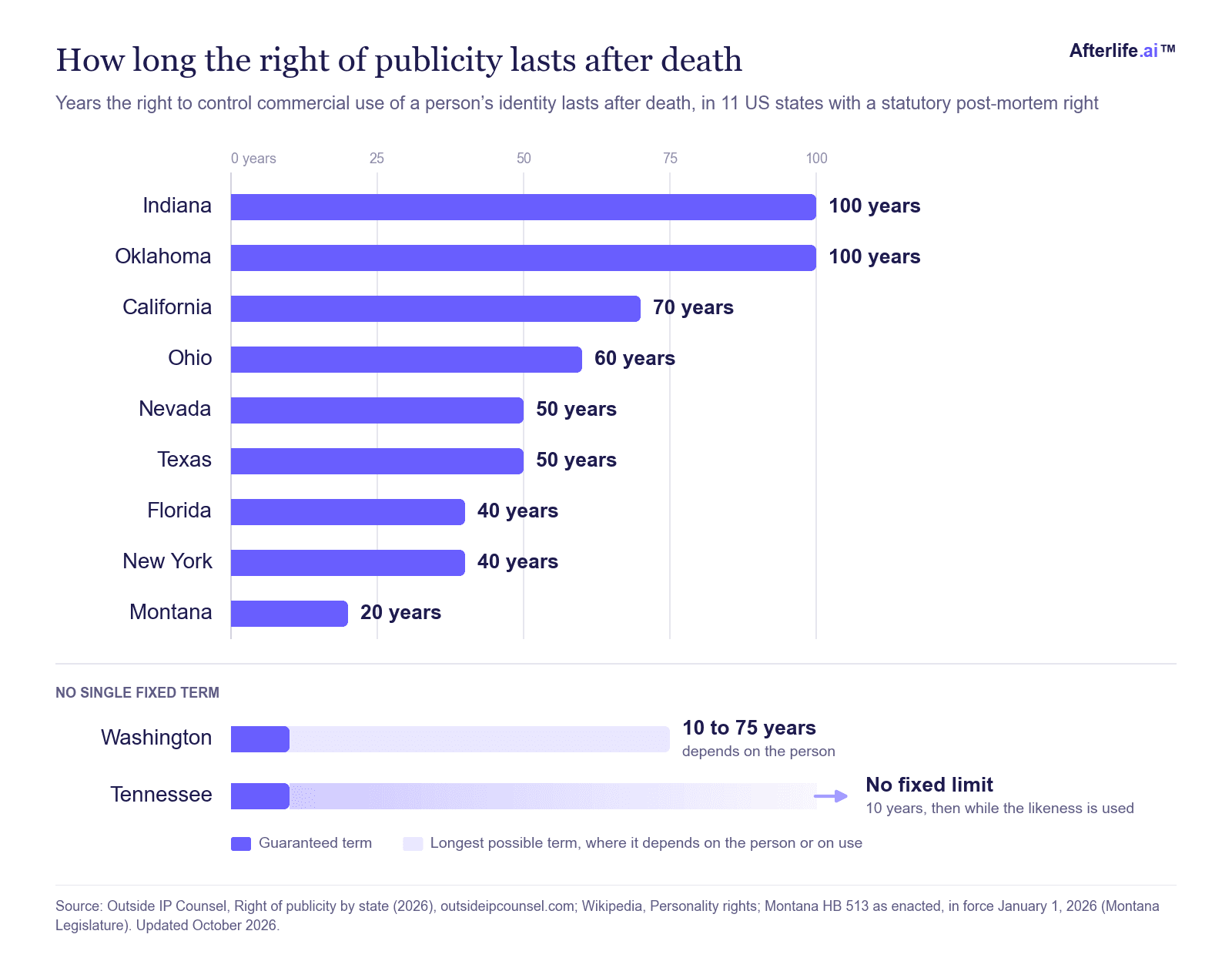
Two cases from the United States show why this matters. When Anthony Bourdain's voice was recreated with AI for a 2021 documentary, the director said the estate had approved, and the executor of his estate publicly denied being consulted (Wikipedia). When Christopher Pelkey's family played an AI video of him at a 2025 sentencing, the Arizona Court of Appeals later found that the AI "erases the interpretive distance" between what a family believes and the person's own voice. Both families acted on what they believed the person wanted, and neither person had written it down.
Researchers have reached the same conclusion. Cambridge researchers called in 2024 for consent from the person whose data builds an AI of the dead, for transparency, for ways to opt out and for dignified ways to retire the recreation (University of Cambridge, May 9, 2024). A Lehigh University audit of 93 AI "afterlife" services found that 82 publish thin or no information on who has authority over a recreation (arXiv, August 28, 2026). For the ownership question in depth, including what nine AI twin companies' contracts say, read who owns your AI twin after you die, and for the families who already face this, read what a griefbot is and whether AI can bring back the dead.
The after-death column is empty in most countries.
Fill it in for yourself, with a named person and rules the software follows.
Name your executorWhy did deepfake law move so fast in 2026?
Deepfake law moved fast in 2026 because the harm became impossible to ignore and the tools became available to anyone with a phone. The turning point was the Grok image scandal. From late December 2025, users of xAI's Grok on X asked the tool to alter photos of real women and girls into revealing or sexualized images, and one analysis over 24 hours on January 5 and 6, 2026 counted about 6,700 sexually suggestive or "nudified" images an hour (Wikipedia). French ministers referred the content to prosecutors on January 2, Paris prosecutors and Europol searched X's Paris offices on February 3, and Canada's Privacy Commissioner issued a finding against the tool in June.
The scandal landed on years of earlier warnings. In January 2024, AI-generated explicit images of Taylor Swift spread across X, and one post was viewed more than 45 million times before removal. In South Korea, police reported more than 800 deepfake sex-crime cases by September 2024. Scams moved the same way, with the FBI's figure of $352 million in AI-related losses among older Americans cited above. Lawmakers who had debated deepfakes for years found that voters now expected action, and 2026 became the year when the EU's labels, India's takedown clocks, South Korea's notices and the UK's creation offense all took effect.
What should you do this year to protect your likeness?
You protect your likeness by creating the authorized version of yourself, recording your consent rules, and naming the person who holds them after you. The six steps below take an afternoon and work in every jurisdiction in this tracker, because each one creates evidence of what you consented to. They also make a fake easier to spot, since your family will know which voice and face are really you.
Build the authorized version of you. Start a Persona on Afterlife.ai™ free, with 25 memories and no card, so the AI that speaks as you is the one you built from your own words.
Record your consent rules. Clone your own voice and record your own Persona Video, which turns one 30-second recording of you into video messages in your face and voice, so every authorized copy of you exists with your consent on record.
Name your executor and Trusted Contacts. Each person you name accepts the Executor Lock™ Agreement while you are alive, so authority after your death is settled before anyone needs it.
Set your release rules. Decide whether photos, memories and live conversation with your Persona are released to your family after the lock, and to whom.
Agree a family code word and a real channel. Tell your family that a request for money in your voice is never real without the code word, which defeats the voice-clone scams the FBI warns about.
Point your will at your settings. Ask your estate lawyer to reference your Executor Lock™ settings in your will, because in many US states a service's own online tool carries legal weight for digital assets.
Step | What the law asks for | What the step creates |
|---|---|---|
Build your own Persona | Consent of the person (every row of the master table) | An authorized version of you, built by you |
Clone your own voice and record Persona Video | Consent for voice and likeness (ELVIS Act, Beijing Internet Court, Arijit Singh) | Your voice and face, with your consent on record |
Name your executor | A named authority after death (California, Montana, NO FAKES bill, Germany) | A person who accepted the role while you were alive |
Set release rules | Control over who sees what (Cambridge rules) | Access for named people only |
Family code word | Protection from voice-clone fraud (FCC ruling) | A check every relative can run |
Point the will at your settings | Digital-asset authority (RUFADAA in 47 states and DC) | A will and a setting that agree |
For the full role of the person you name, read what a digital executor does. For the steps to build the authorized version of yourself, read how to make an AI version of yourself, and for video tools that use your own face and voice, read the best AI avatar apps compared.
What must a business deploying AI twins do?
A business that puts an AI version of a real person in front of customers must disclose that the system is an AI, label synthetic media, and hold written consent from the person whose likeness is used. Those three duties now apply across the EU under Article 50, in South Korea under the AI Basic Act, in China and India under their labeling rules, and in New York for synthetic performers in ads. Consent duties run through every US likeness statute and through Italy, France and Spain. A company that keeps clean consent records and labels every AI interaction covers the common core of these laws, and a company that cannot show consent has exposure in almost every row.
The business case for an owner-held twin is strongest where those duties bite. When the professional builds the twin from their own Persona, consent is on record from the first reply, the badge discloses the AI on every channel, and the professional's executor holds the twin's future instead of the employer. Timeless AI™ Twin puts that twin on a professional's website, in apps through an API and inside AI assistants over MCP, at $59.99 a month or $599 a year on Timeless Pro (prices in US dollars), answers in the professional's own words and cloned voice, and answers truthfully whenever a visitor asks who is typing. Twins are for people 18 and over, and our Terms bar anyone from building a Persona of another person without that person's explicit written consent (section 5.1). For what a founder Persona is and who needs one, read a founder Persona for your company, and for what a disclosed twin brings in, read how Afterlife.ai™ Twin books clients while you are away.
Disclosure, labels and consent come built in.
Put your own twin online on your website, your app and AI assistants.
Put a disclosed, consented twin onlineWhat happens to your likeness if the AI company closes?
Most AI companies that store a person's voice and face say nothing about what happens to that likeness when the person dies, and several have closed or changed hands. HereAfter AI posted a shutdown notice in July 2026 and has been offline since August, leaving families to request recordings by email, and our guide to what happened when HereAfter AI shut down explains how to ask for them. StoryFile filed for Chapter 11 in May 2024 and was sold in 2025, and Eternos, which helped the Berlin entrepreneur Michael Bommer build an AI of himself in 2024, renamed itself Uare.ai in November 2025 and moved into professional AI.
The law in this tracker protects you against strangers who copy you. It does far less to protect the copy you authorized from the fate of the company that stores it. That is why the contract matters as much as the statute. Our Terms of Service call the Executor Lock™ permanent and irreversible (section 8.3), and the Persona and every decision about the Persona stay with the person who built the Persona and the people that person named.
So which deepfake laws apply to you?
The deepfake laws that apply to you depend on where you live, and the rule underneath them is the same everywhere. Your consent decides what may be made of your face and voice, and someone you named should hold that decision after you. The United States has criminal law for intimate images, election laws in 31 states and long post-mortem rights in California, Indiana, Oklahoma and Tennessee, with a federal likeness right waiting in the Senate. Europe labels everything and is moving toward Denmark's model, Asia labels everything and moves fastest on takedowns, and the after-death question is still open in most of the world. Build the authorized version of yourself, record your consent and name your executor this year, and you will have answered that question before any court has to.
For companies, law firms, insurers and universities deploying AI versions of real people
Twins with consent on record, a badge on every channel and an executor named for each person, under one agreement.
Deploying twins in your company? Talk to usFrequently asked questions
Which countries have deepfake laws?
Most major economies now have laws that reach deepfakes, including the United States, the EU member states, the United Kingdom, China, India, South Korea, Japan, Singapore, Brazil and Israel. Few have a single deepfake statute. Most regulate sexual deepfakes, election deepfakes, labeling and commercial use through criminal, election, privacy and AI laws.
Is deepfake illegal in the US?
Publishing non-consensual intimate deepfakes is a federal crime under the TAKE IT DOWN Act, signed May 19, 2025. Election deepfakes are regulated in 31 states, and unauthorized commercial replicas are illegal in states such as Tennessee, California and New York. A federal likeness right, the NO FAKES Act, cleared Senate Judiciary on June 18, 2026 and is not law yet.
Is deepfake illegal in the UK?
Sharing an intimate image that appears to show a person without consent is a crime under the Online Safety Act 2023, creating one became a crime on February 6, 2026, and the Crime and Policing Act 2026 targets the tools that make them. The UK has no general right over your own image or voice.
Is deepfake illegal in India?
India requires labels and permanent metadata on synthetic content and takedown of intimate deepfakes within two hours of a complaint, under IT Rules amendments in force since February 20, 2026. The Bombay High Court protected the singer Arijit Singh's voice from AI cloning in July 2024.
Is it illegal to clone someone's voice?
Cloning your own voice is legal. Cloning someone else's voice without consent can break the law in many places, including Tennessee under the ELVIS Act, in robocalls under the FCC's 2024 ruling, in China after the Beijing Internet Court's 2024 voice ruling, and in India and Japan through personality and publicity rights.
Is the NO FAKES Act law?
No. The NO FAKES Act of 2026 (S.4591) was advanced by the Senate Judiciary Committee by unanimous voice vote on June 18, 2026, and neither chamber has passed it. As introduced, it would create a federal right in every person's voice and visual likeness that passes to heirs and lasts up to 70 years after death.
What does EU AI Act Article 50 require?
Article 50 requires that people be told when they are interacting with an AI, that synthetic content carry machine-readable marking, and that deepfakes be labeled. It has applied since August 2, 2026, with fines of up to €15 million or 3% of worldwide turnover.
Does Denmark have a deepfake law?
Denmark has a bill, agreed by a broad majority of parties on June 26, 2025, that gives every person rights over realistic AI imitations of their face, voice and body for 50 years after death. We re-check its final adoption every month and update this tracker on the day it passes.
What is the TAKE IT DOWN Act?
The TAKE IT DOWN Act is a US federal law signed on May 19, 2025 that criminalizes publishing non-consensual intimate images, real or AI-generated, with up to two years in prison. Platforms must remove a reported image within 48 hours, and the Federal Trade Commission enforces that duty.
Can someone make an AI of me after I die without permission?
In many places, yes, unless you or the law say otherwise. California protects a deceased personality's likeness for 70 years, Indiana and Oklahoma for 100, and Germany protects pictures for 10 years. The strongest protection is your own written decision, made while alive, naming who controls any AI of you.
Is it legal to make an AI version of yourself?
Yes. Every law in this tracker protects a person's own consent, and an AI of yourself, built by you, is the clearest case of consent there is. On Afterlife.ai™ you build your Persona from your own memories, clone your own voice and name who takes over, starting free with no card.
Why did Idy build consent and governance before the AI?
Idy started with the questions these laws now ask, which are who controls your likeness while you live, who decides after you die, who may see what, and how consent is recorded so software obeys it. Executor Lock™ is the answer, built on technology covered by Idy's 78 patents pending.
How we researched this page
We read the statutes, bills, court rulings and regulator materials linked in each row, including the US Government Publishing Office text of S.4591, the German federal law portal, legislation.gov.uk and the Beijing Internet Court, and commentary from law firms and research bodies in the United States, the EU, the UK, Italy, France, Spain, India, Singapore, Brazil and Israel. Every row carries its date and source, and the tracker is re-checked every month.