
Who owns your AI twin after you die? The 2026 answer, by contract, by state and by country
Three things decide what happens to an AI version of you when you die, namely the contract you clicked, the law where you live and the instructions you leave. Most people leave the third one blank, and this guide shows you how to fill it in.
Unless you decide in writing, the company holding your account decides what happens to your AI twin after you die. We read the terms of nine AI twin platforms, about 85,000 words, and none names an executor or an heir. Publicity law protects a dead person's likeness in some US states, but never says who speaks for the twin.
Suzanne Somers wanted her readers to keep getting answers from her after her death. Her husband, Alan Hamel, told Fox News in October 2025 that her AI twin was "Suzanne's idea", and the twin was built after her death in October 2023 by an AI company called Hollo, from her 27 books and hundreds of interviews (Fox News, October 22, 2025). Dolly Parton died in Nashville on August 25, 2026, and within a day a fake AI recording of her "final wish" was circulating online, which Snopes rated Fake on August 26 (NPR; Snopes). On September 30, 2026, the Arizona Court of Appeals vacated a manslaughter sentence because the judge had relied on an AI video of the man who was killed, saying the AI "erases the interpretive distance between the family's belief of what the victim would have said and the victim's own voice and opinions" (Fox 10 Phoenix, September 30, 2026).
Those three stories describe the three ways an AI version of a person comes to exist after death. Somers chose the idea and someone else built the twin, Parton chose nothing and strangers built a fake, and the Pelkey family built a video with words they wrote for him. In each case, somebody other than the person ended up deciding what the AI version said and who controlled it. This guide explains who holds that power today, what the contracts and the laws in more than 20 jurisdictions actually say, and the five decisions that put the power back with you, in writing, in a system the software obeys.
By Chris Williams, founder of Idy, the company behind Afterlife.ai™ and Timeless AI™. Updated October 2, 2026.
The person who decides what your AI twin says after you die should be someone you picked, while you are alive to pick them.
Name your executorDefinitions
AI twin: an AI version of a real person that speaks in the first person, in that person's words and voice, and answers questions as that person.
Persona: the AI version of you that you build on Afterlife.ai™ from your own memories, in your own cloned voice, which your twin draws on.
Right of publicity: a person's right to control commercial use of their name, image, voice and likeness. In some US states the right passes to heirs after death, which lawyers call the post-mortem right of publicity.
Digital executor: the person you name to carry out your wishes for your accounts, files and AI likeness after you die.
Trusted Contact: a person you name who may see or talk with your Persona at the access level you choose, and who can start an Executor Lock™ report.
Executor Lock™: Idy's patent-pending system of named executors, Trusted Contacts, a verified death report and a sealed snapshot of your Persona that can never be changed.
Who owns your AI twin after you die?
By default, the company that holds your account controls your AI twin after you die, because almost no contract and no law names a successor for the twin itself. Ownership of an AI twin splits into three layers, and each layer answers a different part of the question. The contract decides what the company may do with the account, the data and the model. The law decides who may stop other people from commercially exploiting your name, face and voice. Your own written instructions decide who speaks for the twin, what the twin may say and who may listen, and in most cases nobody has written those instructions down.
Layer | What it decides | Who holds it by default | What changes the default |
|---|---|---|---|
The platform contract | Whether your account, data and AI model survive, and who may use them | The company, under its terms of service | A contract that names your executor and your rules |
Publicity and personality law | Whether others may commercially use your name, image and voice after death | Your heirs or estate, in the places that protect a dead person's likeness at all | Your will, plus a record of what you consented to |
Your own instructions | Who speaks for your twin, what the twin may say, and who may listen | Nobody, unless you write them down | Executor Lock™: named executors, a sealed snapshot and release rules |
The first two layers are about stopping misuse, and both are weak tools for running an AI twin. A right of publicity lets your heirs sue an advertiser who uses your face, but the right never tells a server which person may log in, which memories stay private or which of the twin's doors keep answering. A terms-of-service agreement covers the company's own interests and, as the next section shows, usually says nothing at all about your death. The third layer is the only one that answers the question people actually mean when they ask who owns an AI twin, and it is the layer you control completely if you act while you are alive.
What do AI twin companies' contracts say about your death?
None of the nine AI twin and avatar platforms whose full terms we read says what happens to your clone, your account or your earnings when you die. We read about 85,000 words of service terms, searched each document for death, deceased, estate, executor, heir, next of kin, inherit and probate, and read every hit in context (terms checked October 1, 2026). The word "death" appears only in standard liability clauses about injury caused by negligence, at Tavus, Coachvox AI, Sensay, Uare.ai and Character.AI. Not one contract mentions an executor, an estate or an heir of the user.
Platform | Price (checked October 1, 2026) | Says what happens to your clone at death? | Names an executor? | Can end quiet accounts? |
|---|---|---|---|---|
Delphi | Builder $79, Scaler $299 a month; top tier named "Immortal", custom price | No | No | Content deleted at termination unless kept 6 months at your election |
Uare.ai (formerly Eternos) | Professional $199.99 a month | No | No | Yes, for lack of use; your AI deleted or de-identified when you cancel |
Character.AI | c.ai+ $94.99 a year | No | No | Yes, for any reason including lack of use |
Tavus | Starter $59, Growth $397 a month | No | No | Content may be deleted at termination |
HeyGen | Creator $29, Business $149 a month | No | No | Free plan: after 6 months unused |
Synthesia | Creator $89 a month | No | No | Custom avatars deleted with the account |
Coachvox AI | $83 a month, billed yearly | No | No | Yes, after 6 months or more of inactivity |
Sensay | $500 per knowledge base a year | No | No | Yes, for lack of use |
CustomGPT.ai | Standard $99 a month | No | No | Not addressed |
Afterlife.ai™ | Free; Legacy $14.99; Eternal $29.99; Afterlife Pro $59.99 a month or $599 a year | Yes: Terms section 8 and the Executor Lock™ Agreement | Yes: up to five executors | No inactivity clause in our Terms or Privacy Policy |
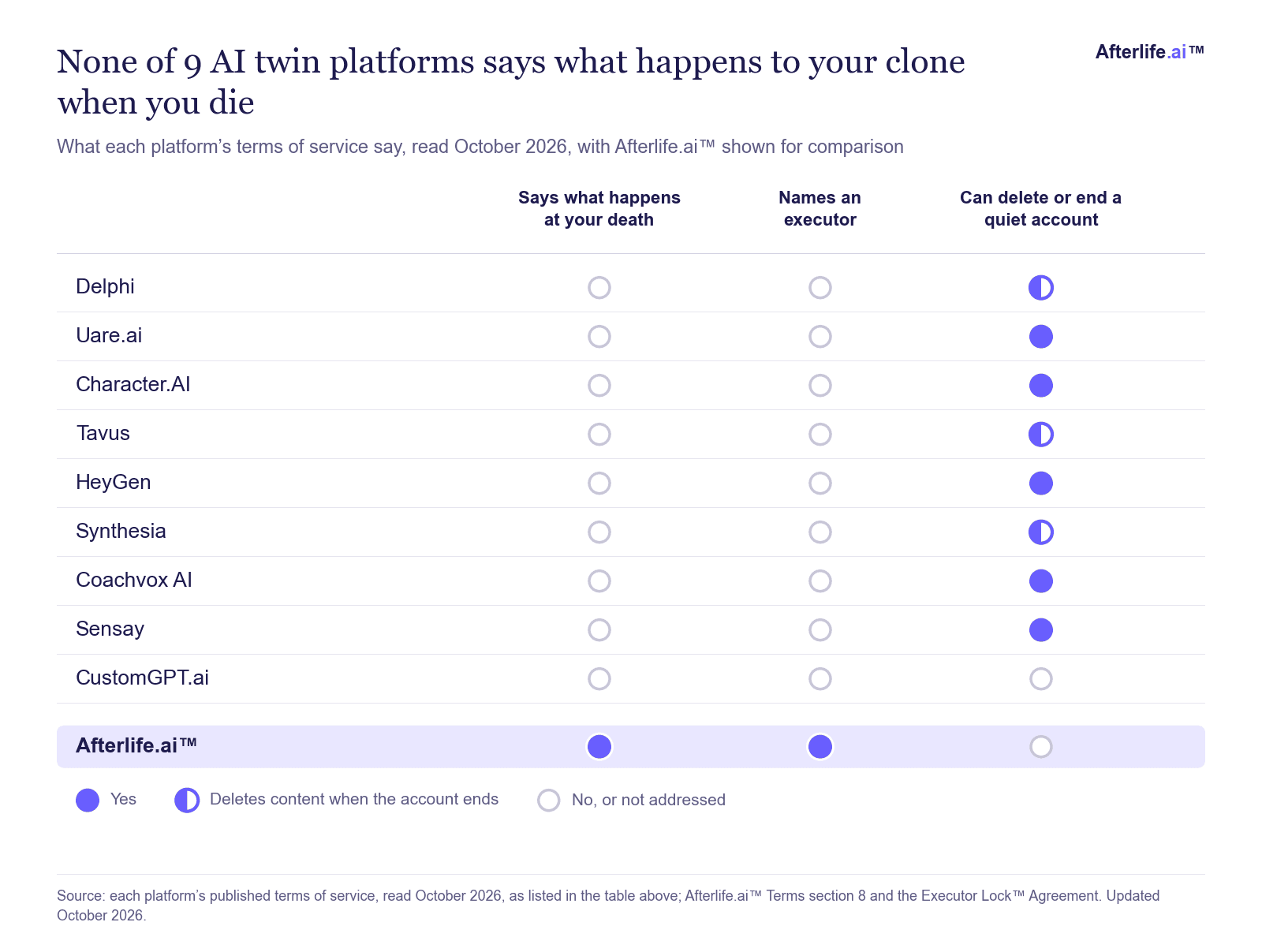
All prices on this page are in US dollars. Four findings stand out, and every one of them affects who controls your twin after you die. Nine of nine contracts are silent on the death of the user, so the company decides by default. Five of the nine reserve the right to delete or terminate accounts for inactivity or lack of use (Character.AI, Uare.ai, Sensay, Coachvox AI and HeyGen's free plan), and a dead user's account looks exactly like an inactive one to a server. Delphi named its top tier "Immortal", yet its two documents, about 14,600 words together, never mention death. Uare.ai began as Eternos, the company that helped the Berlin entrepreneur Michael Bommer, who had terminal cancer, build an AI of himself in 2024, and its current terms delete or de-identify the AI you built when you cancel (TechCrunch, November 11, 2025).
Researchers see the same gap across the whole category. A Lehigh University audit of 93 AI "afterlife" services, published as a preprint on August 28, 2026, found that 82 published thin or no information on who has consent or authority over a recreation, 82 said little about objection or redress, and 77 said little about deletion (arXiv). The largest platforms are also preparing for a world in which users keep talking after death. Microsoft holds US patent US10853717B2, granted December 1, 2020, on "creating a conversational chat bot of a specific person" (Google Patents), and Meta was granted a patent in late 2025 on a language model that simulates a user who is away or dead, although Meta told Business Insider it had no plans to use it (MediaPost, February 17, 2026). Our guide to the Facebook death patent quotes that patent's own words. When the platform holds the model and the contract is silent, the platform's rules apply, so the only reliable way to own the outcome is to choose a platform whose contract already names your successor.
No platform in that table wrote your rules for you.
Write them yourself, starting with 25 free memories and no card.
Build your Persona free, no cardDoes the right of publicity survive death?
Yes in some US states and no in many others, and where the right does survive, it lasts anywhere from 10 to 100 years after death. The right of publicity is a person's right to control commercial use of their identity, and because courts and legislatures treat it as a form of property, it can pass to heirs in the states that allow it (Wikipedia, Personality rights). A 2026 law-firm guide to the state rules notes that many states recognize no post-mortem right at all (Outside IP Counsel, 2026). The table below covers the states where the rule is clearest.
State | How long the right lasts after death | What else matters for an AI twin |
|---|---|---|
Indiana | 100 years | Covers signature, gestures, distinctive appearance and mannerisms as well as name, image and likeness |
Oklahoma | 100 years | One of the longest terms in the country |
California | 70 years | Celebrities Rights Act of 1985; AB 1836 makes an unconsented digital replica of a deceased personality in an audiovisual work or sound recording cost the greater of $10,000 or actual damages |
Ohio | 60 years | Statutory right |
Texas | 50 years | Statutory right |
Nevada | 50 years | Statutory right |
New York | 40 years | Since May 2021 for deceased performers and personalities domiciled in New York; since December 11, 2025, commercial use of a deceased personality's digital replica needs the rights holders' consent |
Florida | 40 years | Statutory right |
Washington | 10 to 75 years | The term depends on the person's circumstances; a digital replica statute followed on June 11, 2026 |
Tennessee | 10 years, then for as long as the likeness keeps being used | The ELVIS Act, in force July 1, 2024, protects voice against unauthorized AI use |
Montana | 20 years | The right attaches whether or not the person ever earned money from their likeness |
Sources: Outside IP Counsel, 2026; Wikipedia, Personality rights; California AB 1836; Office of the Governor of New York, December 11, 2025; Vanderbilt Law, 2025; digital replica laws in every US state; Montana HB 513 as enacted.
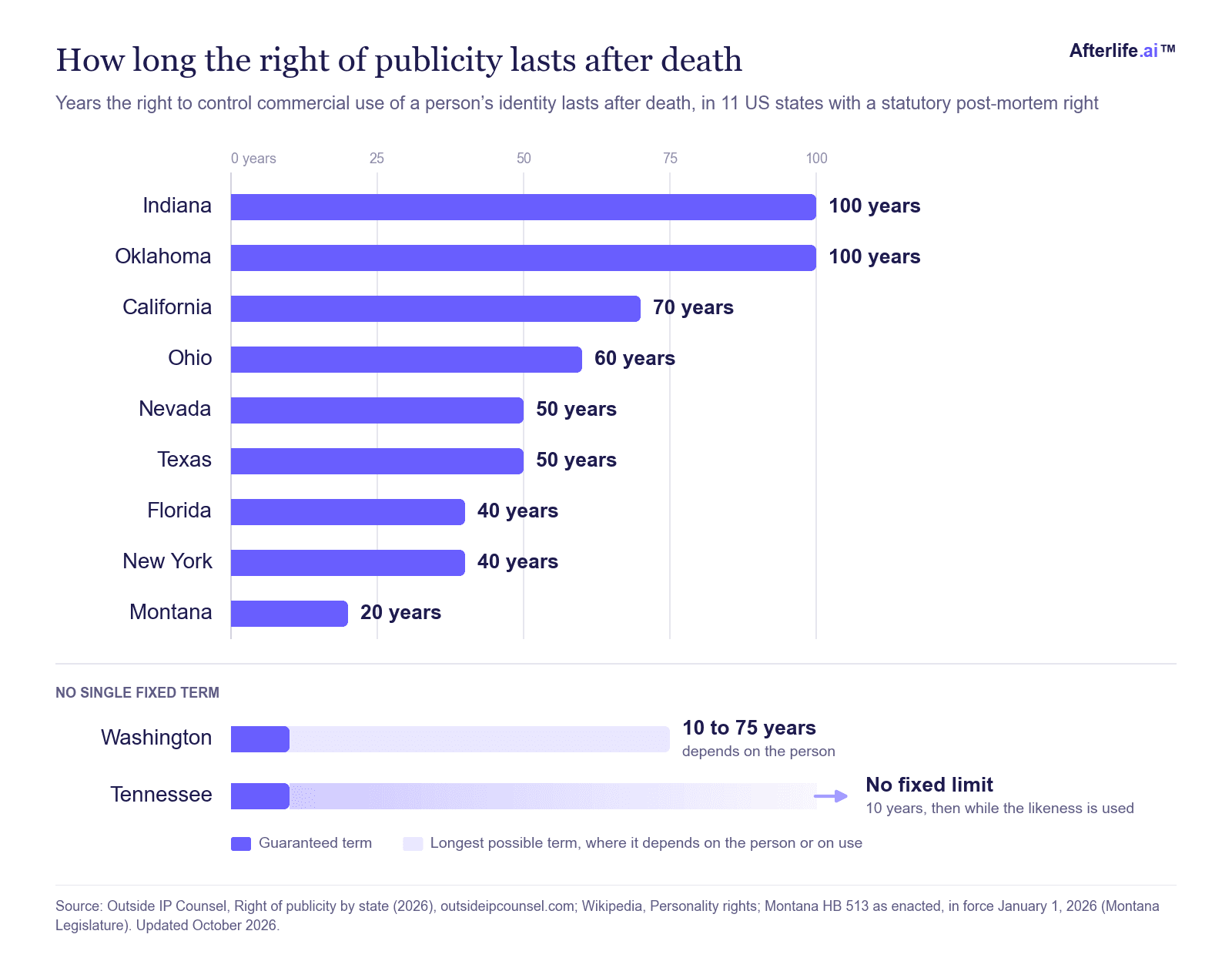
Where you live when you die matters as much as the statute. The California Supreme Court held, in Lugosi v. Universal Pictures in 1979, that Bela Lugosi's personality rights could not pass to his heirs, and the state legislature responded in 1985 with the Celebrities Rights Act, which extended the right to 70 years after death. In 2008 a federal judge in California ruled that Marilyn Monroe's right of publicity could not be protected there, because although she died in California she was legally domiciled in New York, which at the time did not protect a dead person's right of publicity (Wikipedia, Personality rights). New York added a post-mortem right for deceased performers and personalities in 2021, decades too late for Monroe's estate.
A federal right is moving through Congress. The NO FAKES Act of 2026 (S.4591), advanced by the Senate Judiciary Committee by unanimous voice vote on June 18, 2026, would create a federal right in every person's voice and visual likeness that does not expire at death, passes to executors and heirs or by will, and lasts 10 years after death, renewable in five-year periods up to 70 years while the heirs show authorized public use (Holland & Knight, June 22, 2026; S.4591 as introduced). The bill is not law yet, and our guide to the NO FAKES Act explained tracks its progress. Even if the bill passes, it will give your heirs the power to stop unauthorized replicas, and it will still leave you to decide who runs the authorized one.
Who controls your identity after you die?
Control of your identity after death splits four ways, and your will reaches only one of the four. Your estate holds whatever publicity rights the law of your home state or country gives it. The platforms that hold your accounts follow the after-death settings you chose inside their own products, or their own rules if you chose none. The companies that hold your recordings and AI models follow their contracts. Anyone with a few clips of your voice or a handful of photos can attempt a copy, and the law only reaches that person after the harm is done.
Who holds the power | What they control after you die | What you can do about it today |
|---|---|---|
Your estate and heirs | Commercial use of your name, face and voice, where the law protects them | Make a will and name the person who should hold these rights |
The platforms that hold your accounts | Your photos, messages and files on their services | Set Apple Legacy Contact, Google Inactive Account Manager and a Facebook legacy contact |
The company that holds your AI twin | Your account, your memories and the AI model built from them | Choose a contract that names your executor and seals your Persona |
Anyone with your recordings | Attempted copies of your voice and face | Build the authorized version of you, so your family knows which one is real |
The big consumer platforms each built an after-death setting for your data. Apple lets you name Legacy Contacts who can reach the data in your Apple Account with an access key and proof of death (Apple Support). Google's Inactive Account Manager lets you choose up to 10 people to receive selected data after your account has been inactive for a period you set (Google Support), and Facebook lets you choose a legacy contact to look after a memorialized account (Facebook Help Center). None of those settings governs an AI that speaks as you. Executor Lock™ is that setting for your Persona and your twin, and for the accounts themselves, our guide to who owns your accounts and data after you die walks through each service.
The fourth holder, the stranger with your recordings, is the one families meet first. The Parton fake spread within a day of her death, and Robin Williams' daughter Zelda asked people again on September 24, 2026 to stop sharing a fake clip of her father (NZ City). For the voice specifically, our guides on who owns your voice clone and how to protect your voice from AI cloning explain the practical steps. The strongest single protection is an authorized version of you that your family already knows, because a fake is easiest to spot next to the real thing.
What does the law say outside the United States?
Most countries protect a living person's image and voice, fewer protect a dead person's, and almost none names who speaks for an authorized AI copy after death. The pattern across Europe and Asia is consent from the living person, then a limited role for the family. The table summarizes the after-death rule in each jurisdiction, and the paragraphs below explain the ones our readers ask about most. For criminal deepfake rules, labeling duties and penalties in every country, read deepfake and AI likeness laws by country.
Jurisdiction | Rule for a person's likeness after death | Source |
|---|---|---|
Germany | Pictures may be published for 10 years after death only with the consent of the spouse or partner and children, otherwise the parents | |
Denmark | A bill would protect realistic AI imitations of a person's face, voice and body for 50 years after death | |
Portugal | An image may not be published without consent even after death, when consent comes from family or heirs | |
France | Article 9 of the Civil Code protects private life and image; publishing an AI montage of a person without consent is a crime under Penal Code article 226-8 | |
Italy | Spreading AI-made images, video or voice without consent that can deceive and cause harm carries 1 to 5 years in prison | |
United Kingdom | No general right over your own image or voice; the government will only "consider" a digital replica right | |
Guernsey | Personality rights can be registered, including for up to 100 years after death | |
Canada | Four provinces' privacy statutes end the claim at death; common-law personality rights are inheritable | |
China | Draft rules allow recreations of the dead only with family authorization; the data law lets the person's own arrangement prevail over next of kin | |
Japan | Courts recognize publicity rights in a performer's voice; no specific post-mortem AI rule | |
India | Courts protect voice and persona from AI cloning; no specific post-mortem AI rule | |
South Korea | A 2022 amendment to the Unfair Competition Prevention Act protects commercial publicity; no specific post-mortem AI rule | |
Brazil | The Constitution and Civil Code article 20 protect a person's image against unauthorized commercial use | |
Jamaica | The Supreme Court recognized a property right in Bob Marley's personality that survived his death (1994) |
Germany has protected a person's picture after death for more than a century. Section 22 of the Kunsturhebergesetz allows publication only with the person's consent, and for 10 years after death only with the consent of the surviving spouse or partner and the children, or otherwise the parents (German federal law portal). German courts also recognize a general right of personality, set out by the Federal Court of Justice in its Marlene Dietrich decision. The German rule hands the decision to the family for a decade, which is a sensible default for a photograph and a poor one for an AI twin that might keep teaching or advising for decades.
Denmark has gone furthest toward treating your likeness as your own property. A broad majority of Danish parties agreed on June 26, 2025 to a bill that requires the imitated person's consent before realistic AI imitations of their face, voice or body are shared, protects that right for 50 years after death, and uses the EU's notice-and-action system for takedowns, and the Danish culture minister has said Ireland intends to follow (EPRS, January 2026). Ministers from every EU member state except Hungary also signed a declaration under the Danish Council presidency stating that "Our citizens must be protected against digital replicas of their personal characteristics without consent". Europe is writing down the consent principle, and the after-death decision is still left to families.
France and Italy reach AI copies mainly through criminal law. France's SREN law of May 21, 2024 punishes publishing an AI montage of a person's image or words without consent, where the artificial nature is not obvious or stated, with up to one year and €15,000, rising to two years and €45,000 online (Village de la Justice). Italy's Law 132/2025, in force since October 10, 2025, punishes the harmful spread of AI-made images, video or voice without consent with one to five years in prison (CDS). Both laws protect the person against unauthorized copies, and neither tells a family who should run an authorized one.
The United Kingdom gives a person no general right over their own image or voice at all. A March 2026 government report on copyright and AI said only that it would consider a digital replica right, with no timetable (Resultsense, August 10, 2026). People in the UK rely on passing off, defamation and data protection law, none of which was designed for an AI twin. For a UK reader, a record of consent and a named executor, made while alive, does the work the statute book does not yet do.
China combines the strictest labeling regime in the world with a rule that puts the person's own wishes first. The Beijing Internet Court held in April 2024 that a voice actor's rights extended to an AI voice built from her recordings and awarded her 250,000 yuan, about $34,500 (Beijing Internet Court). The Cyberspace Administration's draft rules of April 2026 would allow AI recreations of the dead only with family authorization (AFP via TechXplore, April 19, 2026). China's Personal Information Protection Law lets next of kin exercise rights over a dead person's data "except where the deceased has arranged otherwise before their death" (Article 49, DigiChina translation), which means that even in China a written arrangement made while alive outranks the family.
Japan, India and South Korea protect voices and personas through the courts, without a specific rule for AI copies of the dead. On September 30, 2026 the Tokyo District Court held, in voice actor Kenjiro Tsuda's case against TikTok, that unauthorized use of a performer's voice can infringe publicity rights (IOL). In India, the Bombay High Court barred anyone from using the singer Arijit Singh's name, voice, vocal style, image or signature without his consent on July 26, 2024, expressly covering generative AI and voice-conversion tools (Columbia Global Freedom of Expression). South Korea added a publicity provision to its Unfair Competition Prevention Act in 2022, and its Ministry of Justice announced plans to write personality rights for everyone into the Civil Code (Wikipedia, Personality rights).
Does your will cover your AI twin?
Your will covers your estate, including any publicity rights your state recognizes, but a will does not instruct the platform that runs your twin and is often read weeks after the funeral. A will is the right document for property, guardianship and money, and everyone should have one, which our guide on how to make a digital will in the US explains. A will cannot tell a server which person may log in, which memories stay private, or whether the twin's public pages stay on. Dolly Parton's fake took a day to appear, and most wills take far longer than that to reach anyone who can act on them.
US digital-asset law already gives weight to settings you choose inside a service. The Revised Uniform Fiduciary Access to Digital Assets Act (RUFADAA), revised by the Uniform Law Commission in 2015, created the "online tool", a setting inside a service where a user directs what happens to their digital assets after death (Data Privacy and Security Insider, October 15, 2015). In California's enactment, approved on September 24, 2016, a direction given through such a tool overrides a contrary direction in a will, trust or power of attorney, as long as the user can change the setting at any time (California AB 691). As of mid-2026, 47 states and the District of Columbia have adopted RUFADAA, and the full list is in which states have adopted RUFADAA.
The practical answer is to use both, and to make them agree. Set your rules inside the service that holds your AI twin, then ask your estate lawyer to point your will at those settings and to name the same people in both places. Our guide on how to put consent for an AI of you in your will gives sample wording for the clause. Whether a particular service's settings count as an "online tool" under your state's law is a question for your lawyer, and the safest plan is a will and a setting that say the same thing.
What happened when nobody decided?
When a person left no instructions for their likeness, the decision fell to whoever acted first, and the results ranged from a public denial to a vacated sentence. Anthony Bourdain's voice was recreated with AI for the 2021 documentary "Roadrunner", reading words he had written but never recorded; the director said the estate had given its blessing, and Ottavia Busia, his ex-wife and the executor of his estate, publicly denied being consulted (Wikipedia). In April 2024 Drake released a track with AI-generated vocals in the style of Tupac Shakur, and the estate's lawyer sent a cease-and-desist on personality-rights grounds before the track came down (Wikipedia). In both cases the estate had to fight after the fact, because nobody could point to a record of what the person wanted.
The Pelkey case shows the same problem from inside a loving family. Christopher Pelkey was killed in a 2021 road-rage shooting in Chandler, Arizona, and at the May 2025 sentencing his sister played a four-and-a-half-minute AI video of him, built from his photos and voice recordings and speaking a script the family wrote (CBS News, May 2025). The Arizona Court of Appeals vacated the 10.5-year sentence on September 30, 2026, finding that the judge's reliance on the video made the sentencing "fundamentally unfair". The family acted out of love, and the court still drew a firm line between words a family imagines and words the person actually said.
Case | Country | Who held the power after death | How the power was exercised |
|---|---|---|---|
Anthony Bourdain, 2021 | United States | His executor, under his estate | Contested after the film was released |
Tupac Shakur, 2024 | United States | His estate, through its publicity rights | A cease-and-desist after the track came out |
Christopher Pelkey, 2025 to 2026 | United States | His family, then a court | A video the family scripted, then a vacated sentence |
Dolly Parton, 2026 | United States | Strangers, then fact-checkers | A fake within a day, rated Fake by Snopes |
"Meeting You", 2020 | South Korea | The family and a broadcaster | A virtual-reality recreation of a seven-year-old girl, seen more than 19 million times (World Economic Forum) |
Paid recreations of the dead, 2024 | China | Direct family members | About 2,000 clients at two companies, with family permission (MIT Technology Review, May 7, 2024) |
What happened when the person decided?
When the person decided in writing, their wishes held, and nobody had to guess. James Earl Jones signed a deal with Lucasfilm in 2022 allowing archival recordings to generate Darth Vader's voice, retired from the role that September and died on September 9, 2024, aged 93, with the question already answered (Wikipedia). Robin Williams put his name, signature, photograph and likeness in a trust that bars commercial use, digital insertion into films and holograms until at least August 11, 2039 (Harvard Journal of Sports and Entertainment Law, March 31, 2015). The musician Holly Herndon built a voice model of herself in 2021 and a community of stewards who decide whether new works made with her voice are sold with her approval (Wikipedia).
Each of those people used the tools available to a celebrity with a legal team, and each solved a different part of the problem. Jones licensed one voice for one character, Williams banned commercial uses for 25 years, and Herndon set up a governance body for her voice. Suzanne Somers chose to have an AI twin and left her husband to carry the project out, while Val Kilmer's family completed his scenes in the 2026 film "As Deep as the Grave" with an AI-generated Kilmer, with the cooperation of his estate and the support of his children (Wikipedia). The industry is converging on the same shape. StoryFile published a draft Digital Likeness Directive on July 23, 2026, under which a steward you name can pause, narrow or retire a recreation but never expand it (StoryFile).
Executor Lock™ gives an ordinary person the combined power of all four approaches in one afternoon. You name the people who carry out your wishes, as Herndon named her stewards. You decide exactly what your Persona may say and to whom, as Jones decided for one voice. You set release rules for your photos, your memories and live conversation, and you can leave your twin's public doors off after the lock, which gives you the protection Williams wrote into his trust without leaving your family with nothing authorized to point to.
Who owns the value of your likeness after you die?
The money a likeness earns after death goes to whoever holds the rights and the contract, which is why the rules for a likeness belong in writing while the person is alive. Michael Jackson earned an estimated $105 million in 2025, 16 years after his death, and his estate has generated about $3.5 billion since 2009, according to Forbes as reported by Complex (Complex, November 2, 2025). In January 2026 the creator Khaby Lame signed an all-stock deal reported at up to $975 million that granted a company rights to an AI twin of him (Black Enterprise, September 16, 2026). The musician Grimes offered in April 2023 to split royalties 50/50 on successful songs that used her AI voice (BBC News, April 25, 2023).
For most people the value of a likeness after death is not a licensing deal, and the real question is who controls the version of you that keeps working. Your estate inherits whatever publicity rights your state recognizes and whatever your business owns, under your will. Your AI twin is different, because a twin keeps answering people in your name, and the person who controls that twin should be someone you chose while you were alive. On Afterlife.ai™ that person is the executor you named, and each door of your twin keeps answering after the lock unless you switched that door off.
Worked example (invented person, stated assumptions). Marcus Hill is a 61-year-old high-school chemistry teacher in Denver who explains stoichiometry better than any textbook and tutors students privately at $60 an hour. He builds his Persona, switches on Afterlife.ai™ Twin, and opens a door on his website that answers students at midnight in his words and his own voice and sends the ones who want more help to book a tutoring session. He names his daughter, Alicia, as his executor and leaves the student door on after the lock.
Marcus's twin | Per month |
|---|---|
Extra tutoring sessions booked through his twin (8, by assumption) | $480 |
Afterlife Pro on the yearly plan ($599 a year) | $49.92 |
Marcus's month after the plan | $430.08 |
After the lock | The student door keeps answering from the sealed snapshot, governed by Alicia |
One extra session a month pays for the plan, and the student door keeps teaching Marcus's explanations after he is gone, under the rules he set and the executor he chose. Marcus also names Alicia in his will and tells his lawyer what he set up, so the will and the setting agree. Nobody in his family has to negotiate with a platform, because the platform already has his instructions. For more worked examples with the numbers, read how Afterlife.ai™ Twin books clients while you are away.
Your twin can work while you work, while you sleep and after you die, and you decide today who governs your twin.
Switch on Afterlife.ai™ TwinHow does Executor Lock™ decide who owns your twin?
Executor Lock™ answers the ownership question in advance, in a contract the people you name sign while you are alive, and the product enforces every step. Our Terms of Service make what happens at death part of the agreement (section 8) and call the lock permanent and irreversible (section 8.3). Our Privacy Policy states that "IDY does not modify, supplement or alter your Persona after the Executor Lock™ Event" (section 6). The six steps are the same for every Persona on Afterlife.ai™ and Timeless AI™.
Name your people. You name one or more executors and your Trusted Contacts, and each one accepts the Executor Lock™ Agreement while you are alive, so authority is settled before anyone needs it.
Report. After your death, an executor or a Trusted Contact who accepted the agreement uploads evidence, such as a death certificate or a funeral notice.
Check. Automated analysis reads the evidence, and then a person reviews the evidence before anything about your Persona changes.
Cooling-off. Seven days pass in which every executor is told about the report and can dispute the report, and you can cancel a false report with proof of life.
Lock. Your Persona becomes a sealed snapshot of every memory exactly as the memory stood that day, with nothing pruned, nothing re-weighted and a tamper-evident seal on the record.
Release. Your release rules for photos, memories and live conversation take effect for the people you named, and each public door of your twin follows the after-lock choice you made.
After the lock | Can do | Cannot do |
|---|---|---|
Your executor | Start the lock with evidence, dispute a false report, invite people you named who never accepted, request a handoff of the executor role, ask Idy to delete your Persona and your twin | Unlock your Persona, edit a memory, add a core memory, change your personality or values, switch on a door you left off |
Your Trusted Contacts | Start a report, and see or talk with your Persona at the access level you gave them | Change who you are or what your Persona says |
Your family | Tell your Persona new things, such as a wedding or a birth, which your Persona remembers | Rewrite your character, tone or values |
Idy | Run your Persona and your twin under the rules you set | Modify, supplement or alter your Persona after the lock (Privacy Policy section 6) |
On Afterlife.ai™ Twin the after-lock setting is on for each door unless you switch that door off, so every door you opened keeps answering under the executor you named. Your twin answers visitors in your own words and your own cloned voice, under your name and photo, with a badge that marks the conversation as your AI twin. Your voice clone and the Persona Video messages you make in your own face and voice, from one 30-second recording of you, sit inside the same sealed Persona, so the executor you named governs your voice and your face as well as your words. The lock fixes your character, and conversation carries on, because new short-term memories and big life events still reach your Persona after the lock while your personality, tone and values stay exactly as you left them. That is the difference between a twin and a griefbot built by someone else, which our guide to what a griefbot is and whether AI can bring back the dead explains, and for the role itself, read what a digital executor does.
Pick the person who carries out your wishes, and let them accept the role while you can still talk it through.
Name your executorWhy did Idy solve ownership before building the twin?
Idy, the company behind Afterlife.ai™ and Timeless AI™, decided early that an AI twin nobody can legally inherit is a liability for the family that is left with the twin, and that the ownership question had to be answered before the twin was worth building. We spent our first years on the parts of personal AI that other companies postponed, namely who controls your likeness while you live, who decides what happens to the likeness when you die, who may see which parts of your life, and how consent is recorded so that software actually obeys the consent. Our answer is Executor Lock™, and Idy has 78 patents pending on that work. In plain words, the patents pending cover verifying a death before control of a Persona changes hands, handing authority to a named executor and sealing the Persona at that moment, proof that consent was given, and who inherits access to a Persona. Idy has also filed two international patent applications under the Patent Cooperation Treaty, so the protection is being pursued beyond a single country.
That order of work is why an Idy twin can work as you while you live, keep answering and booking while you are away, and pass to the people you named when you die. Video-avatar tools such as Tavus, HeyGen and Synthesia were built to produce marketing, training and support videos, creator clones such as Delphi and Uare.ai were built to answer an audience, and Character.AI was built for entertainment. None of them names an executor or plans for the owner's death, which is exactly what the contracts table above shows.
Researchers and governments have since asked for the same safeguards we built. In May 2024, researchers at the University of Cambridge's Leverhulme Centre for the Future of Intelligence called for consent from the person whose data builds an AI of the dead, transparency that users are talking to an AI, ways to opt out and dignified ways to retire a recreation (University of Cambridge, May 9, 2024). Every one of those safeguards is a decision you make in advance with Executor Lock™. For professionals who want the same protection for a working twin, read about an AI Persona for creators and professionals and a founder Persona for your company.
What five decisions should you write down this year?
Five decisions settle who owns your AI twin after you die, and each one takes minutes once you know the answer. Write them down while you are well, tell the people involved, and record them somewhere the software will follow. The table shows where each decision lives in Executor Lock™.
Name who decides. Choose an executor and a backup, and ask them to accept the role now. Legacy at $14.99 a month includes one executor and ten Trusted Contacts, and Eternal at $29.99 includes up to five executors and unlimited Trusted Contacts.
Decide what gets sealed. Everything you share with your Persona becomes part of the sealed snapshot at the lock, so share the stories, opinions and advice you want kept, in your own words.
Decide who may talk with your Persona and what they see. Give each Trusted Contact view, chat or contribute access, and set release rules for photos, memories and live conversation.
Decide which public doors keep answering, and fund your family's access. Choose, door by door, whether your twin keeps answering the public after the lock, and fund your family's private access with a prepaid long-term plan or continuity credits.
Decide who can retire your twin, and make your will agree. Make sure your executor knows they can ask Idy to delete your Persona and your twin, and ask your lawyer to name the same people in your will.
Decision | What it settles | Where Executor Lock™ records it |
|---|---|---|
Who decides | Authority after your death | Named executors who accepted the Executor Lock™ Agreement |
What gets sealed | Your character and memories | The sealed snapshot at the lock |
Who may talk with your Persona | Privacy among your family and friends | Trusted Contacts, access levels and release rules |
Which doors keep answering | Your public twin after death | The after-lock setting on each door |
Who can retire your twin | The right to end everything, and a will that agrees | Your executor's deletion request, and your will |
Long-term funding is already available for your Persona. The 20-year Legacy plan costs $1,299 and the 80-year plan costs $2,999, and continuity credits cover 12 or 24 months of Legacy ($149 or $279) or Eternal ($299 or $549) for your family after the lock. A gifted plan lets you pay a monthly Legacy or Eternal plan for one of your people. Before your family ever pays, they see a preview of three photos, so nobody is asked to pay before they know what is waiting for them.
Estate lawyers, insurers, financial advisers, universities and practices
Your clients are already asking who owns their AI after they die. Give them an answer with named executors and a sealed snapshot under one agreement.
Talk to us about Executor Lock™ for your clientsSo who owns your AI twin after you die?
You do, if you decide now, and somebody else does if you leave the decision blank. The contracts on the market are silent, the laws protect your likeness from strangers for anywhere from zero to 100 years depending on where you die, and neither tells anyone who should speak for the authorized version of you. The people in this guide who decided in writing, from James Earl Jones to Robin Williams, kept control, and the families of people who did not decide ended up in a fact-check, a public dispute or a courtroom. Build your Persona, name your executor, set your release rules and set each door's after-lock choice this year, and the question of who owns your AI twin will already have an answer in your own words. For the full product, read about Afterlife.ai™ Twin, the AI twin that passes to the people you name.
Frequently asked questions
Who owns my AI twin after I die?
By default, the company that holds your account decides, because none of the nine AI twin platforms whose terms we read names an executor or an heir. Publicity laws protect your likeness in some places but never name who runs the twin. With Executor Lock™ on Afterlife.ai™, the executor you named takes control under rules you set while alive.
Does the right of publicity survive death?
In some US states it does, for between 10 and 100 years. Indiana and Oklahoma protect a likeness for 100 years, California for 70, Ohio for 60, Texas and Nevada for 50, and New York and Florida for 40. Many states recognize no post-mortem right at all, and where you were domiciled at death decides which rule applies.
Which states protect a dead person's voice from AI?
Tennessee's ELVIS Act protects voice against unauthorized AI use, California's AB 1836 covers digital replicas of deceased personalities in audiovisual works and sound recordings, and New York has required rights holders' consent for commercial digital replicas of deceased personalities since December 11, 2025. Montana and Washington have newer digital replica laws.
Does my will cover my AI twin?
Your will covers your estate and any publicity rights your state recognizes, but it does not instruct the platform that runs your twin. Under RUFADAA, which 47 states and the District of Columbia have adopted, a service's own online tool can carry legal weight for digital assets. Set your rules in the service, then make your will point at them.
Can my family change what my AI twin says after I die?
Not under Executor Lock™. The lock seals a perfect snapshot of your Persona, our Terms call the lock permanent and irreversible, and our Privacy Policy says IDY does not modify, supplement or alter your Persona afterward. Your family can tell your Persona new things, like a wedding, and your character stays exactly as you left it.
Can someone make an AI of me after I die without permission?
In many places they can try, and the law only reacts afterward. California, New York and Tennessee restrict commercial AI replicas of the dead, Germany protects pictures for 10 years, and China's draft rules require family authorization. Your strongest protection is an authorized version of you, built by you, with a named executor.
What happens to my AI clone if the company shuts down?
That depends on the company's contract, and most AI twin contracts say little about it. HereAfter AI went offline in August 2026, and StoryFile filed for Chapter 11 in 2024 before being sold. Our Terms pass Idy's obligations to any successor and keep the lock permanent, and prepaid 20-year and 80-year plans keep your Persona funded. Read what happened when HereAfter AI shut down.
Who controls my identity after I die?
Control splits four ways. Your estate holds any publicity rights, the platforms follow their own after-death settings, the company holding your AI twin follows its contract, and anyone with your recordings can attempt a copy. Executor Lock™ covers the AI part by naming who decides, sealing your Persona and setting who may see what.
Who owns my voice clone?
You own your recordings, and the company usually owns or licenses the model it trained from them, under its terms. On Afterlife.ai™ you clone your own voice with your own consent, your Persona speaks in that voice only to the people you named, and your executor governs your voice after you die. Read who owns your voice clone.
Can my AI twin keep working after I die?
Yes, on Afterlife.ai™ Twin. Each door keeps answering after the lock unless you switched that door off, from the sealed snapshot of everything you taught, and the executor you named governs the twin under your rules. Name the same people in your will so your estate plan and your settings agree.
Is it creepy to plan your own AI twin?
A copy nobody authorized is the creepy kind, and those already appear within a day of a famous death. A twin you built, under rules you wrote, with an executor who can retire the twin, is the respectful alternative to a copy that is coming either way.
Why did Idy build Executor Lock™ before the twin?
Because ownership after death is the hard part of personal AI, and solving it first makes everything else possible. Idy has 78 patents pending on consent, verified handovers to a named executor, the sealed snapshot and inheritance, which is why an Idy twin can keep working safely after the owner dies and pass to the people the owner named.
How we researched this page
We read the published terms and pricing pages of Delphi, Uare.ai, Character.AI, Tavus, HeyGen, Synthesia, Coachvox AI, Sensay and CustomGPT.ai (about 85,000 words, checked October 1, 2026), the statutes and bills linked in each table, court reports from the United States, China, Japan and India, the German federal law portal, the European Parliamentary Research Service, research from the University of Cambridge and Lehigh University, and news reports from Fox News, NPR, Snopes, CBS News and Fox 10 Phoenix. Every outside fact links to its source and date.