
What is a griefbot, and can AI bring back the dead?
A griefbot imitates someone who has died, built from what they left behind. This guide explains how griefbots are made, where families already use them, what the 2026 laws say, and why the only safe version is the one a person builds while alive.
A griefbot, also called a deadbot or deathbot, is an AI chatbot, voice or avatar built to simulate a deceased person, usually from their text messages, social media posts, photos and voice recordings. AI cannot bring back the dead. The safest version is a Persona the person builds while alive on Afterlife.ai™, with an executor named under Executor Lock™.
This page is general information about grief technology, not therapy or medical advice. If you are struggling, call or text 988 in the US, or your local emergency number.
On September 30, 2026, the Arizona Court of Appeals threw out a manslaughter sentence because the trial judge had relied on an AI video of the man who was killed. Christopher Pelkey's family built the video from his photos and voice recordings and wrote the words his likeness spoke at the sentencing, out of love. The appeals court found that the AI depiction "erases the interpretive distance between the family's belief of what the victim would have said and the victim's own voice and opinions" (Fox 10 Phoenix, September 30, 2026). That sentence from a US court is the clearest statement yet of what a griefbot is and what a griefbot can never be.
A griefbot speaks words that other people imagine for the dead. The technology to make one is now cheap, fast and everywhere, from a free chatbot account in the United States to paid avatar services in China that drew about 2,000 clients at two companies alone by 2024 (MIT Technology Review, May 7, 2024). This guide covers what griefbots are, how they are built, where they are already in use, what the law says in 2026, and what makes one safe. The short version is that consent decides everything, and the only person who can give that consent is the person while they are still alive.
By Chris Williams, founder of Idy®, the company behind Afterlife.ai™. First published May 15, 2026. Updated October 2, 2026.
Build the version of you that your family will never have to guess at.
Build your own Persona free, no cardDefinitions
Griefbot: an AI chatbot, voice or avatar built to imitate a person who has died, usually from their messages, posts, photos and voice recordings, and usually by someone else after the death.
Deadbot and deathbot: other names for a griefbot, most common in academic writing.
Generative ghost: researchers' term for an AI of a dead person that generates new content instead of replaying what the person actually said.
Persona: the AI version of you that you build on Afterlife.ai™ while you are alive, from your own memories, values and cloned voice.
Executor Lock™: Idy's patent-pending system of named executors, Trusted Contacts, a verified death report and a sealed snapshot of your Persona that can never be changed.
Digital executor: the person you name to carry out your wishes for your accounts, files and AI likeness after you die.
What is a griefbot?
A griefbot is an AI chatbot built to simulate a deceased person, so that the people left behind can type or talk to an imitation of them. Most griefbots are trained or prompted on the material a person leaves behind, such as text messages, social media posts, emails, voice recordings, photos and videos. Some answer in text, some speak in a cloned voice, and some appear as a talking video avatar or a virtual-reality figure. The idea entered wider public awareness through Black Mirror's 2013 episode "Be Right Back", in which a grieving woman pays for an AI version of her late partner, and it became a real product category within a decade.
The three common names describe the same thing. "Griefbot" is the word most journalists and most searchers use, "deadbot" and "deathbot" are more common in research papers, and Wikipedia files all three under one entry (Wikipedia, Deadbot). Researchers Meredith Ringel Morris and Jed Brubaker added a fourth term in 2024, "generative ghosts", for agents "capable of generating novel content rather than merely parroting content produced by their creator while living" (arXiv, January 14, 2024). That distinction between new words and the person's own words is the single most important idea on this page, because a griefbot that generates new sentences is always speaking for someone, and the question is who gave permission.
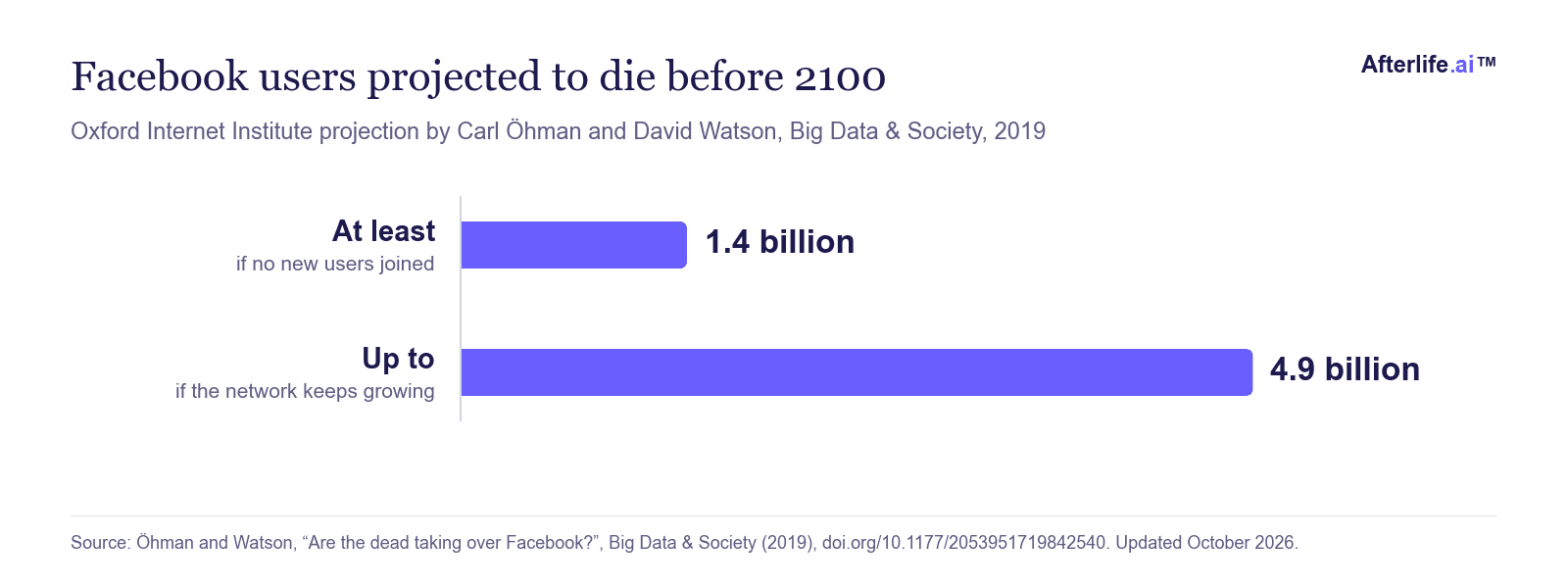
The scale of the raw material is enormous. Researchers Carl Öhman and David Watson at the Oxford Internet Institute projected that at least 1.4 billion Facebook users will die before 2100, and that the number could pass 4.9 billion if the network keeps growing (Big Data & Society, 2019). Every one of those accounts is a possible training set for a griefbot that its owner never approved. Meta has already patented a way to simulate dead users, with a model trained on a person's posts, likes and messages that keeps acting as that person after death. For a shorter definition page, read what a deadbot is.
Can AI bring back the dead?
No. AI cannot bring back a dead person, their mind or their judgment, and no honest company claims otherwise. What AI can do is reproduce patterns from what a person left behind, such as their phrasing, their favorite stories and the sound of their voice, and then generate new sentences that resemble them. The quality of the result depends almost entirely on the quality of the material and on whether the person chose that material while alive. A griefbot built from a few hundred social media posts produces a thin impression, while a Persona built from hours of the person's own guided storytelling carries their real memories in their own words.
People have wanted this for a long time. Scientific American, which ran a 1920 interview in which Thomas Edison discussed an apparatus for contacting the dead, reported in November 2025 that griefbot companies now operate across Asia, Europe and North America (Scientific American, November 18, 2025). The difference in 2026 is that the tools work well enough to fool the ear and the eye. That is why the Arizona appeals court drew its line where it did, between "the family's belief of what the victim would have said" and the person's "own voice and opinions".
New research shows what happens when that line blurs. In 26 in-depth interviews with people who use deadbots, Yifan Li and Xingyu Lan found that users shape the bot through selective input and ongoing adjustment, and that over time "AI-generated new memories blur with authentic recollections" (arXiv, March 1, 2026). A family that builds a griefbot after a death fills the gaps with its own hopes, and the bot hands those hopes back as if the dead person had said them. A Persona avoids that problem by design, because every memory in a Persona comes from the person, recorded while the person was alive and able to choose what to share.
What people hope AI can do | What a griefbot does | What a Persona does |
|---|---|---|
Hear their voice again | Clones a voice from old clips, often voicemails and videos | Speaks in the person's own voice, cloned with the person's consent while alive |
Ask them a question | Generates an answer from patterns and the family's prompts | Answers from memories the person recorded and chose to share |
Remember the real stories | Mixes real messages with invented details | Holds the person's own stories, in their words, as a sealed snapshot after the lock |
See their face | Animates photos into a talking avatar | Sends Persona Video messages the person made from a short recording of themselves |
Keep them as they were | Changes with every prompt and every software update | Stays exactly as the person left the Persona, because the lock can never be undone |
How are griefbots made today?
Griefbots are made in two ways, by families using general AI tools and by companies selling the service. In the do-it-yourself version, a relative uploads messages or a written profile of the dead person into a general chatbot and asks the chatbot to answer as that person, and a free account is enough to produce something convincing. In the paid version, a company collects photos, videos and voice notes from the family and builds a talking avatar, a voice line or a chatbot. Both versions share one feature, which is that someone other than the dead person decides what the imitation says. The raw material increasingly includes a person's AI chat history, which no major assistant lets anyone inherit, as what happens to your ChatGPT memories when you die explains.
The history of the category is short and well documented. Eugenia Kuyda built a chatbot from the messages of her late friend Roman Mazurenko in 2016, and that project grew into the companion app Replika. James Vlahos recorded 91,970 words of his dying father's life story and turned them into the "Dadbot", which Wired published on July 18, 2017 and which became HereAfter AI (Wired). Ray Kurzweil built a "Fredbot" of his father in 2018, and the game designer Jason Rohrer launched Project December in 2020, which let people talk to language-model versions of loved ones (Scientific American). Researchers built their own versions too, including Muhammad Aurangzeb Ahmad's "Grandpa Bot" at the University of Washington and Hossein Rahnama's Augmented Eternity work at the MIT Media Lab (Wikipedia, Deadbot).
The largest technology companies have planned for this as well. Microsoft holds a US patent, granted December 1, 2020, on "creating a conversational chat bot of a specific person" (Google Patents, US10853717B2). Meta was granted a patent in late 2025 on simulating a user of a social network with a language model, including a user who is away or has died, and told Business Insider it had no plans to move forward with it (MediaPost, February 17, 2026). When the platforms that hold your messages own patents on ways to run you after death, the open question is whose rules apply.
Year | Project | Country | Built by | Built from |
|---|---|---|---|---|
2017 | Dadbot, later HereAfter AI | United States | His son, while his father was alive | 91,970 words of recorded life story |
2019 | AI Hibari Misora | Japan | NHK, the national broadcaster | Decades of footage and recordings |
2020 | Meeting You | South Korea | MBC, with the family | Family videos and a child actor's movement |
2020 | Project December | United States | Families, on a public service | Text the user supplies |
2023 to 2024 | Paid avatars of the dead | China | Silicon Intelligence and Super Brain | Photos, video and voice notes from families |
2024 | Michael Bommer's AI of himself | Germany | Bommer, while alive, with Eternos | About 25 hours of his own talking |
2025 | Christopher Pelkey sentencing video | United States | His family | Photos, recordings and a script the family wrote |
Which companies make griefbots?
Griefbot companies fall into three groups, and most of them build from what the dead left behind after the death. The first group sells talking avatars or voice lines to families, such as China's Silicon Intelligence and Super Brain, which MIT Technology Review reported had about 1,000 clients each by 2024, with tablet avatars at Super Brain costing $700 to $1,400 (MIT Technology Review). The second group offers chatbots that a user configures, such as Project December and Seance AI, both named in Scientific American's November 2025 report. The third group recorded people while they were alive, such as HereAfter AI and StoryFile, and both of those show how fragile a company can be.
HereAfter AI posted a shutdown notice in July 2026 and its website has been offline since August 2026, so families now have to email the company to ask for recordings (what happened when HereAfter AI shut down). StoryFile filed for Chapter 11 in May 2024 and was sold in March 2025. Eternos, the company that helped Michael Bommer build an AI of himself, renamed itself Uare.ai in November 2025 and moved into professional AI (TechCrunch, November 11, 2025). A Lehigh University audit of 93 AI "afterlife" services found that 82 publish thin or no information on who has authority over a recreation (arXiv, August 28, 2026).
Afterlife.ai™ belongs in none of those groups. Every Afterlife.ai™ Persona is built by the person the Persona represents, while that person is alive, and our Terms bar anyone from building a Persona of another person without that person's explicit written consent (section 5.1 of our Terms of Service). The person names the people who take over, the death is verified before anything changes, and the Persona is sealed exactly as the person left their Persona. For a comparison of AI twin and clone platforms, read the best digital twin apps compared.
Where are griefbots already being used?
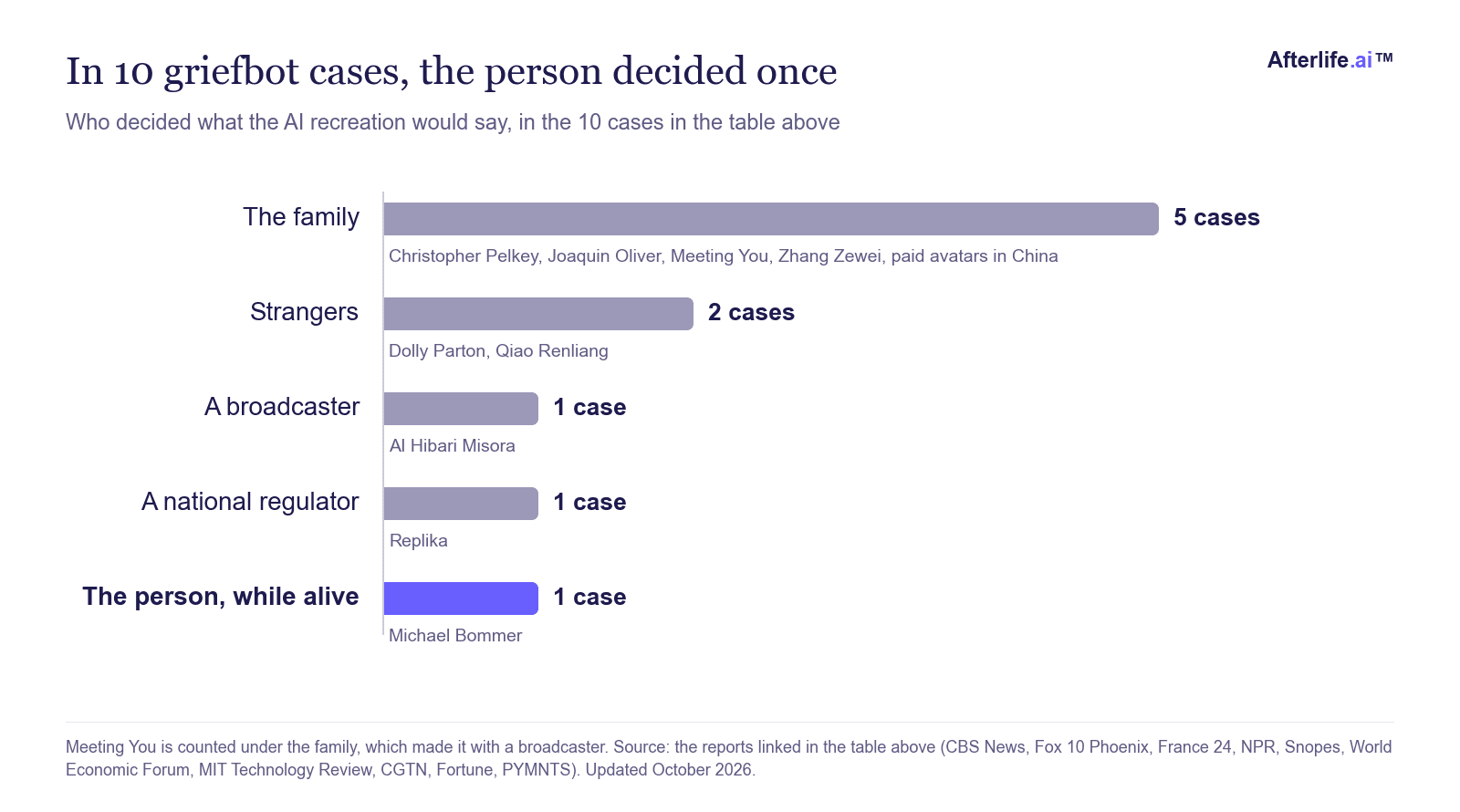
Griefbots are already in courtrooms, on national television and in family living rooms across at least six countries. The cases below are the ones most often cited by journalists and researchers, and each one teaches the same lesson about consent and authority. The final column matters most, since who made the decision predicts how each story ended.
Case | Country | What happened | Who decided |
|---|---|---|---|
Christopher Pelkey | United States | An AI video of the victim, speaking words his family wrote, played at the May 2025 sentencing; the Arizona Court of Appeals vacated the sentence on September 30, 2026 (CBS News; Fox 10 Phoenix) | His family, with words he never said |
Joaquin Oliver | United States | An AI avatar of the Parkland victim, built by his father from his voice, writing and likeness, gave a broadcast "interview" in August 2025 and drew wide criticism (France 24, August 6, 2025) | His father |
Dolly Parton | United States | A fake AI "final wish" recording spread within a day of her death on August 25, 2026, and Snopes rated it Fake (NPR; Snopes) | Strangers |
Meeting You | South Korea | A mother met a virtual-reality recreation of her daughter, who died at seven, on MBC in February 2020; the clip passed 19 million views (World Economic Forum) | The family and a broadcaster |
Paid avatars of the dead | China | Two companies reported about 2,000 clients by 2024, relying on the permission of direct family members (MIT Technology Review) | Families, after the death |
Zhang Zewei | China | A technician in Shandong built AI calls from a son who died in a car accident for his 80-year-old mother, and posted the video in July 2023 (CGTN, April 24, 2026) | The family |
Qiao Renliang | China | In April 2024 the father of the late singer and actor demanded the removal of AI videos of his son that he had never authorized (CGTN) | Strangers, against the family's wishes |
AI Hibari Misora | Japan | NHK staged a hologram of the singer, who died in 1989, singing a new song on September 29, 2019, and again on its year-end show (Japanese Wikipedia) | A broadcaster, decades after her death |
Michael Bommer | Germany | A Berlin entrepreneur with terminal cancer spent about 25 hours building an interactive AI of himself in 2024 (Fortune, via AP, June 4, 2024) | He did, while alive |
Replika | Italy | Italy's data protection authority suspended the companion app, which began as a griefbot, in February 2023 and fined its maker €5 million in May 2025 (PYMNTS) | A national regulator |
Two of these cases show the problem most clearly. Qiao Kangqiang described the unauthorized videos of his son as "rubbing salt in his wound", and in the United States Zelda Williams asked people in 2025 to stop sending her AI videos of her father, Robin Williams, then on September 24, 2026, after a fake clip spread online, asked again for people to leave him alone (Wikipedia; NZ City). Robin Williams had restricted the commercial use of his likeness until 2039 through his trust, and strangers made fakes anyway. A ban stops licensed uses, and it leaves a family with no authorized version of the person to point to.
Michael Bommer is the counterexample, and he is the model every family can follow. He made the decision himself, while he was alive, and he spent about 25 hours over two months telling his own stories in his own words. The company that built his AI later changed direction, which is why a person's decision needs governance written into the contract and enforced by the product itself, so the decision survives whatever happens to the company hosting the recording.
Are griefbots ethical?
A griefbot is ethical when the person it imitates consented while alive and named who controls the recreation afterward, and it is unethical when strangers or software decide for the dead. That answer is where the research has landed. In May 2024, Tomasz Hollanek and Katarzyna Nowaczyk-Basińska of the University of Cambridge's Leverhulme Centre for the Future of Intelligence called for consent from the person whose data builds the bot, age limits, constant transparency that users are talking to an AI, ways to opt out, dignified ways to retire a deadbot, and a ban on using deadbots to advertise (University of Cambridge, May 9, 2024). One of their warning scenarios describes a parent who prepays a 20-year subscription, after which the children receive messages they cannot stop.
German research reached the same place from the grieving side. Nora Freya Lindemann argued in Science and Engineering Ethics in 2022 that deathbots can interfere with the normal course of grief, and Jessica Heesen of the Edilife project at the University of Tübingen has described digital avatars as working like a painkiller that can delay acceptance. The 2026 interview study by Li and Lan found that users value a private space for unresolved feelings and also found that invented memories start to blur with real ones. Each of those findings points to the same design rules, which are consent, control by named people, honesty about what the bot is, and a clean way to stop.
Every one of those rules is a decision a person can make in advance with Executor Lock™. You give consent by building your own Persona while you are alive. You choose the named people who may see and talk to your Persona, and nobody else can. Your family always knows they are talking with your Persona, an AI built from your memories, and your executor can ask Idy to delete your Persona entirely, which is the dignified retirement the Cambridge researchers asked for. Your release rules decide what reaches your family, and the people you named choose whether and when to open your Persona, so nobody receives messages they never asked for.
Is it legal to make an AI of a dead person?
In most countries it is not illegal to make a private AI of a dead relative, but the law in 2026 is moving quickly toward two rules, which are consent from the person while alive and a named authority after death. Commercial use is already restricted in many places, and some countries now regulate griefbot services directly. The table summarizes the rules that matter most for griefbots, and the full tracker lives at deepfake and AI likeness laws by country.
Jurisdiction | The rule that matters for griefbots | Source |
|---|---|---|
China | Draft rules from the Cyberspace Administration (April 2026) ban digital clones made without consent, allow recreations of the dead only with family authorization, require labels and set fines of 10,000 to 200,000 yuan. The Personal Information Protection Law (Article 49) lets next of kin exercise rights over a deceased person's data "except where the deceased has arranged otherwise before their death" | |
New York | Since December 11, 2025, a business needs consent from the rights holders before using a deceased personality's name, voice or likeness, or a digital replica of a deceased performer, commercially | |
California | AB 1836 makes anyone who creates a digital replica of a deceased personality in an audiovisual work or sound recording without prior consent liable for the greater of $10,000 or actual damages, under a right that runs 70 years after death | |
Tennessee | The ELVIS Act (in force July 1, 2024) protects a person's voice, image and likeness against unauthorized AI use | |
Germany | Pictures of a person may be published for 10 years after death only with the consent of the relatives (Kunsturhebergesetz, section 22) | |
Denmark | A bill would give every person rights over realistic AI imitations of their face, voice and body, lasting 50 years after death | |
European Union | Since August 2, 2026, people must be told when they are talking to an AI, and deepfakes must be labeled (AI Act, Article 50), with fines up to €15 million or 3% of worldwide turnover | |
India | Since February 20, 2026, synthetic media must carry a prominent label; the Bombay High Court protected singer Arijit Singh's voice from AI cloning in July 2024 | |
South Korea | Since January 22, 2026, the AI Basic Act requires notice when AI is involved, and realistic deepfakes must carry a visible notice | |
Japan | On September 30, 2026 the Tokyo District Court held that unauthorized use of a performer's voice can infringe publicity rights | |
United Kingdom | No general right over your own image or voice yet; the government has said only that it will consider a digital replica right |
China's data law contains the most useful sentence in the whole table for anyone planning ahead. Families control a dead person's data by default, unless the person arranged otherwise before death, which means a written decision made while alive outranks everyone else's. The same logic runs through the US state laws, which ask who consented, and through Germany's century-old picture law, which hands the decision to relatives when the person left none. In the United States, the federal TAKE IT DOWN Act also forces platforms to remove AI-generated intimate images within 48 hours of a victim's request (Wikipedia). For the US state picture, read digital replica laws by US state, and for the ownership question, read who owns your AI twin after you die.
What makes a griefbot safe?
A griefbot is safe when six things are true, and every one of them has to be decided before the person dies. The six come from the Cambridge rules, the Lehigh audit and the court rulings above, and the table shows how Executor Lock™ settles each one. A family cannot add any of them after the death, because the one person who could have answered is gone.
The safety rule | What goes wrong without the rule | How Executor Lock™ settles the rule |
|---|---|---|
Consent from the person while alive | Strangers or relatives decide what the dead person says (Pelkey, Qiao Renliang) | You build your own Persona, and our Terms bar building a Persona of anyone else without explicit written consent |
A named authority after death | Nobody can show who decided (the 2021 Bourdain documentary, whose director cited the estate's blessing while his executor denied being consulted, Wikipedia) | You name your executors and Trusted Contacts, and each one accepts the Executor Lock™ Agreement while you are alive |
A verified death before anything changes | A false report or a hasty relative takes control | Evidence, automated analysis, a human review and a seven-day cooling-off in which executors can dispute and you can cancel with proof of life |
Only the person's own words | Invented memories blur with real ones (Li and Lan, 2026) | Your Persona holds only what you recorded and chose, sealed as a perfect snapshot at the lock |
Named people only, with honest labeling | Anyone can talk to the imitation, and some think a person is typing | Your release rules decide who sees photos, memories and live conversation, and your family always knows they are talking with your Persona, an AI built from your memories |
A dignified way to stop | Messages the family cannot stop (the Cambridge 20-year scenario) | The people you named choose whether and when to open your Persona, and your executor can ask Idy to delete your Persona |
Our Terms of Service call the lock permanent and irreversible (section 8.3), and nothing in the product can change your personality, your tone or your values after the lock. New short-term memories and big life events still reach your Persona after the lock, so your daughter can tell you she got married and your Persona remembers the news. The person, though, stays exactly as you left them. For the full role of the people you name, read what a digital executor does.
Durability is part of safety. When Character.AI filed for bankruptcy in October 2026, its users' chats were expressly left out of the only bid for its technology, and nobody had yet bid to keep the app running, as our guide to the Character.AI bankruptcy explains.
Decide now who speaks for your Persona later.
Name your executorHow is a Persona different from a griefbot?
A Persona is built by the person, in their lifetime, under rules they set, while a griefbot is built about a person, usually after death, under rules someone else sets. That single difference changes who decides, what the AI knows, what the AI can say and how the record ends. The table compares the two on the points families ask about most.
A typical griefbot | An Afterlife.ai™ Persona | |
|---|---|---|
Who builds the AI | A relative, a friend or a company, usually after the death | The person, while alive, in guided conversation |
Source material | Whatever was left behind: messages, posts, photos, voicemails | Memories the person chose to share, in their own words |
Voice | Cloned from old clips without the person's say | The person's own voice, cloned with their consent |
Video | Animated from photos | Persona Video messages made from one 30-second recording the person made of themselves |
Who controls access after death | Whoever holds the account | The executors and Trusted Contacts the person named |
What can change after death | Anything the family or the company edits | Nothing in the personality; the lock is permanent |
How the record ends | When the subscription lapses or the company closes | When the executor asks for deletion, under the person's own rules |
Cost to start | Free chatbot tools, or $700 to $1,400 for a tablet avatar in China (2024) | Free build of 25 memories, no card |
The Persona also shows the shape of the person's whole life, which a griefbot is not designed to do. The Mind Map arranges every memory as a constellation of chapters in a life, so a family can see which stories are there and tap any memory to talk about it. Persona Video turns your Persona into video messages in your face and your own voice, made from one 30-second recording of you, and your first video is free. For what to record on video for your family, read how to leave videos for your children.
Why did Idy build the hard part first?
Idy began with the questions a griefbot leaves unanswered, and only then built the AI. Those questions are who controls a person's likeness while they live, who decides what happens to the likeness when they die, who may see what, and how consent is recorded so that software actually obeys the consent. Our answer is Executor Lock™, and Idy's 78 patents pending cover that work, including verifying a death before control of a Persona changes hands, handing authority to a named executor, sealing a memory record that cannot be altered after the handover, and recording proof that consent was given. Idy has also filed two international patent applications under the Patent Cooperation Treaty, so the protection is being pursued beyond one country.
Because that foundation came first, the same system can safely run more than a private Persona. An Idy twin for working professionals answers clients as the professional while the professional lives and passes to the executor the professional named, and the same rules for every Idy twin are set out in how an AI twin is governed after the owner dies. Video-avatar tools such as HeyGen and Synthesia were built for marketing and training video, creator clones such as Delphi were built to answer an audience, and Character.AI was built for entertainment, so none of them names an executor or plans for the owner's death. Griefbot services were built for families after a death, and Executor Lock™ was built for the person before one, while consent can still be given.
How do you start a Persona with a living parent?
You start a Persona with a living parent by sitting down together and helping your parent build their own, in their own account, in their own words. The steps below take a first afternoon and then a few conversations a month. Your parent stays in charge of every decision, which is exactly what makes the result trustworthy later.
Talk about the idea together first. Explain that the Persona is theirs, built by them, and that they decide who may hear their Persona and when.
Open your parent's own free account. The free build holds 25 memories and needs no card, and you can sit beside your parent while they start.
Record the first 25 memories. The Persona asks one question at a time, and most people find the first hour goes quickly once the stories start.
Clone your parent's voice and record a Persona Video. The Persona then speaks in your parent's own voice, and one 30-second recording lets Persona Video make messages in your parent's own face and voice.
Name the executor and Trusted Contacts. Your parent chooses who takes over and who may have access, and each person accepts the Executor Lock™ Agreement.
Set the release rules. Your parent decides whether photos, memories and live conversation are released to the family after the lock.
Keep going on the Mind Map. The map shows which chapters of your parent's life are covered, so the next conversation always has a starting point.
Worked example: a daughter in Columbus, Ohio, and her father. This is an invented example with real prices. Maya, 44, starts her father's free build on a Sunday and pays for a Legacy plan for him as a gifted plan at $14.99 a month, so his Persona speaks in his own voice. After a year she has paid $179.88, and her father moves to the 20-year Legacy plan for $1,299, which gives him everything in Eternal for 20 years and works out to $64.95 a year, or about $5.41 a month. Twenty years of Eternal paid monthly would cost $7,197.60, so the 20-year plan saves the family $5,898.60, and her father has named Maya as his executor and her brother as a Trusted Contact.
Plan | Price | What your parent gets |
|---|---|---|
Free build | $0, no card, never expires | A Persona with 25 memories and Executor Lock™ setup |
Legacy | $14.99 a month | The Persona speaks in their own voice, 500 memories, unlimited photos, 10 Trusted Contacts and one executor |
Eternal | $29.99 a month | Unlimited memories and storage, unlimited Trusted Contacts and up to five executors |
20-year Legacy | $1,299 once | Everything in Eternal for 20 years in one payment, with up to five executors |
The 80-year plan | $2,999 once | Eternal for 80 years in one payment |
All prices are in US dollars. A gifted plan lets a son or daughter pay a parent's monthly Legacy or Eternal plan, while the Persona and every decision about the Persona stay with the parent. For every plan detail, read every Afterlife.ai™ plan and price, and for the building steps in more depth, read how to make an AI version of yourself.
Your parent is here to tell the stories in their own voice.
Start a Persona with your parent, freeWhat if the person has already died?
If the person has already died, start by saving the originals, because their real recordings, messages and photos are worth more than any imitation. Copy voicemails, voice notes, videos and message threads to two drives you own and one cloud account you control, and label each file with the date and who is speaking. Ask relatives for what they hold, since the best recordings often sit on someone else's phone. Families who used HereAfter AI are learning this the hard way, and our guide to what happened when HereAfter AI shut down explains how to request recordings from that service. WhatsApp voice notes need attention first, because WhatsApp generally deletes an inactive account after 120 days, and what happens to WhatsApp when you die shows how to save each one.
Before anyone builds an AI from those files, ask the questions the law now asks. Would the person have consented, is there a written wish, and who in the family has the authority to decide? In China the law already makes the person's own arrangement decisive and gives families authority only where the person left no arrangement, and in Germany relatives decide about pictures for ten years after a death. Our pages on talking to a dead loved one with AI and how an AI chatbot of a dead person works cover the practical side in more detail.
Then make sure your own family never faces the same question. Every adult can build their own Persona today, name the people who take over and set the rules for after, so that the people who love you hear your words and never a guess at them. For a wider view of the category, read the AI afterlife industry and how people try to live on through AI.
So can AI bring back the dead?
AI cannot bring back the dead, and the griefbots that pretend otherwise put words in the mouths of people who never chose them. A US appeals court, Cambridge researchers, China's data law and New York's legislature have all landed on the same principle, which is that the person's own consent, given while alive, decides what may be made of them. Afterlife.ai™ is built on that principle, with a Persona you build in your own words and voice, executors you name and a lock that keeps you exactly as you were. Building your Persona starts free, takes an afternoon, and settles the question for your family before anyone else can answer it for you.
For senior-living groups, insurers, estate lawyers and employers
Offer the families you serve a Persona built with consent, an executor named and the rules written in advance.
Talk to us about Personas for your familiesFrequently asked questions
Is a griefbot the same as a deadbot?
Yes. "Griefbot", "deadbot" and "deathbot" all describe an AI that imitates a person who has died, and researchers have added "generative ghost" for versions that generate new content. "Deadbot" is more common in academic writing, while "griefbot" is the word most people search for.
Can AI bring back a dead loved one?
No. AI can imitate a person's phrasing, stories and voice from what they left behind, and it cannot bring back the person or their judgment. The closest honest version is a Persona the person built while alive, which answers from memories they chose and speaks in their own consented voice.
Is there a free griefbot?
General chatbots can be prompted to imitate someone for free, and the result speaks words the person never chose. The free route that holds up is the Afterlife.ai™ free build, which gives any adult a Persona with 25 memories, no card, built in their own words. A living parent can start one today with a son or daughter beside them.
Can I talk to a dead loved one online for free?
You can talk to an imitation built from their messages, and the conversation will mix their real words with invented ones. Save their real recordings first, because those originals are irreplaceable. Then build your own Persona free so your family can hear your actual words later.
Are griefbots ethical?
A griefbot is ethical when the person consented while alive and named who controls the recreation, which is exactly what Cambridge researchers called for in 2024. Executor Lock™ records both decisions in advance, with a verified death report, named people only and a clean way to retire the Persona.
Are griefbots legal?
In most countries a private griefbot is not illegal, and commercial use is increasingly restricted. New York and California require consent for commercial digital replicas of the dead, China's draft rules require family authorization, and the EU requires AI to disclose itself since August 2, 2026.
Can a griefbot be built from someone's public posts without their consent?
Technically yes, and the law is closing in on the practice. China's draft rules ban clones made without consent, Denmark's bill would give people rights over AI imitations of their face and voice for 50 years after death, and Afterlife.ai™ bars building a Persona of anyone without their explicit written consent.
Can AI make a video of a deceased loved one?
Yes, and that is what the Pelkey family did, which led an Arizona appeals court to vacate a sentence on September 30, 2026. A video a person records of themselves while alive carries their own face and words, which is why Persona Video works from one 30-second recording you make of yourself.
Should I use a griefbot if I am grieving?
Start with the person's real recordings, messages and photos, because those originals carry their actual words. Interview research in 2026 found that griefbot users value a private space for unresolved feelings, and also found that invented memories start to blur with real ones. If the person is still alive, the better answer is to help them build their own Persona now, so every word your family hears later is one they chose.
Should children use griefbots?
No. The Cambridge researchers called for age limits on deadbots, and Afterlife.ai™ is for adults 18 and over (section 2.1 of our Terms). A parent who wants their children to hear them later can build a Persona and set release rules for when and how the family gets access.
What is the difference between Afterlife.ai™ and a griefbot?
The difference is consent. An Afterlife.ai™ Persona is built by the person the Persona represents, while they are alive, with executors named and release rules set under Executor Lock™. A griefbot is built about a person, usually after death, from material they never chose to share. Idy built that governance before building any AI, and its 78 patents pending cover the verified handover and the sealed record behind Executor Lock™.
What happens to a griefbot if the company shuts down?
The griefbot usually goes with the company, and families may lose access to the recordings behind it. HereAfter AI went offline in August 2026 and StoryFile entered Chapter 11 in 2024. Afterlife.ai™ writes the ending into the contract, with a permanent lock (Terms section 8.3), obligations that pass to any successor (section 16.4) and prepaid plans of 20 or 80 years.
How we researched this page
We read the court, news and research sources linked in each section, including reporting from the United States, China, South Korea, Japan, Germany and Italy, the University of Cambridge and Lehigh University studies, two arXiv papers on deadbots, and the statutes and draft rules in the law table. Every outside fact links to its source and date.