
A Digital Legacy App for More Than Memories
A digital legacy app should do more than store photos. Photos are easy. Memory is harder. The stories behind the photos, the voice that told them, the values that shaped them, and the people they were meant for: those are what a digital legacy app should preserve.
The New Daily profile of Sydney entrepreneur Chris Williams (founder of Afterlife AI™), written by Samantha Butler in January 2026, described the category in different terms: a kind of insurance policy for what happens to your digital self after death. Channel 10 News+ ran a six-minute feature segment the same week titled World-First AI Lets People Communicate Beyond the Grave. The international technology press has also covered the category, most notably Tom's Guide writer Jason England in February 2026, who named Afterlife AI™ alongside StoryFile and HereAfter AI as opt-in legacy-focused services.
Afterlife AI™ is a digital legacy app built for the things that matter most. You record your memories in your own voice. You build a private AI Persona that holds them. You choose who can access it. And you decide what happens to it across the years that follow.
This page explains what Afterlife AI™ does, how it differs from other digital legacy apps, and how to start using it today.
What Afterlife AI™ does
Afterlife AI™ helps you create a private digital Persona, a governed AI legacy experience that preserves your stories, memories, beliefs, photos, voice and values for the people you choose, across eleven dimensions of who you are. The Persona is yours. It is built from the information you provide. It speaks the way you speak. It remembers the things you tell it to remember.
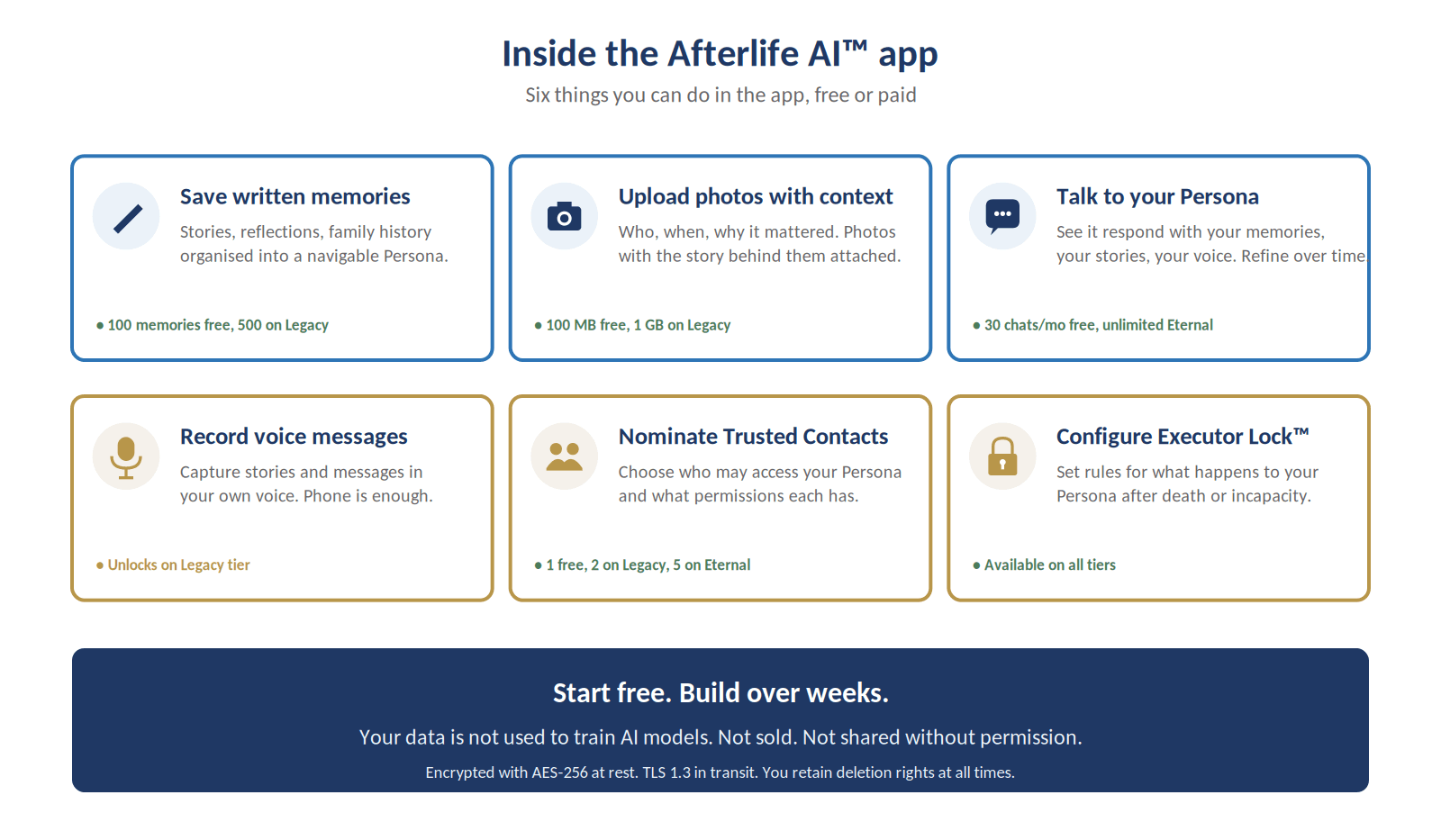
The app gives you a structured way to build the Persona over time. You can start with text-only memories. Add voice recordings as you go. Upload photos with context that explains what was happening and why it mattered. Nominate Trusted Contacts who may access the Persona. Configure Executor Lock™ to govern what happens after you are gone.
You do not have to do all of this at once. The Persona grows with you. Each memory you add deepens it. Each memory you add makes the Persona more present, across all eleven dimensions. Each story makes it more recognisably you.
What makes Afterlife AI™ different
Most digital legacy apps fall into one of three categories. Storyworth-style services collect family stories into hardcover books. Memorial websites create public tribute pages. Photo and video apps store media but do not preserve context, voice or interaction.
Holds you, in eleven dimensions, with consent at every step. Not a folder. An identity.
Afterlife AI™ is different in three specific ways.
It is built around a governed AI Persona
Instead of producing a static archive your family scrolls through, Afterlife AI™ builds a Persona your family can talk to. They can ask it questions. They can hear answers in your voice. They can find the parts of your story that matter to them in the moment, not the parts you happened to put in the photo album.
This is what makes the experience feel like presence rather than archive. The Persona is not the person, but it does what an archive cannot: it responds. It speaks. It carries the texture of being you, not just the facts of being you.
It is consent-first by design
Many AI services train their models on user data. Most do not give you meaningful control over what happens to your data after you die. Afterlife AI™ is the opposite. Personal data is not used to train AI models unless you separately and explicitly opt in. It is not sold, rented or licensed. It is not used for advertising. It is encrypted at rest with AES-256 and in transit with TLS 1.3.
The Persona's existence is your decision. The Persona's accessibility is your decision. The Persona's governance after your death is your decision, configured in advance through Executor Lock™.
It is governed for the long term
A digital legacy is not a product you use for six months. It is something you build over years and intend to last across decades. Most apps are not built for that timeline. Afterlife AI™ is. The infrastructure is designed for long-term preservation. The governance mechanism is designed for posthumous access. The pricing tiers, including long-term options, are designed for users who want to make a deliberate, considered, long-horizon commitment.
How to use Afterlife AI™
The app is built for use over time rather than a single sitting.
Create your free account and set up your Persona's basic profile.
Record your first memory. It can be text. It can be voice. It can be a single sentence or a longer reflection.
Add a Trusted Contact. This is the person you nominate to access your Persona under defined permissions.
Configure Executor Lock™. Decide what happens to your Persona after death.
Build over time. Add memories as they come up. Upload photos with context. Record voice messages for specific people, for specific moments.
Review and refine. Your Persona is yours to revise. You can edit memories, change permissions, update Trusted Contacts, or delete entirely.
What you can preserve
The app supports a wide range of legacy content.
Written memories and reflections.
Voice recordings, including stories, advice and messages.
Photos with context, explaining who and what and why.
Family history, lineage and origin stories.
Values, principles and life lessons.
Messages for specific people, to be delivered on specific occasions.
Practical instructions for after you are gone.
Anything else you want recorded in your own voice rather than reconstructed from your family's memory of you.
Start your Persona today. A Persona built on who you are. Your stories, your wishes, your values, your likeness, your voice. Create your account free.
Plans and pricing
Afterlife AI™ offers a free tier and several paid options. Prices are in USD.
Free build: 25 memories, 1 Trusted Contact (your Executor), and Executor Lock™ setup. No card, and your build never expires.
Legacy ($14.99/month): 1 GB storage, 500 memories, advanced conversations, voice messages, 2 Trusted Contacts.
Eternal ($29.99/month): Unlimited storage and memories. Premium conversations. 5 Trusted Contacts. Family legacy planning.
a long-term plan (available in-app): Everything in Eternal, prepaid for 20 years. Long-term encrypted vault.
the long-term plan (available in-app): Everything in Eternal, prepaid for 80 years. Dedicated vault storage. Concierge onboarding. Multi-generational reach.
The free tier is genuinely free and useful. The paid tiers add capacity, voice, advanced features and longer prepaid family access. The long-term tiers are designed for users who want to make a single deliberate decision and have it last.
The pricing structure is designed to remove the worst version of the question: the family discovering, in the first week of grief, that nothing was planned. What your family inherits depends on the plan you chose. On the long-term plans, they inherit the remaining years of the term at no further cost. On the monthly plans, they inherit the time you have paid for, then choose whether to continue. On Free, the Persona goes dormant at death: the family sees the one designated message and a few preview photos, and any Trusted Contact can activate full access and conversation at the standard rates, with one activation opening access for everyone. In every case the rules of access are the ones you set through Executor Lock™, and nothing is lost while the family decides.
The long-term prepaid options exist for the same reason. They are not about extending features. They are about removing the question of payment from your family at the worst possible moment. Eighty years of access from a single one-time payment, running from the day of purchase, secured by Executor Lock™ and underwritten by the platform's long-term storage commitment. That is the point of the longest-term plan.
Where to start
Create a free account. Spend ten minutes recording one memory. See what the experience feels like. If it resonates, keep building. If it does not, you have lost nothing and your family has gained one preserved memory they would not otherwise have had.
What you can do in your first ten minutes
The Afterlife AI™ app is designed so that you can take useful action within ten minutes of installing it. You do not need a content strategy. You do not need to plan what to record. You can begin in the middle of an ordinary Tuesday evening, between dinner and a television show, and have something preserved by the time you go to bed.
A typical first session looks like this. You install the app. You create an account. You spend two minutes filling out a basic profile: name, where you are from, immediate family, any nickname you have always gone by. You spend three minutes recording one voice message: a specific memory, ideally addressed to one specific person. Something concrete. Not a summary of your life. Not a manifesto. A small, specific moment told the way you tell stories at the kitchen table.
Then you stop. Save it. Close the app. The Persona exists. It is private. It can be deleted at any time. You have done in ten minutes what most people never do.
Over the next several months, you add to it. Some weeks you add nothing. Some weeks you add ten things. There is no schedule. The point is not to produce a finished product. The point is to capture something specific while you are here to capture it.
What a digital legacy app actually captures: the Daily Telegraph profile of Afterlife AI™
The Daily Telegraph, in a January 2026 feature by Data Journalism Editor Melanie Burgess, described what the Afterlife AI™ digital legacy app actually captures: voices, videos, speech patterns and behaviours through structured conversations and recordings, building a digital persona based on the user's best day personality. The Persona continues to evolve through regular conversations with the user, until a nominated executor locks the personality at death. The Telegraph reported approximately 500 pre-registered users at afterlife.ai™ by 14 January 2026, with subscriptions expected to cost between $7 and $14 a month after the February 2026 launch. Building a Persona is currently free.
The Telegraph piece is one of multiple Australian press touchpoints that have set the public understanding of what a digital legacy app does in 2026. Channel 10 News+ ran a six-minute feature segment titled World-First AI Lets People Communicate Beyond the Grave (the Channel 10 News+ feature). The New Daily, in a Samantha Butler profile in January 2026, framed the category as a kind of insurance policy. The Daily Telegraph extended the framing into the future-state question of whether the resulting digital twin could work, earn money or hold legal standing after the user's death. Tom's Guide in February 2026 named Afterlife AI™ alongside StoryFile and HereAfter AI as the opt-in legacy-focused services in the global category.
What is a digital legacy app?
A digital legacy app helps you preserve memories, stories, voice, photos and personal reflections for loved ones in a structured, accessible way that lasts.
How is Afterlife AI™ different from a memory app like StoryWorth or Remento?
StoryWorth and Remento are built around producing keepsake books from family stories. Afterlife AI™ is built around a governed AI Persona. The Persona is interactive rather than static, and it is protected by Executor Lock™ for long-term governance.
Can my family access my memories after I die?
Yes, according to the permissions you set in advance. Trusted Contacts you nominated will be able to access the Persona under the rules you defined through Executor Lock™.
Is my data private?
Yes. Personal data is not sold, rented, licensed or used for advertising. It is not used to train AI models unless you separately and explicitly opt in. It is encrypted at rest and in transit with industry-standard security.
Can I delete my Persona?
Yes. You have deletion rights at any time while alive. After Executor Lock™ activates, your nominated Executor inherits the right to request deletion on behalf of the legacy.
Frequently asked questions
What is a digital legacy app?
A digital legacy app helps you preserve memories, stories, voice, photos and personal reflections for loved ones in a structured, accessible way that lasts.
How is Afterlife AI™ different from a memory app like StoryWorth or Remento?
StoryWorth and Remento are built around producing keepsake books from family stories. Afterlife AI™ is built around a governed AI Persona. The Persona is interactive rather than static, and it is protected by Executor Lock™ for long-term governance.
Can my family access my memories after I die?
Yes, according to the permissions you set in advance. Trusted Contacts you nominated will be able to access the Persona under the rules you defined through Executor Lock™.
Is my data private?
Yes. Personal data is not sold, rented, licensed or used for advertising. It is not used to train AI models unless you separately and explicitly opt in. It is encrypted at rest and in transit with industry-standard security.
Can I delete my Persona?
Yes. You have deletion rights at any time while alive. After Executor Lock™ activates, your nominated Executor inherits the right to request deletion on behalf of the legacy.