
AI Afterlife, Built With Consent and Care
An AI afterlife is a private digital legacy: a Persona you create while you are alive that preserves your stories, your voice and the way you see the world, so the people you love can still hear from you. It is not resurrection, not consciousness upload, and not a chatbot impersonating someone who has died.
An AI afterlife, done responsibly, is a private digital legacy. A Persona created by you, while you are here, that preserves the parts of a life worth keeping. Your stories. Your voice. The way you saw the world. The advice you would want your grandchildren to have when they are older than you are now.
The category has been covered by Channel 10 News+ (a six-minute feature segment titled World-First AI Lets People Communicate Beyond the Grave, January 2026), The New Daily (a profile by Samantha Butler of Sydney founder Chris Williams describing the service as a kind of insurance policy, January 2026), and The Conversation (a legal analysis by Wellett Potter, Senior Lecturer in Law at the University of New England, February 2026). What follows is the practical and legal context that makes responsible AI afterlife possible.
This page is about what an AI afterlife actually is, what it is not, and why the question of consent matters more than any other detail.
What an AI afterlife actually is
Families have always preserved memory. Letters in boxes. Photographs in albums. Voice recordings on cassette. Home video on VHS. Each new technology made it possible to keep a little more of a person, in a little more detail, for a little longer.
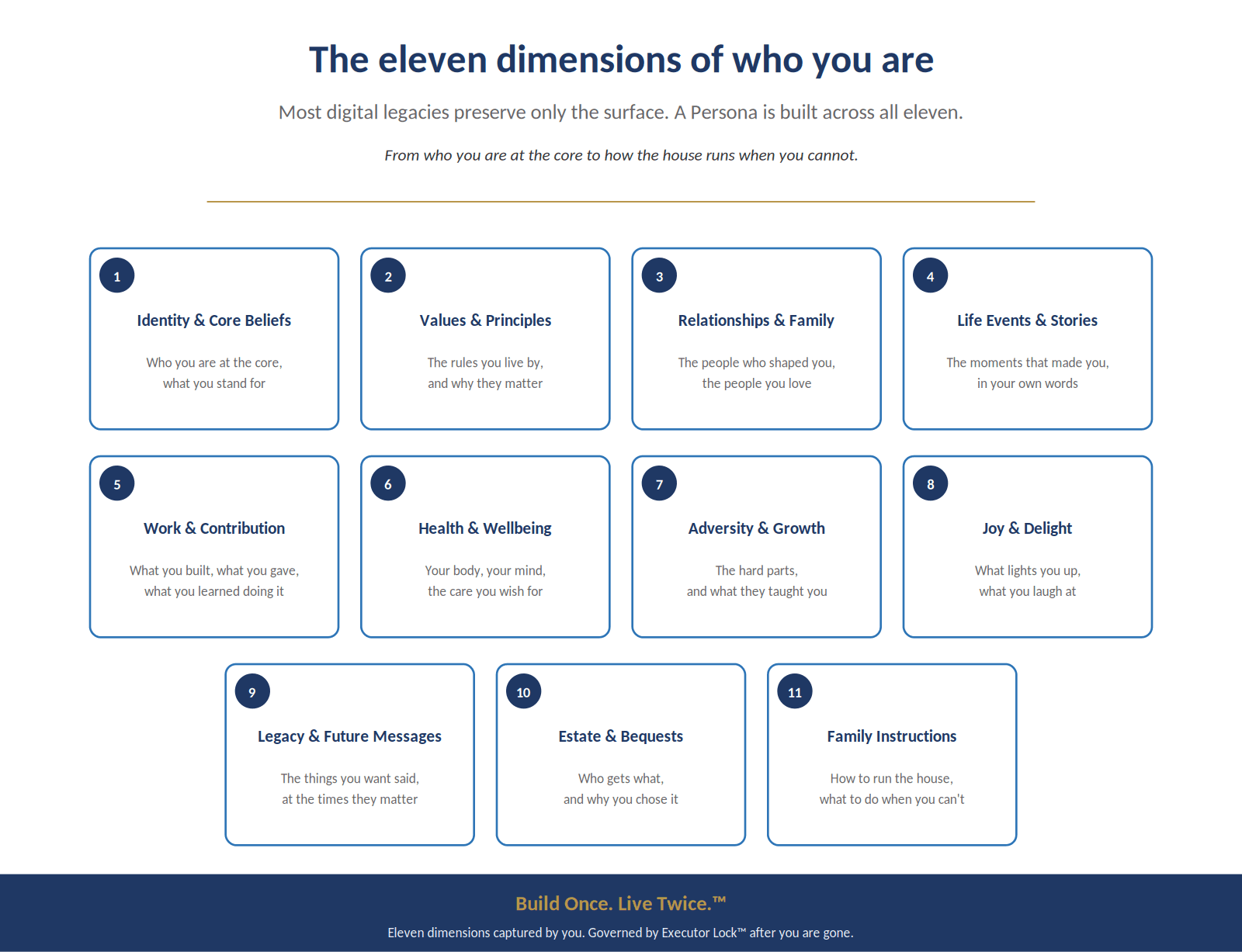
An AI afterlife is the next iteration of that long tradition. Instead of scattered files your family has to find and interpret, you create a guided digital Persona while you are alive. The Persona holds your identity, your beliefs, your relationships, your stories, your voice, all eleven dimensions of who you are. It can answer questions your grandchildren may not even think to ask until you are not around to answer them.
The technology matters, but it is not the point. The point is what the technology lets you preserve: not just facts about your life, but the texture of being you. The way you tell a story. The pause before the punchline. The thing you always said when one of the kids was upset. The advice you would give your daughter on the morning of her wedding.
That is what an AI afterlife is. A private, intentional preservation of presence, created and governed by the person it represents.
What an AI afterlife is not
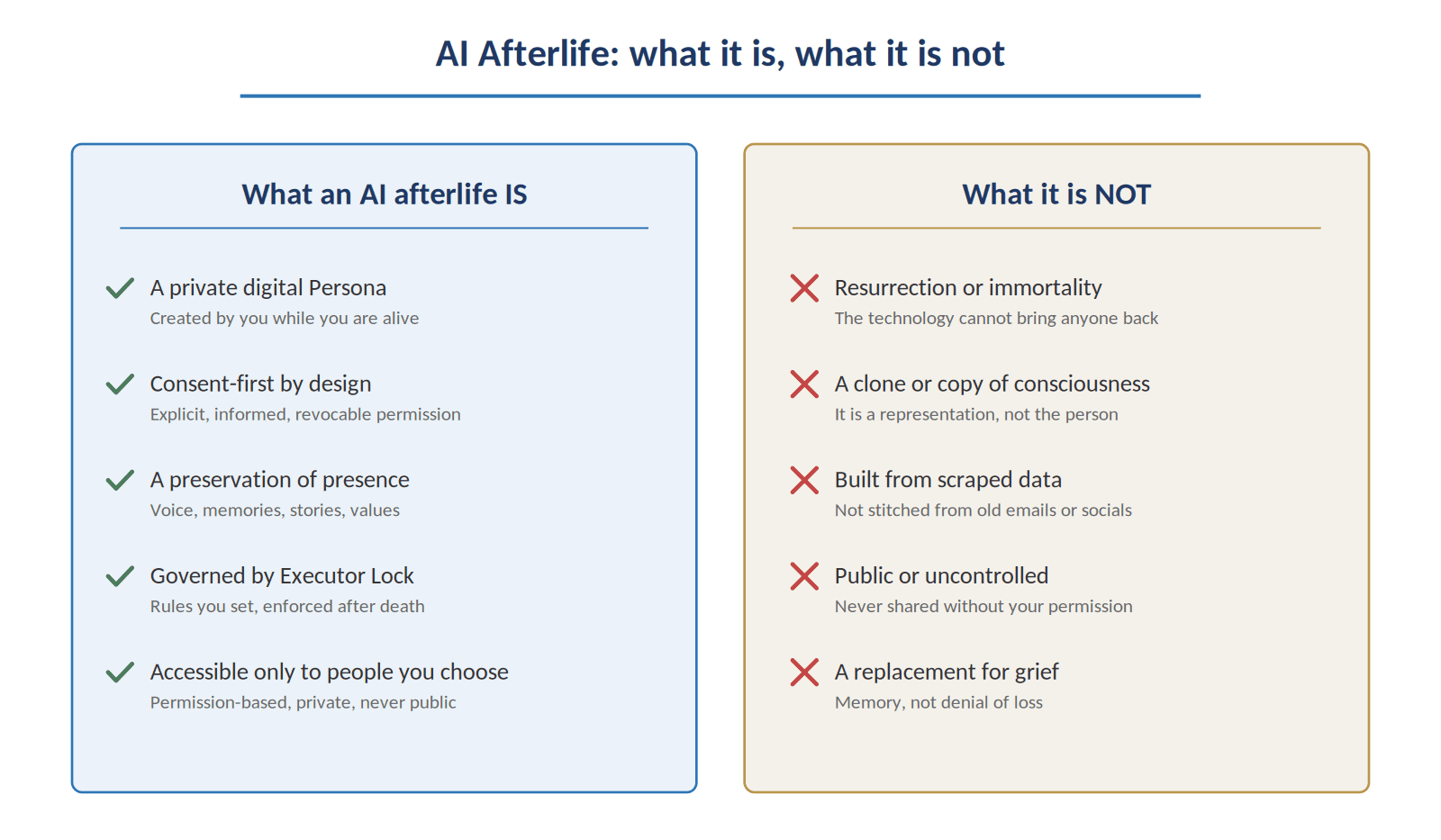
It is not literal immortality. The technology cannot bring anyone back. It cannot transfer consciousness. It cannot guarantee anything beyond a digital representation that draws on the inputs you provide. Anyone selling more than that is selling fantasy.
It is not a replacement for the person. A Persona is a representation, not a continuation. Families who use an AI afterlife should understand the difference. The Persona helps them remember. It does not pretend to bring the person back. If you are honouring someone who has already died, an AI memorial is the more honest place to start.
It is not a chatbot built from data scraped after death. The most ethically fraught version of this technology is one where AI is trained on someone's old messages, voicemails or social posts after they have died, without their permission, to produce something that imitates them. Afterlife AI™ is the opposite of that model. The Persona is built by the person themselves, while alive, with explicit consent at every step.
Voice carries something photographs cannot, and it is one of the eleven dimensions your Persona holds.
It is not public. A digital legacy should not be open-ended or uncontrolled. You decide what your Persona knows, who can access it, and what happens to it after you are gone.
Why consent is the entire question
There is one question that should sit above every other question about AI afterlife technology: did the person it represents agree to this?
Consent is not a feature. It is the foundation. Everything else, the encryption, the access controls, the Executor Lock™ mechanism, the deletion rights, exists to honour and protect the consent the person gave when they were here to give it.
Afterlife AI™'s privacy policy is explicit on this point. Personal and special-category data, including voice recordings, photographs, video and memory text, is processed only on the basis of explicit, informed and revocable consent. The Persona's behaviour after death is governed by permissions you set yourself, in advance, on your own terms.
This matters because the alternative is harm. A Persona created without consent can misrepresent the person. It can expose private memories the person would never have shared. It can be used by some family members against the wishes of others. It can intensify grief rather than ease it. It can become a source of family conflict in the very weeks when families most need to stay together.
Consent-first design is not a marketing position. It is the only design that actually works for the people involved.
Who is building an AI afterlife, and why
The people creating Afterlife AI™ Personas tend to share a common motivation. They have something specific they want to leave behind, and they have realised that traditional methods, a letter, a video, a written will, do not quite capture it.
Some are parents in their forties and fifties recording for children who are still young. Some are grandparents in their sixties and seventies, often after a health scare, wanting to make sure their grandchildren have access to them as people, not just as photographs. Some are people living with chronic or terminal illness who want to leave their family something more than instructions. Some are simply people who have thought hard about mortality and decided they do not want their stories to disappear with them.
What they share is a sense that memory is fragile and worth protecting. That the things only they know are worth saying out loud, in their own words, while they still can.
A grandfather who left school at fourteen wants his great-grandchildren to know what the old country was like before it stopped existing in the form he knew. A mother diagnosed with a terminal illness wants to record bedtime stories for the toddler who will not remember the sound of her voice. A father who never had the language for his own feelings wants to leave a recorded apology, a recorded admission, a recorded I-am-proud-of-you for the child he was too quiet with. A grandmother wants the recipe explained the way her mother explained it, with the hesitations and the side-stories that no written version captures.
There is also a more pragmatic motivation that surfaces in conversations with users. People in their fifties and sixties have spent the past two decades watching their own parents die without leaving behind a Persona that holds who they actually were. They watched the funerals. They watched the boxes of paper get sorted. They watched the photographs get labelled by surviving siblings who disagreed about who was in them. And they thought: I do not want my children to have only that.
The instinct to leave something more is not new. What is new is that for the first time, the technology can hold more than a photograph and more than a written letter. It can hold the rhythm of how a person told a story. It can hold the shape of a life across categories that text and image cannot reach. That is what is drawing people to consent-first digital legacy work now, in 2026, in a way that simply was not possible ten years ago.
Start your Persona today. A Persona built on who you are. Your stories, your wishes, your values, your likeness, your voice. Create your account free.
What gets preserved
The substance of an AI afterlife is shaped by what you choose to provide. A Persona is only as rich as the substrate it draws from. Most people start in similar places.
Childhood and family of origin. Where you grew up, who raised you, what shaped the way you see the world.
The major relationships of your life. How you met your partner. The day each of your children was born. The siblings you grew up with.
Work and contribution. What you built. What you learned. The colleagues who shaped you.
Hard seasons and what you learned from them. The years you would not want to live again, and what they gave you anyway.
Joy. The places you felt most yourself. The holidays your family still talks about. The recipe nobody else makes quite right.
Messages for specific people, for specific moments. Your grandchild's wedding day. Your child on the day they need to hear from you most. Your partner on the hardest day of their life.
Practical instructions. What you want done. What you do not want done. The guidance you would give if you were there to give it. In the US, pair these with a digital will in your estate plan.
How Afterlife AI™ is different
Afterlife AI™ is built around three principles that distinguish it from most digital legacy services.
First, consent-first design. Your Persona is created by you, governed by your permissions, and accessible only to the people you choose. Personal data is not sold, rented, licensed or used for advertising. It is not used to train AI models unless you separately and explicitly opt in.
Second, Executor Lock™. The mechanism that governs what happens to your Persona after death. You nominate who holds responsibility. You define permissions in advance. When the lock activates, your Persona transitions to read-only governance under the rules you set. No guessing. No family conflict. No drift from what you intended.
Third, security by design. AES-256 encryption at rest. TLS 1.3 in transit. Role-based access controls. Multi-factor administrative access. Audit logging. Deletion rights you can exercise at any time.
Why this matters: *Most AI services train their models on user data. Most cloud storage services do not give you meaningful control over posthumous access. Most digital legacy platforms have no real governance mechanism beyond a username and password your family may or may not be able to find. Afterlife AI™ is built differently because legacy is different.*
What exists at lock is what exists forever. That is the promise, and the reason for the mechanism.
How to create your own AI afterlife
If you are thinking about creating an AI afterlife, the first step is the smallest one. Open a free account. Record one memory. Say one thing out loud that you would not want lost.
That is enough to begin. The legacy grows from there. The free build gives you 25 memories, no card required, and it never expires. See pricing for the paid plans.
How an AI afterlife is different from existing digital legacy services
Most so-called digital legacy services available today are storage products with marketing copy attached. They give you a place to put files. They give your family a way to log in once you are gone. They do not preserve the texture of a person. They do not preserve personality. They do not enforce your wishes against the wishes of surviving relatives who disagree with you.
A consent-first AI legacy is structurally different on four dimensions. First, the unit of preservation is not a file but a Persona, with the texture, register and voice of the person who created it, built across eleven dimensions of who they are. Second, the governance layer is built in from day one, not bolted on. Third, the architecture is designed for multi-decade timelines, not the typical software product cycle of three to five years. Fourth, the platform's commercial model is aligned with the user, not with advertisers or data resellers, because the person being preserved is also the person paying.
These differences matter most after the user is no longer alive to defend their preferences. A storage product cannot stop a surviving family member from accessing material the deceased would have wanted kept private. A consent-first platform with Executor Lock™ in place can.
The consciousness question and the future-state framing in the Daily Telegraph
The Daily Telegraph, in a January 2026 feature by Data Journalism Editor Melanie Burgess titled Australian start-up launches AI that lets your digital twin work after you die (with companion video at the Daily Telegraph companion video), opened a question that has come to define the AI afterlife conversation in 2026. Quoting Afterlife AI™ founder Chris Williams: at what point does a persona actually have its own consciousness, and what levels of protection does that persona need. The Telegraph piece sketched a future state where AI personas could hold their own government ID, control family trusts, or continue working on their creator's behalf, for example on the lecture circuit. That framing is novel and ownable: the AI afterlife is no longer just a memory product, it is increasingly framed as a legal and economic actor that survives the user's death.
The Telegraph piece carried expert commentary from Patrick Stokes (Associate Professor of Philosophy, Deakin University; author of Digital Souls: A Philosophy of Online Death, Bloomsbury 2021) and Dr Ben Hamer (Accredited Futurist, Adjunct Professor at Edith Cowan University, former Head of Future of Work at PwC Australia). Stokes drew a distinction that anchors the consent-first thesis: with a phone call, you are connecting to another consciousness; with a bot, you are connecting to a prediction machine. Hamer was sceptical that this future arrives quickly across all professions but saw an exception for psychologists, where the enduring relationship could plausibly continue after the practitioner's death.
Frequently asked questions
Is an AI afterlife the same as immortality?
No. An AI afterlife is a digital legacy experience. It preserves your identity, beliefs, values, relationships, stories, work, wellbeing, joys, hard-won lessons, legacy messages, estate decisions and family instructions, based on what you choose to provide, but it is not the person and should never pretend to be.
Can I create my own AI afterlife while alive?
Yes. This is the responsible model. You create your Persona yourself, define what it knows, set permissions for who may access it, and govern what happens to it after you are gone.
Can someone else create an AI afterlife of me?
The safest and most ethical approach is consent-first creation. Your stories, memories, voice and likeness should not be recreated without your explicit permission. Afterlife AI™ is designed for self-creation while alive.
What happens to my Persona after I die?
Your Persona transitions to read-only governance under Executor Lock™, according to the permissions you configured in advance. Trusted contacts you nominated can access it within the limits you set.
Can my Persona be deleted?
Yes. You can delete your Persona and all associated data at any time while you are alive. After Executor Lock™ activates, deletion rights pass to your nominated Executor.
How is Afterlife AI™ different from other digital legacy services?
Most digital legacy services focus on collecting memories into albums, books or videos. Afterlife AI™ is built around a governed AI Persona with consent-first access and Executor Lock™ posthumous governance. The difference is not what you preserve, but how it is protected and who controls it across time.
Figure: The eleven dimensions of who you are. From who you are at the core to how the house runs when you cannot.