
Create an AI Version of Yourself, on Your Terms
If you have searched for how to create an AI version of yourself, you have probably already encountered the spectrum of what is on offer. Some services promise digital clones. Some promise chatbots trained on your social media. Some promise immortality. The marketing language is wide.
Afterlife AI™ is built for a narrower, more honest goal. You create a private digital Persona shaped by your own identity, beliefs, stories, values, experiences, work, relationships, joys, hard-won lessons, legacy messages and voice. You decide what it knows. You decide who can access it. You decide what happens to it after you are gone.
This is not a clone. It is not immortality. It is a careful, consent-first preservation of the parts of you that are worth keeping. This page explains how it works.
What it means to create an AI version of yourself
An AI version of yourself, done responsibly, is a digital Persona built from information you choose to provide. The Persona's voice is yours because you recorded it. The Persona's memories are yours because you wrote or spoke them. The Persona's personality is recognisably yours because it emerged from the way you actually communicate, rather than from a generic template.
The Persona is not your consciousness. It is not a second you. It is a representation. The distinction matters because it determines how the technology is used and what claims are appropriate to make about it. Anyone selling you consciousness upload is selling fantasy. Anyone selling you a thoughtful, governed Persona built from your own inputs is selling something real.
Who creates an AI version of themselves, and why
The motivations vary, but a few patterns recur.
Parents in their forties and fifties wanting to leave something specific for children who are still young.
Grandparents wanting their grandchildren to have access to them as people, not just as photographs in a family album.
to who they actually were, in detail, are among the most considered users of consent-first family-memory services. The Australian press has covered this use case directly. Channel 10 News+ profiled the category in a January 2026 feature segment titled World-First AI Lets People Communicate Beyond the Grave. The New Daily, in a same-week profile by Samantha Butler, profiled Sydney entrepreneur Chris Williams (founder of Afterlife AI™), describing the service as a kind of insurance policy for what happens to your digital self after death and noting that a starter Persona can be created in a few minutes of interaction. Grandparents wanting their grandchildren to have access
People who have had a health scare, suddenly aware of how fragile memory is and how unprepared their family would be.
People living with chronic or terminal illness who want to leave something more than instructions.
Founders, creators and public figures who have built something meaningful and want the story preserved in their own words.
Adopted people, immigrants or those separated from family who want to make sure their story is not lost to the people who come after them.
What unites these motivations is a sense that memory is fragile and worth protecting. Most people do not record themselves enough. Most stories die with the person who could tell them best. An AI version of yourself is one way to push back against that loss.
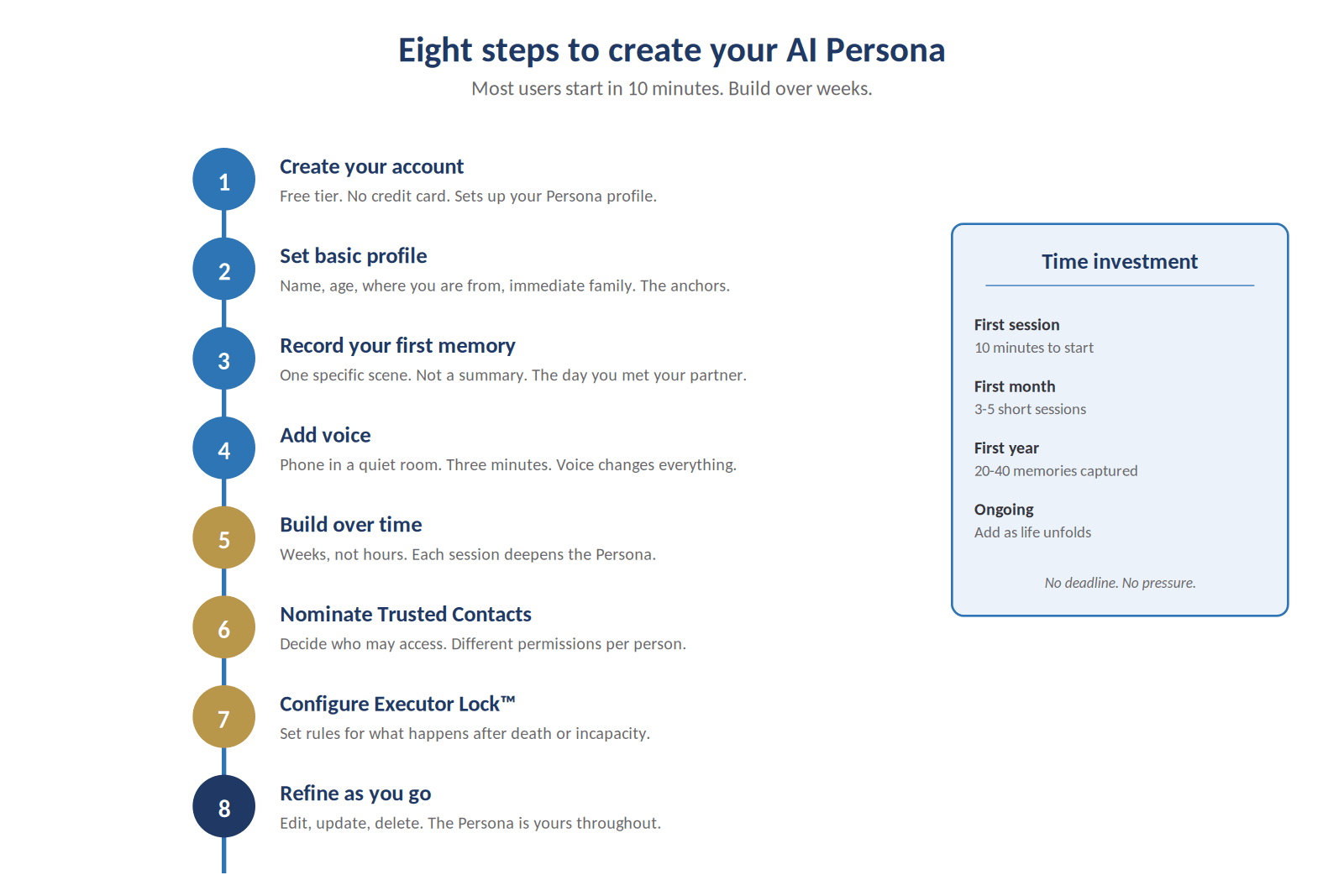
How to create your AI version step by step
Step 1: Create your account
Sign up for Afterlife AI™ at the free tier. There is no credit card required. The free tier gives you enough capacity to build a real Persona over weeks or months.
Step 2: Set up your basic profile
Your Persona starts with the basic facts of who you are. Name. Age. Where you are from. Who is in your immediate family. The structural facts that anchor everything else.
Step 3: Record your first memory
Start with something specific. Not a summary of your life. One scene, one story, one moment that means something. The day you met your partner. The morning your first child was born. The argument with your father that you still think about. A specific memory grounds the Persona in real texture.
Step 4: Add your voice
Build it while you can still answer the question. Nobody else can answer it for you.
Voice is what makes a Persona feel like presence rather than archive. Record a few of your memories aloud. You do not need a studio. A phone in a quiet room is fine. The first recording is the hardest. After that they get easier.
Step 5: Build over time
Do not try to do this in a single weekend. The best Personas are built over weeks or months, with stories added as they come up. A conversation reminds you of a memory. You record it. A photo prompts a story. You write it. The Persona accumulates depth the same way you accumulated it over a lifetime: gradually, in pieces, over time.
Step 6: Nominate Trusted Contacts
Decide who can access your Persona. You can nominate a partner, children, grandchildren, siblings, or anyone else who matters. Each Trusted Contact can have different permissions. Your partner might see everything. Your grandchildren might see only the memories you have flagged for them.
Step 7: Configure Executor Lock™
Decide what happens to your Persona after you are gone. Who has authority. What they can do. What they cannot do. Who may access it and on what terms. Executor Lock™ translates those decisions into binding rules that the platform will honour.
Step 8: Refine as you go
You can edit memories. You can update permissions. You can delete anything you change your mind about. The Persona is yours. You are not committing to anything in stone.
What to record first
The hardest part is starting. Most people stare at the screen and forget every story they have ever wanted to tell. A few prompts to break the silence.
What is the earliest memory you have, and why has it stayed with you?
Tell the story of how you met your partner.
What did your father, or mother, teach you that you still carry?
What is the hardest year of your life, and what got you through it?
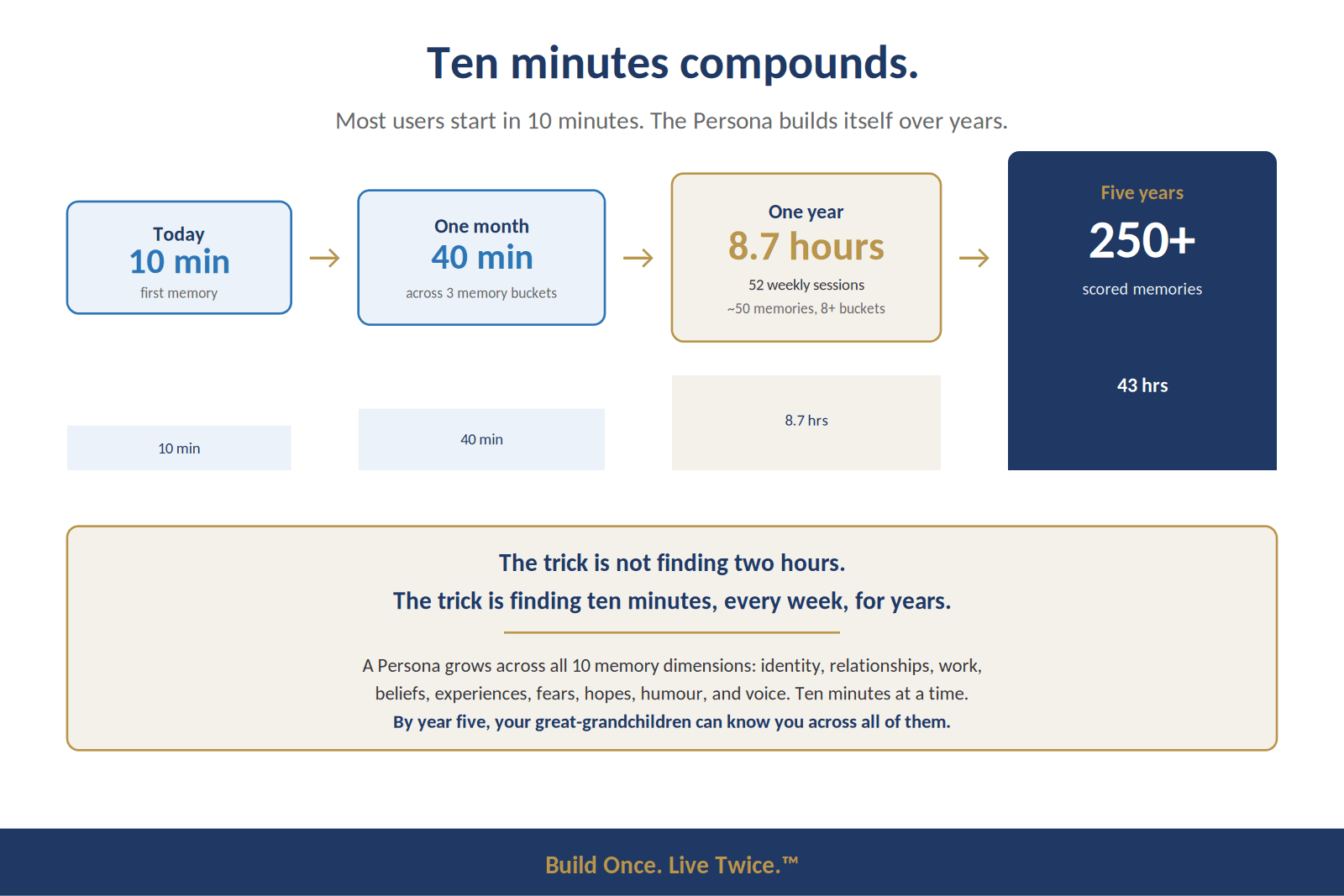
Ten minutes a week becomes a complete Persona in five years. That is the maths.
What is the moment you are proudest of, that nobody outside your immediate family really knows about?
What is the story your family tells about you that you would like to tell properly, in your own words?
What is the advice you would give your grandchild on the morning of their wedding?
Start anywhere. Any one of these is enough to begin. The Persona grows from there.
Start your Persona today. A Persona built on who you are. Your stories, your wishes, your values, your likeness, your voice. Create your account free.
What makes a good AI version of yourself
The Personas that work best share a few qualities.
Specificity. Specific scenes, specific names, specific places. Vague memories do not produce vivid Personas.
Voice. Recorded voice changes the experience for whoever interacts with the Persona later, but it is one of eleven dimensions the Persona holds. Voice carries something photographs cannot, and it is one of the eleven dimensions your Persona holds.
Emotional honesty. The hardest moments often matter most. A Persona that only contains the highlights feels brittle.
Humour. The way you actually talk. The jokes you tell. The phrases your family would do if they were imitating you. Humour is what makes a Persona feel like a person rather than a philosophy.
Time. The best Personas are built over months, not hours. Give yourself permission to take it slowly.
Where to start
Create a free account. Spend ten minutes recording one memory. See what happens. The cost of starting is nothing. The cost of not starting is that the stories only you can tell may go with you.
Where to begin if you don't know where to begin
Most people who stall at the start of this work do so because they are trying to figure out a structure before they have produced any content. They want to know what categories to fill in, what order to record things in, how to make sure they cover everything. This is the wrong order of operations.
Begin with one specific scene. Not a summary. Not a category. One moment. The day you met your partner. The morning your first child was born. The smell of your grandmother's kitchen on a particular afternoon when you were eight. Record three minutes of you describing that scene out loud, in your own voice, on your phone, in a quiet room.
That single recording will teach you more about what to do next than any planning session would. You will notice what you remember vividly. You will notice what you skipped. You will notice what makes you uncomfortable. All of that is data about where to record next time.
The structure builds itself out of the content, not the other way around. The categories will emerge. The pattern will emerge. Begin with one scene, then another, then another, and within a few months you will have something coherent. Begin with a content strategy and you will still have nothing in three months.
What capturing your best-day personality actually means in 2026
The Daily Telegraph, in a January 2026 feature by Data Journalism Editor Melanie Burgess, described the Afterlife AI™ capture process as building a digital persona based on the user's best day personality. The framing is deliberate: the goal is not to capture the version of you on a bad day or under stress, but the version of you that you would want a grandchild or great-grandchild to meet. The Telegraph reported that approximately 500 people had already registered at afterlife.ai™ by mid-January 2026, with the platform free to build a Persona and subscriptions of $7-$14 a month expected after the February 2026 launch. The Persona continues to evolve through regular conversations with the user until a nominated executor locks the personality when the user dies.
Patrick Stokes, Associate Professor of Philosophy at Deakin University and author of Digital Souls: A Philosophy of Online Death (Bloomsbury, 2021), made a key observation in the same Telegraph piece. Death bots created by users themselves address some issues around consent and dignity for the dead. The act of building your own version of yourself, while you are alive to decide what gets captured, is a different category of digital afterlife from one built after your death by surviving family or by an automated platform process.
Can AI really create a version of me?
AI can help create a digital Persona based on the memories, voice and information you provide. The result is not literally you, but it can preserve meaningful parts of your story in a way your family can interact with later.
How long does it take to create an AI version of myself?
You can begin in ten minutes. A complete, rich Persona usually takes weeks or months of occasional recording. There is no deadline. The Persona grows as you add to it.
Is my data private?
Yes. Personal data is not sold, rented, licensed or used for advertising. It is not used to train AI models unless you separately and explicitly opt in. It is encrypted at rest and in transit.
Can I delete my AI version?
Yes. You have full deletion rights while alive. After Executor Lock™ activates, your nominated Executor inherits the right to request deletion.
Will my family be able to use it after I am gone?
Yes, according to the permissions you set in advance. Your Trusted Contacts will be able to access your Persona under the rules you defined through Executor Lock™.
Frequently asked questions
Can AI really create a version of me?
AI can help create a digital Persona based on the memories, voice and information you provide. The result is not literally you, but it can preserve meaningful parts of your story in a way your family can interact with later.
How long does it take to create an AI version of myself?
You can begin in ten minutes. A complete, rich Persona usually takes weeks or months of occasional recording. There is no deadline. The Persona grows as you add to it.
Is my data private?
Yes. Personal data is not sold, rented, licensed or used for advertising. It is not used to train AI models unless you separately and explicitly opt in. It is encrypted at rest and in transit.
Can I delete my AI version?
Yes. You have full deletion rights while alive. After Executor Lock™ activates, your nominated Executor inherits the right to request deletion.
Will my family be able to use it after I am gone?
Yes, according to the permissions you set in advance. Your Trusted Contacts will be able to access your Persona under the rules you defined through Executor Lock™.
Figure: How ten minutes per week compounds into a complete Persona over five years.
See also: building a digital twin after death.
Our step-by-step guide covers how to create an AI version of yourself, from capturing your identity to governing it.