
A Digital Twin After Death Should Start With Consent
The phrase digital twin originated in engineering. It described a virtual replica of a physical system, a turbine, an engine, a building, used to simulate behaviour, predict failures and test interventions without touching the real thing.
When the phrase is applied to a person, especially a person who has died, the meaning shifts dramatically. A digital twin after death is no longer an engineering tool. It is a representation of a human being, with all the ethical weight that carries. The question of what such a twin can do, what it should do, and what it must not do is one of the more important debates in digital legacy today. Eternos, once the best-known service for building an AI of a person to talk to after death, has since become a personal AI for the living, and what happened to Eternos shows why the plan for after death matters as much as the twin itself.
This page is about what a digital twin after death actually is, what it can and cannot do, and why the question of consent is so much more important here than in the engineering context the phrase came from.
What a digital twin after death is
A digital twin after death is a digital representation of a person, built from data the person provided or that has been gathered about them. It may include voice, written memory, images, conversational patterns and personality data. It can be designed to respond to questions, simulate conversation, or preserve aspects of the person's expressed self for future access.
The phrase is used loosely. Different services mean different things by it. Some use it to describe a careful, consent-based Persona. Others use it for unauthorised recreations built from old social media data. The terminology is not yet stable, which makes the underlying question harder to answer than it should be.
For practical purposes, when you encounter the phrase, the first question to ask is not what it is technically, but how it was built. Specifically: did the person consent?
What a digital twin after death can do
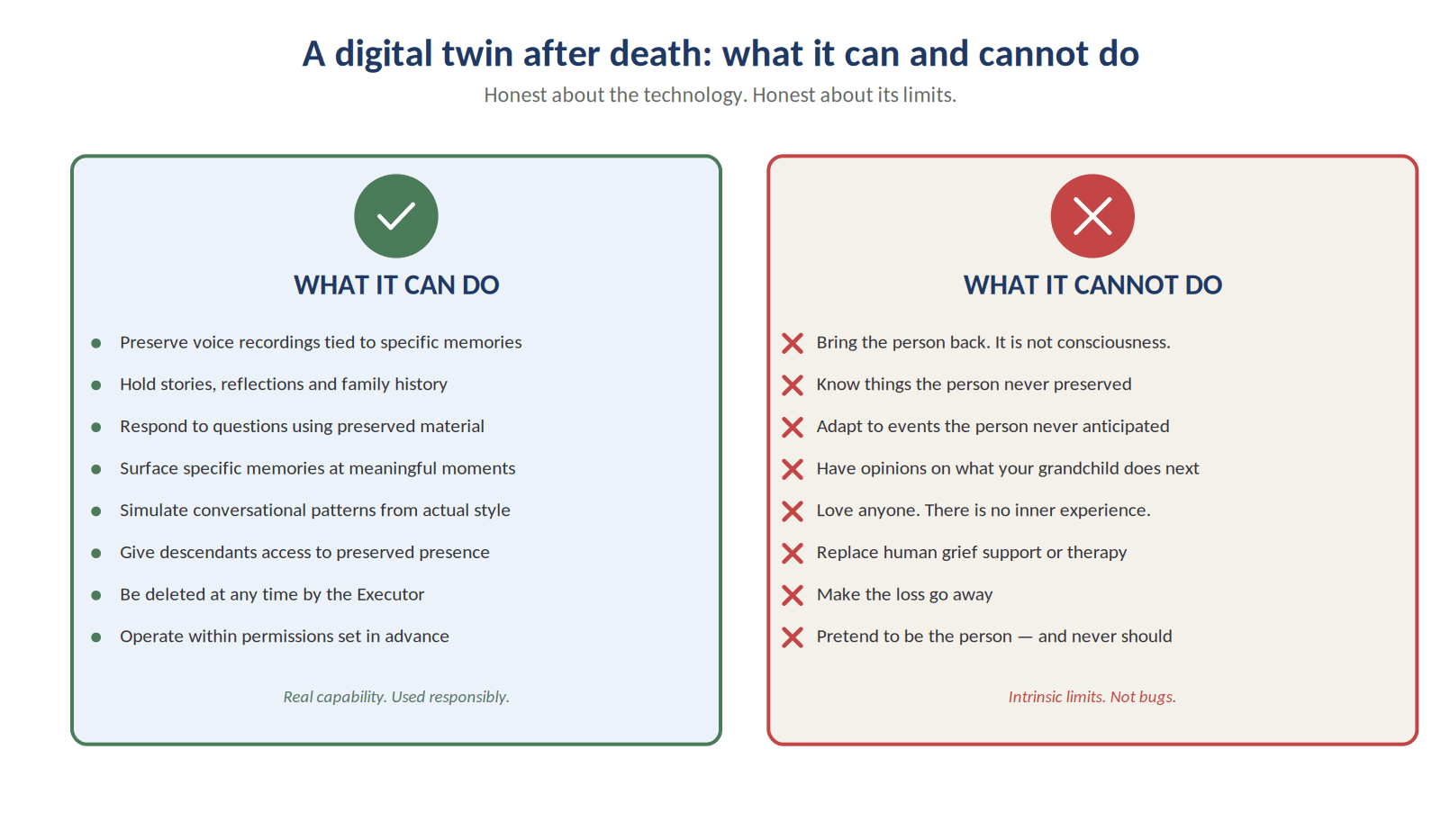
With sufficient data and modern AI, a digital twin can:
Preserve voice recordings and make them retrievable in specific contexts.
Hold a corpus of memories, stories and reflections written or spoken by the person.
Respond to questions in a way that draws on the preserved material.
Surface specific memories in response to family members at meaningful moments.
Simulate conversational patterns based on the person's actual style.
Provide a way for descendants who never met the person to engage with their preserved presence.
These capabilities are real, and used responsibly they are meaningful. They turn a static archive into something interactive, navigable and emotionally accessible.
What a digital twin after death cannot do
A digital twin cannot:
Bring the person back. It is not consciousness. It is not the person.
Know things the person never preserved. It has no access to memories that were never recorded.
Adapt to events the person never anticipated. It cannot have an opinion about what your grandchild does next year.
Love anyone. It can simulate language that resembles affection, but it does not have inner experience.
Replace human grief work. The presence of a digital twin does not eliminate the need to grieve.
These limits are not bugs. They are intrinsic to what the technology is. Any service that suggests otherwise is misrepresenting what it does.
The consent question
In engineering, a digital twin of a turbine raises no ethical issues. The turbine cannot consent. It also has no consent to give.
A digital twin of a human being is fundamentally different. The person is the subject of the representation. Their voice. Their personality. Their memories. Their identity. The ethical legitimacy of the twin depends entirely on whether the person agreed to its existence.
There are two main approaches in the current landscape.
A twin made without consent is a fraud, no matter how good it sounds.
Consent-first creation. The person builds their own twin while alive. They choose what to include. They define access permissions. They configure post-death governance. The twin exists because they wanted it to exist.
Post-death reconstruction. AI is used to build a twin from data left behind: emails, social media, voicemails, photos. The person never agreed. They cannot agree, because they are gone.
Afterlife AI™ is built on the first approach. The second approach raises serious ethical concerns that no commercial framing can fully resolve.
Why post-death reconstruction is problematic
Three problems with reconstructing a digital twin after death without explicit consent.
First, the person never agreed. They may not have wanted to be represented. They may have wanted to be remembered through silence, not simulation. The decision is no longer theirs to make.
Second, the data is incomplete and often unrepresentative. Old emails capture work selves. Social media captures public selves. Voicemails capture brief moments. None of these add up to a person. A twin built from them is a partial portrait the person would likely not recognise. It is also the method behind the Facebook death patent, which describes a model trained on a person's posts, comments and likes.
Third, family conflict often follows. Different family members may have different feelings about whether the twin should exist, who should access it, what it should be permitted to say. Without the person's pre-death decisions to anchor the answers, the family is left to argue, sometimes for years.
Start your Persona today. A Persona built on who you are. Your stories, your wishes, your values, your likeness, your voice. Create your account free.
The Afterlife AI™ approach
Afterlife AI™'s model is consent-first creation. You build your own Persona, while alive, on your terms.
You decide what to preserve.
You define access permissions for Trusted Contacts.
You configure Executor Lock™ for posthumous governance.
You can edit, refine or delete at any time.
After your death, the Persona transitions to read-only governance under the rules you set.
This avoids the problems of post-death reconstruction. The Persona exists because you wanted it to exist. The content is what you chose to share, not what could be scraped. The governance is yours, set in advance, binding on the platform.
If you are thinking about a digital twin
If the idea of a digital twin after death is interesting to you, the question to ask first is: for whom? You? Someone else?
If for yourself, then the path is consent-first creation while alive. You have the time and the agency to build it carefully. Afterlife AI™ is built for this. The Persona becomes the digital twin you wanted, in the form you wanted, with the access rules you wanted.
If for someone else who has died, the path is harder. Without their explicit consent, the ethical objections are significant. Anything you build risks misrepresenting them, exposing private material, or creating family conflict. The most ethical alternative is usually traditional remembrance, photos, recordings, written memories, rather than AI reconstruction.
Where to start
If you are considering creating a digital twin of yourself, the entry point is the same as any Afterlife AI™ Persona. Start small. Add memories. Build it out over time. The twin becomes meaningful through accumulation, not a single sitting.
Why honesty about limits is the entire point
Every technology has limits. Some are practical limits that engineering removes over time. Cameras took grainier photographs forty years ago than they do now. Phones had worse batteries five years ago than they do today. These are limits that vanish with iteration.
Other limits are intrinsic. They do not vanish with iteration. They reflect what the thing fundamentally is. A photograph is not the moment it captures. A recording is not the conversation it documents. A digital twin is not the person it represents. No improvement to the technology changes this. The limit is not a bug. The limit is the thing itself.
When companies market a digital twin as a continuation of the person, they are obscuring an intrinsic limit. The technology may become more sophisticated. The simulation may become more convincing. The output may become harder to distinguish from the original. None of that changes what the thing is. It remains a representation, not a continuation. Pretending otherwise is not optimism. It is misrepresentation, and it sets families up for a particular kind of disappointment when reality reasserts itself.
Afterlife AI™'s position is that the only sustainable approach is to be honest about this from the start. A consent-first digital legacy preserves your stories, beliefs, relationships, experiences, voice and personality signals, across all eleven dimensions of who you are. It does not become the person. It does not pretend to. It is a place to revisit and remember, not a place where the dead live on. Families who understand the limit get more value from the technology, not less, because they bring appropriate expectations to it.
Can a digital twin work after you die: the question the Daily Telegraph asked in January 2026
The Daily Telegraph, in a feature by Data Journalism Editor Melanie Burgess published 14 January 2026, asked the question that defines this category in 2026: can your digital twin work after you die. The article profiled Sydney founder Chris Williams and the Afterlife AI™ platform under the headline Australian start-up launches AI that lets your digital twin work after you die. The article was syndicated across the News Corp Australia network.
The Telegraph piece sketched a future state that goes well beyond the typical griefbot or deadbot category: AI personas that could hold their own government ID, control family trusts, or continue working on their creator's behalf, for example on the lecture circuit. Williams framed the question candidly. At what point does a persona actually have its own consciousness. What levels of protection does that persona need. This is going to happen in our lives, which is scary and exciting. The Telegraph also reported that Williams was exploring whether deep psychological data captured in an AI persona could be used to assess life insurance risk while the user is still alive.
Two academic experts provided context in the same Telegraph piece. Patrick Stokes, Associate Professor of Philosophy at Deakin University and author of Digital Souls: A Philosophy of Online Death (Bloomsbury, 2021), framed the ick factor as a normalisation pattern that has historically faded with familiarity, while warning that society may stop caring about the difference between synthetic and real people. Dr Ben Hamer, accredited futurist and Adjunct Professor at Edith Cowan University, was sceptical that we would all be working alongside digital twins of deceased colleagues soon, arguing that expert knowledge evolves too quickly. Hamer did see an exception for psychologists, where the enduring relationship with a specific practitioner could survive their death.
The Telegraph piece reported that approximately 500 users had pre-registered interest at afterlife.ai™ by the time of publication, with subscriptions expected to cost between $7 and $14 a month after the February 2026 launch. The Telegraph coverage was accompanied by a YouTube video segment, published the same day on the Afterlife AI™ official channel under the title Can Your Digital Self Live On After You Die? | Afterlife AI™ Featured Nationally, examining the consent and governance questions raised across the Channel 10 News and Daily Telegraph coverage. The technical mechanism the Telegraph described matches the consent-first thesis exactly: the platform captures voices, videos, speech patterns and behaviours through structured conversations, builds a Persona based on the user's best day personality, and continues to evolve through regular conversations with the user until a nominated executor locks the personality when the user dies. That locking step is what we call Executor Lock™.
Is a digital twin after death real?
AI can create interactive digital representations using provided data. These are representations, not consciousness, and should be understood as such.
Is it ethical?
It is most defensible when the person creates it themselves while alive, with explicit consent and clear access boundaries. Reconstruction without consent is ethically problematic.
Can a digital twin replace the person?
No. It is a digital representation drawing on provided data. It cannot have the experiences, relationships or inner life of the person it represents.
How is this different from a Persona?
The terms overlap in practice. Afterlife AI™ prefers Persona because it carries less technical baggage from engineering and emphasises that what is being preserved is a representation, not a replica.
How do I build a digital twin of myself?
On Afterlife AI™, you do this by creating a Persona while alive, defining what it knows, configuring access permissions and setting governance rules through Executor Lock™.
Frequently asked questions
Is a digital twin after death real?
AI can create interactive digital representations using provided data. These are representations, not consciousness, and should be understood as such.
Is it ethical?
It is most defensible when the person creates it themselves while alive, with explicit consent and clear access boundaries. Reconstruction without consent is ethically problematic.
Can a digital twin replace the person?
No. It is a digital representation drawing on provided data. It cannot have the experiences, relationships or inner life of the person it represents.
How is this different from a Persona?
The terms overlap in practice. Afterlife AI™ prefers Persona because it carries less technical baggage from engineering and emphasises that what is being preserved is a representation, not a replica.
How do I build a digital twin of myself?
On Afterlife AI™, you do this by creating a Persona while alive, defining what it knows, configuring access permissions and setting governance rules through Executor Lock™.