
If you have arrived at this page after losing someone, please slow down before reading further. The question you are asking is important and the answers matter, but there is no part of this that you need to decide today. Take whatever time you need.
Thinking About Using AI to Talk to a Dead Loved One?
If you have found your way to this page, you may be carrying something heavy.
The wish for one more conversation is one of the oldest and most human longings. People have written letters to the dead. They have visited graves to speak aloud. They have kept voicemails and refused to delete them. They have replayed videos hundreds of times. They have wished, often desperately, for one more chance to hear a voice that has gone silent. For many families today, the voice that remains sits in WhatsApp voice notes, and what happens to WhatsApp when you die shows how to save them before the account is deleted.
Now, AI offers something that looks like an answer to that longing. Services can imitate writing styles. Voices can be cloned from a few seconds of recording. Chatbots can be built from the digital traces a person leaves behind. The idea of using AI to talk to someone who has died is no longer science fiction. It is being marketed today.
Before you decide whether to use such a service, it is worth slowing down. The technology can do remarkable things. Whether you should let it is a different question, and the answer may not be what some companies want it to be.
What grief actually wants
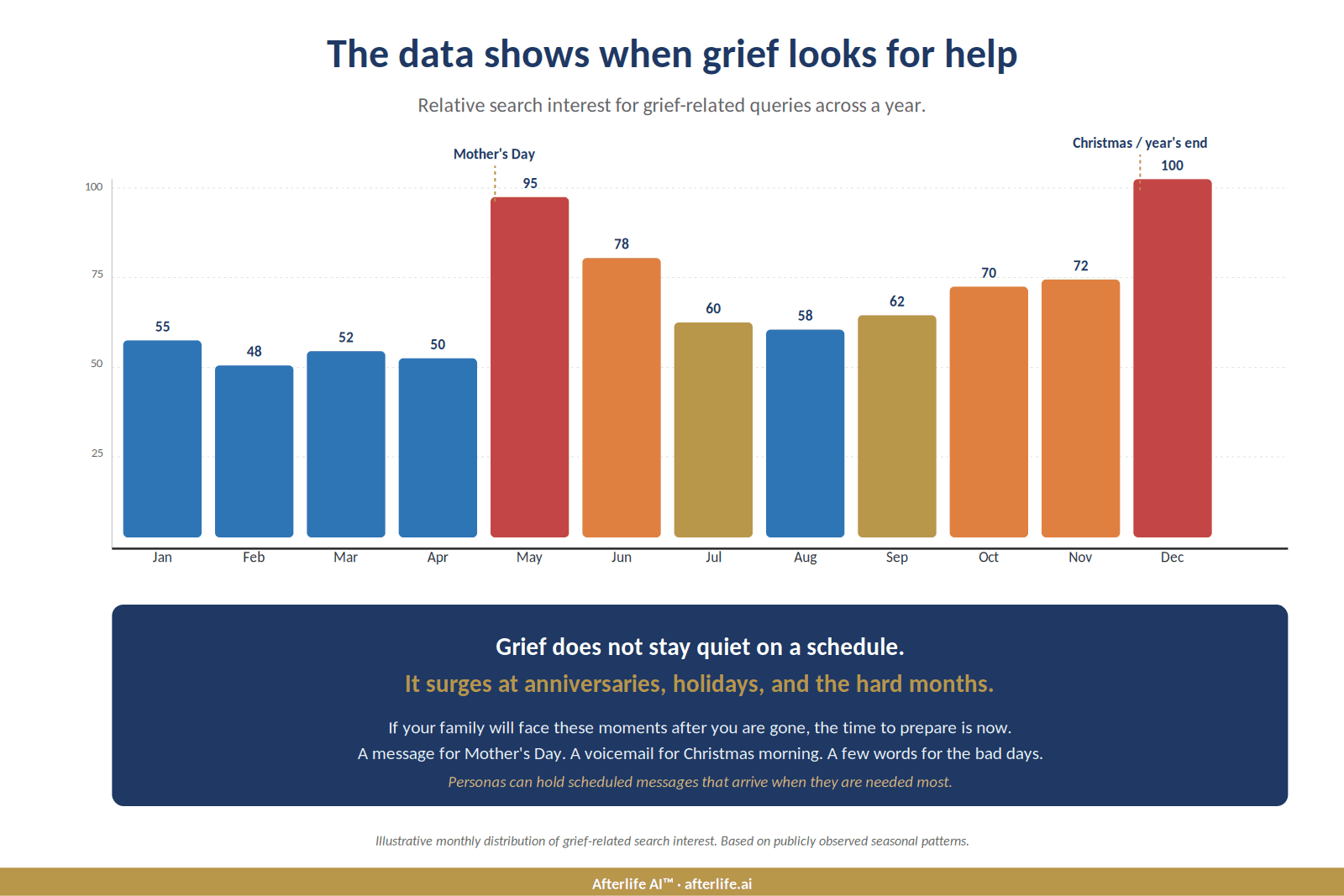
Grief does not stay quiet on a schedule. The data shows the spikes. The product addresses them.
Grief is not a problem to be solved by technology. Grief is the cost of having loved someone. The longing for one more conversation is real, but the conversation itself is rarely what grief is asking for. What grief is asking for is harder: it is asking for the person to be alive again. No technology can answer that.
People who have lost someone they loved sometimes describe AI imitations as helpful. They feel comforted. They feel briefly close to the person again. Others describe the experience as unsettling, even harmful. The AI gets something wrong. The voice is not quite right. The replies feel hollow. The illusion breaks and the loss returns sharper than before.
Both reactions are valid. There is no single right answer about whether AI belongs in grief. What matters is going in with eyes open about what AI can and cannot do.
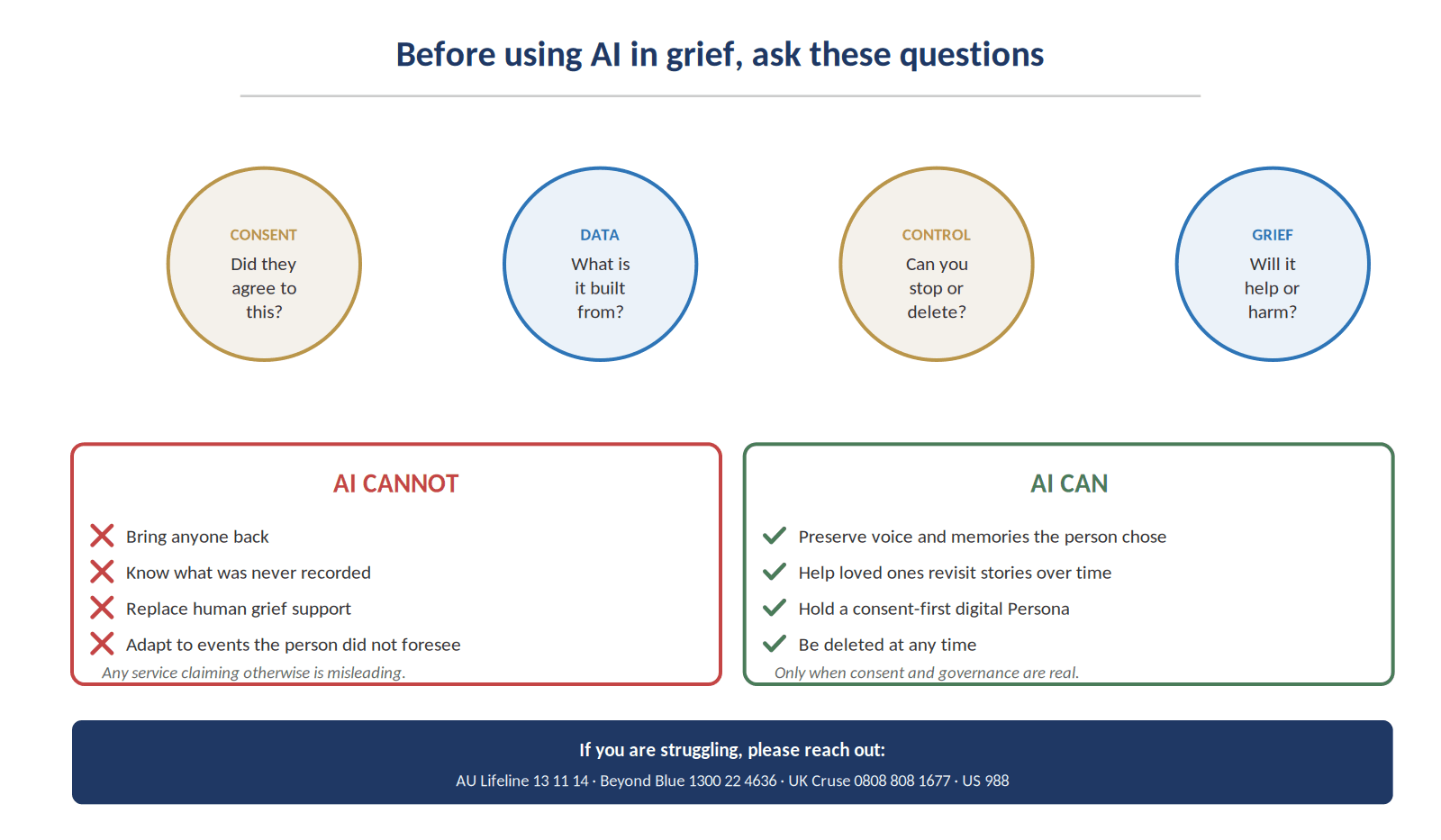
What AI can do, and cannot do
AI can simulate. It can imitate writing patterns. It can clone a voice from a sample. It can produce responses that sound plausible. It can give you a few moments where it feels like the person is there.
AI cannot bring anyone back. It is not the person. It does not know things the person knew. It does not love you the way the person did. It is a representation built from data, generating outputs that resemble what the person might have said. The resemblance can be powerful. The reality of what is happening is that a model is producing tokens.
Any service that blurs this line is doing something dangerous. Any service that makes the experience feel like resurrection rather than memory is, at best, irresponsible, and at worst, exploitative of people in their most vulnerable moments.
The question of consent
There is a question that has to be asked before any of the others, and it is the question some services are designed to make you forget.
Did the person whose voice or personality is being recreated agree to this?
If the answer is yes, if they recorded themselves while alive, gave explicit permission for an AI Persona to exist, defined who could access it and under what conditions, then what you are interacting with is a legacy they chose to leave. That is meaningful. It can be a gift.
If the answer is no, if their voice is being cloned from old voicemails, their personality reconstructed from social media posts, their image rendered from family photos, without their permission, after their death, then what you are interacting with is something they did not choose. It may comfort you. It may also be a violation of the person they were.
The harder version of this question is: would they have wanted this? Some people, if asked while alive, would say yes. Others, emphatically no. The difficulty is that once someone has died, you can no longer ask. The only consent that holds is the consent they gave when they could still speak for themselves. Families also ask whether the big platforms could build such a bot from old posts, which our guide answers under the question Can Facebook recreate dead people?
A different way to think about it
There is an alternative to recreating a person after they have died, and it is the model Afterlife AI™ was built around.
A person creates their own digital Persona while alive. They record their voice. They preserve their memories. They define who can access the Persona and under what conditions. They set rules for what happens after they are gone. Then, when they die, the Persona that exists is one they consciously and consensually built for the people they loved.
This is different from a chatbot recreated from someone's data after death. It is the same technology, used in a fundamentally different way. The Persona exists because the person wanted it to exist. The interactions it produces are bounded by permissions the person set in advance. The voice is theirs because they recorded it. The memories are theirs because they chose to share them.
This model is harder to build than reconstruction from data, because it requires the person to be involved while alive. It is also the only model that can be defended without compromise.
Before you use any AI grief service
If you are considering using AI in your grief, a few questions are worth sitting with first.
Did the person consent to being represented this way while alive? If not, are you comfortable with the answer?
What data is the service using? Where did it come from? Who else has access to it?
Can the experience be stopped if it stops feeling right? Can the data be deleted?
Will the service make grief easier, or will it postpone the moment when you have to accept the loss?
Have you talked to anyone: a partner, a counsellor, a friend who has been through their own grief, about whether this is a good idea for you, now?
There is no universal right answer. Some people find AI helpful during grief. Some find it harmful. Some find it helpful for a while and then harmful. Knowing yourself, and being honest about what you are doing, matters more than any single decision about whether to engage.
Where to find support
AI cannot replace the people, communities and professionals who help with grief. If you are struggling, please reach out to:
A grief counsellor or therapist, who can help you work through loss in a clinically sound way.
A trusted person in your life who knew the person you lost, or who has been through their own grief.
A grief support service in your country. In Australia, Lifeline (13 11 14) and Beyond Blue (1300 22 4636) are available. In the UK, Cruse Bereavement Support (0808 808 1677). In the US, the Crisis Text Line (text HOME to 741741) and the National Suicide Prevention Lifeline (988).
If you are considering a planned digital legacy
If reading this page has made you think not about someone you have lost, but about the legacy you want to leave for the people who love you, Afterlife AI™ is built for exactly that. You can create your own Persona while alive, define your own permissions, and ensure that whatever your family eventually inherits is something you consciously chose to leave them.
There is no urgency. There is no upsell here. You can read more about how consent-first digital legacy works, or you can simply close this page and come back when you are ready. The decision is yours, and it should be made on your terms, not ours.
When the person who has died created a consent-first Persona while they were alive, with their own voice and their own choices about what to preserve, the situation is genuinely different. You are not talking to the dead. You are visiting a private Persona that the person built for the people they loved. The material is what they chose to leave. The voice is theirs. The permission is real.
Used this way, alongside human grief support, an AI legacy can become a place to revisit a story, to hear a specific message again at a specific moment, to share a memory across generations who never met. It does not replace the loss. It does not pretend to. It sits beside the other things you have: the photographs, the recordings, the letters, the people in your life who knew them too.
What grief actually wants
Grief researchers describe several things that grief is seeking, beyond the obvious wish for the person to still be alive. Continuing bonds. A sense that the relationship has not been erased. A way to integrate the loss into ongoing life rather than wall it off. Witnesses. A safe place to put the love that no longer has anywhere to go.
AI cannot meet most of these needs directly. It cannot witness anything. It cannot grieve alongside you. It cannot share the loss with you because it does not experience loss. What it can do, when handled with care, is hold material the person preserved while alive and let you revisit it. That is a much smaller offering than "talk to the dead", and it is the only honest one.
The point has been made across recent academic and press coverage. James Muldoon (Associate Professor in Management, University of Essex) examined the question in The Conversation in January 2026, describing the case of Roro, a Chinese content creator whose deceased mother became a public chatbot on the Xingye platform. Researchers at King's College London (Eva Nieto McAvoy) and Cardiff University tested commercial deathbot services as part of the Leverhulme-funded Synthetic Pasts project and published findings in Memory, Mind and Media: the conversations felt flat and scripted, with cheerful emojis appearing alongside questions about death. Tom's Guide writer Jason England distinguished in February 2026 between opt-in legacy-focused services such as Afterlife AI™, StoryFile and HereAfter AI and the automated reconstruction model described in Meta's US patent US12513102B2.
If what you actually need is to feel less alone with the loss, please consider human resources first. A therapist who works with grief. A peer support group. A friend who has lost someone and knows what the early months are like. These are not consolation prizes for not having the technology. They are first-line care that the technology cannot replace.
See also: creating an AI memorial.
If you want to see what a governed, consent-first conversation actually looks like, talk with a Persona walks through it, and our grief support resources are there for the days the conversation is hard.