
An AI Memorial Should Honour a Life, Not Imitate It Without Consent
A memorial is a way of honouring a life that has ended. Headstones, plaques, foundation gardens, scholarships, websites, books: humans have always built memorials, and they have always been careful with what those memorials say and how they say it.
An AI memorial is a newer form. It uses AI to preserve memories, voice and personal reflections so that loved ones can revisit them over time. Done well, an AI memorial is a meaningful continuation of the tradition of careful, considered remembrance. Done badly, it crosses lines that older forms of memorial never had to negotiate.
This page is about what an AI memorial should be, what it should not be, and how Afterlife AI™'s consent-first model fits into the broader landscape of memorial practice.
What an AI memorial actually is
An AI memorial is a digital experience that preserves aspects of a person's voice, memories, stories and personality, allowing loved ones to engage with the preserved material over time. The technology behind it varies. The intent should not.
A meaningful AI memorial does three things at minimum.
It preserves authentic content from the person: their actual words, their actual voice, their actual stories, rather than fabricating new material in their style.
It is clear about what it is. The experience does not blur the line between memory and resurrection. The technology serves remembrance, not imitation.
It respects the person's consent. The material it draws on was provided by the person themselves, or was authorised by them while alive.
A meaningful AI memorial is, in short, an extension of what memorials have always tried to do: honour a specific life, with care, in a way the person would have recognised.
Why AI memorials need boundaries
The same technology that can preserve memory beautifully can also be used to do things that should not be done.
AI can generate new speech in someone's voice. It can produce written content that imitates someone's style. It can create images that look like the person. With enough data, it can simulate conversation that resembles what the person might have said.
Each of these capabilities can be used responsibly. Each can also be used to manufacture content the person never authorised, never spoke, and would never have endorsed. The line between memorial and fabrication is not technical. It is ethical, and it depends entirely on what the person consented to while they were alive.
Without boundaries, AI memorials can become invasive. They can misrepresent. They can expose private memories the person would have kept private. They can intensify family conflict rather than ease it. The technology is powerful enough to require care.
Consent as the foundation of memorial work
The most important question for any AI memorial is the one that should be asked before any other.
Did the person whose memorial this is choose this? Did they understand what was being preserved? Did they define who could access it, and under what conditions? Did they have the option to refuse?
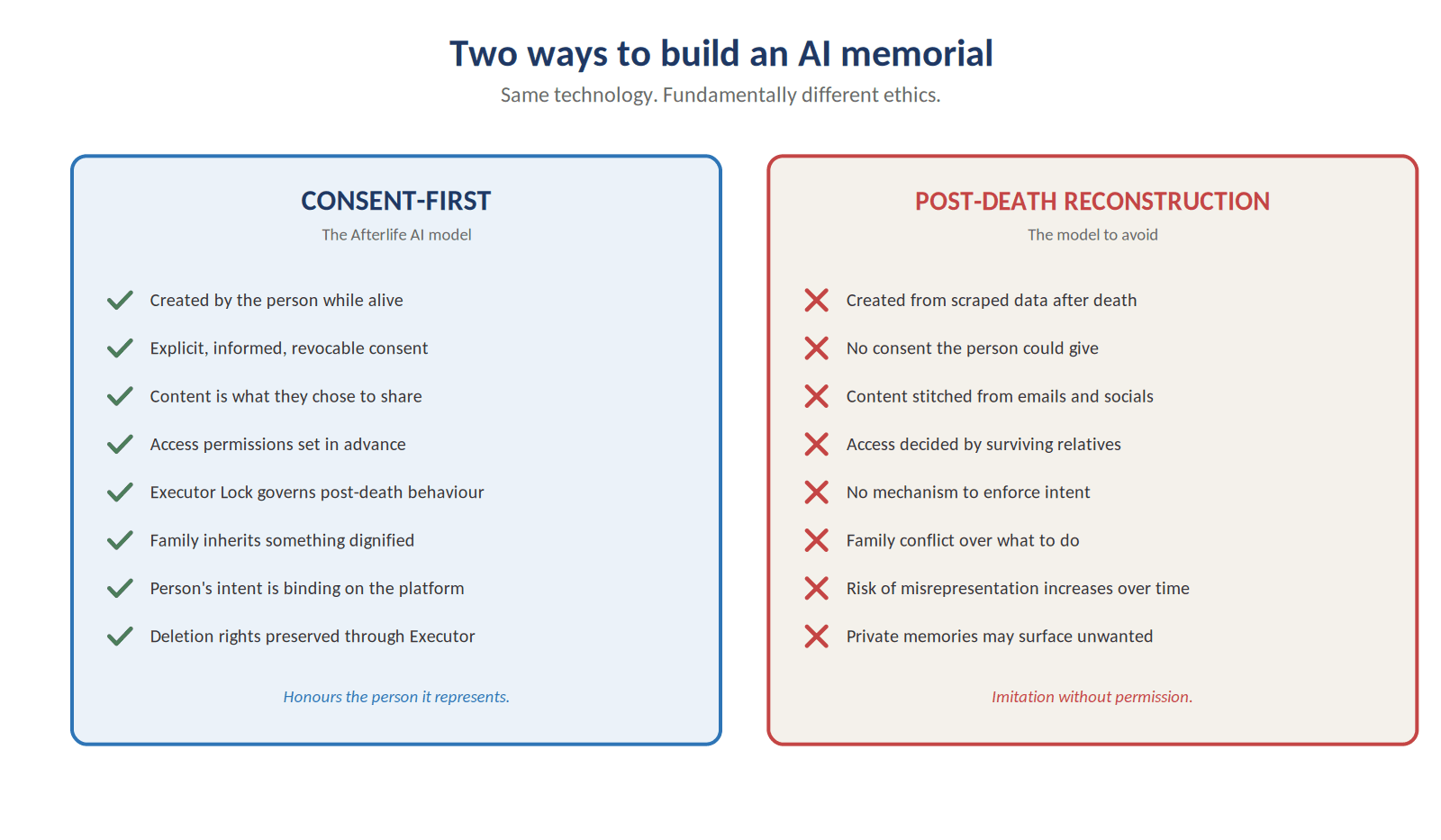
Afterlife AI™'s answer to these questions is built into the design. Personas are created by the person themselves, while alive. Each piece of preserved content is contributed with explicit consent. Access permissions are configured in advance. The Persona's behaviour after death is governed by Executor Lock™ according to the rules the person set themselves.
This is different from recreating someone after death from their old emails, social media posts and voicemail recordings. The same technology used differently produces fundamentally different ethical outcomes.
. The distinction has been made in academic and press coverage repeatedly through 2025 and 2026. James Muldoon (Associate Professor in Management, University of Essex) examined the bereavement-driven reconstruction model in The Conversation in January 2026. Researchers at King's College London (Eva Nieto McAvoy) and Cardiff University tested commercial reconstruction services and identified what they called synthetic intimacy: flat scripted replies and cheerful emojis appearing alongside questions about death. Researchers at Google DeepMind and the University of Colorado Boulder (Morris and Brubaker) have separately written about what they call generative ghosts as the next stage of the category. This is different from recreating someone after death from their old emails
Memory should not be left to chance, and grief should not be left to algorithm.
How Afterlife AI™’s memorial model works
On Afterlife AI™, the memorial begins while the person is alive.
The person creates their own Persona, contributing memories, voice and stories on their own terms.
They configure who may access the Persona, both during their lifetime and after their death.
They define what the Persona is permitted to do, and what it is not.
They nominate one or more Executors with stewardship responsibilities.
They can update, revise or delete any of this at any time.
After the person dies, Executor Lock™ activates. The Persona transitions to read-only governance under the permissions set by the person themselves. Trusted Contacts can access the Persona within the rules established in advance. The memorial becomes accessible to the people it was made for, exactly the way the person intended.
How an AI memorial differs from a traditional memorial
Traditional memorials, gravestones, plaques, photo albums, memorial websites, are static. They preserve a fixed representation of the person, but they cannot respond. A grandchild visiting a gravestone can read the inscription, but cannot ask the grandparent a question. A child looking at a memorial website can see photos, but cannot hear the parent speak.
An AI memorial is different in one important way: it is interactive. The preserved content responds. Voice can be heard. Stories can be found in answer to specific questions. The memorial becomes navigable rather than fixed.
This is what makes the experience feel different from older memorials. It is closer to the experience of having access to the person, even though it is clearly not the person themselves.
How an AI memorial differs from an unauthorised AI imitation
There is a category of AI services that recreate deceased people without their permission. These services have been criticised for exploiting grief, exposing private data and misrepresenting the deceased. The ethical objections to them are significant.
An AI memorial built on Afterlife AI™ is the opposite. It exists because the person chose for it to exist. Its content is real, not generated. Its access is permission-based, not open. Its governance is consent-first, not improvised.
If you are evaluating any AI memorial service, the test is straightforward. Ask whether the person it represents consented to what is being preserved. If the answer is no, or unclear, the service is doing something other than memorial work, whatever it calls itself.
Who creates an AI memorial for themselves
The people who build their own AI memorial on Afterlife AI™ usually share a perspective: they want their family's eventual remembrance of them to be something they had a hand in shaping.
They are not trying to control how they are remembered. They are trying to give their family something specific and dignified to remember. The difference matters. A controlling memorial would feel like vanity. A considered memorial feels like a gift.
Where to start
If creating a memorial feels like the right thing to do, the entry point is the same as any Afterlife AI™ Persona. A free account. One recorded memory. Time to build it out at your own pace. The memorial is not made by the platform. It is made by the person who chose to leave something specific behind.
The reconstruction trap
There is a particular pattern that emerges when a family discovers, in the aftermath of a death, that AI tools exist that can produce something resembling the deceased. The reasoning sounds reasonable in the first week of grief. There are recordings of the voice on old voicemails. There are years of text messages. There are social media posts going back a decade. Surely a model trained on this material could give the family something to talk to.
This is the reconstruction trap. The technology can in fact produce something. The ethical problem is that nothing the technology produces was actually approved by the person it imitates. The deceased never agreed to be reconstructed. They never consented to which of their messages would be used, what tone the model would adopt, what new sentences it would generate in their voice. The family is producing the persona, not the person.
What appears in the first weeks as comfort tends, in many cases, to curdle. The reconstruction makes mistakes the person would never have made. It says things the person would never have said. It produces a version of the dead that the family slowly realises is not the dead at all, but an averaged shadow generated from public data. By the time this becomes clear, families have often shared the reconstruction with others, embedded it in family chats, and become attached to its mistakes.
A consent-first Persona avoids this entire trap. The content is what the person chose to leave. The voice is recordings the person made themselves. The permissions are what the person set. The memorial honours the person rather than approximating them.
Common questions
Can I create an AI memorial for myself?
Yes. Creating it yourself is the clearest way to preserve consent and ensure the memorial reflects what you would have wanted.
Can I create an AI memorial for someone who has already died?
Afterlife AI™ is built around self-creation while alive. Memorials for people who have died are ethically complex and require the explicit consent of the person being represented. We do not support unauthorised recreation.
How is an AI memorial different from a memorial website?
Memorial websites are usually public tribute pages. An Afterlife AI™ memorial is a private, governed Persona accessible only to the people the person nominated, under the conditions they set.
Will my family be able to interact with the memorial after I am gone?
Yes. Trusted Contacts you nominate will have access according to the permissions you set, with the Persona transitioning to read-only governance through Executor Lock™.
Can the memorial be deleted?
Yes. You retain deletion rights during your lifetime. After Executor Lock™ activates, the Executor inherits the right to request deletion.