
Executor Lock™: The Governance Layer for Your AI Legacy
Creating an AI Persona is one part of digital legacy. The harder part is what happens next.
Who holds access when you no longer can? Who can unlock your legacy? What can your loved ones see, and what should remain private? Can the Persona be changed? Can it be deleted? Who decides?
These questions sound technical. They are actually moral. Without clear answers, families end up in conflict over a Persona the person who created it would have hated to see contested. With clear answers, families inherit something dignified, governed, and aligned with the wishes of the person it represents.
Executor Lock™ is Afterlife AI™'s answer to those questions. It is the mechanism that translates your pre-death decisions into post-death behaviour, automatically, and without leaving your family to guess.
What Executor Lock™ is
Executor Lock™ is a governance mechanism. It is not a feature toggle. It is the architectural backbone that makes consent-first digital legacy possible.
When you create an Afterlife AI™ Persona, you configure Executor Lock™ as part of setup. You nominate one or more Executors. You define what they can access. You decide what your Persona is permitted to do after the Lock activates. You set rules for deletion, retention, and transfer.
When the Lock activates, typically at death, your Persona transitions to read-only governance under the permissions you set. The Persona's behaviour is now bounded by your pre-configured rules. The Executor cannot change those rules arbitrarily. They can act within them. They can request deletion. They cannot rewrite your intent.
This is the difference between storage and stewardship. A storage account holds files. A stewardship system enforces a person's wishes across time.
Why Executor Lock™ exists
Most digital services are not built for what happens to the user after they die. Email accounts go dormant. Social profiles linger. Cloud storage continues being billed to an estate that may not know it exists. Passwords become impossible to recover. Decisions get made by whichever family member happens to be technically capable, often in disagreement with other family members who feel differently.
AI Personas raise these problems to a new level. The Persona contains voice. It contains memories. It can respond to questions. It can be interacted with. The stakes of getting governance wrong are higher because the thing being governed is more sensitive, more personal, more capable of being misused, and more emotionally loaded for the family who inherits it.
Without a governance mechanism designed specifically for AI legacy, the default outcomes are bad. Families fight over access. Personas drift from what the person would have wanted. Private memories surface in front of people who should not see them. The technology that was meant to preserve a person ends up creating conflict among the people who loved them.
Executor Lock™ exists to prevent those outcomes by making your wishes binding, in advance, on the platform that hosts your Persona.
What Executor Lock™ protects
Executor Lock™ is designed to protect six specific things, all of which matter to the integrity of a digital legacy.
Your consent. The Persona behaves only within the permissions you set.
Your memories. Content you chose to preserve is preserved; content you chose to keep private remains private.
Your voice. Voice recordings are governed by your access rules, not your family's improvisation.
Your nominated contacts. Only the people you trusted access the Persona, under the conditions you specified.
Your deletion rights. Deletion authority is preserved through the Executor according to rules you set.
Your family. Most importantly, Executor Lock™ protects the people you love from having to make impossible decisions in the worst weeks of their lives.
How Executor Lock™ works
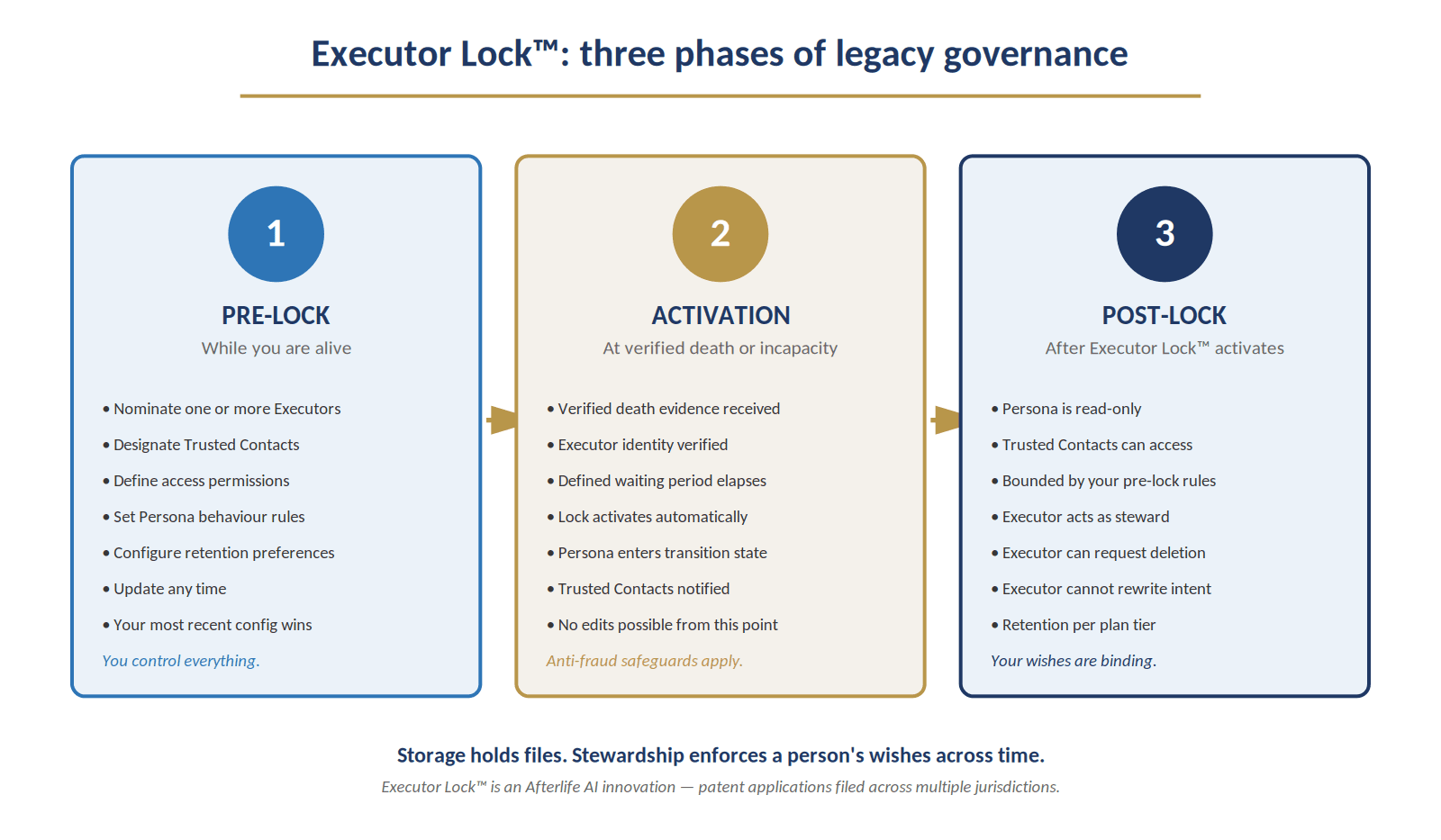
The mechanism operates in three phases.
Phase 1: Pre-lock configuration
While you are alive and using Afterlife AI™, you set the rules. You nominate Executors. You designate Trusted Contacts. You define what each can access. You specify what the Persona is permitted to do after the Lock activates. You can update any of this at any time. Your most recent configuration is the one that will be honoured.
Phase 2: Lock activation
The Lock activates on a defined trigger: verified death. The activation process involves identity verification of the Executor and a defined waiting period to prevent fraudulent triggering. Once activated, the Persona transitions to its post-lock state.
Phase 3: Post-lock governance
After the Lock activates, the Persona is in read-only governance. It can continue responding to questions from authorised users, within the limits you set. The Executor cannot edit your memories, change your permissions arbitrarily, or alter the Persona's core behaviour. They can request deletion of the Persona on behalf of the legacy, in accordance with the policy you agreed to.
This is the critical design choice. The Executor is a steward, not an owner. The Persona belongs to the person it represents, even after that person is gone.
Consider the practical sequence of events that Executor Lock™ is designed to govern. A creator has spent several years building a Persona. They have nominated an Executor. They have designated three Trusted Contacts and specified what each may access. They have left explicit instructions that one particular set of memories is to be sealed for ten years before the youngest grandchild may view them, and that another set is never to be displayed publicly.
The creator dies. The Executor obtains the documentation required to initiate activation. This documentation is not a casual request through the app; it is verifiable evidence sufficient to satisfy the platform's anti-fraud requirements, and it is checked against signals from independent sources where possible.
A defined waiting period elapses. During this period, the Persona remains in its pre-lock state. The waiting period exists precisely to prevent fraudulent activations, hasty decisions in the immediate aftermath of a death, and disputes among surviving family members that have not yet been resolved. Where appropriate, surviving Trusted Contacts may be notified during this window so that any objection or counter-evidence can be raised.
When the waiting period elapses without successful challenge, the lock activates. The Persona enters its read-only post-lock state. The creator can no longer edit it. The Executor cannot rewrite its content. The Trusted Contacts may now access it according to the permissions the creator set in advance. The memories that were marked for delayed release remain sealed until their release dates. The materials marked private remain private. The wishes the creator documented while alive are now enforced by the platform itself.
This is the mechanism. It is deliberately bureaucratic. The bureaucracy is the point. A digital legacy without process is just storage with optimism attached. Executor Lock™ replaces optimism with enforceable rules and a platform commitment to those rules.
Start your Persona today. A Persona built on who you are. Your stories, your wishes, your values, your likeness, your voice. Create your account free.
Who should be your Executor
Choosing an Executor is one of the most important decisions you will make on the platform. The right person is not always obvious.
They should be trustworthy enough to honour your wishes even when they are inconvenient.
They should be calm enough to act sensibly during a grief period.
They should be technologically capable enough to use the platform without difficulty.
They should be someone who will outlive you, which usually means younger or in good health.
They should not be someone whose interests conflict with your other family members.
They should know you well enough to interpret edge cases consistent with what you would have wanted.
Many people nominate a partner. Some nominate an adult child. Some nominate a sibling or close friend. The right choice depends on your circumstances. The wrong choice creates problems later. Choose carefully, and remember the designation is never final while you are alive: you can reassign the role at any time in your settings, with the incoming Executor accepting the Executor Lock™ Agreement before it takes effect.
How Executor Lock™ differs from other approaches
Other digital legacy services use various ad-hoc approaches to posthumous access. Some rely on the family inheriting login credentials. Some use static access lists. Some have no real mechanism at all and trust that families will work it out.
Executor Lock™ is a different kind of mechanism. It is a designed governance system with defined phases, identity verification, configurable permissions, and a clear separation between ownership (the person who created the Persona) and stewardship (the Executor).
This matters because legacy is a multi-decade timeframe. Ad-hoc approaches that work for the first six months may not work for the first ten years. A designed mechanism is built to outlast informal arrangements.
Note on Executor Lock™: *Executor Lock™ is an Afterlife AI™ innovation, currently the subject of patent applications across multiple jurisdictions. The combination of consent-first design, posthumous governance, identity-verified activation and read-only state transition is, to our knowledge, the most defined governance mechanism currently available in the digital legacy category.*
Where to start
If you have already created an Afterlife AI™ Persona, your Executor Lock™ configuration is in your account settings. Spend ten minutes reviewing it. If you have not yet created a Persona, Executor Lock™ is part of the setup process. The earlier you configure it, the more your eventual legacy reflects your actual intent.
Most people put this off because it feels morbid. It is not morbid. It is the opposite. Configuring Executor Lock™ is one of the most thoughtful things you can do for the people you love. It removes a decision they would otherwise have to make in your absence. It tells them, clearly, what you wanted. It protects them from having to guess.
Why governance matters more than storage
Most digital legacy products solve the easy half of the problem. They keep files. Files are cheap to store and easy to retrieve. The difficult half is governance: who decides, when they decide, on what evidence, against what objections, with what enforcement.
Governance is what families actually fail at. The grandmother whose adult children disagree about whether to take down her Facebook. The father whose ex-wife wants to delete certain photographs that the children want to keep. The brother who wants to access voice recordings that the deceased explicitly said were only for the spouse. The estate that gets stuck in dispute for years because nobody can produce evidence of what the deceased actually wanted.
Executor Lock™ is designed to make governance the default. Your wishes are documented while you are alive, in a format that the platform can enforce after you are gone, against the objections of people who may disagree. This is not an aesthetic feature. It is the difference between a legacy that survives intact and a legacy that gets edited down by whoever shows up first.
Note: this page describes Afterlife AI™'s intended Executor Lock™ framework. Specific retention periods, fraud-protection windows, and dispute-resolution mechanisms are set out in the current product Terms of Service and Executor Lock™ Agreement, which should be consulted for the operative wording.
Frequently asked questions
What is Executor Lock™?
Executor Lock™ is Afterlife AI™'s governance mechanism for managing your Persona after death. It transitions your Persona to read-only governance under permissions you set in advance, with your nominated Executor as steward.
Who can I choose as my Executor?
Anyone you trust to respect your wishes. Most users nominate a partner, adult child, sibling or close friend. You can change your designated Executor at any time while you are alive; the incoming Executor accepts the Executor Lock™ Agreement before the role takes effect.
Can my Executor change my Persona after I die?
No. After Executor Lock™ activates, your Persona transitions to read-only governance. The Executor can act within the permissions you configured, but cannot rewrite your wishes.
How does Executor Lock™ activate?
Activation requires verified evidence of death, plus identity verification of the nominated Executor, plus a defined waiting period to prevent fraudulent triggering.
Can I update my Executor Lock™ configuration?
Yes, at any time while you are alive. Your most recent configuration is the one that will be honoured at activation.
What happens if my Executor dies before me?
You designate a replacement in your settings at any time before activation, and the incoming Executor accepts the Executor Lock™ Agreement before the role takes effect. There is no automatic succession: the role can never pass to someone you did not designate. The platform's periodic reviews exist to keep the designation current, and if the role is vacant when it is needed, reassignment runs through identity verification and Trust and Safety approval.
Is Executor Lock™ legally binding?
Executor Lock™ governs your Persona on the Afterlife AI™ platform. It is a platform mechanism, not a legal instrument. For matters that intersect with your will, estate or other legal arrangements, you should consult appropriate legal advice.