
A Digital Legacy Platform Built for Long-Term Trust
Digital legacy is not a storage problem. It is a governance problem.
Who can access your memories? Who decides what your Persona can do? When does posthumous access begin? What permissions apply, and who enforces them? What happens in ten years, when the family members who first inherited the Persona are themselves older, or gone? How is the integrity of the Persona maintained across decades?
A digital legacy platform should answer these questions before they become burdens for the people you love. Afterlife AI™ is built specifically to answer them, not as a feature, but as the architecture the whole platform rests on.
, and the standard for answering them was raised in 2026. Wellett Potter (Senior Lecturer in Law, University of New England) published a legal analysis in The Conversation in February 2026 syndicated across more than ten outlets including the University of New England, Phys.org, inkl and Hypergrid Business. Potter argued that the use of an AI digital twin service is the deliberate, contractual creation of AI-generated data for posthumous use, with the contract between the creator and the platform as the locus of the consent question. A digital legacy platform that does not answer this contractual question explicitly is not yet a complete platform.
What a digital legacy platform should do
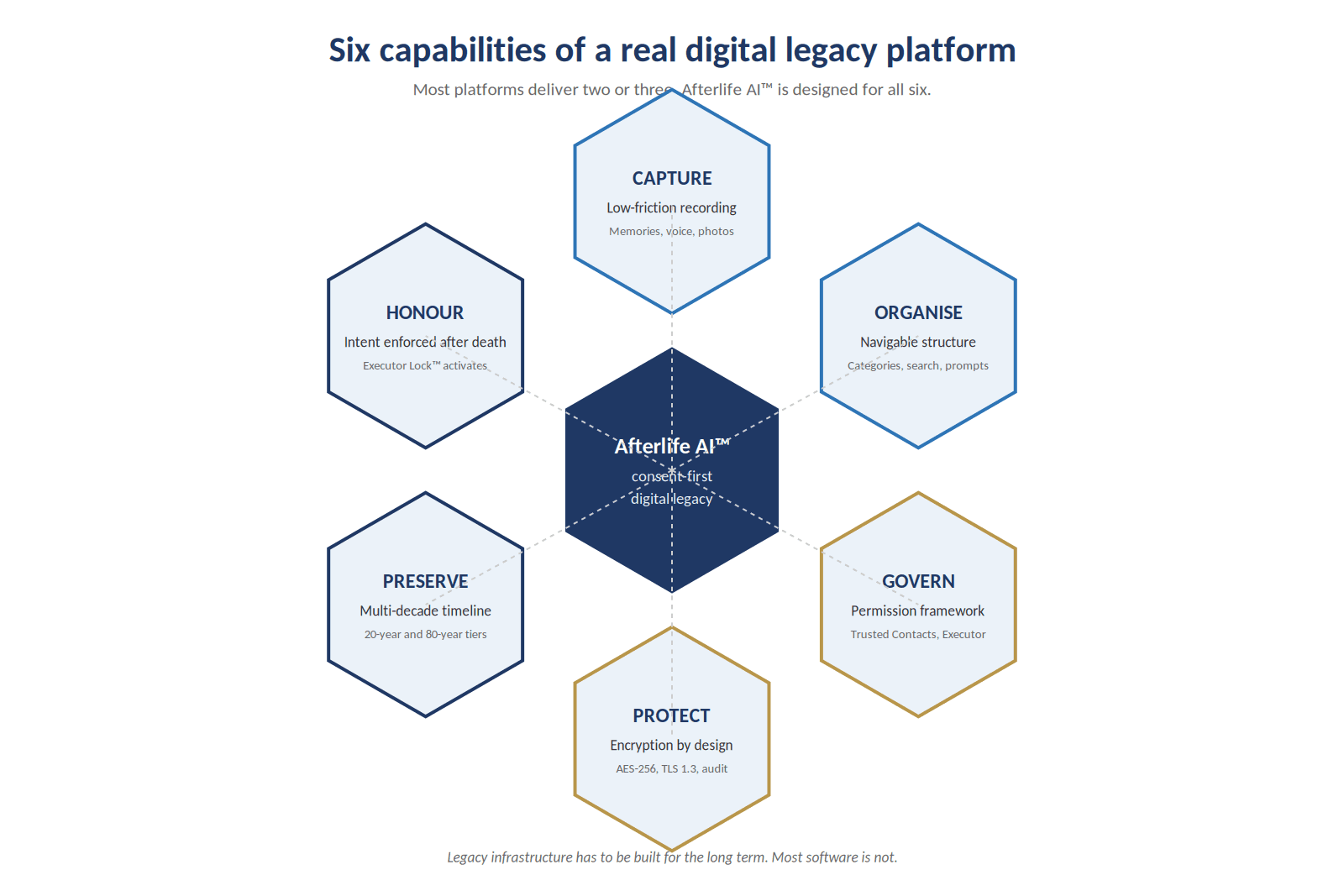
A meaningful digital legacy platform should deliver six capabilities.
Capture: enable users to record memories, voice and stories with low friction.
Organise: structure the captured content in ways that families can navigate, decades later.
Govern: define who can access what, under which conditions, with mechanisms that hold across time.
Protect: encrypt data at rest and in transit, with auditable access controls.
Preserve: maintain the integrity of the legacy across multi-decade timeframes.
Honour intent: ensure the user's wishes, configured while alive, are enforced after the user is gone.
Most digital legacy services deliver two or three of these. Afterlife AI™ is designed for all six.
Built for consent
The foundation of Afterlife AI™'s design is consent-first processing of personal data. The privacy policy is explicit: personal and special-category data, including voice recordings, photographs and emotional metadata, is processed on the basis of explicit, informed and revocable consent.
This means that nothing happens to your data without you having agreed to it. You opt in to specific types of processing. You can revoke consent at any time. Your data is not used to train AI models unless you separately and explicitly permit it. It is not sold, rented or licensed. It is not used for advertising. It is yours.
Consent is not buried in terms and conditions. It is the operating principle of the platform.
Built for governance
Executor Lock™ is the mechanism that makes long-term governance possible. It is not a single feature. It is the architectural backbone that ties your pre-death decisions to your post-death behaviour.
You configure Executor Lock™ during onboarding and refine it over time. You nominate one or more Executors. You set permissions for what your Persona can and cannot do after the Lock activates. You define access rules, deletion preferences and Trusted Contact boundaries.
When the Lock activates, following verified death, your Persona transitions to read-only governance under the permissions you set. Your Executor becomes the steward, not the owner. The Persona's behaviour is bounded by your intent. The family inherits clarity rather than questions.
Built for security
Security on a digital legacy platform matters more than on most services because the data being protected is more personal than most services hold.
AES-256 encryption at rest.
TLS 1.3 in transit.
Role-based access controls limiting who can see what within the organisation.
Multi-factor authentication for administrative access.
Audit logging of significant actions.
Defined deletion rights, exercisable by the user during life and by the Executor after death.
These are not premium features. They are the baseline. A digital legacy platform that handles voice, photos and personal memory has to operate at a higher security standard than ordinary storage.
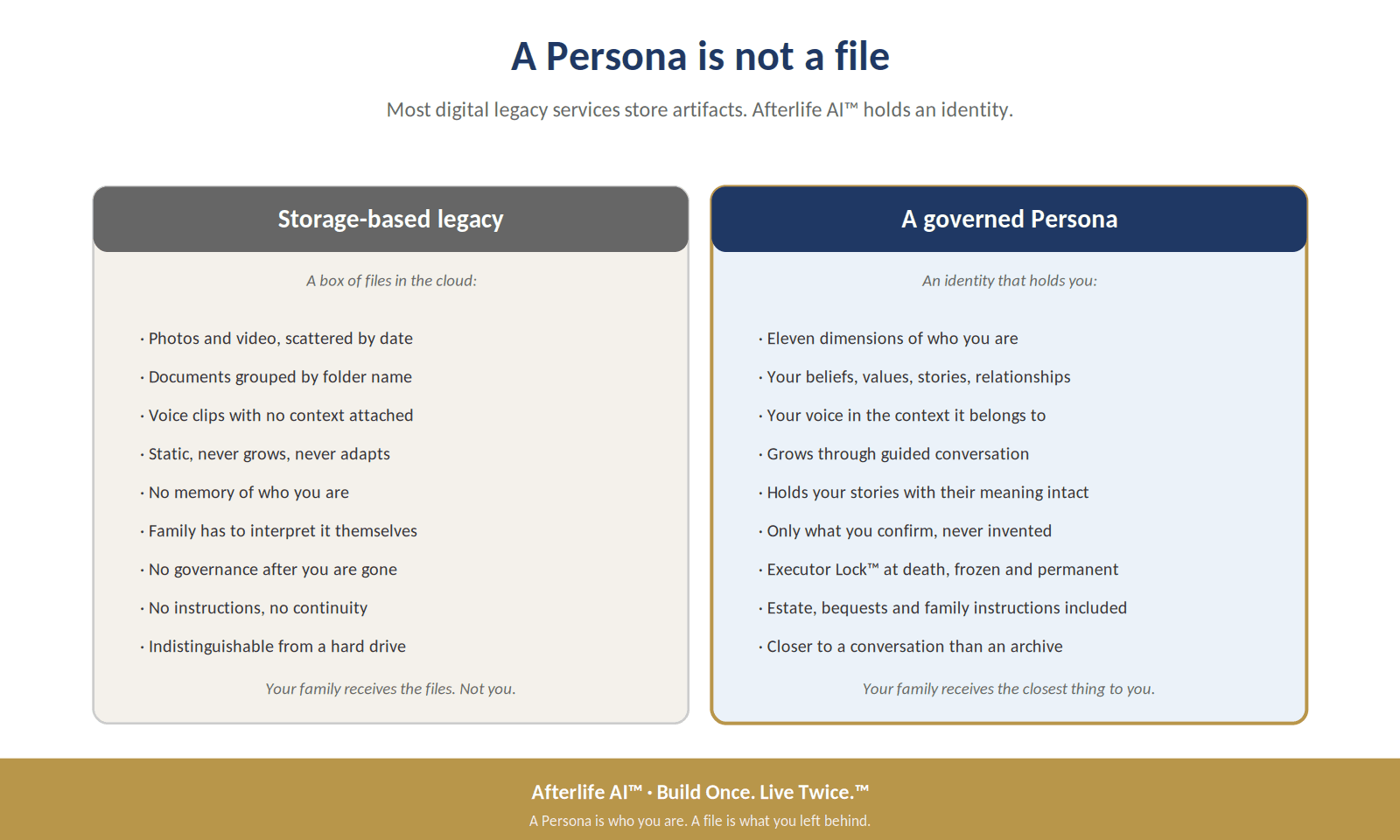
A Persona is who you are. A file is what you left behind.
Built for the long term
Most software is designed for the next quarter. A digital legacy platform has to be designed for the next quarter-century.
This affects how Afterlife AI™ thinks about pricing, infrastructure, contracts and partnerships. The long-term prepaid tiers (20-Year, 80-Year) are not promotional. They are commitments to specific time horizons, backed by infrastructure investment, storage planning and governance commitments that match the timeframe.
It also affects how we think about data portability and platform continuity. Users should be able to export their data. The platform's policies are designed to outlast individual product versions, individual team members, even individual corporate structures. Legacy is for the long term, and legacy infrastructure has to be planned that way.
Start your Persona today. A Persona built on who you are. Your stories, your wishes, your values, your likeness, your voice. Create your account free.
Built for families
Families inherit digital legacies in the worst weeks of their lives. The platform they encounter for the first time, often in grief, should be designed to be navigable, comprehensible and humane.
Afterlife AI™'s posthumous experience is designed for this. When Executor Lock™ activates, the Executor receives clear guidance on what to do next. The Trusted Contacts who can access the Persona receive dignified communications, not commercial pressure. The interface they meet is designed for grief, not for conversion.
How Afterlife AI™ compares
Other digital legacy services in the market take different approaches. Some focus on collecting family stories into hardcover books. Some build conversational video memorials. Some operate as memorial websites with public tribute pages. Some are essentially generic cloud storage with a legacy-themed wrapper.
Afterlife AI™ is different in three ways.
It is built around a governed AI Persona, not a static archive.
It uses Executor Lock™ to enforce posthumous governance with mechanisms designed specifically for that purpose.
It is consent-first by design, with privacy and security commitments that exceed what most adjacent services offer.
There are five practical questions that distinguish a serious digital legacy platform from a storage product wearing legacy branding. Does the platform have an explicit governance mechanism that enforces user wishes after death, against the wishes of survivors if necessary? Does the platform have a documented retention policy that aligns with the timeline of the user's intent, not the timeline of a typical software product? Is the commercial model aligned with the user (subscription paid by the creator, not advertising paid by data resellers)? Does the platform treat consent as a first-class concept, with explicit, informed, and revocable permissions throughout? Is the architecture built for multi-decade timelines, with concrete commitments rather than aspirational language?
Afterlife AI™ is designed to answer yes to all five. The Executor Lock™ governance mechanism. Tier-aligned access through the long-term plan, eighty years from purchase. Subscription paid by the creator with family access included. Consent-first design backed by an explicit privacy policy. Architecture and storage commitments built for the timeline the product describes. These are the structural reasons that the platform exists as something other than another file-storage product.
Who uses Afterlife AI™
The platform's users tend to share specific motivations.
Individuals planning their own digital legacy in middle and later life.
Families with members living with terminal or chronic illness, planning the legacy together.
Parents wanting to leave something specific for children still young.
Grandparents wanting their grandchildren to know them as people, not just photographs.
Founders, creators and professionals who want their work and perspective preserved in their own words.
People who have lost someone and want to ensure their own family does not face the same gap.
Where to start
Begin with a free account. Build a small Persona over a few weeks. See whether the experience matches what you would want for the long term. The free tier is genuinely useful. Paid tiers are for users who decide the platform is worth committing to for the legacy they are building.
Platform versus product: why it matters
Most consumer software is built as a product. A product is something a user buys, uses for a period of months or years, and eventually stops using when something better arrives or when their needs change. The economics, the architecture, and the customer support model are all calibrated for a relatively short relationship with each user.
A digital legacy platform cannot operate this way. The relationship is generational. The user creates content while they are alive. The platform holds that content for decades. The next generation accesses it. The generation after that may access it. The infrastructure must outlive the original user, and the institutional commitment must outlive the original founders.
This places unusual demands on architecture. Storage durability targets must be set at a different order of magnitude. Encryption must remain reasonable thirty years from now, not three. Access control must survive multiple changes of leadership at the platform and in the user's own family. The platform must be solvent and operational long after the person who created the original Persona has been forgotten by everyone except the descendants who inherit it.
These are not currently standard product-management concerns in consumer software. They are closer to the concerns of pension funds and trust companies than of typical SaaS businesses. A digital legacy platform that does not take these concerns seriously is not a legacy platform. It is a storage product with marketing.
Frequently asked questions
What is a digital legacy platform?
A platform that helps you preserve memories, voice, photos, stories and access permissions across time, with governance designed for use after the creator's death.
Why does governance matter?
Because a digital legacy can last for decades. Without a designed governance mechanism, families face uncertainty over access, deletion, privacy and authority. With one, they inherit clarity.
How is Afterlife AI™ different from cloud storage?
Cloud storage keeps files. Afterlife AI™ helps you build a governed AI Persona and ensures posthumous behaviour matches the wishes you set in advance.
What about long-term reliability?
Long-term prepaid tiers are backed by infrastructure commitments matched to the chosen duration. Standard service-level commitments apply to all tiers. Data is portable and exportable.
Can I export my data?
Yes. You have data portability rights at any time during your life. Your Executor inherits relevant export rights after Executor Lock™ activates.
See also: our digital legacy app.