Your Digital Afterlife Should Belong to You
Your digital afterlife is everything that remains of you in digital form. Photographs. Videos. Voice notes. Cloud folders. Messages. Social accounts. Subscriptions. Old emails. The drafts you never sent. And, increasingly, AI Personas built from the information people choose to preserve.
Most people leave a digital afterlife by accident. Files accumulate across services. Passwords get forgotten. Accounts become unreachable. Memories sit in folders nobody knows how to navigate. Your family ends up with fragments rather than a story.
Afterlife AI™ helps you build a digital afterlife on purpose. A Persona that preserves what matters. Memories that are findable. Voice that is hearable. Stories that are organised. Access that is governed by your choices, not by luck or guesswork.
What a digital afterlife actually includes
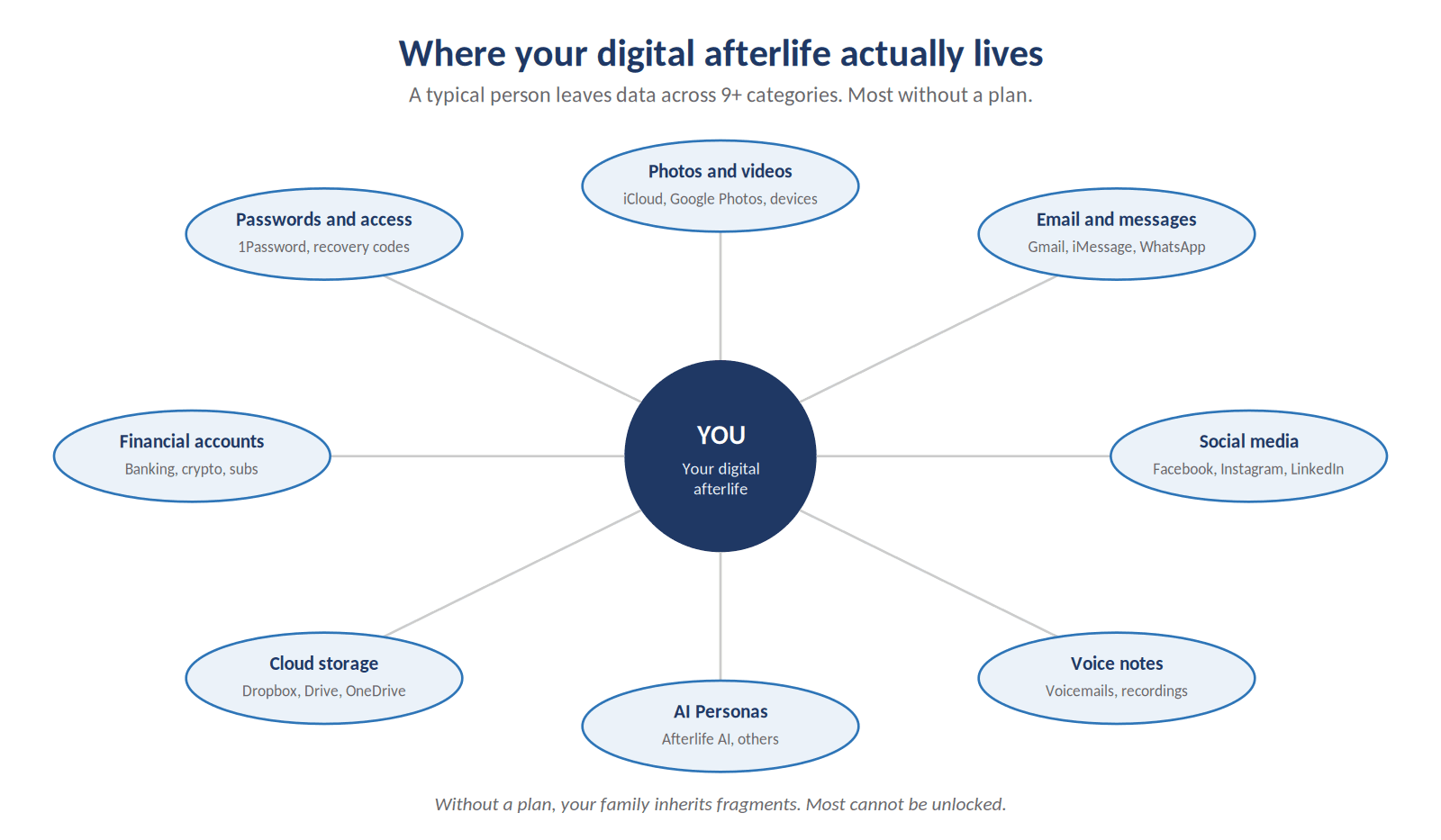
Your digital afterlife is broader than most people realise. It is not just what is on your phone.
Photographs spread across devices, cloud services, social media and old hard drives.
Videos, including phone recordings, video messages and family events captured over decades.
Voice notes, voicemails and audio messages you may not have realised you kept.
Messages, texts, chat histories and emails containing real conversations with the people in your life.
Cloud accounts holding documents, drafts, journals and personal files.
Social media accounts, public and private, containing posts, photos and exchanges.
Subscriptions, financial accounts, payment methods and recurring services.
Passwords, two-factor codes and access mechanisms your family may need.
Personal AI services, including any Personas, chatbots or AI tools you have set up.
Most of this exists. Most of it is unorganised. Most of it your family will struggle to access if you are not there to help them.
Why digital afterlife planning matters
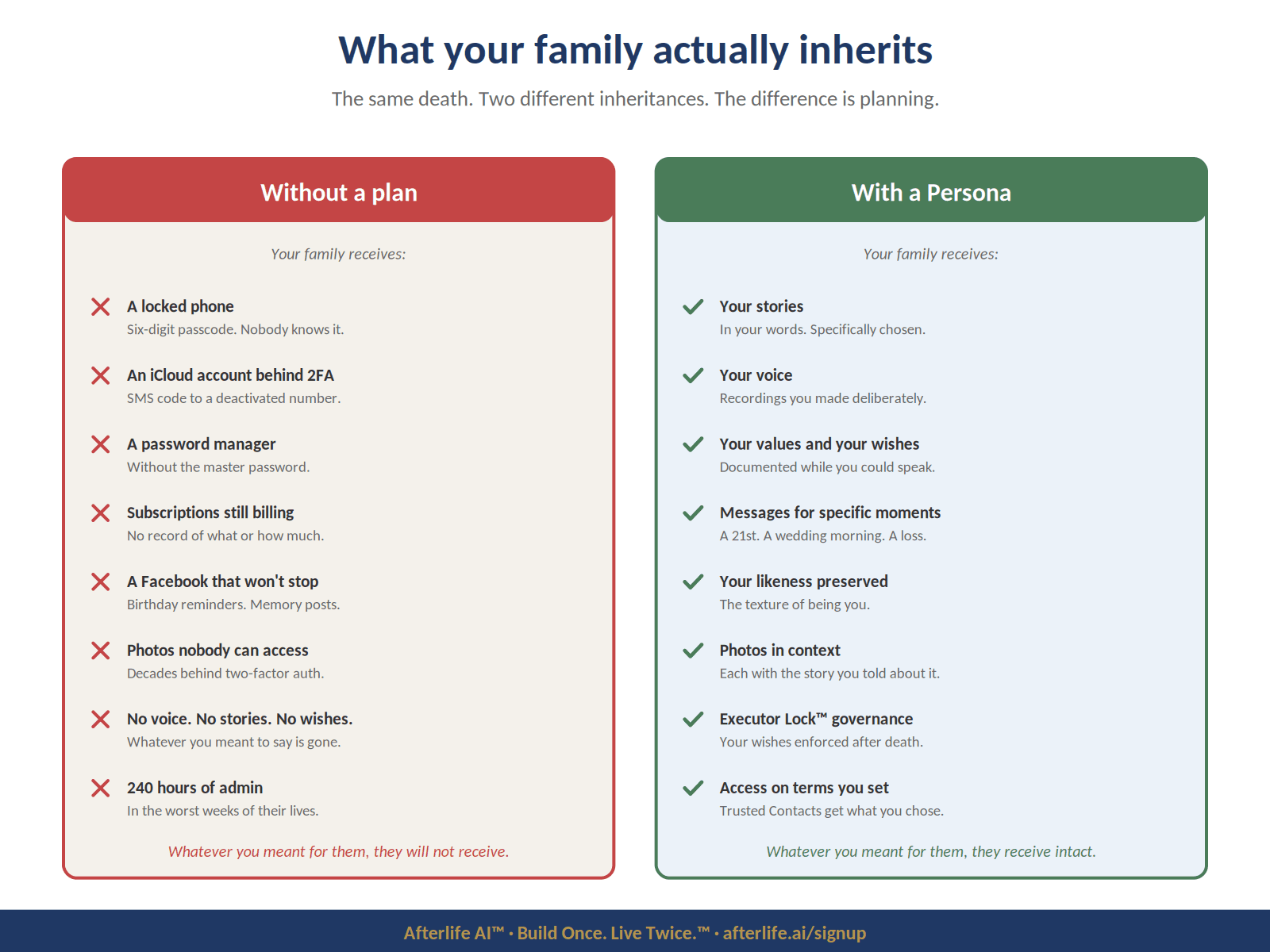
Without a plan, your family inherits scattered fragments. They may have access to your photos but no way to access your phone. They may have your email but no way to recover your subscriptions. They may have voice notes but no way to understand what was happening when you recorded them.
With a plan, your family inherits something coherent. Memories with context. Voice recordings tied to stories. Account instructions tied to passwords. AI Personas governed by permissions you set in advance.
Digital afterlife planning is not about making your death easier for yourself. It is about making your absence easier for the people who outlive you. The difference between a family spending six months trying to access your old email accounts and a family inheriting a clean, organised, accessible legacy is the difference between confusion and care.
Consider a concrete scenario. A 67-year-old man has a heart attack on a Tuesday afternoon. He dies that evening. His wife, who is 65, is now in charge of an estate that includes their physical assets and approximately fourteen years of accumulated digital life. She knows his email password because they have always shared it. She does not know the passcode to his iPhone, the recovery codes for his crypto wallet, the access details for the bank account that pays the mortgage, the location of the will that he scanned and stored in a cloud folder, or whether he wanted his Facebook account taken down or memorialised.
Over the next eighteen months she will spend approximately 240 hours dealing with digital estate matters that her husband could have resolved in a single afternoon while he was alive. Some of those matters she will never resolve. The photographs on his phone of the trip to Croatia, the only trip they took without the children, are gone because the phone is locked and the iCloud backup requires two-factor authentication to a number that was disconnected when his mobile plan was terminated.
This is not an unusual scenario. It is the modal scenario. Estate professionals report that digital asset management has become the most time-consuming and emotionally difficult part of estate administration over the past five years, and the trend is accelerating as the proportion of life lived through digital systems continues to rise.
A box of files in the cloud is not an heir. A governed Persona is.
The cost is not only practical. There is a particular kind of grief that comes from knowing that something specific is gone forever because nobody planned for the technology to outlive the person. The wedding video that was on a hard drive that was thrown out because nobody knew what was on it. The voice messages on the phone that was wiped before anyone realised they were the only voice recordings of a parent that existed. These losses are preventable. Most are prevented by an hour of planning. None are prevented by hope.
The questions your family will ask
When someone dies, their family is suddenly trying to make decisions about a digital presence they may never have thought about. The questions are predictable.
What accounts did they have, and where?
How do we access their phone?
What should we do with their social media?
Where are the photos kept?
Did they leave any messages for us?
What did they want done with all of this?
Who has authority to make these decisions?
A digital afterlife plan answers these questions before they get asked. It tells your family which accounts matter, which can be closed, which memories you wanted preserved, and who you trusted to make decisions on your behalf.
Where AI fits in
AI Personas are the newest layer of digital afterlife planning. They are also the most powerful, and the most personal.
Unlike photos or files, an AI Persona is interactive. Your loved ones can ask it questions. They can hear your voice. They can find the answer to a question that mattered to them in your own words. That changes the texture of remembering. A photograph shows what you looked like. A Persona helps preserve who you were.
But AI also changes the stakes of digital afterlife planning. A Persona contains more sensitive data than a photo album. It contains voice. It contains personality. It contains memories the person may have intended only for specific people. The governance of that Persona, in life and after death, has to be more deliberate than the governance of a photo library.
This is why Afterlife AI™ built the Persona experience around consent-first design, with Executor Lock™ as the mechanism that translates the user's pre-death wishes into post-death behaviour. The Persona's existence is meaningful. The Persona's governance has to be at least as careful as its creation.
Start your Persona today. A Persona built on who you are. Your stories, your wishes, your values, your likeness, your voice. Create your account free.
What to include in your digital afterlife plan
If you are ready to start planning, the structure is straightforward.
Life stories. The memories only you know, recorded in your own voice.
Family history. Where you came from, who shaped you, what should travel forward.
Values and principles. The way you saw the world and what you would want your grandchildren to carry.
Messages for specific people. Things you want a particular person to hear, on a particular day, in your own words.
Account instructions. What you have, where it is, and what you want done with each thing.
Trusted contacts. Who you nominate to access what, with what permissions.
Executor preferences. Who has authority to make decisions on your behalf when you cannot.
Deletion preferences. What you want removed, immediately or eventually.
AI Persona governance. If you have built a Persona, what happens to it, who controls access, and how long it should be preserved.
Where to start
Begin with a small audit. Open a note on your phone and list the accounts that contain anything meaningful: photos, emails, voice notes, social profiles. You do not need passwords yet. Just the list.
Then ask yourself, for each one: if I were not here next week, would my family know this existed and what to do with it?
The gap between that list and your family's likely answer is the size of the digital afterlife planning you have ahead of you. Most people are surprised by how big the gap is. The good news is that closing it does not require a single weekend of paperwork. It requires beginning, then adding pieces over time.
What a digital afterlife plan actually contains
A digital afterlife plan, properly constructed, is not a single document. It is a small set of decisions documented in a place your family can find. The decisions sit in five categories.
Access. Who can get into your devices, accounts, and storage if you are not available to unlock them. This typically involves a password manager, a designated executor, and clear instructions about what to access and what to leave alone.
Authority. Who has the right to make decisions about your digital presence. For some accounts this is determined by platform policy. For most, it is determined by what you have documented and who is named in your estate plan.
Preservation. What you want kept and in what form. Photographs and videos. Voice recordings. Written communication. A Persona, if you have created one. The instructions for who should inherit these materials and on what terms.
Removal. What you want deleted. Browsing history, certain emails, particular accounts, specific files. Be specific. Default settings on most platforms preserve too much; consent-first digital legacy preserves only what you chose.
Stewardship. Who will enforce your decisions across time. This is where Executor Lock™ matters. A wish written down is only as durable as the person enforcing it. A wish enforced by a platform that survives you is durable on a different scale.
Frequently asked questions
Is digital afterlife planning the same as estate planning?
No. Estate planning typically focuses on physical and financial assets, governed by your will. Digital afterlife planning focuses on memories, data, online presence, AI Personas and access permissions. The two complement each other but cover different ground.
Do I need a lawyer to plan my digital afterlife?
Not necessarily. The memory and Persona side of your digital afterlife can be planned directly through Afterlife AI™. The legal side, especially anything involving financial accounts or estate matters, may benefit from professional advice.
Can I decide what happens to my AI Persona after death?
Yes. Afterlife AI™'s Executor Lock™ mechanism lets you configure permissions in advance, so your Persona transitions to read-only governance under rules you set yourself.
What if I want my data deleted after I die?
Deletion preferences are part of your digital afterlife plan. You can record what should be deleted, what should be kept, and who has authority to act on those preferences. On the platform itself, deletion is unconditional while you are alive, and passes to your Executor under the Executor Lock™ Agreement after.
How long should a digital afterlife last?
There is no single answer. Some families want a brief window where digital memories are accessible during the grieving period. Others want a multi-generational legacy that descendants can access decades later. Afterlife AI™ offers plans that match both.