
HereAfter AI is shutting down: what happened, and how to save what you recorded
HereAfter AI's website has been offline since August 18, 2026, and the only retrieval route the company named is an email to its support team. This guide gives you the dated record, the steps to get your family's recordings back, and the questions to ask before you trust anyone with a voice again.
HereAfter AI is shutting down. The company posted a farewell notice in July 2026, its website has been offline since August 18, 2026, and the only retrieval route it offered is an email to support@hereafter.ai. Send that request today from the address on your account, then save every file you receive in three places.
HereAfter AI status | What we found | Checked |
|---|---|---|
Main website, hereafter.ai | Returns an HTTP 404 error | September 30 and October 1, 2026 |
Web app, app.hereafter.ai | Still loads the HereAfter web app | October 1, 2026 |
Retrieval route | An email to support@hereafter.ai, the only channel the farewell notice named | Notice recorded July 18, 2026 |
Deadline to request recordings | None announced | July 18 to October 1, 2026 |
Self-serve export | None offered in the notice; full MP3 downloads came only with the Unlimited plan while the app was sold | July 18, 2026 |
Status on the Killed by AI tracker | Listed as a wind-down, with the website inaccessible from August 18, 2026 (Killed by AI) | October 2, 2026 |
James Vlahos recorded 91,970 words of his dying father's life story and turned the transcript into a chatbot that answered his family's questions in his father's words. Wired published the story of that "Dadbot" on July 18, 2017 (Wired), and the project grew into HereAfter AI, one of the best-known "talk to Dad again" products in the world. For years, when the press wrote about preserving a parent's voice, HereAfter was the app they named. In 2026 the company wound down, and the families who trusted it with their parents' voices now have to ask, one email at a time, for files they assumed would always be there.
HereAfter's ending did not come from a lack of demand. Families kept recording and kept paying, and the recordings in those accounts are among the most valuable files those families own. What HereAfter never published was a plan for its own ending, with a deadline, a download path on every plan and a named person in charge of each account after its owner died. That missing plan is the lesson of this page, and it is the reason Afterlife.ai™ wrote the ending of every Persona into the contract before building anything else.
By Chris Williams, founder of Idy®, the company behind Afterlife.ai™. First published July 18, 2026. Updated October 2, 2026.
Your parent is still here to tell the stories.
Start again with the ending written first.
Build your Persona free, no cardDefinitions
HereAfter AI: a life-story interview app, grown from James Vlahos's 2017 Dadbot, that saved each answer as a real audio recording so family members could later ask questions and hear the storyteller reply.
Persona: the AI version of you that you build on Afterlife.ai™ while you are alive, from your own memories, values and cloned voice, which answers your family in your words.
Executor Lock™: Idy's patent-pending system of named executors, Trusted Contacts, a verified death report and a sealed snapshot of your Persona that can never be changed.
Digital executor: the person you name to carry out your wishes for your accounts, files and AI likeness after you die.
Is HereAfter AI still working?
No, HereAfter AI is not working as a product, and families should treat the service as closed. The main website, hereafter.ai, returned an HTTP 404 error on our checks on September 30 and October 1, 2026, after a farewell notice replaced the homepage in July 2026. The separate web app address, app.hereafter.ai, still loaded the HereAfter web app when we checked on October 1, 2026, so it is worth one attempt to sign in before anything else. The company has never announced a deadline, and that silence is the strongest reason to act this week.
The public tracker Killed by AI lists HereAfter AI as a wind-down and records that the website itself became inaccessible on August 18, 2026 (Killed by AI). The same entry says the founder left the company in January 2024 and that the app was last updated in September 2023. None of that changes what a family should do next, which is to request every file now and keep asking until the files arrive. For the full dated record, read the dated HereAfter AI timeline.
What happened to HereAfter AI?
HereAfter AI grew out of one of the most human projects in modern software, a son recording his father's stories, jokes and songs while his father was alive, then building a way for the family to hear them again by asking questions. An interviewer guided each storyteller through their life chapter by chapter, and every answer was stored as real recorded audio. When a granddaughter later asked about a wedding day, what played was her grandfather, in his own breath and timing, telling the story he chose to tell. That design is exactly why the files sitting in those accounts are worth rescuing now.
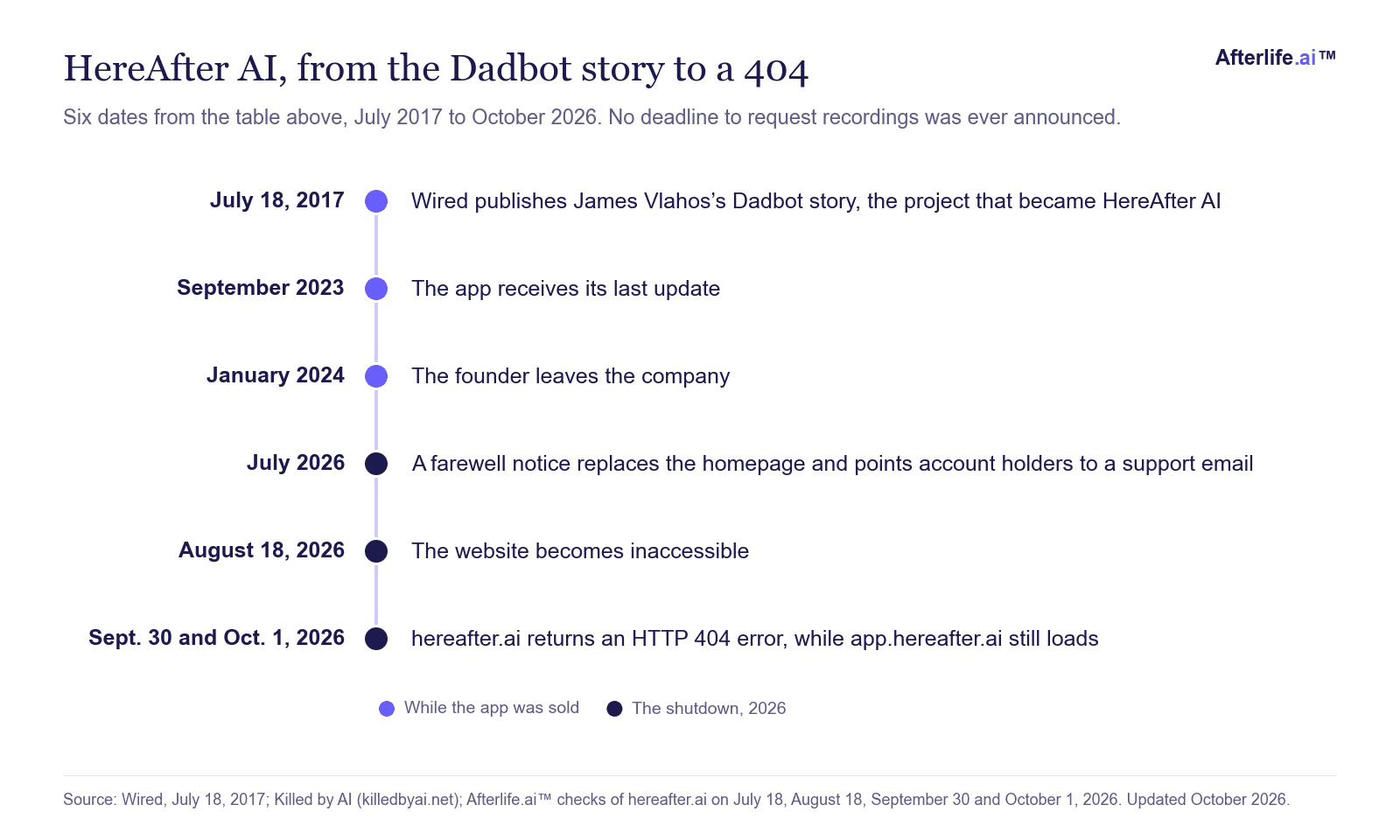
The record below is dated from our own checks of the live HereAfter site and from public sources. Every line is a snapshot of what we could verify on the date shown, and we update the page whenever the status changes. If you are reading this later, treat each line as a dated record and check the status table at the top of the page first.
Date | What happened | Source |
|---|---|---|
July 18, 2017 | Wired publishes James Vlahos's Dadbot story, the project that became HereAfter AI | |
While the app was sold | Plans cost $3.99, $5.99 and $7.99 a month, and full MP3 downloads came only with the $7.99 Unlimited plan | Our check of the live site, July 18, 2026 |
September 2023 | The app receives its last update | |
January 2024 | The founder leaves the company | |
July 2026 | A farewell notice replaces the homepage, states that HereAfter is shutting down and directs account holders to support@hereafter.ai; the FAQ and blog pages return errors and the app's domain is listed for sale | Our check, July 18, 2026 |
August 18, 2026 | The website becomes inaccessible | Killed by AI; our check, August 18, 2026 |
September 30 and October 1, 2026 | hereafter.ai returns HTTP 404, while app.hereafter.ai still loads the web app | Our checks |
There was no scandal, no dramatic collapse and no acquisition announcement, and the company has published no explanation, deadline or refund policy alongside the notice. A small team appears to have simply run out of road, which happens to good companies, and HereAfter was a good company. Even so, a well-made product with real recordings ended with a notice and an error page, and families were left to ask for their own files one email at a time. For the product itself, read what HereAfter AI was and our HereAfter AI review.
How do you get your recordings out of HereAfter AI?
You get your recordings out of HereAfter AI by trying the web app once, then emailing support@hereafter.ai from the address on your account and asking for a complete export. Email is the whole mechanism the company named, so write the email today. You are asking a winding-down team for a careful favor, and the clearer your request, the easier it is to honor. The steps below put the fastest options first.
Try the HereAfter web app first. Go to app.hereafter.ai and sign in with the email or Google account you used, and download anything the app still lets you download.
Find the email address on the account. Search your inbox and your card statements for HereAfter receipts, because a request sent from the registered address is the easiest one for the team to verify.
Email support@hereafter.ai from that address. Ask for every audio recording, every transcript, the interview question each recording answers, and any photos attached to stories, in MP3 or another standard format.
Search your own devices and ask relatives. Anyone on the Unlimited plan could download MP3s, so check old laptops, phones and cloud drives, and ask every relative who listened whether they saved a copy.
Save every file in three places. Keep two copies on separate drives you own and one in a cloud account you control.
Label each file with its question and date. A folder of unlabeled audio is a puzzle, while the same folder with question titles and transcripts is a life story.
Follow up every week until the files arrive. Keep a record of every request and reply, and send account details only to support@hereafter.ai, the address HereAfter itself named.
You can send the template below as it stands, filling in the brackets with your own details. It asks for the audio and also for the context around the audio, because the question each recording answers is what turns a folder of files into a life story. Keep a copy of the email you send, with the date, so every follow-up can quote your first request.
Subject: Recording export request for [your account email]. Hello. I am a HereAfter customer, account email [your account email]. Following the notice on your homepage, I would like to request a complete export of my account: all audio recordings, transcripts if available, the interview questions each recording answers, and any photos attached to our stories. MP3 or any standard format is fine. I am happy to verify the account however you need. Thank you for what you built. [Your name]
If the storyteller in your account has already died, those recordings may be the last of their voice your family will ever hold, and nothing made later replaces an original. Retrieve the files first, and let every other decision wait until they are safe. For the deeper walkthrough on file formats, labeling and long-term storage, read how to save your HereAfter recordings.
What should you do with the recordings once you have them?
Once the files arrive, protect them, label them and share them, in that order. Copy the folder to your two drives and your cloud account the same day, and check that every file plays. Then rename each file with the storyteller's name, the question and the date, and keep the transcripts beside the audio. Finally, send a copy to every relative who would want one, because a recording held in five homes survives far longer than a recording held in one.
If the storyteller is still alive, the recordings become the starting point for something new. Play a recording together, ask the follow-up question you always wanted to ask, and let your parent retell the story in a Persona, where the memory joins a growing map of their life and can answer the next question in their own voice. The original file stays exactly as it is, as the family archive, and the Persona carries the stories forward with your parent deciding who may hear them later. For more on keeping a voice, read how to preserve a parent's voice.
How much did HereAfter AI cost?
HereAfter AI cost $3.99, $5.99 or $7.99 a month, depending on the plan, when we checked the live site on July 18, 2026. Full MP3 downloads of a family's own recordings came only with the $7.99 Unlimited plan, which is why many subscribers on the cheaper plans have no copy of their own audio today. The prices below are in US dollars and are recorded for reference, since the plans are no longer sold.
Plan | Price while sold | Full MP3 downloads |
|---|---|---|
Starter | $3.99 a month | No |
Storyteller | $5.99 a month | No |
Unlimited | $7.99 a month | Yes |
The download rule is the detail that matters most in hindsight. A family on the Unlimited plan could hold its own copies the whole time, while every other family depended on the company staying open. For the full price history, read HereAfter AI pricing.
Which other AI afterlife and avatar companies have closed or changed course?
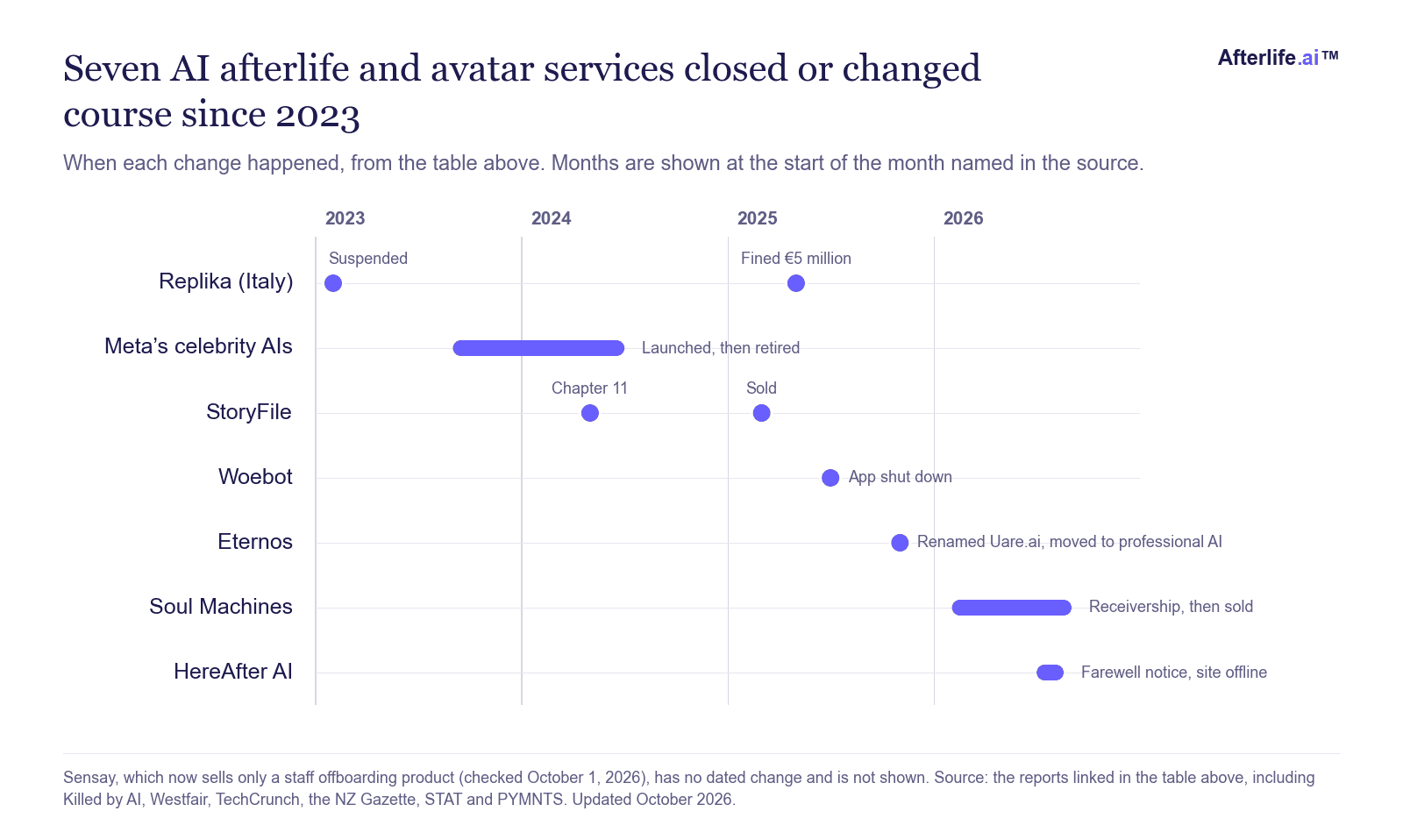
HereAfter is one of at least eight well-known AI legacy, avatar and companion services that have closed, been sold, changed direction or been forced to change by a regulator since 2023. The pattern holds across the United States, Europe and New Zealand. A person's recordings and likeness are only as safe as the company, the balance sheet and the contract behind them. The full stories of two of them are in what happened to StoryFile and what happened to Eternos.
Service | What happened | When | Source |
|---|---|---|---|
HereAfter AI (United States) | Farewell notice, website offline, recordings by email request only | July to August 2026 | Our checks; Killed by AI |
StoryFile (United States) | Filed for Chapter 11 with $1.5 million in assets against $10.5 million in liabilities, then sold to Key 7 Investment | May 2024; March 2025 | |
Eternos (United States) | Renamed itself Uare.ai, raised $10.3 million and moved into professional AI after finding most prospective users were not preparing for death | November 2025 | |
Soul Machines (New Zealand) | Went into receivership and was bought by AppDirect; its standard terms let it assign customer contracts, keep studio-built avatars and delete customer data 30 days after a contract ends | February to September 2026 | |
Sensay | Now sells only a staff offboarding product, at $500 per knowledge base a year | Checked October 1, 2026 | |
Woebot (United States) | Shut down its therapy chatbot app, used by about 1.5 million people; the founder blamed the cost of FDA requirements | July 2025 | |
Meta's celebrity AIs (United States) | Launched 28 AI characters based on famous people, then retired them within a year | September 2023 to July 2024 | |
Replika (Italy) | Suspended in Italy by the data protection authority, then its maker was fined €5 million | February 2023; May 2025 |
The most instructive entry is a person. Michael Bommer, a 61-year-old Berlin entrepreneur with terminal colon cancer, spent two months and about 25 hours of talking to build an interactive AI of himself with Eternos, as the company's first client (Fortune, via AP, June 4, 2024). He did everything right, and the company then changed direction. Under its current name, the company's terms say that on cancellation it deletes or de-identifies the content and any AI a user created (Uare.ai Terms, June 30, 2026), which is the standard any family should check before trusting a service with a parent.
Researchers see the same gap across the whole category. A Lehigh University audit of 93 AI "afterlife" services found that 82 publish thin or no information on who has authority over a recreation, and 77 say little about deletion or export (arXiv, August 28, 2026). For the general lesson, read what happens when a digital legacy company shuts down. Meta's own record shows the same pattern at the largest scale, and our guide to Meta's AI experiments with real people covers its celebrity characters, AI Studio and its patent to simulate dead users.
The biggest failure in the category came in October 2026, when Character.AI, the chatbot app with about 12 million monthly users, filed for Chapter 11 in Delaware and its users' chats were left out of the only bid for its technology. Our guide to the Character.AI bankruptcy covers what happens to those chats and how to save them.
What should you ask of any successor?
Before you move your family's stories anywhere, ask seven questions and expect written answers. HereAfter's families learned that a beautiful product can still end with an error page, and the questions below are the ones that decide whether the next service ends the same way. Ask them of every company you consider, including us, and treat silence as a no.
How does the service end, and is the ending in the contract?
Who decides what happens to the recordings and the AI after I die, and how do you check that a death is real?
Can anyone change who I am after I die, including my family or the company?
Do you delete accounts that go quiet?
If you are sold or close, what passes to the buyer, and what stays protected?
What do we keep in our own hands the whole time?
Who pays after I die, and what does my family see first?
The question | Who failed it | The Afterlife.ai™ answer |
|---|---|---|
1. How does the service end? | HereAfter: a notice, then a 404 | Section 8 of our Terms of Service and the Executor Lock™ Agreement set out what happens at your death, and section 8.3 makes the lock permanent and irreversible |
2. Who decides after I die? | Nine of nine AI twin and avatar platforms whose terms we read name nobody | The executors you name, after evidence, automated analysis, a human review and a seven-day cooling-off in which executors can dispute and you can cancel with proof of life |
3. Can anyone change who I am? | Meta's celebrity AIs spoke from someone else's script | No. Nothing in the product can change your personality, tone or values after the lock |
4. Do you delete quiet accounts? | Five of nine AI twin and avatar platforms reserve the right | Our Terms contain no clause that deletes an account for inactivity |
5. What happens in a sale? | StoryFile and Soul Machines passed to buyers | Our obligations pass to any successor (section 16.4), and the lock stays permanent under section 8.3 |
6. What stays in our hands? | HereAfter gave full MP3s only to its top plan | Your original recordings and photos stay yours on your own drives, and your Persona stays under the control of the executors you named |
7. Who pays after I die? | HereAfter never said | Prepaid 20-year and 80-year plans, continuity credits, or a family member's Legacy ($14.99) or Eternal ($29.99) plan; until someone activates, your family sees a preview of three photos |
Question two is the one almost no company in this category can answer, and answering that question is why we built Executor Lock™. When we read the published terms of nine AI twin and avatar platforms, about 85,000 words in total, none of them said what happens to your clone, your account or your earnings when you die (terms checked October 1, 2026). For the ownership question in depth, read who owns your AI twin after you die.
Put the ending in place before the first story.
Name your executor before you recordHow does Executor Lock™ write the ending in advance?
Executor Lock™ writes the ending of your Persona while you are alive, so nobody has to improvise it after you die. You name the people, they accept the job in writing, and the product follows the same six steps for every Afterlife.ai™ Persona.
Name your people. You name one or more executors and your Trusted Contacts, and each one accepts the Executor Lock™ Agreement while you are alive.
Report. After your death, an executor or a Trusted Contact you named uploads evidence, such as a death certificate or a funeral notice.
Check. Automated analysis reads the evidence, and then a person reviews the evidence before anything changes.
Cooling-off. Seven days pass in which every executor is told about the report and can dispute the report, and you can cancel a false report with proof of life.
Lock. Your Persona becomes a sealed snapshot of every memory as the memory stood that day, with nothing pruned, nothing re-weighted and a tamper-evident seal on the record.
Release. Your release rules for photos, memories and live conversation take effect for the people you named.
After the lock, your executor can invite the people you named who never accepted their invitation, hand the executor role to someone else, and ask Idy to delete your Persona. Your executor cannot unlock your Persona, edit a memory or change who you are, and nothing in the product can change your personality after the lock. New short-term memories and big life events still reach your Persona, so a grandchild can share good news and your Persona remembers the news while staying exactly who you were. For the whole role, read what a digital executor does.
Why did Idy build the ending first?
Idy built the ending first because the HereAfter story is the predictable result of building the product and leaving the ending for later. Our first years went into the questions that most personal AI companies skip, which are who controls your likeness while you live, who decides about the likeness when you die, who may see what, and how consent is recorded so that software obeys the consent. The answer is Executor Lock™, built on Idy's 78 patents pending, which cover verifying a death before control of a Persona changes hands, handing authority to a named executor, sealing a memory record that becomes permanent at the handover, and keeping a Persona the same person when the underlying AI models change. Idy has also filed two international patent applications under the Patent Cooperation Treaty.
Because that foundation came first, one Idy twin can work as you while you live, keep answering and booking while you are away, and pass to the people you named when you die. That is how the Afterlife.ai™ Twin built for families works, on the same Executor Lock™. Video-avatar tools such as Tavus, HeyGen and Synthesia were built for marketing and support videos, and creator clones such as Delphi and Uare.ai were built to answer an audience, so none of them names an executor or plans for its owner's death. Life-story apps such as HereAfter were built to record, and the recording was beautiful, while the ending was left to a notice on a homepage.
What are the alternatives to HereAfter AI?
The best alternative to HereAfter AI depends on what HereAfter was for your family. Some families want the interviews to continue, some want a keepsake book on a shelf, and some want a voice that can still answer a new question. The table compares the main options, with prices in US dollars, and every option is better with the original HereAfter files saved first.
Service | Price | What you get | Voice playback |
|---|---|---|---|
Keep the files yourself | Free | The original recordings | Yes, the real recordings |
StoryWorth | From $59 a year (checked October 2, 2026) | Weekly prompts that become a printed book | No, the book prints text |
Storii | $9.99 a month or $99.99 a year (checked August 18, 2026) | Life stories recorded over ordinary phone calls | Yes, the call recordings |
Remento | $99 for a year and one hardcover book, then $99 a year or $12 a month (checked October 2, 2026) | Prompted recordings that become a book with QR links to the audio | Yes, behind QR codes |
Afterlife.ai™ | Free build of 25 memories, then Legacy $14.99 or Eternal $29.99 a month | A Persona that answers in the storyteller's words and own cloned voice, a Mind Map of their life and Persona Video messages | Yes, in their own consented voice, with executors named under Executor Lock™ |
A printed book is the right choice when paper is the keepsake your family wants, and our page on HereAfter AI compared with StoryWorth covers that choice in depth. Storii suits a parent who tells stories best over the phone. Afterlife.ai™ is the choice for a family that wants a parent's voice to keep answering new questions, with the parent deciding the ending in advance. Every Persona speaks in the storyteller's own cloned voice and shows their life on the Mind Map, and Persona Video turns the Persona into video messages in the storyteller's face and voice, made from one 30-second recording of the storyteller, with the first video free.
Worked example: what an ending costs over 20 years. HereAfter's Unlimited plan, at $7.99 a month, would have cost a family $1,917.60 over twenty years, with no executor and no written ending. Afterlife.ai™ Legacy at $14.99 a month costs $3,597.60 over the same twenty years, and the 20-year Legacy plan, which includes everything in Eternal, costs $1,299 once, which is $64.95 a year and $618.60 less than twenty years of HereAfter's top plan would have cost. The table shows all three, with the ending each one buys.
Over 20 years | HereAfter AI Unlimited (while sold) | Afterlife.ai™ Legacy, monthly | Afterlife.ai™ 20-year Legacy, prepaid |
|---|---|---|---|
Price | $7.99 a month | $14.99 a month | $1,299 once |
Total over 20 years | $1,917.60 | $3,597.60 | $1,299.00 |
Cost per year | $95.88 | $179.88 | $64.95 |
A named executor | Not offered | One executor and 10 Trusted Contacts | Up to five executors and five Trusted Contacts |
A written ending | None published | Terms section 8 and the Executor Lock™ Agreement | Terms section 8 and the Executor Lock™ Agreement |
After the storyteller dies | A notice, then an error page | Continuity credits ($149 for 12 months) or a family plan keep access open | Remaining prepaid years fund the family's access |
The prepaid plan is the one that answers HereAfter's failure most directly, because the years are paid before anything can go wrong and the people who take over are named in advance. Continuity credits cover a shorter bridge, at $149 for 12 months of Legacy or $279 for 24 months, for families who prefer to pay monthly while the storyteller is alive. For a full head-to-head, read Afterlife.ai™ compared with HereAfter AI, and for every plan, read every Afterlife.ai™ plan and price.
You can help.
Your parent owns the Persona and makes every decision about the Persona.
Start your parent's Persona together, freeHow do you start again with a living parent?
You start again by helping your parent build their own Persona, in their own account, with the ending decided on the first day. The order below puts the ending first, which is the step HereAfter's families never got. Most families finish the first five steps in an afternoon.
Open your parent's free account together. The free build holds 25 memories, needs no card and never expires, and your parent owns the account.
Name the executor and Trusted Contacts first. Your parent chooses who takes over and who may have access, and each person accepts the Executor Lock™ Agreement.
Set the release rules. Your parent decides whether photos, memories and live conversation are released to the family after the lock.
Record the first stories. Play a saved HereAfter recording if you have one, and let your parent retell the story in conversation with the Persona.
Clone your parent's voice and record a Persona Video. The Persona then speaks in your parent's own voice, and one 30-second recording lets Persona Video make messages in your parent's own face and voice.
Keep going on the Mind Map. The map shows which chapters of your parent's life are covered, so every conversation has a starting point.
Our Terms bar anyone from building a Persona of another person without that person's explicit written consent (section 5.1), and the service is for adults 18 and over (section 2.1). That rule is what makes a parent's Persona trustworthy later, because every word in the Persona came from the parent. For a longer guide, read how to make an AI version of yourself, and for why consent matters so much, read what a griefbot is, and why consent changes everything.
Why does the ending matter more in 2026?
The ending matters more in 2026 because copies of people are now made after they die whether or not anyone planned for them. Within a day of Dolly Parton's death on August 25, 2026, a fake AI recording of her "final wish" was spreading online, and Snopes rated the clip Fake (Snopes). On September 30, 2026, an Arizona appeals court vacated a sentence because the judge relied on an AI video of a dead man speaking words his family wrote (Fox 10 Phoenix). In both cases nobody could point to rules the person had set while alive.
James Earl Jones showed the alternative. In 2022 he signed a deal letting Lucasfilm generate Darth Vader's voice from archival recordings, two years before he died on September 9, 2024 (Wikipedia), so nobody had to guess or sue. Cambridge researchers have called for exactly that kind of advance consent, along with ways to retire a recreation with dignity (University of Cambridge, May 9, 2024). Governments are writing the same rule into law, and the country-by-country picture is in deepfake and AI likeness laws by country.
So should your family try again?
Yes, if the storyteller is alive and willing, and only with a service that shows you the ending in writing before you start. HereAfter proved that families want to hear a parent's voice answer their questions, and the recordings it made are worth every effort to rescue. The next service has to pass a harder test, which is whether what you build will still be there, governed by the people your parent chose, when the grandchildren ask. Afterlife.ai™ was built to pass that test, starting free.
Senior-living groups, insurers and estate lawyers
The families you serve were HereAfter's customers. Offer them a Persona with the ending written in from the first day.
Talk to us about offering families an ending in writingFrequently asked questions
Is HereAfter AI still working?
No. HereAfter AI posted a farewell notice in July 2026, its main website has been offline since August 18, 2026, and hereafter.ai returned a 404 error on our checks on September 30 and October 1, 2026. The web app address, app.hereafter.ai, still loaded on October 1, so try signing in once, then put your energy into retrieving your files.
Is HereAfter AI shutting down?
Yes. The farewell notice on HereAfter's homepage, recorded on July 18, 2026, stated that HereAfter is shutting down and directed account holders to support@hereafter.ai to request their recordings. No deadline, explanation or refund policy has been published.
How do I get my recordings back from HereAfter AI?
Email support@hereafter.ai from the address on your account and request a complete export of audio, transcripts, question titles and photos. Try signing in at app.hereafter.ai first, then search your own devices and ask relatives for any MP3s they downloaded, and save everything in three places.
Is there a deadline to download HereAfter recordings?
No deadline has been announced, and that is exactly why you should act this week. Wind-downs get quieter over time, inboxes stop being read and domains change hands, and HereAfter's app domain was already listed for sale in July 2026.
What happened to HereAfter AI?
HereAfter AI, the life-story interview app that grew from James Vlahos's 2017 Dadbot, posted a shutdown notice in July 2026 and directed account holders to a support email for their recordings. Its website became inaccessible on August 18, 2026, according to the Killed by AI tracker.
Who founded HereAfter AI?
HereAfter AI was co-founded by the journalist James Vlahos, whose Dadbot of his dying father was published by Wired in July 2017. Killed by AI reports that he left the company in January 2024.
How much did HereAfter AI cost?
HereAfter AI cost $3.99, $5.99 or $7.99 a month when we checked the live site on July 18, 2026. Full MP3 downloads came only with the $7.99 Unlimited plan.
What is the best alternative to HereAfter AI?
The best alternative depends on what HereAfter was for you. StoryWorth and Remento suit a family that wants a printed keepsake, and Storii suits a parent who tells stories best over the phone. Afterlife.ai™ suits a family that wants a Persona answering in a parent's own words and voice, with an executor named and the ending written in advance, and the Persona starts free with 25 memories and no card.
Can my HereAfter recordings become part of an Afterlife.ai™ Persona?
Yes, your recordings can serve as source material. Keep the original files safe, then let your parent retell those stories in conversation with their Persona, where each story becomes a memory in their own words. Voice cloning is separate and consent-based, so your parent records their own voice for their Persona while they are alive.
Can I move my HereAfter recordings into another app?
Yes. Once the MP3s are in your hands they are yours, so keep the originals in two places you control and use the best stories wherever you go next, whether a printed book service or a Persona your parent builds in their own words.
Which AI afterlife companies have shut down?
HereAfter AI went offline in 2026, StoryFile filed for Chapter 11 in 2024 and was sold in 2025, Eternos became Uare.ai and moved into professional AI in 2025, Soul Machines went into receivership in 2026, and Sensay now sells only staff offboarding. A Lehigh University audit in August 2026 found that 82 of 93 AI afterlife services publish thin or no information on who has authority over a recreation.
What if Idy shuts down too?
Our Terms answer that in writing, because Idy built the ending before building anything else. Our obligations pass to any successor (section 16.4), the lock stays permanent (section 8.3), and you can prepay your Persona for 20 or 80 years today so your family's access never depends on a monthly card payment. Executor Lock™ runs on technology covered by Idy's 78 patents pending.
How we researched this page
We checked hereafter.ai and app.hereafter.ai by hand on the dates shown, read the Killed by AI entry, the Wired, Westfair, AV Interactive, TechCrunch, STAT, Fortune and PYMNTS reporting linked above, the published terms of the AI twin and avatar platforms named in the successor table, the Lehigh University and University of Cambridge research, and the price pages of StoryWorth, Storii and Remento. Every outside fact links to its source and date.