
What a digital executor does, and why your AI twin needs one
A digital executor used to close accounts and save photos. In 2026 the job also includes deciding what your AI likeness may say and who may hear it. This guide covers the whole role, the law in the US, the UK, Europe and China, a free digital executor form, and how to name the person who governs your AI.
A digital executor is the person responsible for managing your digital assets after your death, from closing or memorializing accounts and saving photos to handling online money and deciding what your AI likeness may say. On Afterlife.ai™ from Idy, Executor Lock™ lets you name that person today and seals your Persona exactly as you left your Persona.
In July 2021, the makers of a documentary about Anthony Bourdain used an AI model of his voice to read words he had written but never recorded, and the director said the estate had given its blessing. Bourdain's ex-wife, who was the executor of his estate, publicly denied being consulted (Wikipedia). Five years later the stakes are higher. On September 30, 2026, the Arizona Court of Appeals vacated a sentence because the judge had relied on an AI video of a man who had been killed, speaking words his family wrote (Fox 10 Phoenix, September 30, 2026), and within a day of Dolly Parton's death in August 2026 a fake AI recording of her "final wish" was spreading online (Snopes).
The job of a digital executor has grown to match. Your executor still needs to reach your email, save your photos, stop your subscriptions and deal with your online money. Your executor now also needs authority over the most personal digital asset you will ever leave, which is an AI that can speak in your voice and appear in your face. This guide explains every part of the role, how the law treats it in the United States, the United Kingdom, Germany, France and China, how Apple, Google and Facebook handle death, and how to name the person who governs your AI before anyone else decides for you.
By Chris Williams, founder of Idy®, the company behind Afterlife.ai™. First published May 15, 2026. Updated October 2, 2026.
The most important name in your digital plan is the one you write down today.
Name your executorDefinitions
Digital executor: the person responsible for managing your digital assets after your death, including accounts, files, photos, online money and your AI likeness.
Digital assets: everything you own or control online, from email and photos to cryptocurrency, domain names, social media profiles and AI accounts.
Online tool: a service's own after-death setting, such as Apple Legacy Contact, which under the US law RUFADAA outranks your will for that account.
Persona: the AI version of you that you build on Afterlife.ai™ from your own memories, values and cloned voice.
Executor Lock™: Idy's patent-pending system of named executors, Trusted Contacts, a verified death report and a sealed snapshot of your Persona that can never be changed.
Trusted Contact: a person you name under Executor Lock™ who can report your death and receive access to your Persona under your release rules.
What is a digital executor?
A digital executor is the person you trust to carry out your wishes for your digital life after you die. The role sits beside the executor of your estate, who handles property, money and the will itself, and the two can be the same person or two different people. In most countries "digital executor" is a practical title rather than a separate legal office, so the authority comes from your will, from the platforms' own settings and, increasingly, from the AI services you use. The table shows how the roles fit together.
Role | What the role covers | Where the authority comes from |
|---|---|---|
Executor of the estate | Property, bank accounts, debts, taxes and distributing what you leave under the will | Your will, confirmed by a court in probate |
Digital executor | Email, photos, files, social media, subscriptions, online money and the instructions you left for each | Your will or a separate written authority, plus each platform's own settings |
Platform contact (Apple Legacy Contact, Google Inactive Account Manager, Facebook legacy contact) | One company's account, under that company's rules | The setting you turned on inside that account |
Executor under Executor Lock™ | Your Persona and any AI twin: starting the lock, carrying out your release rules and your after-lock choices | The Executor Lock™ Agreement, accepted by you and your executor while you are alive |
The scale of the job is why the role exists. Researchers Carl Öhman and David Watson at the Oxford Internet Institute projected that at least 1.4 billion Facebook users will die before 2100, and that the number could pass 4.9 billion if the network keeps growing (Big Data & Society, 2019). Wikipedia's entry on digital inheritance puts the average person at about 150 online accounts that require a password (Wikipedia). Without somebody authorized and equipped to handle that layer, the digital half of an estate goes unmanaged, and the companies holding the accounts decide what happens by default. For the traditional role, read what the executor of an estate does.
What does a digital executor do?
A digital executor finds your digital assets, secures them, carries out your instructions for each one, and hands on what should be kept. The work falls into seven areas, and the seventh is the one most guides still leave out. The order below is roughly the order the work happens in after a death.
Inventory. Find out what exists, using your list, your password manager, your email and your financial records, because most people own far more accounts than they ever write down. Some accounts can never pass to anyone, and what happens to your Steam account when you die shows how a game library works under those rules.
Security. Secure your phone, your email and your password manager first, because email is the key that resets most other accounts, and lock down anything a fraudster could use.
Platform requests. Use each platform's after-death process, such as Apple's Legacy Contact access request, Google's Inactive Account Manager, and Facebook's memorialization or deletion.
Preservation. Download the photos, videos, documents and messages your family will want before any account is closed or deleted.
Money. Deal with online banking, payment apps, brokerage accounts and cryptocurrency alongside the estate's executor, because these assets carry value and legal duties. Cash App, for example, releases a balance only against a Small Estate Affidavit or a court letter, as what happens to your Cash App account when you die explains.
Subscriptions and recurring bills. Cancel the streaming services, software, memberships and cloud storage that would otherwise keep charging your cards.
Your AI. Carry out your wishes for your Persona, any AI twin, your voice clone and your AI videos, which on Afterlife.ai™ means starting Executor Lock™ and following the release rules you set.
The seventh area changes the character of the job. Closing an email account is administration, while deciding what an AI that speaks as you may say, and who may hear it, is a question about your identity. A digital executor with a clear written decision from you can carry out that wish in minutes. A digital executor without one is left guessing, which is exactly the position Bourdain's executor and the Pelkey family found themselves in. For the AI accounts themselves, read what happens to your AI chat history when you die.
Do you need a digital executor?
Yes, if you have a smartphone, an email account and photos in the cloud, which in 2026 means almost every adult. Platforms will not hand your accounts to your family just because they ask, privacy law in the United States makes providers wary of releasing the content of your messages without your consent, and some services delete accounts that go quiet. Google, for example, says it may delete a Google Account and its data if you are inactive across Google for at least two years (Google). A named digital executor with written authority turns all of those barriers into a checklist.
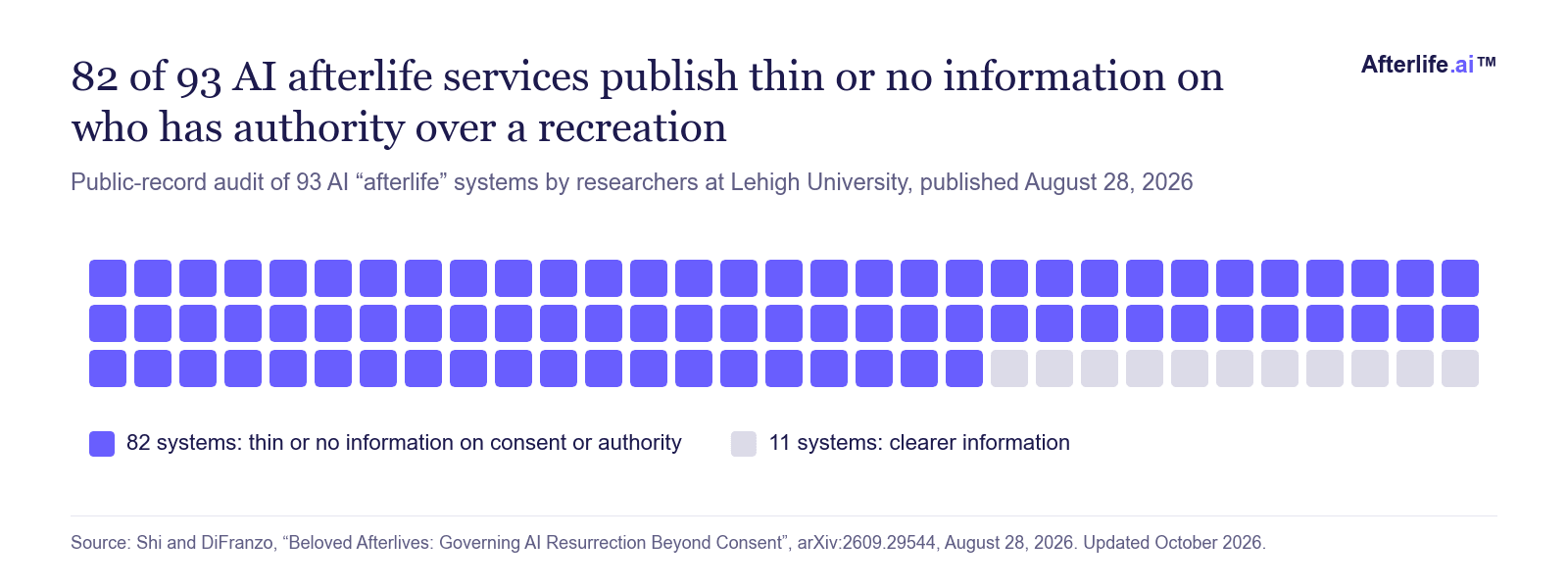
You need one even more if you use AI services that hold a version of you. When we read the full service terms of nine AI twin and avatar platforms in October 2026, about 85,000 words in total, none of them said what happens to your clone, your account or your earnings when you die. Five of the nine reserve the right to delete or terminate accounts for inactivity or "lack of use", which is exactly what an account looks like after its owner dies. A Lehigh University audit published in August 2026 found that 82 of 93 AI "afterlife" services publish thin or no information on who has authority over a recreation of a person (arXiv, August 28, 2026).
The answer for most people is a single trusted person with three things, which are a written authority, a list of what exists, and your decisions about your AI likeness. The rest of this guide shows how to give your executor all three. If you would rather start with the AI part, Afterlife.ai™ lets you name your executor on the free build, before you write anything else.
Is a digital executor legally recognized?
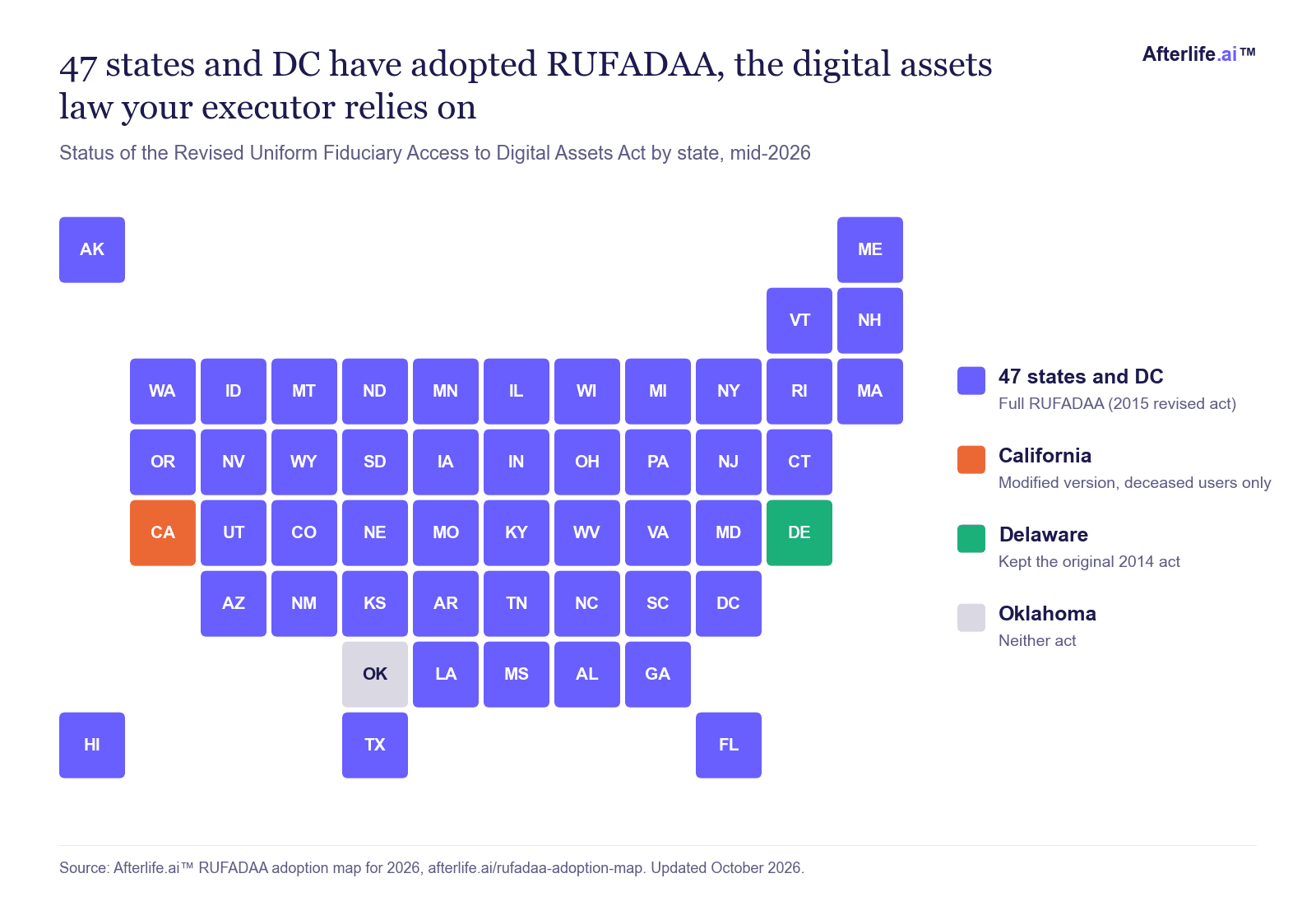
In the United States, the authority behind a digital executor is recognized through RUFADAA, the Revised Uniform Fiduciary Access to Digital Assets Act, which nearly every state has adopted. The Uniform Law Commission released the revised act in 2015 to tell online providers when they may, and when they must, give a fiduciary such as your executor access to your digital accounts. Our state-by-state map counts 47 states plus the District of Columbia with the full act as of mid-2026, with California using a modified version, Delaware keeping the original 2014 act and Oklahoma adopting neither (the RUFADAA adoption map for 2026). Each state passes its own version, so the details vary, and an estate lawyer in your state should draft the actual wording of your will.
RUFADAA works on a three-tier order of priority, and the order surprises most families. Tier one is the provider's own online tool, such as Apple Legacy Contact, Google Inactive Account Manager or Facebook's legacy contact, and a choice you make there overrides everything, including your will. Tier two is your directions in a will, trust or power of attorney, which apply where you used no online tool. Tier three is the provider's terms of service, which decide only when you left nothing at the first two tiers (Wikipedia; California AB 691).
The act also separates two kinds of data. A fiduciary with general authority can usually obtain the catalog of your electronic communications, meaning who you corresponded with and when, along with most files and photos. The content of your messages, meaning the actual bodies of emails and chats, is disclosed only if you gave express consent in an online tool or in your estate documents, because the federal Stored Communications Act of 1986 bars providers from releasing that content freely. A will that says nothing about digital assets therefore leaves your executor with less than most people expect, and a will with an express digital-assets clause, plus the platform settings below, leaves your executor with what you intended.
Other countries reach the same question by different routes. The table summarizes the rules that matter most for a digital executor outside the United States, and for AI likeness rules specifically, read deepfake and AI likeness laws by country.
Country | The rule a digital executor works under | Source |
|---|---|---|
United Kingdom | There is no separate legal office of digital executor; the executors named in your will deal with digital assets, and many people add instructions in a letter of wishes. The UK still has no general right over your own image or voice, and the government said in March 2026 only that it will consider a digital replica right | |
Germany | The Federal Court of Justice ruled on July 12, 2018 that a social media user agreement passes to the heirs on death, so the parents of a 15-year-old girl could access her Facebook account. Separately, pictures of a person may be published for 10 years after death only with the relatives' consent | Library of Congress, September 7, 2018; German federal law portal |
France | Since the Digital Republic Act of October 7, 2016, article 85 of the French Data Protection Act lets anyone set directives for the retention, deletion and communication of their personal data after death; heirs have limited rights where no directive exists | |
European Union | The GDPR does not apply to the personal data of deceased people (Recital 27), so each member state sets its own rules for the dead | |
China | Article 49 of the Personal Information Protection Law lets next of kin consult, copy, correct or delete a dead person's information "except where the deceased has arranged otherwise before their death" |
The pattern across all five systems is the same, and it favors the person who plans. The United States puts your own online settings above your will, France lets you write directives for your data, and China lets your own arrangement override your family's default rights. In each place, a clear decision made while you are alive beats whatever the family, the platform or the law would decide without you. For the UK process, read how probate works in the UK and how to make a will in the UK.
What is a digital executor in a will?
A digital executor in a will is a person the will names, or empowers, to deal with your digital assets, usually through a clause that grants authority to access, manage, distribute and close your digital accounts. In the United States, that clause matters because RUFADAA gives your executor access to the content of your messages only with your express consent. Your lawyer will draft the wording for your state, and a good clause usually covers five points. The clause names the person, grants authority over digital assets and electronic communications including their content, points to a separate list of accounts kept outside the will, allows the executor to hire technical help, and names a backup.
Keep passwords out of the will itself, because wills become public documents in probate in many places. The will should say where your inventory and your password manager's emergency access live, and the inventory should say what exists and what you want done with each item. For the details, read how to list digital assets in a will and how password managers handle death.
Your will is also the wrong place for decisions about your AI likeness, for a practical reason. A will is read after the death, often weeks later, while an AI Persona or a voice clone needs a decision the moment a death is reported, and the platform has to be able to act on that decision. A setting inside the service that holds your Persona, accepted by your executor while you are alive, is the instrument that actually works. That is how Executor Lock™ is designed, and the later sections explain each step.
How do Apple, Google and Facebook handle death?
Apple, Google and Facebook each offer their own after-death setting, and under RUFADAA each of those settings outranks your will for that account. Turning all three on takes about twenty minutes and saves your digital executor weeks. The table compares what each setting does, based on each company's own help pages as of October 2, 2026.
Platform | The setting | Who can use it | What they can do | What they cannot do |
|---|---|---|---|---|
Apple | Legacy Contact, part of Apple's Digital Legacy program; needs iOS 15.2, iPadOS 15.2 or macOS Monterey 12.1 or later | One or more people over 13, each with the access key you generate, plus a death certificate | Reach photos, messages, notes, files, device backups and more; any one Legacy Contact can decide alone, including permanent deletion | Access purchased movies, music, books or subscriptions, or anything in iCloud Keychain, such as passwords and payment details |
Inactive Account Manager | Up to 10 people you choose, with different data for different people | Receive a notice and a link to download the data you chose, after the period of inactivity you set | Google may delete an account inactive across Google for at least two years | |
Legacy contact, or permanent deletion after death | One legacy contact you choose | Write a pinned post, update the profile and cover photo, request removal of the account and download a copy of what you shared | Log in to your account, read your messages, or remove friends |
Sources: Apple, Google and Facebook. Each setting covers one company's data and none of them governs an AI that speaks as you, which is the gap Executor Lock™ fills for your Persona. Meta has even patented a way for a model trained on a user's activity to keep posting as that user after death, as the Facebook death patent shows. For step-by-step guides by platform, read what happens to iCloud when you die, how Google Inactive Account Manager works, what happens to Facebook when you die, what happens to Gmail when you die and how to unlock a deceased person's iPhone.
How do you choose a digital executor?
Choose the person you trust most with your private life who is also comfortable with technology and will have time in the months after your death. Those three traits matter more than family seniority, because the job is detailed, private and concentrated into a short period. Many people choose an adult child, a younger sibling or a trusted friend who works with technology, and some estates hire a professional fiduciary when there is significant cryptocurrency, a business or a large body of creative work. The checklist below covers the questions to ask before you ask the person.
Question | Why it matters |
|---|---|
Do you trust this person with your email, messages and photos? | Your digital executor may see things you never meant anyone to see |
Is this person comfortable with passwords, two-factor codes and settings menus? | Much of the job happens inside account settings and recovery flows |
Will this person have time in the first three months after your death? | Most of the work is concentrated in that period |
Does this person live where the practical work can be done? | Distance is fine for most tasks, and phones and devices still need a physical home |
Will this person respect your wishes for your AI likeness, even if the family disagrees? | Your executor carries out your rules for your Persona, not the family's preferences |
Who is your backup if this person cannot serve? | People die first, fall ill, move or fall out with families |
Have you told your estate's executor and your lawyer? | The two executors need to work together on assets with value |
Ask the person directly, explain the job, and tell them where your instructions will live. Name a backup in your will, and on Afterlife.ai™ name more than one executor if your plan allows it, because Eternal allows up to five. Before the lock, you can reassign the role at any time, and the incoming executor accepts the Executor Lock™ Agreement before the change takes effect.
What does a digital executor need from you?
Your digital executor needs written authority, a list of what exists, a way in, and your decisions. The free form below is the list and the decisions, and it works on paper, in a document or inside a password manager's secure notes. Fill it in once, review it every year, and tell your executor and your lawyer where it lives. Never write passwords on the form itself, and say instead where the password manager is and how emergency access works.
Free digital executor form (copy and fill in)
Section | What to write | Example entry |
|---|---|---|
1. You | Full name, date of birth, where your will is kept, your lawyer's name | Will with the family lawyer; copy in the fire safe |
2. Your digital executor | Name, phone, email, and the date they agreed | Daughter, agreed March 2026 |
3. Your backup | Name and contact details | Brother |
4. Way in | Password manager name and emergency-access setup; where device passcodes are kept | Emergency access granted to daughter; phone passcode in sealed envelope with the will |
5. Email | Each email account and what to do with it | Personal Gmail: keep 12 months, then close; work email: tell employer |
6. Phone and devices | Each phone, tablet and computer, and what to keep from each | Keep photos and notes from iPhone; wipe and sell the laptop |
7. Platform settings already on | Apple Legacy Contact, Google Inactive Account Manager, Facebook legacy contact | Apple and Google set; Facebook: delete after death |
8. Photos and files | Cloud storage accounts and what to download | Download all family photos before closing |
9. Social media | Each profile and your wish (memorialize, delete, keep) | Instagram: memorialize; X: delete |
10. Money online | Banks, payment apps, brokerages, cryptocurrency wallets and where recovery phrases are kept | Crypto recovery phrase in bank safe-deposit box |
11. Subscriptions | Every recurring charge to cancel | Streaming, software, cloud storage |
12. Websites and businesses | Domains, websites, online stores, business accounts | Renew domain for one year, then let lapse |
13. AI accounts | Chat assistants, voice clones, avatars and what to do with each | Delete assistant history; keep Persona |
14. Your Persona and AI likeness | Where your Persona lives, who your executor and Trusted Contacts are, your release rules | Afterlife.ai™ Persona; executor named under Executor Lock™; photos, memories and live conversation released to family |
15. Your wishes for your voice and face | Whether anyone may make new AI voice or video of you, and for what | No new AI recordings beyond my Persona |
Sections 13 to 15 are the new part of the job. Write them in plain words, because your family and your executor will read them at a hard moment, and a clear sentence from you settles questions that would otherwise become arguments. For section 14, the strongest entry is a Persona you built yourself with the executor already named inside the service, because that decision is carried out by the software the day the death is verified.
Fill in section 14 the easy way, by building your Persona and naming your executor inside the service.
Build your Persona free, no cardWhat happens to your AI twin, your voice clone and your videos when you die?
Without a written decision, your AI twin, your voice clone and your videos are governed by whoever holds the account, and by the company's terms, which in our review of nine platforms said nothing at all about death. With a written decision inside the service, your executor carries out your rules and nobody else can change them. The cases below show both outcomes, and the difference between them is always who decided.
Case | Country | What happened | Who decided |
|---|---|---|---|
Anthony Bourdain | United States | A 2021 documentary used an AI model of his voice; the director cited the estate's blessing and the executor denied being consulted (Wikipedia) | Nobody could show who decided |
Christopher Pelkey | United States | His family's AI video of him, speaking words they wrote, played at the 2025 sentencing; the Arizona Court of Appeals vacated the sentence on September 30, 2026 (Fox 10 Phoenix) | His family, with words he never said |
Dolly Parton | United States | A fake AI "final wish" recording spread within a day of her death in August 2026 (Snopes) | Strangers |
Robin Williams | United States | His trust barred any use of his likeness until at least August 11, 2039 (Harvard JSEL, 2015); on September 24, 2026, after a fake clip spread, his daughter Zelda again asked people to leave him alone (NZ City) | He did, and strangers ignored the decision |
James Earl Jones | United States | Signed a deal in 2022 letting Lucasfilm generate Darth Vader's voice from archival recordings, two years before he died (Wikipedia) | He did |
Paid avatars of the dead | China | Two companies reported about 2,000 clients for AI recreations of the dead by 2024, relying on the permission of direct family members (MIT Technology Review) | Families, after the death |
The lesson for a digital executor is that a ban alone is not enough, and a decision alone is not enough either. Robin Williams decided, and fakes appeared anyway, because his family had no authorized version of him to point to. James Earl Jones decided, and his decision covered one voice and one character. The complete answer is an authorized version of you, built by you, with an executor named to govern that version and a clear rule against anything else. New York has already written part of that rule into law, requiring consent from the rights holders since December 11, 2025 before a business uses a deceased personality's name, voice or likeness, or a digital replica of a deceased performer, commercially (Office of the Governor).
For the ownership question in depth, read who owns your AI twin after you die. For how families build AI of people after a death, read what a griefbot is and why consent changes everything. For what happens when the company holding the recordings closes, read what happened when HereAfter AI shut down.
How does Executor Lock™ work, step by step?
Executor Lock™ is the after-death setting for your Persona, and it runs in six steps that you set up while you are alive and your executor carries out after you die. Nobody improvises these steps after the fact. You can set up Executor Lock™ on the free build, which includes one executor and five Trusted Contacts.
Name your people. You name one or more executors and your Trusted Contacts, and each one accepts the Executor Lock™ Agreement while you are alive.
Report. After your death, an executor or a Trusted Contact who accepted uploads evidence, such as a death certificate or a funeral notice.
Check. Automated analysis reads the evidence, and then a person reviews the evidence before anything changes.
Cooling-off. Seven days pass in which every executor is told about the report and can dispute the report, and you can cancel a false report with proof of life.
Lock. Your Persona becomes a sealed snapshot of every memory as the memory stood that day, with nothing pruned, nothing re-weighted and a tamper-evident seal on the record.
Release. Your release rules for photos, memories and live conversation take effect for your family, and each twin door follows the after-lock choice you made.
Our Terms of Service call the lock permanent and irreversible (section 8.3), and nothing in the product can change your personality, your tone or your values after the lock. New short-term memories and big life events can still reach your Persona, so your son can tell your Persona that he got the job and your Persona remembers the news. Your character, your tone and your values stay exactly as you set them. Your release rules start switched on for photos, memories and live conversation, and you can switch any of them off.
Your executor can | Your executor cannot |
|---|---|
Start the lock with evidence, or dispute a report that is false | Unlock your Persona after the lock |
Invite people you named who never accepted their invitation, once access is paid | Edit one of your memories or add a core memory |
Request a handoff of the executor role to someone else | Change your personality, your tone or your values |
Ask Idy to delete your Persona and any twin | Override the release rules you set |
Each Trusted Contact gets the access level you choose, to view, to chat or to contribute, and the number of people you can name depends on your plan. If you run an AI twin, each door carries its own switch for whether that door keeps answering after the lock. On Afterlife.ai™ Twin the switch starts on, and you decide door by door. For every Idy twin's after-death rules, read how an AI twin is governed after the owner dies and how Executor Lock™ works.
Plan | Price (US dollars) | Executors | Trusted Contacts |
|---|---|---|---|
Free build | $0, no card | 1 | 5 |
Legacy | $14.99 a month | 1 | 10 |
Eternal | $29.99 a month | Up to 5 | Unlimited |
20-year Legacy plan | $1,299 once | Up to 5 | 5 |
The 80-year plan | $2,999 once | Up to 10 | 10 |
Your executor accepts the agreement while you are here to explain your wishes.
Name your executorWho pays for your family's access after you die?
Your family's access to your Persona after the lock is paid by the plan you leave in place, so you can settle the cost today and spare your executor the decision. Until someone activates a plan, your family sees a preview of three photos, so nobody is asked to pay before they know what is waiting for them. Access can run on your live plan, a prepaid long-term plan, continuity credits, or a family member's own Legacy or Eternal seat. A gifted plan also lets a son or daughter pay a parent's monthly Legacy or Eternal plan while every decision about the Persona stays with the parent.
Worked example: Tom, a contractor in Denver. Tom is an invented example, and every price is real. Tom, 58, wants his Persona open to his family for the next 20 years with everything in Eternal, including up to five executors. Paying Eternal monthly for 20 years would cost $29.99 times 240 months, which is $7,197.60. The 20-year Legacy plan gives him everything in Eternal for 20 years from purchase for $1,299 once, which saves $5,898.60, and his family inherits whatever years remain when he dies. His sister, who prefers to stay on Legacy at $14.99 a month, adds a 24-month Legacy continuity credit for $279, which banks 24 months of access for her family after the lock and costs $80.76 less than 24 monthly payments of $14.99.
Option | Price (US dollars) | What the option covers |
|---|---|---|
Legacy, monthly | $14.99 a month | Legacy while the plan is paid |
Eternal, monthly | $29.99 a month | Eternal while the plan is paid |
20-year Legacy plan | $1,299 once | Everything in Eternal for 20 years from purchase; family inherits the remaining years |
The 80-year plan | $2,999 once | Everything in Eternal for 80 years from purchase |
Legacy continuity credit | $149 for 12 months or $279 for 24 months | Banks months of Legacy access for your family after the lock |
Eternal continuity credit | $299 for 12 months or $549 for 24 months | Banks months of Eternal access for your family after the lock |
Every one of these options can be bought today, and each one removes a cost your executor would otherwise have to settle for your family in the weeks after your death. For the full details of each plan, read every Afterlife.ai™ plan and price.
Why did Idy build this first?
Idy, the company behind Afterlife.ai™, built the executor before the AI, because every hard question in personal AI is a question your executor will one day have to answer. Those questions are who controls your likeness while you live, who decides what happens to the likeness when you die, who may see what, and how consent is recorded so that software actually obeys the consent. Our answer is Executor Lock™, and the work behind it is covered by Idy's 78 patents pending, including verifying a death or a loss of capacity before control of a Persona changes hands, handing authority to a named executor and locking the Persona at that moment, and a memory architecture that becomes permanent at the handover. Idy has also filed two international patent applications under the Patent Cooperation Treaty, so the protection is being pursued beyond one country.
Because that foundation came first, the same system governs everything an Idy Persona can become. A private Persona for your family, a twin that answers your clients on your website, in apps and inside AI assistants, and Persona Video messages in your face and your own voice all pass to the executor you named, under the rules you set. Video-avatar tools such as Tavus, HeyGen and Synthesia were built for marketing and support videos, creator clones such as Delphi and Uare.ai were built to answer an audience, and Character.AI was built for entertainment, so none of them names an executor or plans for its owner's death. For a full comparison, read the best digital twin apps compared.
Researchers and governments have since asked for exactly these rules. In May 2024, researchers at the University of Cambridge called for consent from the person whose data builds an AI of them, constant transparency that people are talking to an AI, and dignified ways to retire a recreation (University of Cambridge, May 9, 2024), and ministers from every EU member state except Hungary signed a declaration that "Our citizens must be protected against digital replicas of their personal characteristics without consent" (European Parliamentary Research Service, January 2026). Your digital executor, working under Executor Lock™, is how those principles reach your own family.
What does a digital executor do in the first 30 days?
Most of a digital executor's urgent work happens in the first 30 days, and the order matters because some accounts keep charging and some data can be lost. The timeline below is a practical sequence, and your estate's executor and lawyer should agree it with your digital executor. Social media can wait, while email, money and devices cannot. When social media's turn comes, LinkedIn lets anyone memorialize a profile but only the estate's representative close one, as what happens to your LinkedIn account when you die explains.
When | What to do | Why now |
|---|---|---|
Days 1 to 3 | Secure the phone, the email and the password manager; find the digital executor form | Email resets most other accounts, and a phone left unlocked is a fraud risk |
Days 1 to 7 | Report the death under Executor Lock™ with the death certificate or funeral notice | The seven-day cooling-off starts with the report |
Week 1 | Notify banks and card issuers, freeze cards, list recurring charges | Automatic payments keep running until someone stops them |
Weeks 2 to 3 | Make the Apple Legacy Contact request, check Google Inactive Account Manager, download photos and files | Preserve data before any account is closed |
Weeks 2 to 4 | Cancel subscriptions, deal with payment apps and cryptocurrency with the estate's executor | These assets carry value and legal duties |
Month 2 and later | Memorialize or delete social media profiles, close remaining accounts, renew or release domains | Less urgent, and easier once the money side is settled |
How does a digital executor work with the executor of the estate?
The digital executor and the executor of the estate work as one team, sharing a list of what was found and agreeing what happens to every account that holds money or value. When one person holds both roles, the coordination is simple. When two people hold them, the digital executor reports what exists and the estate's executor handles anything that has to pass through probate, such as account balances, cryptocurrency and business assets. An estate lawyer advises both, and for estates with significant digital assets the lawyer's advice is worth the cost. For the US process, read what happens to digital accounts after death, and for crypto platforms, read what happens to a Coinbase account when you die.
So what should you do this week?
Name your digital executor, turn on Apple Legacy Contact and Google Inactive Account Manager, choose your Facebook setting, fill in the digital executor form, and tell your lawyer what you set up. Then decide what happens to the most personal digital asset you will leave, which is an AI that speaks as you. On Afterlife.ai™ you can build your Persona free, name your executor and Trusted Contacts, set your release rules and make your first Persona Video in an afternoon. For the building steps, read how to make an AI version of yourself, and for video messages for your family, read how to leave videos for your children.
For estate lawyers, financial advisers, insurers and senior-living groups
Give your clients a digital executor for their AI likeness, with Executor Lock™ set up inside the service and the rules written in advance.
Talk to us about Executor Lock™ for your clientsFrequently asked questions
What is a digital executor?
A digital executor is the person responsible for managing your digital assets after your death, including email, photos, files, social media, subscriptions, online money and, increasingly, your AI likeness. The role works beside the executor of your estate, and the two can be the same person.
Do I need a digital executor in my will?
In the United States, naming a digital executor in your will, with express authority over your digital assets and the content of your messages, gives that person the access RUFADAA allows. Platform settings such as Apple Legacy Contact outrank the will for their own accounts, so use both, and have an estate lawyer draft the clause for your state.
Can my digital executor be the same as my regular executor?
Yes, in most cases. If your regular executor is comfortable with technology and you trust them with full access to your accounts, they can serve in both roles.
Do I need to pay a digital executor?
Most family digital executors serve without payment, as part of the broader executor duty. Professional fiduciaries charge fees, which can be worth paying for estates with significant cryptocurrency, business interests or creative work.
What if my digital executor lives in a different state?
That is generally fine. RUFADAA is a uniform state law adopted in nearly every state, so the rules your executor works under are similar from state to state, and most of the work happens online.
How long does the digital executor work take?
The concentrated work typically takes two to four months, and cryptocurrency or business accounts can take longer. On Afterlife.ai™ the Persona side is quick, because your executor reports the death, the seven-day cooling-off runs, and the platform carries out your rules.
Should my digital executor know about all my accounts in advance?
They should know that they are your digital executor and where your inventory and your password manager's emergency access will be found. They do not need access to your accounts while you are alive.
Does Apple have a digital executor?
Apple's equivalent is the Legacy Contact, part of its Digital Legacy program. A Legacy Contact with the access key you generate and a death certificate can reach your photos, messages, notes, files and backups, and cannot reach purchased media or the passwords and payment details in iCloud Keychain.
How do I give someone access to my accounts when I die?
Turn on each platform's own after-death setting, name a digital executor in your will with express authority, and keep a written inventory and password-manager emergency access where your executor can find them. For your Persona, name your executor under Executor Lock™ on Afterlife.ai™.
Who should be the executor for my AI twin or voice clone?
Choose the person most likely to carry out your wishes rather than their own, because your executor's job is to apply your rules for your voice, your face and your Persona. Name that person inside the service that holds your Persona, so the decision is enforced by the software and not only written in a will.
Is there a free digital executor form?
Yes. The form on this page is free to copy, with 15 sections covering your executor, your accounts, your money online, your AI accounts and your wishes for your voice and face. Keep passwords off the form and record where your password manager's emergency access lives instead.
Why does Idy have 78 patents pending?
Idy built the hard part of personal AI first. The 78 patents pending cover verifying a death before control of a Persona changes hands, handing authority to a named executor, locking the Persona so nobody can rewrite the record, and recording consent so software obeys the consent.
How we researched this page
We read Apple's, Google's and Facebook's own help pages on after-death settings on October 2, 2026, the RUFADAA material and California's AB 691, the German, French and Chinese sources linked in the law table, the service terms of nine AI twin and avatar platforms on October 1, 2026, and reporting and research from Fox 10 Phoenix, Snopes, MIT Technology Review, the Oxford Internet Institute, the University of Cambridge and Lehigh University. Every outside fact links to its source and date.