
Afterlife.ai™ Twin is the AI twin that works as you while you live and passes to the people you name when you die
Build an AI twin from your own memories and your own voice, put your twin to work on your website, in apps and inside AI assistants, and decide today who takes over when you die.
Afterlife.ai™ Twin is an AI twin of you from Idy, the company behind Afterlife.ai™ and Timeless AI™. Your twin answers in the first person, in your words and your own cloned voice, on your website, through an API and inside AI assistants, and passes under Executor Lock™ to the executor you name when you die.
On September 30, 2026, the Arizona Court of Appeals threw out a manslaughter sentence because the trial judge had relied on an AI video of the man who was killed. Christopher Pelkey's family built that video from his photos and voice recordings and wrote the words he spoke, out of love, and the court found that the AI depiction "erases the interpretive distance between the family's belief of what the victim would have said and the victim's own voice and opinions" (Fox 10 Phoenix, September 30, 2026). Five weeks earlier, within a day of Dolly Parton's death, a fake AI recording of her "final wish" was spreading online, and Snopes rated the clip Fake on August 26 (Snopes). Copies of people are already being made after they die, by families, by strangers and by software. The question that decides whether a copy helps or harms is whether the copy carries the person's own words, under rules the person set while alive.
Afterlife.ai™ Twin is built around that question. You build your twin while you are alive, from your own memories and your own cloned voice, and you decide in writing who takes over when you die. While you live, your twin answers for you on your website, inside your apps and inside the AI assistants people already use. While you are away, your twin keeps answering, converting and booking, so the people who need you get your answer at 3 a.m. and land in your calendar by morning. When you die, Executor Lock™ seals your Persona exactly as you left your Persona, hands control to the executor you named, and keeps each door answering if you chose that.
By Chris Williams, founder of Idy, the company behind Afterlife.ai™ and Timeless AI™. Updated October 2, 2026.
Start with the part only you can build, which is your memories in your own words.
Build your Persona free, no cardDefinitions
AI twin: an AI version of a real person that speaks in the first person, in that person's words and voice, and answers questions on the person's behalf.
Persona: the private AI version of you that you build on Afterlife.ai™ by talking about your life, your memories, your values and your voice.
Afterlife.ai™ Twin: the public face of your Persona, which answers visitors in your words and your own cloned voice on your website, through an API and inside AI assistants, and passes to your executor when you die.
Executor Lock™: Idy's patent-pending system of named executors, Trusted Contacts, a verified death report and a sealed snapshot of your Persona that can never be changed.
Digital executor: the person you name to carry out your wishes for your accounts, files and AI likeness after you die.
Key-person risk: the risk that a business loses revenue, relationships or know-how when one essential person dies, falls ill or steps back.
What is Afterlife.ai™ Twin?
Afterlife.ai™ Twin is an AI twin of you that you build, govern and leave to the people you choose. Your twin starts from your Persona, the private AI version of you that you build by talking about your life, and speaks in the first person under your name and photo, in your own cloned voice. You decide which parts of your life your twin draws on, which doors your twin answers through, where ready visitors are sent to book, and what happens to every one of those choices when you die. Afterlife Pro is the plan that switches your twin on, at $59.99 a month or $599 a year, and every price on this page is in US dollars.
The simplest way to understand the product is to follow one twin through the three stages of a life. Most AI products stop at the first stage. Afterlife.ai™ Twin is designed for all three, and the third stage is settled by you, in writing, before anyone else can decide for you.
Stage | What your twin does | Who is in charge | What you set today |
|---|---|---|---|
While you live and work | Answers in your words and your own cloned voice, in the first person, on your website, through an API and inside AI assistants, in each visitor's language | You. You read every conversation and pause any door with one switch | Which parts of your life your twin draws on, and which doors are open |
While you are away | Keeps answering at 3 a.m., on vacation, through an illness and in retirement, qualifies visitors and sends ready ones to your booking link | You | Your booking link, your fees, your service area and the questions your twin answers |
After you die | Executor Lock™ seals your Persona and hands control to your executor, and each door keeps answering unless you switched that door off | Your rules, carried out by the executor you named | Your executors, your Trusted Contacts, your release rules and your after-lock choice for each door |
That is what Idy means by Build Once. Live Twice.™ You do the work of building yourself once, while you are alive and able to choose every word, and your twin keeps working for you, for your business and for your family long after that. The rest of this page walks through each stage in order, with real prices, worked examples and the rules your executor follows.
What does your AI twin do while you live?
Your twin answers the questions people ask you, in your words and your own voice, whenever they ask. A visitor sees your name, your photo and a small Afterlife.ai™ Twin badge, and your twin replies as "I", in your phrasing and in the visitor's own language. When a visitor asks whether a person is typing, your twin says plainly, in one line, that the visitor is talking with your AI twin, and then carries on. Visitors can ask anything, but only you teach your twin, because your twin answers from the Persona you built and never from strangers' conversations.
Take an example. Ruth, 64, runs a sourdough school from her kitchen in Portland, Oregon, and answers the same forty questions about sluggish starters, rye hydration and oven temperatures every week. She builds her Persona free on a Sunday afternoon, starting with 25 memories that run from her grandmother's kitchen in Ohio to the batch she ruined in 1989. Then she switches on Afterlife Pro and opens three doors to her twin. Ruth is an invented example, and every plan price around her is real.
Her website. Ruth pastes one line of code into her site, and her twin appears as a chat button under her name and photo, ready to answer students at any hour and send them to her class booking page.
Her course app. Ruth's app connects to her twin with a secret key through the API, so students get answers inside the lessons they already use.
AI assistants. When a student asks an AI assistant about rye hydration, the assistant can consult Ruth's twin directly over MCP, the open protocol AI assistants use to call other services.
Ruth reads every conversation, which is kept for a full year so she can see what students ask most, and she pauses any door with one switch. Afterlife Pro includes 1,000 replies a month, and her twin answers in her own cloned voice, so students hear Ruth rather than a stock narrator. At $59.99 a month, that works out to six cents a reply. Ruth also decides what her twin draws on, so her work, her values and who she is come in by default, while family, health and money stay out unless she adds them.
What happens while you are away?
Your twin keeps answering, converting and booking while you sleep, travel, take a sabbatical or retire, so the people who need you never wait for office hours. Speed decides who wins the work. Harvard Business Review researchers sent web inquiries to 2,241 US companies and found that firms replying within an hour were nearly seven times as likely to qualify the lead as firms replying an hour later, while 23% of companies never replied at all (Harvard Business Review, March 2011). Your twin replies in seconds, in your words, and hands every ready visitor to your own booking link, so your clients book and pay you directly and Idy takes no share of your fees.
Ruth spends three weeks walking in Portugal, and her twin keeps answering students and filling her classes the whole time. The numbers below are illustrative, for an invented owner, and every assumption is written out so you can swap in your own.
Worked example: Ruth's month with her twin. Her website draws 1,200 visitors a month, and her weekend workshops cost $95 a seat.
Ruth's month | Before her twin | With her twin |
|---|---|---|
Visitors who book a seat | 24 (2%) | 30 (2.5%) |
Class revenue at $95 a seat | $2,280 | $2,850 |
Extra revenue | $570 | |
Hours a week answering email | About 3 | Under 1 |
Afterlife Pro | $59.99 |
One extra seat a month pays for the plan, and the six extra seats leave Ruth $510.01 ahead each month after Afterlife Pro. The time matters as much as the money, because the two hours a week she no longer spends on email add up to more than 100 hours a year for baking and teaching. For what an AI version of you can and cannot answer for an audience, read an AI Persona for creators and professionals.
Your twin answers tonight, books tomorrow and keeps going while you are away.
Switch on Afterlife.ai™ TwinHow does a founder keep the business answering after them?
A founder keeps the business answering by putting the knowledge that only the founder holds into a twin that staff, customers and buyers can ask, and by naming in writing who takes control of that twin. Insurers and succession planners call the danger key-person risk, and the risk is largest in the businesses where the founder still prices the difficult jobs, remembers every key customer's history and knows why each supplier was chosen. An eGain and Deloitte report in June 2026 put the value of knowledge at risk from retiring workers at $6.9 trillion to $9.6 trillion, with more than 30 million Americans turning 65 within four years and 92% of organizations failing to capture retirees' knowledge consistently (Quiver Quantitative, June 22, 2026). Key-person insurance replaces money after a death, and a founder twin replaces the answers.
Worked example: Frank's printing company in Cleveland. Frank, 66, is an invented founder who built a 22-person commercial printing company and plans to hand the business to his daughter, Gina, within five years. He answers about 20 questions a week that nobody else can answer, on how to price a rush job, which paper supplier to call first when stock runs short and what each long-standing customer expects, and each answer takes him about 12 minutes. His twin answers staff inside the company's chat tool through the API and answers customers on the website, and handles 55% of those questions, by assumption.
Frank's founder twin | Per year |
|---|---|
Questions only Frank can answer (20 a week at 12 minutes) | 208 hours |
Share his twin answers (55%, by assumption) | About 114 hours |
Value of those hours at an assumed $175 an hour | About $20,000 |
Afterlife Pro, yearly | $599 |
Doors that keep answering after the lock | The staff door and the customer door |
The time is the first payoff, and continuity is the bigger one. Frank names Gina and his operations manager as executors, and both accept the Executor Lock™ Agreement while he is alive. Because the after-lock setting is on for each door unless he switches a door off, his twin keeps answering staff and customers from the sealed snapshot of everything he taught if he dies before the handover, and the same twin answers Gina's team while she takes over if he simply steps back. A buyer doing due diligence can ask the twin how Frank priced contracts, which turns the founder's head into an asset the business owns on paper. For the planning side, read the estate planning checklist, what life insurance covers and what it cannot, how Executor Lock™ works, how to capture your expertise before you retire and a founder Persona for your company.
The business should not stop when you do.
Put the know-how only you hold into a twin your team can ask today.
Put your founder twin to workWhat happens to your AI twin when you die?
When you die, Executor Lock™ hands control to the executor you named, seals your Persona as a perfect snapshot, and runs your twin under the rules you set while you were alive. Nothing about this is improvised by your family or decided by a company after the fact. Ruth names her son, Tom, as her executor and her daughter, Mia, as a Trusted Contact, and both accept the Executor Lock™ Agreement while Ruth is alive. On Afterlife.ai™ Twin each door keeps answering after the lock unless you switch that door off, so Ruth's student door keeps teaching her sourdough method long after her last class. The six steps below are the same for every Afterlife.ai™ Persona.
Name your people. You name one or more executors and your Trusted Contacts, and each one accepts the Executor Lock™ Agreement while you are alive.
Report. After your death, an executor or a Trusted Contact you named uploads evidence, such as a death certificate or a funeral notice.
Check. Automated analysis reads the evidence, and then a person reviews the evidence before anything changes.
Cooling-off. Seven days pass in which every executor is told about the report and can dispute the report, and you can cancel a false report with proof of life.
Lock. Your Persona becomes a sealed snapshot of every memory as the memory stood that day, with nothing pruned, nothing re-weighted and a tamper-evident seal on the record.
Release. Your release rules for photos, memories and live conversation take effect for your family, and each twin door follows the after-lock choice you made.
Our Terms of Service call the lock permanent and irreversible (section 8.3), and nothing in the product can change your personality, your tone or your values after the lock. The lock fixes character, and conversation carries on. Mia can tell her mother's Persona that she got engaged, and the Persona remembers the news, because new short-term memories and big life events still arrive after the lock while Ruth's character, tone and values stay exactly as she set them.
Your executor can | Your executor cannot |
|---|---|
Start the lock with evidence, or dispute a report that is false | Unlock your Persona after the lock |
Invite people you named who never accepted their invitation | Edit one of your memories or add a core memory |
Request a handoff of the executor role to someone else | Change your personality, your tone or your values |
Ask Idy to delete your Persona and your twin | Switch on a door you left off |
The executor's role is to carry out your decisions, and the product gives your executor the tools for that role and nothing more. That balance is what the courts and researchers in this field have been asking for. The Arizona appeals court drew a line between what a family believes a person would say and what the person actually said, and an Afterlife.ai™ Persona sits entirely on the second side of that line because the Persona holds only what you said and chose while you were alive. For the full role, read what a digital executor does.
Pick the person who carries out your wishes.
Name your executorHow do you fund your family's access after you die?
You fund your family's access to your private Persona with a plan you choose today, so nobody faces a bill in the worst week of their lives. Until someone activates a plan, your family sees a preview of three photos, so nobody is asked to pay before they know what is waiting for them. The options below can all be bought now, and each one removes a decision your executor would otherwise face.
Option | Price | What the option covers |
|---|---|---|
Legacy, monthly | $14.99 a month | Your Persona speaks in your own voice, 500 memories, unlimited photos |
Eternal, monthly | $29.99 a month | Unlimited memories and storage, up to five executors |
20-year Legacy plan | $1,299 once | Everything in Eternal for 20 years from purchase; your family inherits the remaining years |
The 80-year plan | $2,999 once | Everything in Eternal for 80 years from purchase |
Continuity credits | Legacy $149 for 12 months or $279 for 24; Eternal $299 for 12 months or $549 for 24 | Banked months of access for your family after the lock |
A gifted year | Legacy $161.99 or Eternal $319.99 | A year of a plan paid for one of your people |
Twenty years of Eternal paid monthly would cost $7,197.60, so the 20-year plan saves $5,898.60 and settles the question for two decades in one payment. A gifted year lets a son or daughter start a parent on their own Persona, with every decision about the Persona staying with the parent. For every plan detail, read every Afterlife.ai™ plan and price.
Why did Idy build the hard part first?
Idy spent its first years on the questions personal AI companies usually leave for later, and Afterlife.ai™ Twin is the result. Those questions are who controls your likeness while you live, who decides what happens to the likeness when you die, who may see what, and how consent is recorded so that software actually obeys the consent. Our answer is Executor Lock™, the system of named executors, Trusted Contacts, a verified death report and a sealed snapshot described above, and Idy's 78 patents pending cover that work. In plain words, the patents pending cover building a Persona over a lifetime and activating the Persona after death, verifying a death before control changes hands, handing authority to a named executor and locking the Persona at that moment, consent and permissions with proof that consent was given, and keeping a Persona the same person when the underlying AI models change.
Because that foundation came first, one Afterlife.ai™ Twin can work as you while you live, keep answering and booking while you are away, and pass to the people you named when you die. Video-avatar tools such as Tavus, HeyGen and Synthesia were built for marketing and support videos. Creator chat clones such as Delphi and Uare.ai were built to answer an audience, and Character.AI was built for entertainment. When we read the published terms of nine AI twin and avatar platforms, about 85,000 words in total, none of them named an executor, and none of them said what happens to your clone or your account when you die (terms checked October 1, 2026).
Researchers and governments have since written down the same rules Idy built into the product. In May 2024, researchers at the University of Cambridge's Leverhulme Centre for the Future of Intelligence called for consent from the person whose data builds a "deadbot", constant transparency that users are talking to an AI, ways to opt out, and dignified ways to retire a recreation (University of Cambridge, May 9, 2024). Ministers from every EU member state except Hungary signed a declaration under the Danish Council presidency in 2025 stating that "Our citizens must be protected against digital replicas of their personal characteristics without consent" (European Parliamentary Research Service, January 2026). A Lehigh University audit published in August 2026 found that 82 of 93 AI "afterlife" services publish thin or no information on who has authority over a recreation (arXiv, August 28, 2026). Executor Lock™ answers each of those demands with a decision you make in advance.
What can your AI twin show and say?
Your twin draws on everything you build into your Persona, and on Afterlife.ai™ that includes your own voice, your own face on video and a map of your life. Your Persona talks in your own cloned voice, and your twin answers visitors in your words and that same voice, so your family and your clients hear you rather than a stock narrator. Persona Video turns your Persona into video messages in your face and your own voice, made from one 30-second recording of you, and your first video is free. The Mind Map shows your memories as a constellation of your life, grouped into chapters, and you can tap any memory to talk about the story behind the memory and see which chapters you have covered.
Those tools make your twin unmistakably you. A grandfather can record a birthday message for each grandchild in his own face and voice, and a founder can welcome every new hire with a video that answers the questions new hires always ask. The precedent for this use of AI is a person speaking with their own voice by their own choice. On July 25, 2024, Representative Jennifer Wexton of Virginia, who had been diagnosed with progressive supranuclear palsy, became the first member of the US House to have an AI model of her own voice speak for her on the House floor (Wikipedia). For what to record for the people you love, read how to leave videos for your children.
Record 30 seconds of yourself and make your first video today.
Make your first video freeWho is Afterlife.ai™ Twin for?
Afterlife.ai™ Twin is for any adult who wants their words, voice and know-how to keep working for the people they care about, and twins are for people 18 and over. The examples below are invented and labeled as such, and each one shows a different reason people build a twin. What they share is a decision made while the person is alive, with an executor named and every door's after-lock choice set.
Example: a grandfather in Phoenix, Arizona. Walt, 78, spent forty years as a high-school baseball coach and has eleven grandchildren spread across four states. His private Persona holds the stories his family asks for, released to them under his rules, while his public twin answers former players and young coaches who want his drills and his advice on running a team, and sends them to book his weekend clinics. After the lock, the coaching door stays open, so a new generation of coaches keeps learning his drills in his own voice.
Example: a family-business founder in Munich, Germany. Katrin, 59, built a bicycle-parts company with 40 staff and wants her successor to hear how she would price a contract or handle a difficult supplier. Her twin runs inside the company's own tools through the API, and after the lock the door stays open for her partners and her children, who now run the business. Germany has protected a person's picture for ten years after death through the consent of relatives, under section 22 of the Kunsturhebergesetz (German federal law portal), and Katrin's twin goes one step further, because she sets the rules herself rather than leaving them to relatives.
Example: a teacher in Mumbai, India. Priya, 45, teaches physics and runs a popular exam-preparation channel. Her twin answers students at midnight before exams, in English, Hindi or Marathi depending on how a student writes, and sends the students who want more to book her paid revision sessions. She sets the after-lock choice for each door separately, closing her school door and keeping her exam-preparation door open for future students.
Example: a retired airline captain in Manchester, England. Graham, 67, flew long-haul routes for 32 years and now mentors student pilots who want to know how to prepare for airline interviews, simulator checks and their first years in the right-hand seat. His twin answers them on his website and inside the AI assistants they already use, and books paid mentoring calls through his own calendar link, while his private Persona holds the family stories his grandchildren ask about. He names his son as executor, so the mentoring door keeps answering after the lock and his advice keeps reaching new pilots.
How have famous people planned their likeness, and what happened when nobody did?
The record from the last decade shows one consistent pattern, which is that people who decided in writing kept control, and families of people who did not decide ended up fighting fakes, studios or each other. The table below lists the cases most often cited, from the United States, Germany, South Korea, Japan and China. Read the last column first, because the answer to who decided predicts how each story ended.
Person or case | Country | What happened | Who decided |
|---|---|---|---|
James Earl Jones | United States | Signed a deal in 2022 letting Lucasfilm generate Darth Vader's voice from archival recordings; retired from the role that September and died on September 9, 2024 (Wikipedia) | He did, in writing, while alive |
Robin Williams | United States | His trust barred commercial use of his name and likeness, including digital insertion into films and holograms, until at least August 11, 2039 (Harvard JSEL, March 31, 2015); on September 24, 2026 his daughter Zelda again asked people to stop sharing fake clips of him (NZ City) | He did, through a trust, and his family still fights fakes |
Suzanne Somers | United States | Her husband, Alan Hamel, told Fox News that her AI twin was "Suzanne's idea"; the twin was built after her October 2023 death by the AI company Hollo from her 27 books and hundreds of interviews (Fox News, October 22, 2025) | She chose the idea; her husband carried the project out after her death |
Anthony Bourdain | United States | The 2021 documentary "Roadrunner" used an AI model of his voice for words he wrote but never recorded; the director said the estate had given its blessing, and his executor publicly denied being consulted (Wikipedia) | Nobody could show who decided |
Tupac Shakur | United States | In April 2024 Drake released a track with an AI copy of Tupac's voice; the estate sent a cease-and-desist and the track came down (Wikipedia) | The estate, after the fact |
Dolly Parton | United States | A fake AI "final wish" recording spread within a day of her death on August 25, 2026, and Snopes rated it Fake (NPR; Snopes) | Strangers |
Christopher Pelkey | United States | His family's AI video at the sentencing of the man who killed him led the Arizona Court of Appeals to vacate the sentence on September 30, 2026 (Fox 10 Phoenix) | His family, with words he never said |
Michael Bommer | Germany | A Berlin entrepreneur with terminal cancer built an interactive AI of himself in 2024 with the startup Eternos, which renamed itself Uare.ai and moved into professional AI in November 2025 (Fortune, June 4, 2024; TechCrunch, November 11, 2025) | He did, while the company's plans changed around him |
"Meeting You" | South Korea | In a February 2020 MBC documentary a mother met a virtual-reality recreation of her daughter, who had died at seven; the reunion clip passed 19 million views (World Economic Forum) | The family and a broadcaster |
AI Hibari Misora | Japan | NHK staged a hologram of the singer, who died in 1989, singing a new song with an AI singing voice on September 29, 2019 (Japanese Wikipedia) | A broadcaster, decades after her death |
Paid recreations of the dead | China | Two companies reported about 2,000 clients by 2024, relying on the permission of direct family members, at prices that fell from about $2,000 to $3,000 to a few hundred dollars within a year (MIT Technology Review, May 7, 2024) | Families, after the death |
James Earl Jones set the standard every ordinary person can now follow. He decided exactly what his voice could do after him, for one character, two years before he died, and nobody had to guess or sue. Suzanne Somers shows how much demand there is for a person's own answers after death, since she wanted her readers to keep getting her information, and Robin Williams shows how far a trust can go and where a trust stops, because a ban stops licensed uses but leaves a family with no authorized version to point to. An Afterlife.ai™ Twin combines the two, with the person's own rules for what may be said and an authorized twin that says only what the person chose.
The Bommer case matters for a different reason. He did everything right and built an AI of himself before he died, and the company that built his AI then changed direction, as startups do. That is why Executor Lock™ is written into the contract and enforced by the product itself. For a full account of how one well-known company in this category closed, read what happened when HereAfter AI shut down.
What does the law say about an AI twin after death?
The law is moving fast in one direction everywhere, which is toward consent from the living person and a named authority after death. In the United States, New York signed a law on December 11, 2025 requiring consent from the rights holders before a business uses a deceased personality's name, voice or likeness, or a digital replica of a deceased performer, for commercial purposes (Office of the Governor of New York). California's AB 1836 makes anyone who creates a digital replica of a deceased personality in an audiovisual work or sound recording without prior consent liable for the greater of $10,000 or actual damages, building on a right that runs 70 years after death (California Legislature). For every state, read digital replica laws by US state.
Outside the United States the direction is the same. Since August 2, 2026, the EU AI Act's Article 50 has required that people be told when they are talking to an AI, with fines up to €15 million or 3% of worldwide turnover (Baker Botts, September 2026), and every Afterlife.ai™ Twin carries a badge and answers truthfully when asked. Denmark's bill would give every person rights over realistic AI imitations of their face, voice and body for 50 years after death (EPRS, January 2026). China's Cyberspace Administration published draft rules in April 2026 that ban clones made without consent and allow recreations of the dead only with family authorization (AFP via TechXplore, April 19, 2026). Every one of these rules asks the same two questions, namely whether the person consented and who speaks for the person afterward, and Executor Lock™ records both answers before you die. The full country-by-country tracker is deepfake and AI likeness laws by country, and the ownership question is covered in who owns your AI twin after you die.
How does Afterlife.ai™ Twin compare with other AI twins?
Afterlife.ai™ Twin is the AI twin built to keep working after the owner dies, while the other well-known products were built for narrower jobs. Delphi and Uare.ai are creator chat clones that answer an audience, Character.AI is an entertainment platform for characters, and Tavus, HeyGen and Synthesia make video avatars for marketing, training and support. The table compares what each one offers on the questions that matter most for a twin of you, with prices and terms as checked on October 1, 2026.
Afterlife.ai™ Twin | Delphi | Uare.ai | Character.AI | HeyGen | Synthesia | |
|---|---|---|---|---|---|---|
Built for | A twin of you that works, books and passes to your executor | Creator chat clones | Creator and professional chat clones | Entertainment characters | Marketing and presenter video | Corporate training and support video |
Price | $59.99 a month or $599 a year | Builder $79 a month; top tier "Immortal", custom price | Professional $199.99 a month to charge visitors | c.ai+ $94.99 a year | Creator $29, Pro $49 a month | Creator $89 a month |
Cut of your income | None; your clients book and pay you directly | Private statement of work | 30% of gross, minus processor fees | No creator charging | No visitor charging | No visitor charging |
Your death in the terms | Section 8 and the Executor Lock™ Agreement | Not mentioned | Not mentioned | Not mentioned | Not mentioned | Not mentioned |
Named executor | Up to five executors | None | None | None | None | None |
When an account goes quiet | No inactivity clause in our Terms | Content deleted on termination unless you elect six months | Accounts can be ended for lack of use | Accounts can be ended for any reason, including lack of use | Free accounts unused for six months can be deleted | Custom avatars deleted with the account |
Keeps answering after you die | Yes, door by door, under your executor | Not addressed | Not addressed | No | No | No |
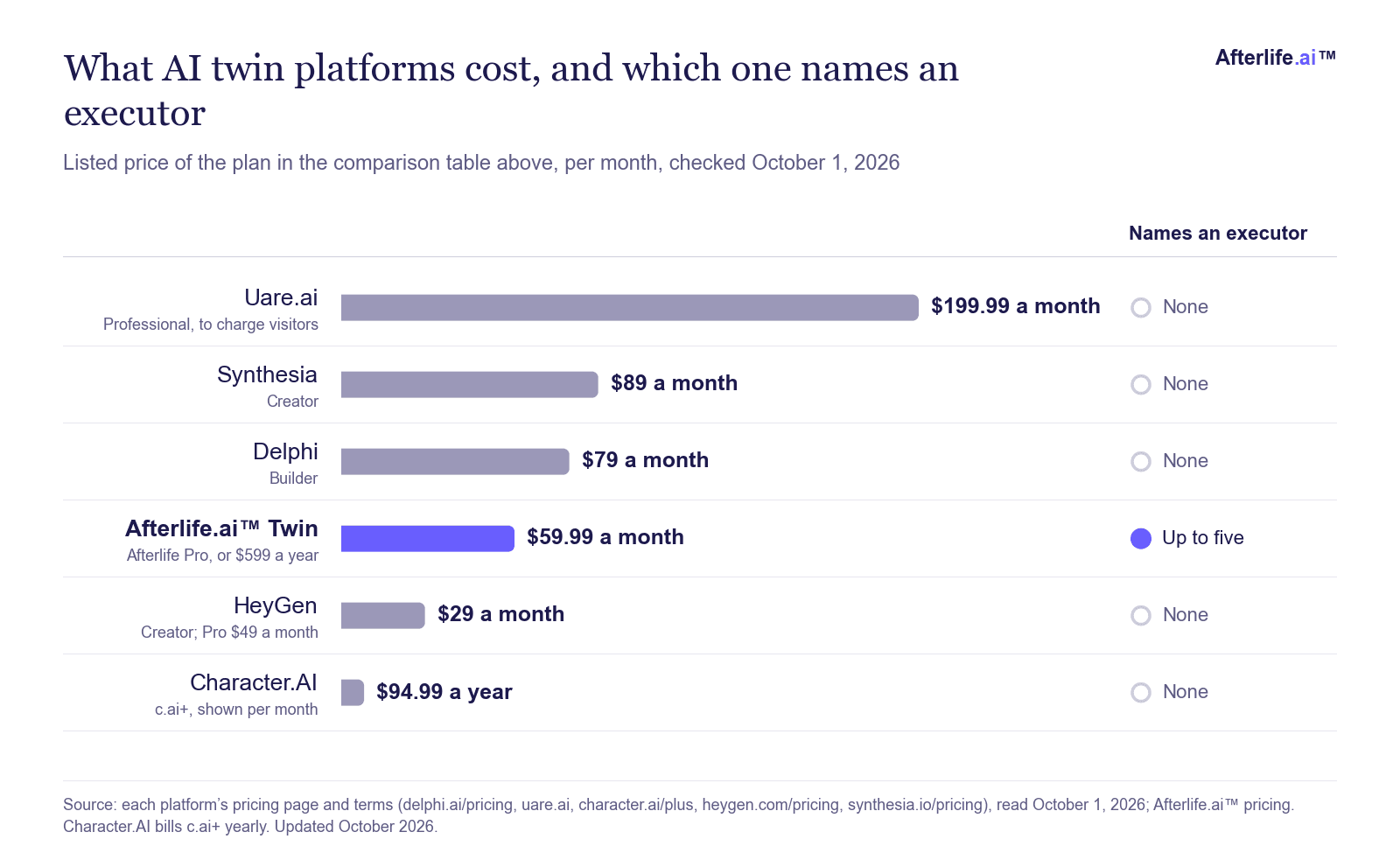
Delphi named its top tier "Immortal", and its Terms and Creator Terms, about 14,600 words between them, never mention death (Delphi pricing; Delphi terms). Charging visitors on Uare.ai needs the $199.99-a-month Professional plan, and Uare.ai keeps 30% of the gross (Uare.ai creator terms, September 23, 2026). Five of the nine platforms we read reserve the right to end accounts for inactivity or lack of use, which is exactly what an account looks like after its owner dies. If you want a face in a marketing video, a video-avatar tool does that job well, and if you want a twin of you that keeps working and passes to the people you chose, Afterlife.ai™ Twin and Timeless AI™ Twin are built for that job. For what to judge a digital twin app on, read the best digital twin apps compared.
What does Afterlife.ai™ Twin cost?
Afterlife.ai™ Twin comes with Afterlife Pro at $59.99 a month or $599 a year, and you can build your Persona free before you pay anything. The yearly price saves $120.88 against twelve monthly payments. Afterlife Pro includes everything in Eternal, which means unlimited memories and storage, your Persona in your own voice and up to five executors, plus your twin on all three doors with 1,000 replies a month in your own cloned voice. If you stop paying, every door pauses at once and nothing you built is deleted.
Plan | Price | What you get |
|---|---|---|
Free | $0, no card, never expires | Your Persona with 25 memories, chat with your Persona, Executor Lock™ setup, your first voice listen and your first Persona Video |
Legacy | $14.99 a month | Your Persona speaks in your own voice, 500 memories, unlimited photos |
Eternal | $29.99 a month | Unlimited memories and storage, your Persona in your voice without limits, up to five executors |
Afterlife Pro with Afterlife.ai™ Twin | $59.99 a month or $599 a year | Everything in Eternal, plus your twin on your website, through the API and inside AI assistants, 1,000 replies a month in your own cloned voice, each door answering after the lock unless you switch the door off |
20-year Legacy | $1,299 once | Everything in Eternal for 20 years, in one payment |
The 80-year plan | $2,999 once | Everything in Eternal for 80 years, in one payment |
A gifted year | Legacy $161.99 or Eternal $319.99 | A year of a plan for one of your people |
For every plan detail, read every Afterlife.ai™ plan and price. For a professional who wants a twin mainly for clients, students or patients, Timeless AI™ Twin, the twin for working professionals, runs on the same engine at the same price, with each door starting off after the lock so the professional switches on only the doors that should continue. Both plans use the same Executor Lock™, so the succession rules on this page apply to either twin, and for the legal side, read who owns your AI twin after you die.
How do you set up an AI twin that passes to your executor?
You can set up the whole thing in an afternoon, and the first two steps are free. The order below is the one that produces the strongest twin, because a twin is only as good as the Persona underneath. Starting with your memories and your voice gives your twin your words and your sound before a single visitor arrives.
Build your Persona free. Talk to your Persona about your life, your work and your values, starting with 25 memories, no card required.
Record your voice and your Persona Video. Your Persona then speaks in your own voice, and one 30-second recording lets Persona Video make messages in your face and voice.
Name your executor and Trusted Contacts. Each person accepts the Executor Lock™ Agreement while you are alive, and you set your release rules for photos, memories and live conversation.
Switch on Afterlife Pro and open your doors. Choose your website, the API, AI assistants or any mix, and try your twin exactly as a visitor will before you open a door.
Add your booking link and set each door's after-lock choice. Give your twin the page where clients book, and decide which doors keep answering after the lock.
Steps one and two are free and need no card, so you can hear your Persona in your own voice before you spend anything. For a deeper guide to the building part, read how to make an AI version of yourself. For the definition of the term, read what a digital twin is, and for the executor's side of the job, read what a digital executor does.
So who decides what your AI twin says after you die?
You do, if you decide now, and someone else will if you do not. The Pelkey family, the Bourdain estate and the Parton family all faced a copy of a person they loved that the person never approved, and each case ended in a courtroom, a public denial or a fact-check. Meta has gone further and patented a way to keep a dead user's account posting, as the Facebook death patent shows. James Earl Jones decided, Robin Williams decided, and Suzanne Somers decided what she wanted, and the first two left nothing to guess. Afterlife.ai™ Twin lets anyone make that decision in an afternoon, with an executor named, a sealed snapshot and a twin that keeps your business and your family answered in your own words.
For employers, faculties, practices and insurers
Give your people twins with Executor Lock™ written in, under one agreement.
Talk to us about twins for your peopleFrequently asked questions
Is there an AI twin that keeps working after I die?
Yes. Afterlife.ai™ Twin keeps answering on the doors you choose after Executor Lock™ seals your Persona, because each door stays on after the lock unless you switch that door off. Your executor carries out your rules, and your Persona stays sealed in the state you left behind. You make the choice door by door, before the lock.
What happens to an AI twin of me when I die?
An executor or Trusted Contact you named reports your death with evidence, a person checks the evidence, and seven days of cooling-off follow. Then your Persona is sealed as a perfect snapshot, each door follows your after-lock choice, and your family's access follows your release rules. Every one of those rules is set by you while you are alive, under the Executor Lock™ Agreement your executor accepted.
Who controls my AI twin after I die?
The executor you named controls your twin, within the rules you set. Your executor can invite the people you named, hand the role on and ask for deletion, and cannot unlock your Persona, edit your memories or change who you are. You can name up to five executors, so the role never rests on one person alone.
Can my family change what my AI twin says after I die?
No. Our Terms call the lock permanent and irreversible (section 8.3), and nothing in the product can change your personality, tone or values after the lock. Your family can still share news with your Persona, such as a wedding or a new baby, and your Persona remembers the news.
Can my company keep using my AI twin after I die?
Yes, if the door your company uses stays on after the lock, which is the default on Afterlife.ai™ Twin. Your staff and customers keep getting your answers from the sealed snapshot of everything you taught, and the executors you named, such as a successor and an operations manager, carry out your rules. That is the simplest protection against key-person risk a founder can buy.
How much does an AI twin of yourself cost?
Afterlife Pro with Afterlife.ai™ Twin costs $59.99 a month or $599 a year and includes 1,000 replies a month in your own cloned voice. You can build your Persona free first, with 25 memories and no card, and prepaid plans for your Persona start at $1,299 for 20 years. In most professions one extra booked client a month covers the plan.
Can I make an AI twin of my mother or father?
You can help, and your parent builds the twin in their own account. Our Terms (section 5.1) bar building a Persona of anyone else without their explicit written consent, publishing a twin is limited to your own Persona, and twins are for people 18 and over. A gifted year of Legacy costs $161.99 and is the easiest way to start a parent on their own Persona.
Does my AI twin sound like me?
Yes. Your Persona speaks in your own cloned voice, your twin answers visitors in your phrasing and that same voice, and Persona Video makes messages in your face and voice from one 30-second recording. The more you tell your Persona, the more your twin sounds like you on every door.
Is an AI twin that outlives me creepy?
A copy nobody authorized is the creepy kind, and those already circulate within a day of a famous death. A twin you built, under rules you wrote, carrying a badge and governed by an executor who can retire the twin, is the respectful answer to a copy that is coming either way.
What if Idy shuts down?
Our Terms of Service pass Idy's obligations to any successor (section 16.4), and the lock stays permanent under section 8.3. You can also prepay your Persona for 20 or 80 years today, so your family's access never depends on a monthly card payment. Idy runs two brands on one platform, with 78 patents pending behind the governance that protects your Persona.
Why does Idy have 78 patents pending?
Idy built the governance first, meaning consent, privacy, verified death, inheritance and who is allowed to change you. The 78 patents pending cover that work, including verified handovers to a named executor and the sealed snapshot behind Executor Lock™, which is why an Idy twin can keep working safely after the owner dies. The patents pending also cover keeping your Persona the same person when the underlying AI models change.
How is Afterlife.ai™ Twin different from Timeless AI™ Twin?
Both run on the same engine, at the same price and under the same Executor Lock™. Afterlife.ai™ Twin is built for your whole life, your family and your business, with each door answering after the lock unless you switch the door off, while Timeless AI™ Twin is built for working professionals, with each door starting off so you switch on only the doors that should continue. Pick the one that matches the main reason you are building, because you can change every setting later.
How we researched this page
We read the published terms and pricing pages of Delphi, Uare.ai, Character.AI, Tavus, HeyGen, Synthesia, Coachvox AI, Sensay and CustomGPT.ai (about 85,000 words, checked October 1, 2026), the Harvard Business Review lead-response study, the eGain and Deloitte retirement report, court and news reports from the United States, Germany, South Korea, Japan and China, the University of Cambridge and Lehigh University research cited above, and the statutes linked in the law section. Every outside fact links to its source and date.