

ChatGPT Prompts to Interview Your Parents
The best ChatGPT prompts to interview your parents make ChatGPT your question coach: your parent talks, you type, and ChatGPT hands you the next question and the follow-up that gets the real story. Here are 40. To keep their stories in their own voice, help them build a Persona on Afterlife.ai™.
As seen in












Most people who mean to interview their parents stall after the first few questions, and the stories wait for a better weekend that may not come. ChatGPT fixes the hardest part, which is knowing what to ask next. You sit with your mom or dad, they talk, and ChatGPT hands you one plain question at a time, then the follow-up that turns "we moved a lot" into the night the truck broke down outside Amarillo. The 40 prompts below run in the order an oral historian would use, from childhood to the hard years, and every one tells ChatGPT to invent nothing.
What you need:
ChatGPT on a laptop or phone, a second phone to record the audio, and a quiet table with coffee.
How long it takes:
30 to 45 minutes a session, once a week. Eight Sundays covers most of a life.
Who does the talking:
your parent. You type a short note of each answer and read out the next question.
What you end up with:
their stories in their own words, a family timeline, a list of everyone they mention, and a recording of their real voice.
How do you interview your parents with ChatGPT?
Treat ChatGPT as your question coach. Create one ChatGPT project for each parent, paste the coach prompt below into the project's instructions, and every chat in that project follows it. Your parent never has to touch the laptop: they talk, you type a short version of each answer, and ChatGPT replies with one question and one follow-up. Record the conversation on a second phone as well, because the recording is the only copy of their real voice, and ChatGPT's memory keeps a summary rather than every word (OpenAI Help Center, 2026).
The coach prompt:
"You are my interview coach. I am interviewing my [mother], [Carol], born in [1948] in [Dayton, Ohio]. She talks and I type short notes of her answers. After each note, give me one plain, warm question to ask her next and one follow-up that asks for a name, a place, a date or what someone actually said. Never invent people, places, dates or feelings, and never put words in her mouth. Keep a running timeline of every year, place and person she mentions and show it when I type TIMELINE. Keep every question short enough to read out loud."
The first message:
"Today we start with her childhood. Give me the first question, and keep each question to one sentence."
Ask permission before you press record, and tell them who will hear it. Some U.S. states require everyone in a private conversation to agree to a recording, so ask out loud and keep the yes on the tape. If you want more questions to choose from, our list of questions to ask your parents before they die and the separate lists for your mom and your dad work well beside these prompts, and for your own story there are our ChatGPT prompts for writing your life story. Interviewing a grandparent instead? See how to interview your grandparents. If your parent would rather use ChatGPT on their own, our guide to ChatGPT for seniors starts from zero.
What should you ask your parents about their childhood?
Start with places and people, never feelings. A parent who freezes at "how did you feel growing up?" will talk for twenty minutes about the kitchen table. These eight prompts open the first two sessions; paste each one into the project when you get there. To go back further than your parents' own memories, use our ChatGPT genealogy prompts.
The house:
"Ask her to walk me through the house she grew up in, room by room, and give me a follow-up whenever she mentions a person."
Their parents as people:
"Give me five questions about her parents as people, not only as parents: their jobs, their tempers, their jokes and what they argued about."
An ordinary weekday:
"Ask what an ordinary weekday looked like when she was ten, from breakfast to bedtime."
Food and money:
"Ask what the family ate when money was tight, and who did the cooking."
School:
"Ask about the teacher she remembers best, and follow up on something that teacher actually said."
Trouble:
"Ask about the worst trouble she got into as a kid and what her own mother or father did about it."
The street:
"Ask her to name the families on her street and what each one was known for."
The radio and the TV:
"Ask what was on the radio or TV in her house, and which show the whole family stopped for."
Christmas gift
The gift that talks back.
Give Mom, Dad, your grandparents or your kids their own Persona for a year. Their Persona asks the questions, they just talk, and every story is kept in their own voice.
Give it for US$149One payment, no subscription. We email you the code straight away, ready for Christmas morning.
What should you ask about their work, money and early years?
The years between 18 and 35 are the ones children know least about. Your parent had a whole life before you arrived, with bosses, rent, friends and plans that changed. These prompts cover the third and fourth sessions.
Leaving home:
"Ask about the day he left his parents' house, starting with the day before."
The first paycheck:
"Ask about his first job, his first paycheck and the first big thing he bought with his own money."
Every address:
"Ask him to list every place he has lived, in order, with the rent and the reason he left."
The work itself:
"Ask what he actually did all day at work, the hardest week he had and what he was proudest of."
The boss:
"Ask about the boss he learned the most from, and the one he couldn't stand."
Service:
"My dad served in the [Army] from [1966] to [1969]. Ask about basic training, his friends and daily life, and let him skip anything."
Friends:
"Ask about the friends who mattered between 18 and 30 and what happened to each friendship."
Money lessons:
"Ask what he wants his grandchildren to know about money, and which mistake taught him that."
Five follow-ups that turn a short answer into a story
1. The day before: ask what happened just before the big moment
Parents tend to summarize their own milestones in one line. Ask "What happened the day before?" and they walk back into the scene: the weather, the argument, the phone call. Prompt: "When she mentions a big moment, give me a question about the day before it."
2. Who else was there: ask for names
A story with names in it can be checked, shared and remembered. Ask who drove, who cooked and who said no. Prompt: "After each answer, list the people she mentioned and give me a question about the one she skipped."
3. What was said: ask for the actual words
"My father was strict" becomes a story the moment you ask what he actually said. Prompt: "Give me a follow-up asking for the exact words someone used, if she remembers them."
4. What it cost: ask for prices and pay
Dollar amounts anchor a memory in its year and make grandchildren pay attention. Prompt: "When she mentions buying, renting or earning anything, ask what it cost."
5. How they would tell it now: ask what they understand today
End each story by asking what they make of it now. That is where a life story turns into advice the family can use. Prompt: "At the end of each story, give me a question asking what she thinks about it now."
How do you ask about love, marriage and becoming a parent?
Ask about meeting before you ask about marriage. Most couples have a polished version of how they met, and the real story sits in the details around it. These prompts work best in sessions five and six, once your parent trusts the format.
How they met:
"Ask how she met my dad, then ask how she thinks he would tell the same story."
The wedding:
"Ask about the wedding day: who came, what went wrong and what it cost."
The hard year:
"Ask which year of the marriage was hardest and what got them through it, and let her answer as briefly as she wants."
The day I was born:
"Ask what she remembers about the day I was born, and what she was worried about that week."
Raising us:
"Ask what she was trying to do differently from her own parents when she raised us."
Each child:
"Ask her to describe each of her children as a little kid in three words, and the story behind each word."
Beliefs:
"Ask what she believes now that she didn't believe at 20, and what changed her mind."
The grandchildren:
"Ask what she wants each grandchild to know about her when they're grown."
How do you ask about the hard chapters?
Go slowly and give them an exit. Loss, illness, migration and family rifts are often the stories that matter most to the next generation, and they are the ones a parent is least likely to volunteer. Tell ChatGPT to keep these questions gentle, and say out loud that any question can be skipped.
Loss:
"Ask about the first time someone close to her died and how her family handled it. Keep the questions gentle and let her stop."
A mistake:
"Ask about a mistake she still thinks about. Don't comfort her; ask what happened and what she'd do now."
Coming to America:
"My parents came to [Chicago] from [Guadalajara] in [1974]. Ask about the trip, the first week and what they left behind."
The lean year:
"Ask about the year money was tightest and how the family got through it."
History up close:
"Ask where she was on [the day of the moon landing] and what her family said about it."
The rift:
"Ask about a family argument that changed who spoke to whom, and let her decide how much to say."
Health:
"Ask about the health scare that changed how she lives, only if she wants to talk about it."
Her own mother:
"Ask what she wishes she had asked her own mother."
What do you do with their answers after each talk?
Spend ten minutes after each session while it is fresh. These prompts turn your notes into something the family keeps, and they set up next week's questions. Copy each finished piece into your own document the same day, and when the stories pile up, our plan for writing a book about a life with ChatGPT turns them into chapters.
Their words:
"Turn my notes from today into a summary in her own words, in first person, and mark anything you inferred with a question mark."
Next week:
"List five questions for next week, based on the gaps in today's answers."
The timeline:
"Update the family timeline by decade and show me which years are still empty."
The cast:
"List every person she named today with one line on who they are."
The checks:
"List every date and place she mentioned so I can check them against photos and papers."
The skipped part:
"When she tells a story I already know, give me a question about the part she always skips."
One story, written up:
"Write up her story about [the 1978 ice storm] in first person, using only her words, and mark anything I should check."
The permission note:
"Help me write a short note asking her permission to record and share her stories, saying who will hear them."
What if your parent says there's nothing to tell?
Almost every parent says this at first. It usually means "I don't know where to start," so start somewhere physical. These four openings work on the most reluctant parent.
Start with a photo:
put one old picture on the table and ask who took it.
Start with an object:
a watch, a recipe card or a tool from the garage holds a story.
Ask for instructions:
"How did you make your mother's pie?" gets more than "Tell me about your mother."
Ask for an opinion:
"What did your generation get right that mine doesn't?" gets a parent talking fast.
Where does ChatGPT fall short for your parents' stories?
ChatGPT is an excellent question coach and a poor place to keep a parent's life. It stores a memory summary that skips details, it has no copy of your parent's voice (ChatGPT Voice speaks in preset voices such as Breeze and Juniper), and the account cannot pass to the family under OpenAI's Terms of Use. Only 10% of Americans 65 and older had used ChatGPT by early 2025 (Pew Research Center, 2025), so the person whose stories you want is rarely the one at the keyboard.
Question | ChatGPT with these prompts | Your parent's Persona on Afterlife.ai™ |
|---|---|---|
Who asks the questions? | You read them out each session | Afterlife.ai™ asks your parent directly, out loud or in writing |
Whose voice is kept? | None: preset voices only | Your parent's own voice, cloned from their answers |
What is kept? | Your notes and a memory summary | Every memory they add, 25 free |
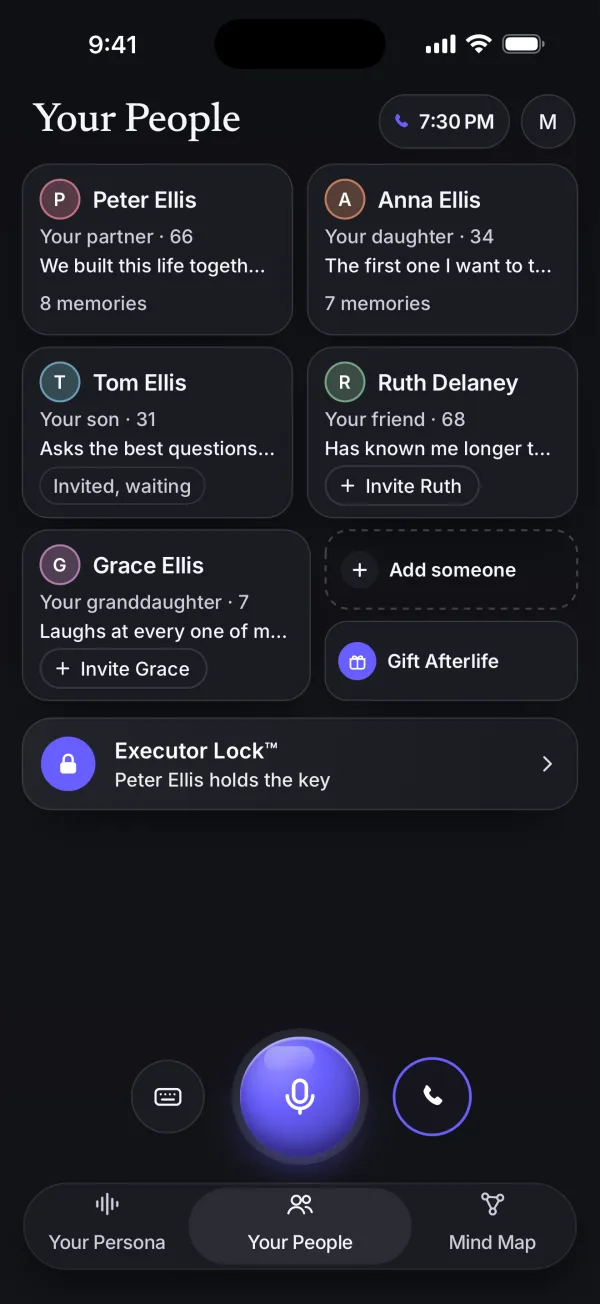
Can grandchildren ask questions later? | No | Yes: their Trusted Contacts can talk with their Persona after the Executor Lock™ |
Who is in control? | Your ChatGPT account | Your parent, who names their people and their executor |
Cost to start | Free plan available | Free build, no card |
Example: eight Sundays with one parent
Here is how eight sessions could run, at about 40 minutes each. It is an example plan, not a rule; follow your parent wherever the stories go.
Week 1:
the house they grew up in and their own parents.
Week 2:
school, trouble and the street they lived on.
Week 3:
leaving home, first jobs and every address since.
Week 4:
work, money and the friends who mattered.
Week 5:
how they met your other parent, and the wedding.
Week 6:
becoming a parent and raising you.
Week 7:
the hard chapters, with every question optional.
Week 8:
what they believe now and what they want their grandchildren to know.
How your parent tells their stories on Afterlife.ai™
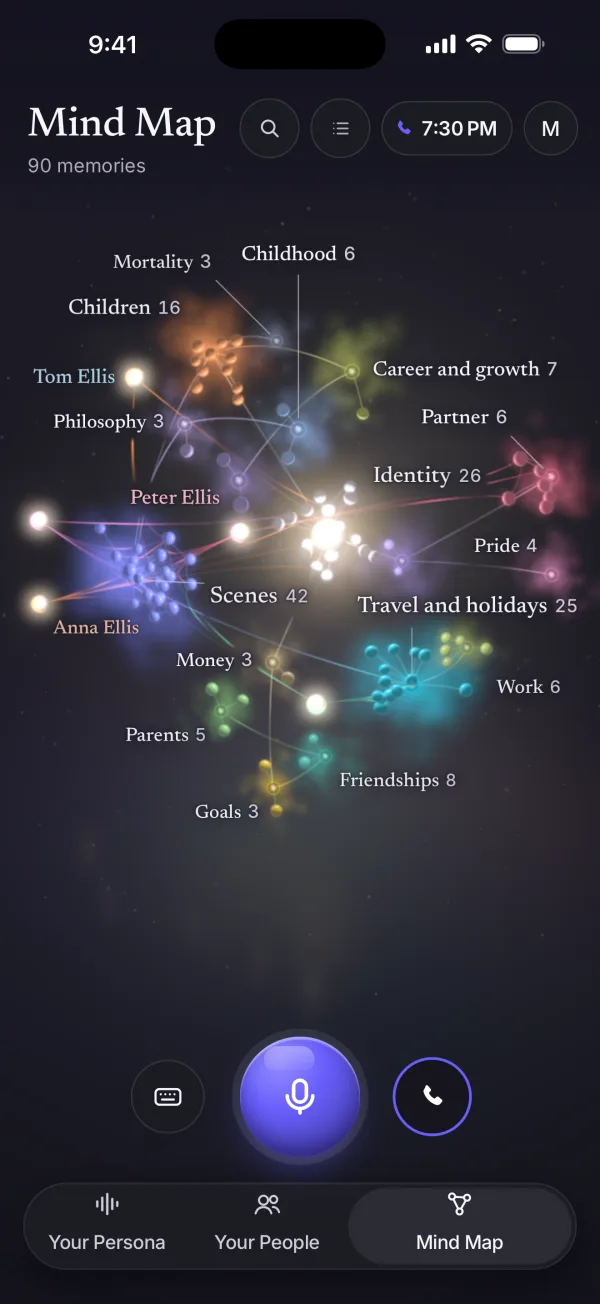
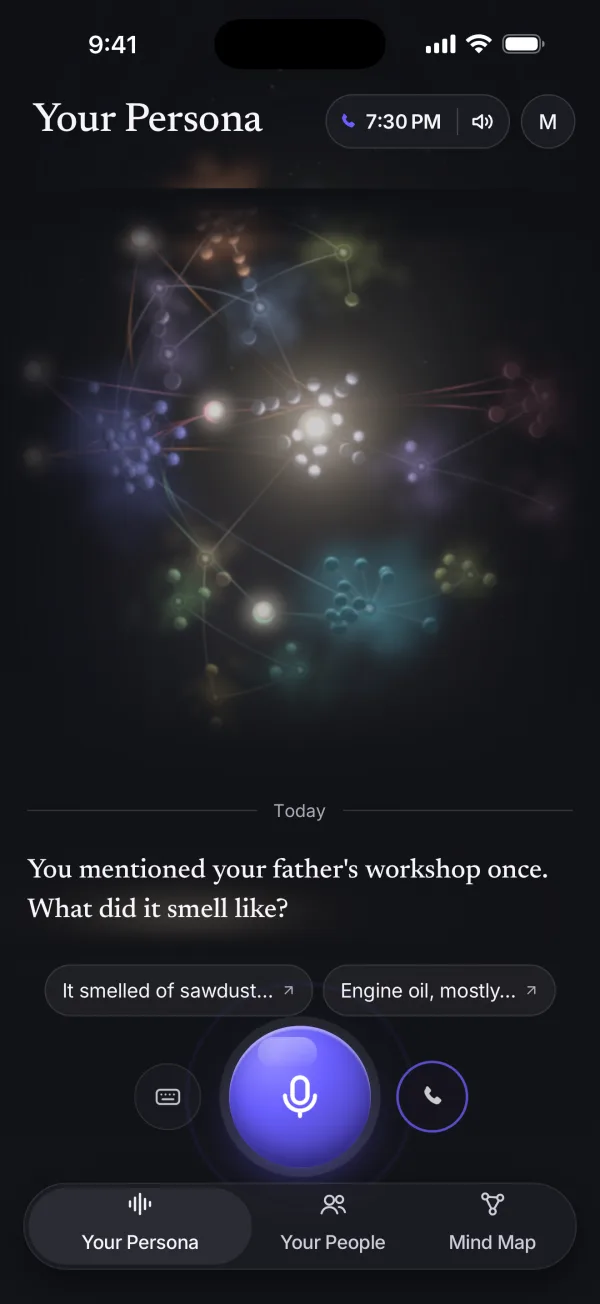
Let them just talk. Afterlife.ai™ turns the interview into the product: the questions come to your parent, every answer is kept, and their stories stay in their own voice for the people they choose. You can sit beside them for the first session and leave the rest to them.
Their own account:
your parent signs up free at app.afterlife.ai or in the iPhone or Android app, with you beside them. The Persona is theirs and every decision is theirs.
Just talk:
they choose "Just talk" and answer three questions out loud, and their voice is cloned from those answers.
A question every day:
each day the room opens on a new question, so there is never a blank page.
Every memory kept:
the free build keeps 25 memories, with no card, and it never expires.
Their people:
they add up to 5 Trusted Contacts free, who can talk with their Persona after the Executor Lock™.
Messages for later:
they can keep a written or spoken message for a grandchild that opens on a date they choose, and our legacy letter prompts help them write it.
More room:
Legacy keeps going past 25 memories for US$14.99 a month, and you can give them a year as a gift.
Afterlife.ai™ never recreates a person who did not consent while alive. Your parent builds their own Persona, in their own words, and the app's screens come in 42 languages, so a parent who would rather talk in Spanish, Vietnamese or Hindi can. For the recording itself, see how to record your parents' life story and how to preserve a parent's voice.
Frequently asked questions
What questions should I ask my parents before they die?
Start with the house they grew up in, their own parents, their first job, how they met your other parent and what they want their grandchildren to know. Places and people get a parent talking far faster than feelings do. Our list of questions to ask your parents before they die has many more to choose from.
How do I get my parents to open up?
Ask about places, objects and instructions before you ask about feelings, and keep each session under 45 minutes. A photo on the table, a recipe or "how did you fix the car?" will open a parent who says there is nothing to tell. Let them skip any question, and they will usually come back to it.
Can ChatGPT interview my mom for me?
ChatGPT can ask the questions out loud in ChatGPT Voice, but most parents over 65 have never used it, so the best results come from sitting beside them and reading ChatGPT's questions yourself. If your mom would rather talk to something directly, her own Persona on Afterlife.ai™ asks her the questions out loud and keeps her answers in her own voice.
How do I record my parents' stories?
Use the voice memo app on a second phone, placed close to your parent, and type short notes into ChatGPT as they talk. Save each recording in two places the same day. Our guide to recording your parents' life story goes further.
Do I need permission to record my parents?
Yes. Ask first and record the yes, because some U.S. states require everyone in a private conversation to agree to a recording. Tell your parent who will hear the stories, and let them mark anything as private.
How long should each interview be?
Thirty to 45 minutes, once a week. Older adults tire faster than they admit, and a short session that ends on a good story makes the next one easier to start.
Can my parent tell their stories in their own language?
Yes. The Afterlife.ai™ app's screens come in 42 languages, and your parent's Persona answers in the language they use, so a parent who thinks in Spanish, Vietnamese or Hindi can tell their stories the way they would tell them at home.
Can I make a Persona of my parent after they die?
No. Afterlife.ai™ never recreates a person who did not consent while alive. Your parent builds their own Persona, choosing every memory that goes in and everyone who may talk with their Persona later.
Is Afterlife.ai™ free?
Yes. The free build gives your parent 25 memories, up to 5 Trusted Contacts and Executor Lock™ setup, with no card, and it never expires. Legacy is US$14.99 a month, Eternal is US$29.99 a month, and you can give a year of either as a gift (see pricing).
Your story is worth keeping.