

ChatGPT Prompts for Genealogy and Family History
The best ChatGPT prompts for genealogy make it a research assistant that never guesses: it plans searches, explains records and turns your tree into stories, and every prompt forbids invented names and dates. Here are 35. For the stories no archive holds, record your family in their own voices on Afterlife.ai™.
As seen in












ChatGPT is a fast, tireless genealogy assistant with one dangerous habit: when it doesn't know an ancestor's birth year, it may supply one. Every prompt on this page fixes that by asking for sources and labeling guesses, in the spirit of the Genealogical Proof Standard that professional genealogists work to (Board for Certification of Genealogists). Use ChatGPT to plan, read, organize and write. Use the records to prove.
Good at:
research plans, explaining old terms and record types, translating transcribed records, timelines and family narratives.
Bad at:
facts about your particular ancestors, which it can invent with total confidence.
The rule:
every claim needs a source you can open yourself. ChatGPT's answer is a lead, never a citation.
Keep private:
living relatives' details and DNA results. Work with names and dates of people who have died.
How should genealogists use ChatGPT?
Make it work to your standards, not its own. The Genealogical Proof Standard asks for five things: reasonably exhaustive research, complete and accurate citations, analysis and correlation of the evidence, resolution of conflicting evidence, and a soundly reasoned written conclusion. ChatGPT can help with every one of them except the first-hand looking, which is still yours. Paste the rules prompt into a ChatGPT project's instructions, switch off "Improve the model for everyone" in Data controls (OpenAI Help Center, 2026), and keep your research log in the same project.
The rules prompt:
"You are my genealogy research assistant. Never invent a name, date, place or relationship. Label everything you tell me as FACT (with the source I gave you), INFERENCE (with your reasoning) or QUESTION. When you suggest a record, say which repository is likely to hold it and what it would prove. Keep a research log of every search I report, including the ones that found nothing."
The log entry:
"Add to the log: I searched the [1940 census] for [Anton Kowalski] in [Hamtramck, Michigan] on [FamilySearch] and found no match under that spelling."
What are the best ChatGPT prompts for a genealogy brick wall?
Start with what you know, then widen the search. Brick walls usually fall to a record type you have not tried, a spelling you have not guessed or a neighbor who left better papers. These eight prompts make ChatGPT plan instead of guess.
The research plan:
"Here is everything I know about [Mary O'Neill], with sources. Write a research plan: the question, the records to search in order, and what each record could prove."
What exists:
"Which kinds of records would exist for a family in [Luzerne County, Pennsylvania] between [1880] and [1920], and where are they usually held? Say if you are unsure."
Name variants:
"List likely spelling variants of [Kowalski] in English-language records, including clerks' common mistakes."
Migration routes:
"What routes and ports did people commonly use to travel from [County Cork] to [Boston] in the [1850s]? Mark anything you are unsure of."
The neighbors:
"Help me build a list of the friends, associates and neighbors who appear with [John Miller] in these records, so I can research them too."
Conflicts:
"These two records give different birth years for the same man. List the ways each could be wrong and which records could settle it."
Missing years:
"Here is my timeline for [Clara Brandt]. Show me the gaps longer than five years and suggest one record type for each."
What would prove it:
"I believe [William Hayes] is the son of [Thomas Hayes]. What evidence would prove it, and what would disprove it?"
Christmas gift
The gift that talks back.
Give Mom, Dad, your grandparents or your kids their own Persona for a year. Their Persona asks the questions, they just talk, and every story is kept in their own voice.
Give it for US$149One payment, no subscription. We email you the code straight away, ready for Christmas morning.
How can ChatGPT help you read old records?
Transcribe first, then ask. ChatGPT can look at a photo of a document, but faded handwriting and old scripts trip it up, so type out what you can read and let ChatGPT explain the rest. Check every word it reads against the original image.
Census columns:
"Explain every column of the [1900 U.S. census] population schedule and what each abbreviation means."
Abbreviations:
"Here is my transcription of a parish register entry. Expand every abbreviation and flag any word you are unsure of."
Translation:
"Translate this transcribed [Polish] baptism record word for word, then summarize who is named and in what role."
Old jobs:
"What was a [cordwainer], and where would records of that work survive?"
Old dates:
"This record is dated [the Feast of Saint Michael, 1734]. What date is that, and should I worry about the old-style calendar?"
Passenger lists:
"Explain each column of this transcribed passenger manifest and what the notes in the margin usually mean."
Obituary to family sheet:
"Turn this obituary into a family group sheet, listing each person with the relationship the obituary states."
5 questions to ask before you trust an AI answer about an ancestor
1. Where would that record be: ask for the repository
A real fact lives in a real record held somewhere. If ChatGPT can't say which archive, courthouse or database would hold it, treat the claim as a guess. Prompt: "Which repository would hold the record that proves this?"
2. Can I open it myself: ask for the record, not the summary
An answer you can't check is not evidence. Find the record or an image of it before the fact goes in your tree. Prompt: "What exactly would I search for to find this record myself?"
3. Original or derived: ask what kind of source it is
A transcription, an index or a family tree online is a derived source and can carry someone else's mistake. Prompt: "Is this an original record, a derivative or an authored work, and how reliable is that kind of source?"
4. Does it conflict: ask what disagrees with it
The Genealogical Proof Standard asks you to resolve conflicting evidence, not ignore it. Prompt: "Which of my records disagree with this, and how could the conflict be resolved?"
5. What would prove it wrong: ask for the test
A good conclusion survives a search for the evidence against it. Prompt: "What record, if I found it, would prove this conclusion wrong?"
Which prompts help you interview living relatives?
The oldest living relative is the archive that closes first. Census sheets tell you where a family lived; only the people who were there can tell you what it was like. These prompts turn ChatGPT into an interview coach for an aunt, a grandparent or a great-uncle, our life story questions and questions to ask your parents before they die add more, and for a full series of sessions with a parent, use our ChatGPT prompts to interview your parents.
The coach prompt:
"I'm interviewing my great-aunt [Ruth], born [1938] in [Toledo, Ohio]. She talks and I type notes. After each note, give me one question and one follow-up asking for a name, a place or a date. Never invent anything."
Names on photos:
"Here is a photo from about [1950]. Give me five questions to ask Ruth about who is in it and where it was taken."
The old country:
"Ask what Ruth's grandparents said about the place they came from, and what they never talked about."
The family names:
"Ask what everyone in the family was called at home, including nicknames, and who was named after whom."
The black sheep:
"Ask about the relative nobody talked about, and why."
Who is missing:
"Ask who isn't in the family tree but should be: stepchildren, foster children, first marriages, babies who died young."
The recipes:
"Ask which dish came from the old country and who made it best."
After the talk:
"Turn my notes into a summary in Ruth's own words, and list every name, date and place for me to check."
How do you turn a family tree into family stories?
Facts become stories when you add place and time. Your tree says Anton was a coal miner in 1910; history says what that meant for a family of seven. These prompts write narratives that keep your sources attached.
A life sketch:
"Write a 300-word life sketch of [Anton Kowalski] using only the facts and sources I've given you, with a footnote for each fact."
The setting:
"What was daily life like for a [coal miner's family] in [Luzerne County] around [1910]? Give general history only and say what I should verify."
Life against history:
"Set this timeline for [Clara Brandt] against the major events of her lifetime that would have touched her town."
For the cousins:
"Write a one-page summary of the [Hayes] line for cousins who know nothing about it, with the sources listed at the end."
Where they lived:
"List every address in these records in order, with the years, so I can map the family's moves."
One story, told well:
"Turn these three records about [Mary's emigration in 1883] into a short story, and mark every sentence that is inference."
The census year:
"The 1950 U.S. census opened to the public on April 1, 2022. Which of my relatives should I look for in it, based on my tree?"
Where does ChatGPT go wrong in family history?
ChatGPT's mistakes in genealogy follow a pattern. Knowing them makes them easy to catch.
Problem | What it looks like | The fix |
|---|---|---|
Invented ancestors | A confident birth year, parent or village with no record behind it | The rules prompt, and a source you can open for every fact |
Outdated record facts | Wrong advice about which records are online or where they sit | Check the archive's own website before you plan a trip |
Merged people | Two men of the same name treated as one | Ask for every record that ties the two together |
Lost detail | A research log reduced to a summary between chats | Keep your log in your own document, not only in ChatGPT's memory |
Privacy | Living relatives' details in a chat | Work only with people who have died, and switch off model training |
What chapter should you write for your own descendants?
You are next on the tree. Every genealogist knows the frustration of an ancestor who left a name and a date and nothing else. Spend one session on yourself with these prompts, and your great-grandchildren will never have that problem. For the full story, our plan for writing a book about your life with ChatGPT takes it to print, and our legacy letter prompts capture what you believe.
Interview me:
"Interview me about my own life, the way I wish I could interview my great-grandmother. One question at a time, and invent nothing."
My research:
"Ask me why I started researching our family and what I found that surprised me most."
The house:
"Ask me about the house I grew up in, room by room."
What I want kept:
"Ask me which three family stories I most want my descendants to know, and record each one in my words."
A letter forward:
"Help me write a short letter to my great-grandchildren about who our family was."
The record no archive holds: your family's voices on Afterlife.ai™
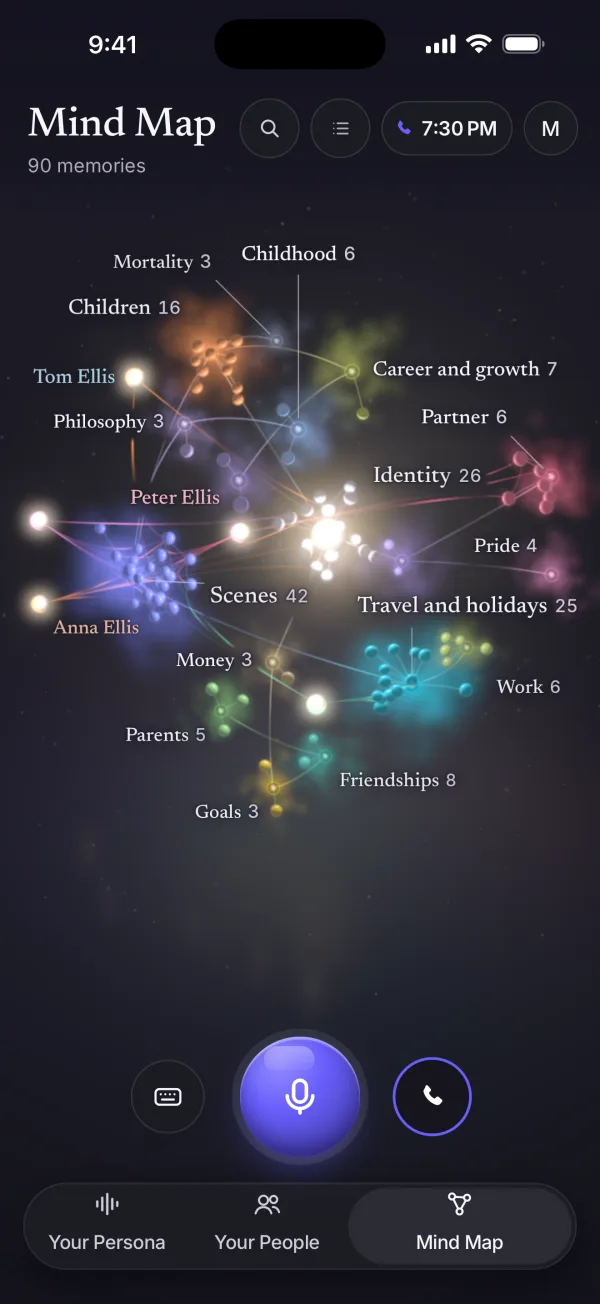
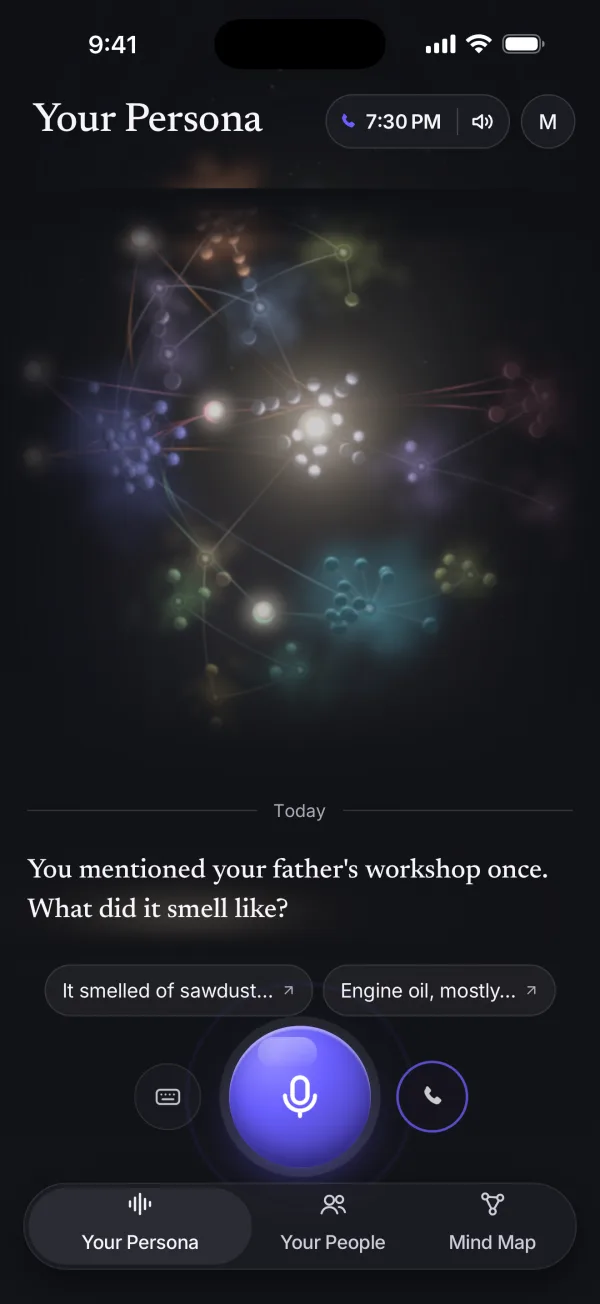
No archive keeps a voice. Census sheets, ship lists and gravestones will outlast us all, but the way your grandmother told the story of the crossing disappears with her. Afterlife.ai™ keeps that part: each person builds a Persona from their own stories, in their own voice, for the people they choose.
Your own Persona:
you are the family historian, so start with yourself. Sign up free at app.afterlife.ai and answer three questions out loud with "Just talk"; your voice is cloned from your answers.
An elder's own Persona:
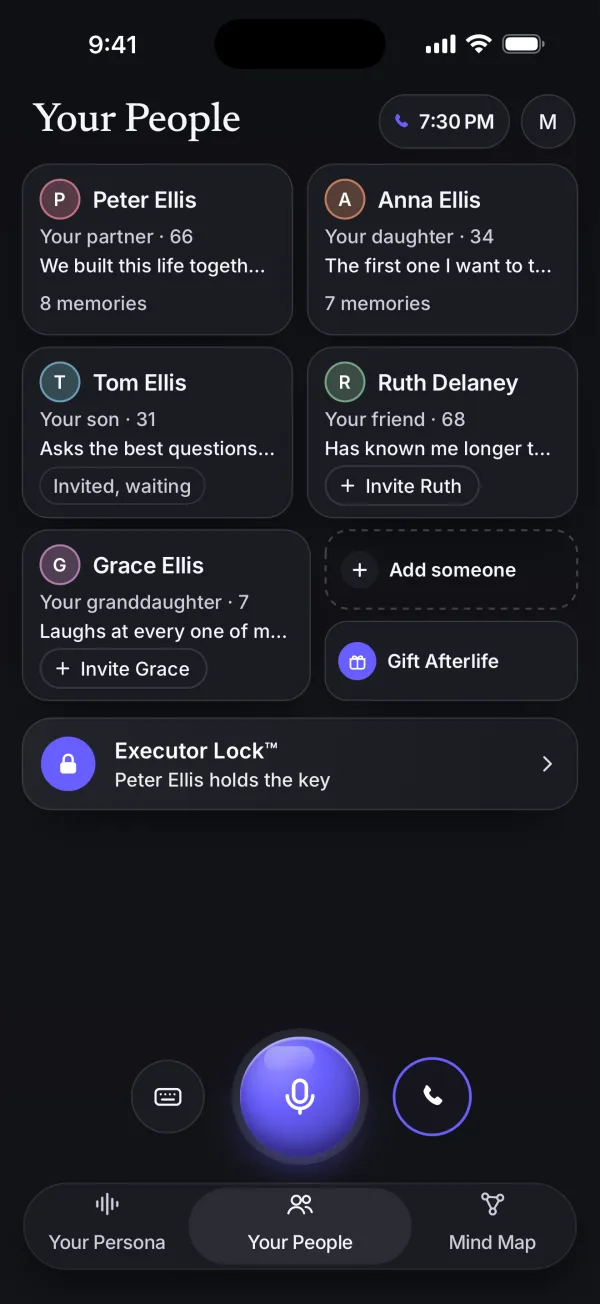
your oldest relative builds their own, with you beside them. Afterlife.ai™ never recreates anyone who did not consent while alive.
Your documents:
in the Mind Map, Add Files reads PDF and Word documents into memories your Persona can draw on, and audio and video recordings are transcribed.
Your people:
add up to 5 Trusted Contacts free, who can talk with your Persona after the Executor Lock™.
Free to start:
25 memories, no card, and the free build never expires. Legacy keeps going for US$14.99 a month (see pricing).
For more on saving a family's history, read the best way to preserve family history, how to interview your grandparents and our ChatGPT prompts for writing your life story.
Frequently asked questions
Can ChatGPT build my family tree?
No. ChatGPT can organize the facts you give it into a tree, a timeline or a family group sheet, but it cannot find your ancestors in records, and it may invent them if asked. Use it to plan searches and arrange what you have proved.
Is ChatGPT accurate for genealogy?
It is accurate about how records and research methods work and unreliable about specific ancestors. Treat every name, date or relationship it offers as a lead to check, and never enter one in your tree without a source you have opened yourself.
What is the best ChatGPT prompt for a genealogy brick wall?
Give ChatGPT everything you know with sources and ask for a research plan: the question, the records to search in order and what each could prove. Then ask which records in that time and place you have not tried yet.
Can ChatGPT read old handwriting?
ChatGPT can look at a photo of a document, but faded ink, old scripts and unusual abbreviations trip it up. Transcribe what you can, ask ChatGPT to explain or translate your transcription, and check every word against the original image.
Is it safe to put my family tree into ChatGPT?
Keep living people out of it, never paste DNA results, and switch off "Improve the model for everyone" in Data controls. Names and dates of people who have died are the safest material to work with.
When was the 1950 census released?
The 1950 U.S. census was released to the public on April 1, 2022, 72 years after it was taken, and the 1960 census is due in 2032 (National Archives).
Can I add my family history documents to Afterlife.ai™?
Yes. Add Files in the Mind Map takes PDF and Word documents and turns their text into memories your Persona can draw on. Audio and video recordings are transcribed too.
Is Afterlife.ai™ free?
Yes. The free build gives you 25 memories, up to 5 Trusted Contacts and Executor Lock™ setup, with no card, and it never expires. Legacy is US$14.99 a month and Eternal is US$29.99 a month.
Your story is worth keeping.