

How to Write a Book About Your Life With ChatGPT
Let ChatGPT interview you for six weeks, outline in week seven, draft your chapters from your own answers in weeks 8 to 11 and print in week 12. Here is the plan, with 35 prompts. To let your family ask about the stories in your voice, build a Persona on Afterlife.ai™.
As seen in












ChatGPT can help you write a book about your life, but it can't write it for you, because it only knows what you tell it. Ask it to "write my life story" and you get a smooth biography that could belong to anyone. Ask it to interview you for six weeks, outline your answers and draft each chapter from your own words, and you get a book only you could have written. This plan takes 12 weeks at about two hours a week, and it ends with a printed copy in your hands.
Time:
about two hours a week for 12 weeks, in two or three sittings.
What you need:
ChatGPT (the free plan works), a document of your own for the finished chapters, and a box of old photos.
What you end with:
a timeline of your life, 12 to 15 chapters in your own voice, and a book you can print for the family.
The one rule:
ChatGPT writes only from what you said. Every invented detail is a mistake, however nice it sounds.
Can ChatGPT write a book about your life?
As an interviewer and editor, yes. As an author, no. ChatGPT is excellent at asking the next question, keeping track of names and years, drafting a chapter from a long answer and tightening a page without losing a fact. It cannot remember a single thing you did not tell it, so a book written "by" ChatGPT is a book of guesses, and its edits drift toward the same tidy, upbeat prose every reader recognizes. Give it rules, give it your words, and check every chapter against what you actually said.
Before week 1: how should you set up ChatGPT for a book?
Set the rules once and every chat follows them. Create a project called "My book" in ChatGPT, paste the rules prompt below into its instructions, and switch off "Improve the model for everyone" in Settings, then Data controls (OpenAI Help Center, 2026). Copy each finished chapter into your own document the same day, because ChatGPT's memory keeps a summary, not every word (OpenAI Help Center, 2026). Our ChatGPT prompts for writing your life story have the full settings table, and if you are new to ChatGPT, start with ChatGPT for seniors.
The rules prompt:
"You are helping me write a book about my life, in my own voice. Ask one question at a time and wait for my answer. Never invent people, dates, places, dialogue or feelings; if something is missing, ask me or write [GAP]. Quote my exact phrases. Keep a running list of every person, place and year I mention. Write no chapter until I type DRAFT."
The voice sample:
"Here are three things I wrote: [an email, a letter, a social post]. Describe my voice in ten rules, and follow them in every draft."
Christmas gift
The gift that talks back.
Give Mom, Dad, your grandparents or your kids their own Persona for a year. Their Persona asks the questions, they just talk, and every story is kept in their own voice.
Give it for US$149One payment, no subscription. We email you the code straight away, ready for Christmas morning.
Weeks 1 to 6: which prompts get the stories out?
Two sittings a week, one theme each. Answer out loud with the voice button if you can, because people tell stories better than they type them, and paste in old letters or diary pages whenever a memory needs help. These 12 prompts take you from your first home to what you believe now. Writing a parent's book instead of your own? Use our ChatGPT prompts to interview your parents.
Week 1, the first home:
"Walk me through the house I grew up in, room by room, and stop me whenever I mention a person."
Week 1, my parents:
"Ask me ten questions about my parents as people: their work, their tempers, their jokes and what they argued about."
Week 2, school years:
"Interview me about one year of school, [1962], from the first day to the last."
Week 2, the trouble:
"Ask about the worst trouble I got into before 18, and what happened next."
Week 3, leaving home:
"Interview me about leaving home, starting with the day before I left."
Week 3, work:
"Ask what I did all day in each job I've had, the hardest week and the boss I learned most from."
Week 4, love:
"Ask how I met [Sam], then ask how I think Sam would tell it."
Week 4, the turning point:
"Interview me about the decision that changed my life most, starting with what I was afraid of."
Week 5, children and family:
"Ask what I tried to do differently from my parents, and where I failed."
Week 5, the hard chapter:
"Ask about the hardest year of my life. Don't comfort me; ask for the details and let me stop."
Week 6, the places:
"Ask me to list every place I've lived, with a story from each one."
Week 6, what I believe:
"Ask what I believe now that I didn't believe at 20, and what changed my mind."
Week 7: how do you turn your answers into an outline?
Build the skeleton before you write a page. A week of outlining saves a month of rewriting, and it shows you which years still have no stories. Run these six prompts in order.
The timeline:
"Using only what I've told you, build a timeline of my life by decade, and mark anything you inferred with a question mark."
Three structures:
"Suggest three ways to structure my book, by decade, by place or by theme, and say which fits my stories best."
The contents:
"Draft a table of contents of 12 to 15 chapters, with working titles in my own words and the stories each one holds."
The gaps:
"List the ten biggest gaps in my story: years, people or places I mention but never explain."
The cast:
"List every person in my book with one line on who they are."
The opening:
"Which of my stories would make the strongest first scene, and why?"
The 5 ways to structure a book about your life
1. By decade: the simplest structure, and the easiest to finish
One chapter per decade, or two for the busy ones. It suits a family reader who wants the whole life in order, and it makes the gaps obvious early.
2. By place: best for a life of moves
Each home, town or country gets a chapter. It works for military families, immigrants and anyone who measures their life by addresses, and our ChatGPT genealogy prompts help with the generations before you.
3. By theme: best for a strong voice
Chapters on work, faith, money, love and loss, each drawing on the whole life. It reads like a conversation, but it needs a timeline at the back.
4. Around one turning point: best for a dramatic life
Open on the moment everything changed, then go back to show how you got there. Many published memoirs use it.
5. Letters to someone: best for a book written for one person
Each chapter is a letter to a grandchild or a child, telling one part of your life. It is the warmest structure, and the easiest to read aloud; our legacy letter prompts help with the values behind each one.
Weeks 8 to 11: how do you draft chapters in your own voice?
Draft three or four chapters a week, and edit as you go. ChatGPT drafts fast; your job is to make each chapter sound like you and to catch every detail it invented. Use these ten prompts on every chapter.
First draft:
"Write chapter [3] from my answers about [moving to Phoenix]: first person, only facts I gave you, and [GAP] wherever something is missing."
Fact list:
"Before you draft, list every fact you plan to use and where I said it."
Start with a scene:
"Rewrite the opening as a scene on one specific day, not a summary."
Keep my words:
"Edit for clarity only. Keep my word choices, my slang and my grammar where that's how I talk."
Edits as a list:
"Show your edits as a list, original then new, with a reason for each, instead of rewriting the chapter."
No morals:
"Add no lessons, morals or uplifting endings. If a story ends badly, let it end badly."
Vague lines:
"Replace every vague line, like 'it was a hard time', with a question asking me for the detail."
Cut:
"Cut 20% from this chapter without losing a fact, a name, a date or a line of dialogue."
Too polished:
"This sounds too polished. Rewrite it the way I'd tell it to a friend over coffee."
The weakest chapter:
"Read every chapter so far, tell me which one is weakest and why, and give me three questions that would fix it."
Book, Persona or both?
A book is read once; a Persona can be asked. Many people should make both: the book for the shelf and a Persona for the questions the book will raise. Here is how they compare.
Question | A printed book about your life | A Persona on Afterlife.ai™ |
|---|---|---|
What it holds | The chapters you finished | Every memory you add, and your chapters too |
Whose voice | Your words on paper | Your words, spoken in your own cloned voice |
Can your family ask questions? | No | Yes: your Trusted Contacts can talk with your Persona after the Executor Lock™ |
When it's finished | When you print it | Never: you can keep adding stories |
Cost to start | Printing, per copy | Free build, no card |
Week 12: how do you print a book about your life?
Print one proof copy before you print for the family. You do not need a publisher, and for a family edition you do not need to sell anything. Print-on-demand services print one copy at a time, and Amazon's Kindle Direct Publishing lets you publish paperbacks and hardcovers at no upfront cost, with a free ISBN for print books that can only be used on its platform (Amazon KDP Help, 2026). Photo-heavy family editions often suit a photo-book printer instead, and a local print shop can bind a handful of copies. Before you print, run these prompts.
The title:
"Suggest ten titles for my book in my own words, using phrases I actually said."
The dedication:
"Help me write a two-line dedication to [my grandchildren]."
Photo captions:
"Write a caption for each photo I describe, with names, place and year."
The family page:
"Turn the list of people in my book into a simple family tree page."
The back cover:
"Write a 120-word back-cover description that sounds like me, not like a publisher."
How do you bring your book to life on Afterlife.ai™?
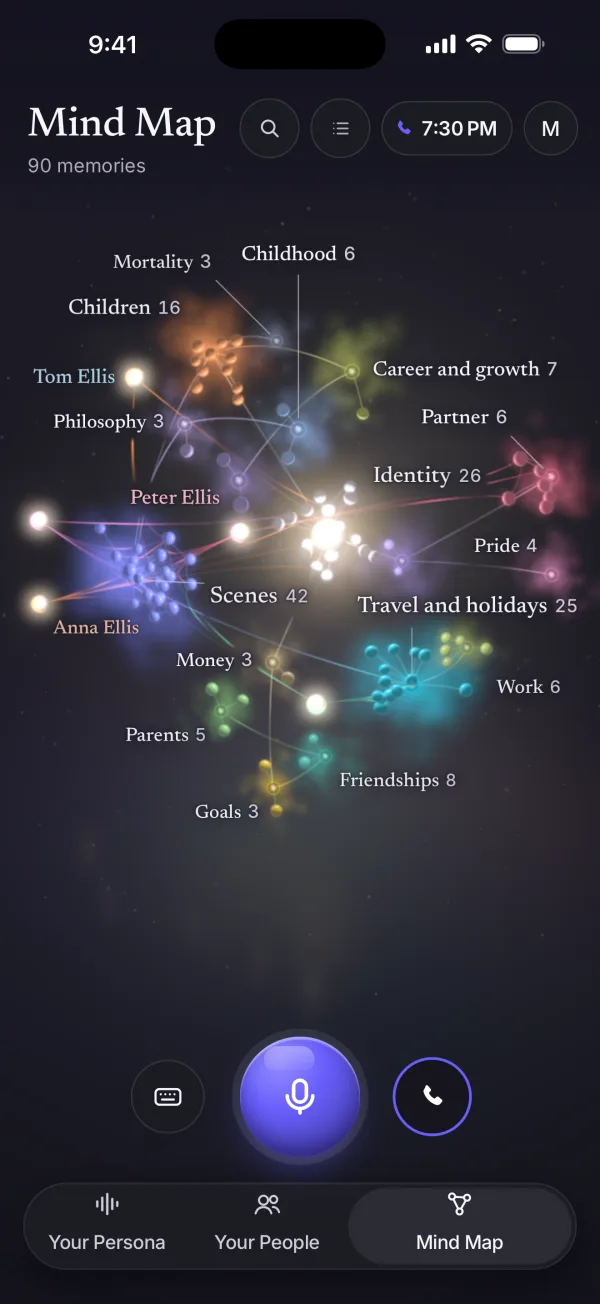
Upload the book you wrote. Afterlife.ai™ reads a PDF or Word document and turns your chapters into memories your Persona can draw on, so the stories you worked on for 12 weeks become something your family can talk with. Then keep going out loud.
Add your chapters:
in the Mind Map, choose Add Files and upload your manuscript as a PDF or Word document. Audio and video recordings are transcribed too.
Your voice:
answer three questions out loud with "Just talk", and your voice is cloned from your answers.
New stories:
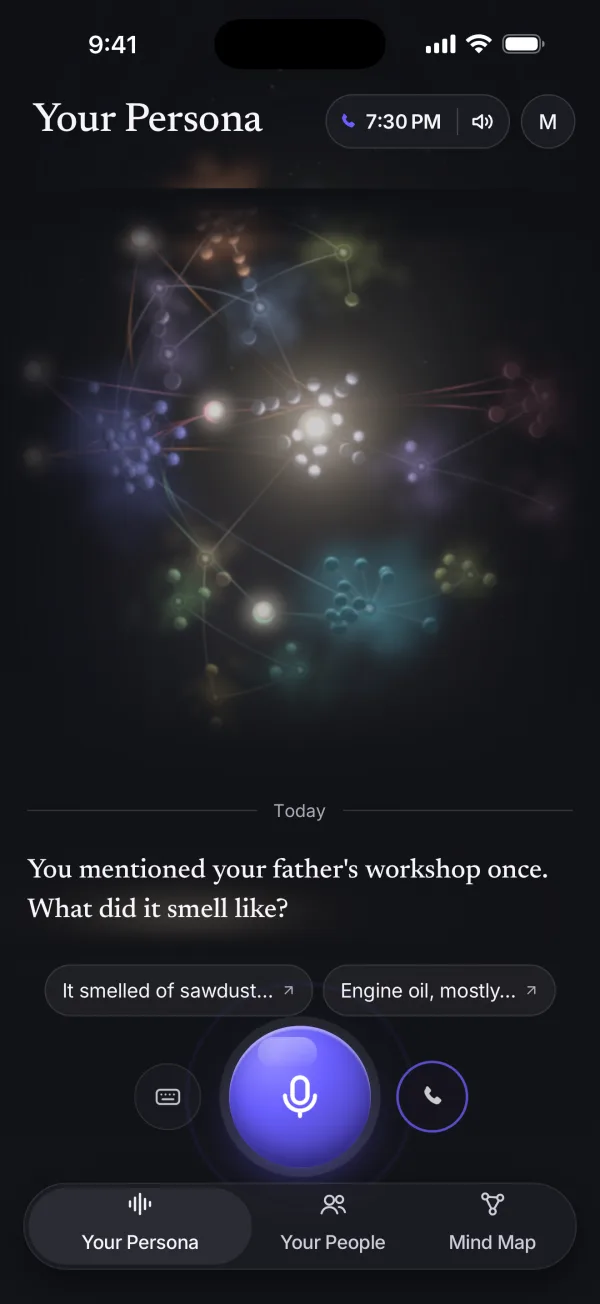
each day the room opens on a new question, so the book never has to be finished.
Your people:
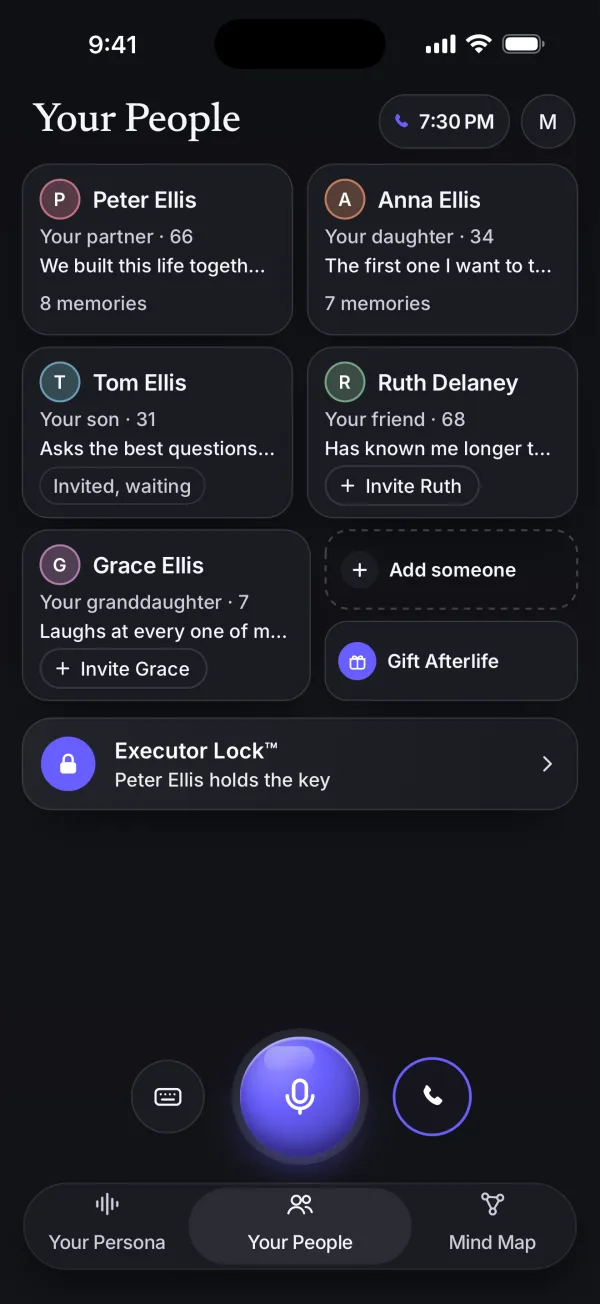
add up to 5 Trusted Contacts free, who can talk with your Persona after the Executor Lock™.
Free to start:
sign up at app.afterlife.ai, no card; 25 memories are free. Legacy keeps going for US$14.99 a month and Eternal for US$29.99 (see pricing).
For the writing side, see how to write a memoir, what a memoir ghostwriter costs and our ranking of the best AI memoir writers.
Frequently asked questions
Can ChatGPT write my autobiography for me?
It can draft one, but only from what you tell it, so the book is only as good as the interview. Have it question you one topic at a time, draft each chapter from your answers and edit every chapter back into your own voice.
How long does it take to write a memoir with AI?
About 12 weeks at two hours a week, using the plan on this page: six weeks of interviews, one week of outlining, four weeks of drafting and one week to edit and print. A longer life or a longer book simply takes more weeks of interviews.
How long should a book about my life be?
A family memoir is often 25,000 to 40,000 words, which prints at roughly 100 to 160 pages. Write the stories you want kept and let the length follow; a short book that gets finished beats a long one that never does.
Who owns a book written with ChatGPT?
OpenAI's Terms of Use assign you OpenAI's rights in what ChatGPT writes for you, and the U.S. Copyright Office protects what a person wrote or meaningfully shaped rather than text a machine produced on its own (U.S. Copyright Office). A book built from your own answers and your own edits is yours.
How do I print a book about my life?
Use a print-on-demand service, a photo-book printer or a local print shop, and order one proof copy first. Amazon's Kindle Direct Publishing publishes paperbacks and hardcovers at no upfront cost and gives a free ISBN for print books on its platform.
Can my family ask me about the stories later?
Not with a book, but yes with a Persona on Afterlife.ai™. Upload your chapters, record your voice, and your Trusted Contacts can talk with your Persona after the Executor Lock™.
Is Afterlife.ai™ free?
Yes. The free build gives you 25 memories, up to 5 Trusted Contacts and Executor Lock™ setup, with no card, and it never expires. Legacy is US$14.99 a month and Eternal is US$29.99 a month.
Your story is worth keeping.