

ChatGPT Prompts for a Legacy Letter
A legacy letter, also called an ethical will, passes on your values, lessons and stories rather than your property. The best ChatGPT prompts make it interview you and keep your exact words. Here are 30. To deliver each letter on the right day, in your own voice, keep it on Afterlife.ai™.
As seen in











A will decides who gets your property; a legacy letter tells the people you love what you learned, what you believe and what you hope for them. The custom is centuries old (it began as the ethical will in Jewish tradition), and the hardest part has always been the blank page. ChatGPT is a good interviewer for one, as long as it asks the questions and you supply every word. The 30 prompts below go one theme at a time: values, lessons, blessings, stories and edits.
Who it's for:
one person, or the whole family. Many people write a separate letter for each child or grandchild.
How long:
one to three pages. Long enough for real stories, short enough to read in one sitting.
When it's read:
at a milestone birthday, a wedding, alongside your will, or after you're gone.
Legal weight:
none. A legacy letter sits beside your will, never in place of it.
What is a legacy letter, and what should it include?
A legacy letter passes on who you are, not what you own. It is sometimes called an ethical will, a life letter or a legacy statement, and it has no legal force. The best ones mix a few clear beliefs with the stories that prove them, and they speak to each reader by name. Most strong legacy letters include six things.
Values:
what you believe matters most, in plain words.
Lessons:
what you learned the hard way, including the mistakes.
Stories:
the moments that made you who you are, told with names and places.
Blessings:
what you hope for each person, one by one.
Thanks and apologies:
what you want to say before it's too late to say it.
Hopes for the family:
what you'd like the family to keep doing after you.
How do you write a legacy letter with ChatGPT?
Let ChatGPT ask and keep your words. Create a ChatGPT project called "Legacy letter", paste the interviewer prompt into its instructions, and switch off "Improve the model for everyone" in Settings, then Data controls (OpenAI Help Center, 2026). New to ChatGPT? Our guide to ChatGPT for seniors starts from zero. Answer one theme per sitting, out loud if you can, and copy every finished paragraph into your own document the same day, because ChatGPT's memory keeps a summary rather than every word (OpenAI Help Center, 2026).
The interviewer prompt:
"You are helping me write a legacy letter to [my two daughters]. Ask me one question at a time about my values, lessons and hopes for them, and wait for my answer. Quote my exact words. Never add advice, lessons or feelings I didn't express. Write nothing until I type DRAFT."
The voice sample:
"Here are three things I've written: [a card, an email, a speech]. Describe my voice in ten rules and follow them in every draft."
Christmas gift
The gift that talks back.
Give Mom, Dad, your grandparents or your kids their own Persona for a year. Their Persona asks the questions, they just talk, and every story is kept in their own voice.
Give it for US$149One payment, no subscription. We email you the code straight away, ready for Christmas morning.
Values: which prompts help you say what you believe?
Beliefs land when a story carries them. "Be honest" is forgettable; the day you returned the extra change is not. These six prompts tie each value to a moment.
The short list:
"Ask me to name the three things I believe matter most in a life, then ask for a story behind each one."
The proof:
"For each value I named, ask me for a time I lived up to it and a time I didn't."
Work:
"Ask me what I believe about work and money, and which job taught me that."
Faith and doubt:
"Ask what I believe about faith or meaning now, and how it changed over my life."
People:
"Ask what I believe about friendship and family, and who taught me."
Change of mind:
"Ask what I believed at 25 that I don't believe now, and what changed my mind."
Lessons: which prompts draw out what you learned the hard way?
The lessons worth leaving cost you something. Readers trust a letter that admits mistakes, and they remember the ones that come with a price. Let ChatGPT push past the polished version.
The big mistake:
"Ask about the biggest mistake I made and what it taught me. Don't comfort me; ask for the details."
Money:
"Ask what I'd tell my children about money, and the moment I learned it."
Love:
"Ask what I've learned about marriage and love, from the good years and the hard ones."
Fear:
"Ask about something I was afraid of and did anyway, and what happened."
Regret:
"Ask what I'd do differently if I had my twenties again."
Advice in one line:
"Ask me for one sentence of advice for each decade of life, and the story behind each."
Five mistakes that make a legacy letter sound like a greeting card
1. Advice without a story: every lesson needs the moment behind it
"Work hard" means nothing on its own. The night you drove a delivery route after your day job means everything. Pair each piece of advice with the story that earned it.
2. One letter for everyone: write to each person by name
A letter to "my family" reads like a speech. A paragraph that starts with one grandchild's name and a memory only the two of you share is the part they keep.
3. Letting ChatGPT smooth your words: keep how you talk
ChatGPT drifts toward tidy, upbeat prose with a moral at the end. Ask for edits as a list, keep your phrases, and cut any sentence you would never say out loud.
4. Leaving out the hard parts: honesty is what makes it believable
A letter with no losses, arguments or regrets reads as a highlight reel. One honest paragraph about a hard year gives the rest of the letter its weight.
5. Nobody knows it exists: decide how it will reach them
A letter in a drawer or a chat history may never be found. Decide now who receives it, when, and how, and tell your executor.
Blessings: how do you write something different for each person?
Write to each person on their own. Ask ChatGPT for one paragraph per name, and give it a specific memory for each one, so no two blessings read alike.
One memory each:
"For each of my [three grandchildren], ask me for one memory I have with them alone."
What I see in them:
"Ask me what I see in [Ava] that she may not see in herself yet."
What I hope for them:
"Ask me what I hope [Ben]'s life holds, without telling him what to do."
Proud of:
"Ask me what I'm proudest of in each of my children, with an example for each."
For the unborn:
"Help me write a paragraph for grandchildren I may never meet."
The partner:
"Ask me what I want my [wife] to know when she reads this."
Stories: which memories explain who you are?
Three stories are enough. Pick the ones your family tells about you, the ones they don't know, and the one that changed you most. These prompts find them, and for the whole story, our plan for writing a book about your life with ChatGPT goes chapter by chapter.
The family favorite:
"Ask me which story my family always asks me to tell, and get the full version, including the part I skip."
The unknown one:
"Ask me for a story about my life that my children have never heard."
The turning point:
"Interview me about the moment my life changed direction, starting with the day before."
Where I come from:
"Ask about my own parents and grandparents, and what they handed down to me." (To record their own words while you can, use our ChatGPT prompts to interview your parents.)
The ordinary day:
"Ask me to describe an ordinary day when my children were small."
The place:
"Ask about the place I feel most like myself, and why."
Editing: how do you keep the letter in your own voice?
Edit for clarity, never for polish. A legacy letter should sound like you at the kitchen table, not like a sympathy card. These six prompts keep ChatGPT honest.
First draft:
"Using only my answers, draft the letter to [my daughters] in first person, one to two pages, and mark anything you inferred."
Edits as a list:
"Show every edit as a list, original then new, with the reason, instead of rewriting."
Cut the morals:
"Remove any lesson, moral or uplifting line I didn't say."
Read aloud:
"Give me a version I could read aloud in five minutes without stumbling."
The hard line:
"Find the sentence that could hurt someone, and help me say it more kindly without losing the truth."
The check:
"Compare this draft with my original answers and list anything whose meaning changed."
Where does ChatGPT fall short for a legacy letter?
ChatGPT helps you write the letter, and then the letter just sits there. It cannot deliver it on the right day, keep it in your voice or answer the questions it raises, and under OpenAI's Terms of Use your account cannot pass to your family. Afterlife.ai™ covers the part after the writing.
Question | ChatGPT with these prompts | Afterlife.ai™ |
|---|---|---|
Who asks the questions? | You paste a prompt each sitting | Afterlife.ai™ asks you, out loud or in writing |
Your exact words kept | Only what you copy out yourself | Every memory you add, 25 free |
Delivered on the day | No | Kept messages open on the date you choose, or after your passing |
In your own voice | No: preset voices only | Yes: spoken messages, and a Persona in your cloned voice |
Can they ask what you meant? | No | Yes: your Trusted Contacts can talk with your Persona after the Executor Lock™ |
Cost to start | Free plan available | Free build, no card |
Example: a legacy letter built from five answers
Here is what five answers can become, as an illustration, not a real family. The writer told ChatGPT about a delivery job, a lost bet, a grandmother's kitchen, a marriage that nearly ended, and a granddaughter who asks too many questions; ChatGPT asked follow-ups and kept the writer's words.
The opening:
"Ava, you asked me once why I never complain about getting up early. Here is the answer, and it starts with a bakery truck in 1971."
The value:
"I believe you keep your word even when nobody would know. I learned that the night I drove the route alone with a fever because I'd promised."
The lesson:
"Your grandmother and I nearly quit on each other in 1983. We didn't, and the reason was boring: we kept eating dinner together."
The blessing:
"Keep asking too many questions. It's the best thing about you, and it will annoy all the right people."
The close:
"You don't have to agree with any of this. I just wanted you to know where it came from."
How do you keep a legacy letter on Afterlife.ai™?
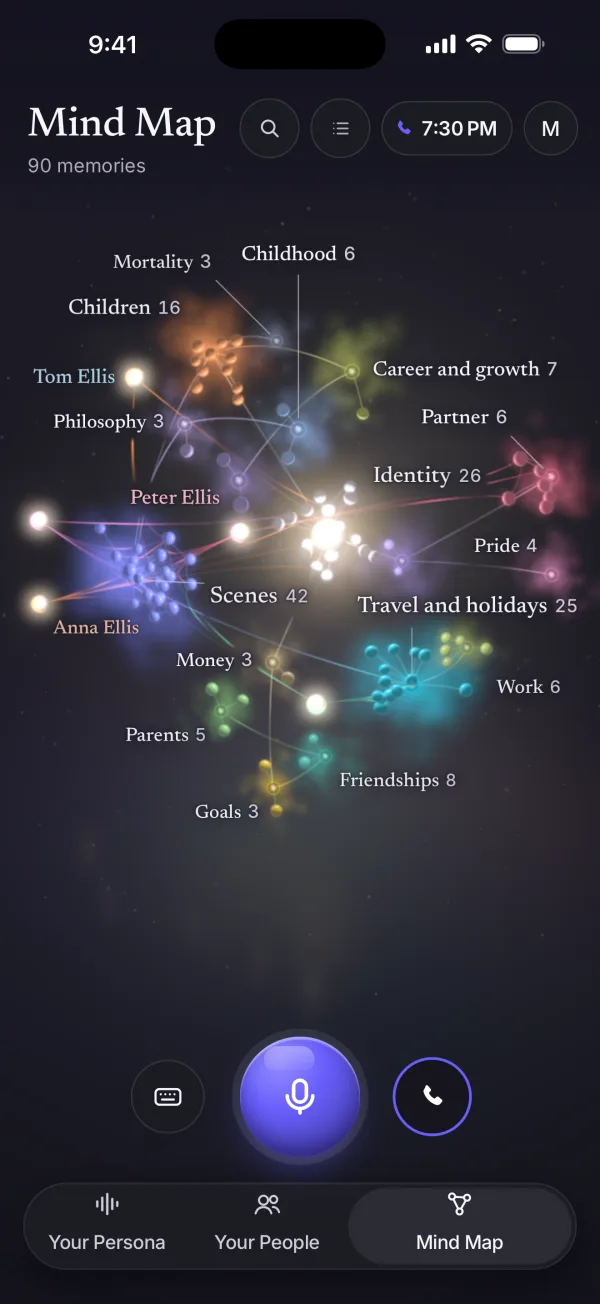
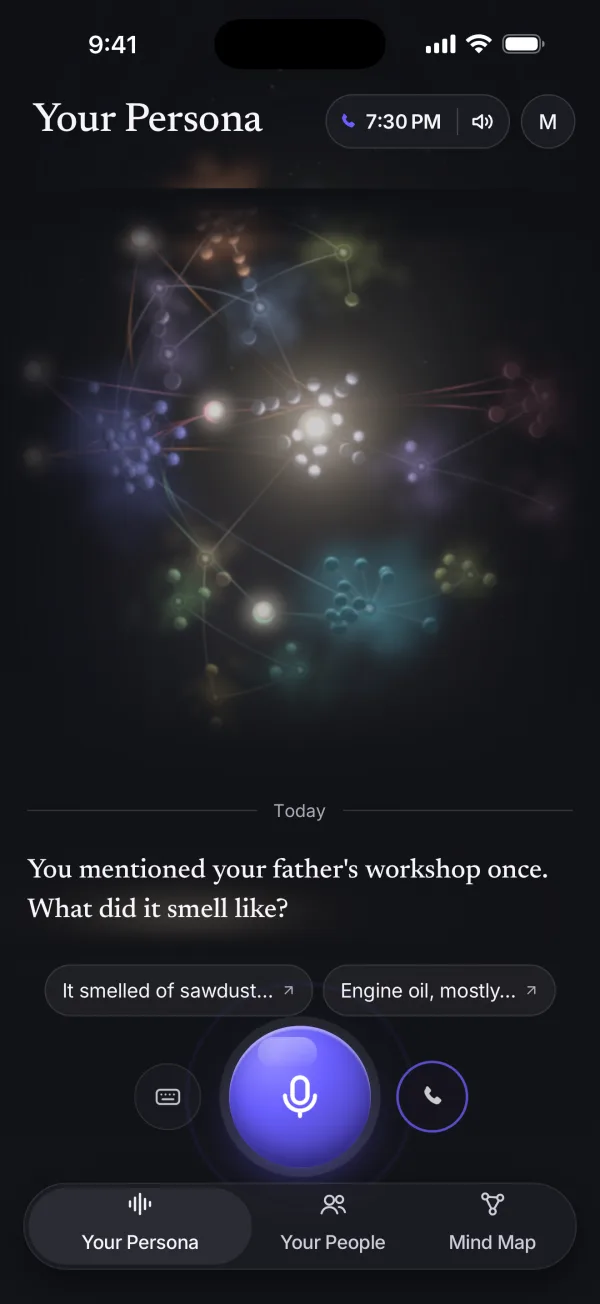
Write it once and let it arrive on the right day. Afterlife.ai™ keeps a message for each person in your life, delivers each one when you choose, and builds a Persona that can tell the stories behind your letter in your own voice.
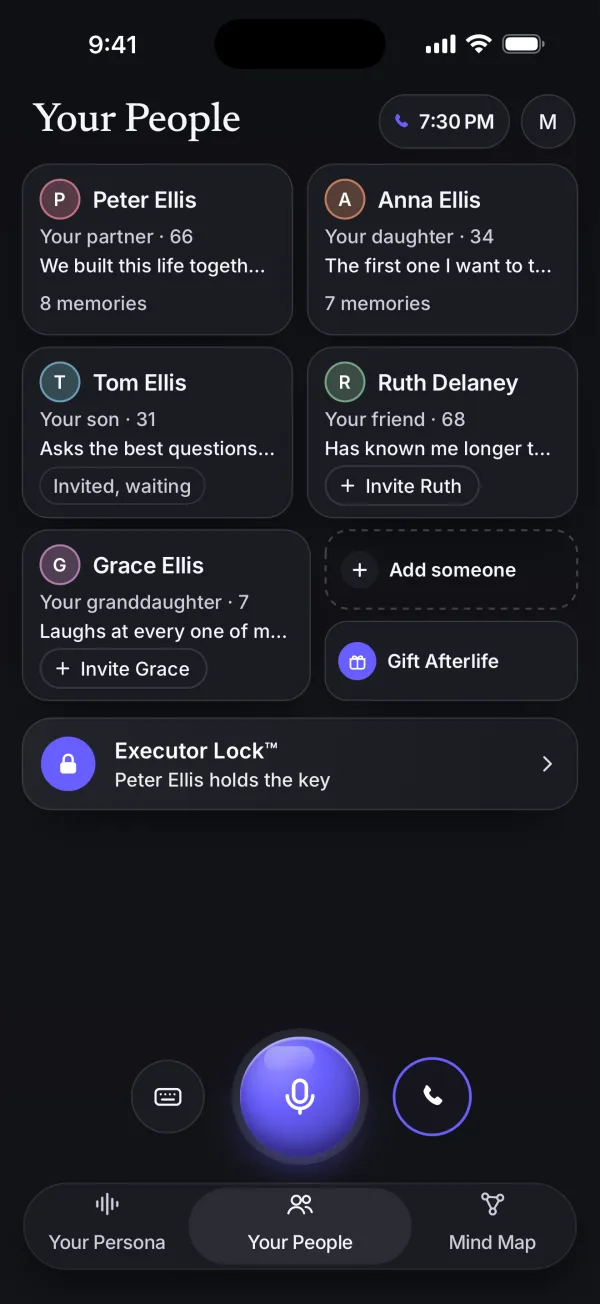
A message for each person:
in Your People, keep a written or spoken message that opens on a date you choose, such as an 18th birthday, or after your passing at the Executor Lock™.
In your own voice:
record the letter as a spoken message, and answer three questions out loud with "Just talk" so your voice is cloned for your Persona.
The stories behind the letter:
talk with your Persona whenever a memory comes back; each day the room opens on a new question.
Who holds the key:
name your executor and up to 5 Trusted Contacts free. After the Executor Lock™, they can talk with your Persona, and the Lock takes a perfect snapshot so the personality never changes.
Free to start:
sign up at app.afterlife.ai. 25 memories are free, with no card, and the free build never expires. Legacy keeps going for US$14.99 a month (see pricing).
For more on the letters themselves, see our guides to the legacy letter, the ethical will, a letter to your children before death and a letter to your grandchildren.
Frequently asked questions
What is a legacy letter?
A legacy letter is a personal letter that passes on your values, lessons, stories and hopes to the people you love. It is also called an ethical will, and it has no legal force; it sits beside a will rather than replacing one.
What should a legacy letter include?
Your core values with a story behind each, the lessons you learned the hard way, a blessing for each person by name, any thanks or apologies you want to make, and your hopes for the family. One to three pages is enough.
Is an ethical will legally binding?
No. An ethical will, or legacy letter, carries no legal weight and cannot leave property to anyone. Keep it with your will so your executor knows it exists, and use your will for anything legal.
How long should a legacy letter be?
One to three pages, or about five minutes read aloud. Long enough to hold real stories, short enough that every reader finishes it.
Can I write a different legacy letter for each child or grandchild?
Yes, and it is usually better. On Afterlife.ai™ you can keep a separate written or spoken message for each person in Your People, each opening on its own date or after your passing.
When should a legacy letter be read?
Whenever you choose: at a milestone birthday, at a wedding, alongside your will, or after you're gone. Many people give one letter while they are alive and leave another for later.
Should I use AI to write a legacy letter?
Use AI to ask the questions and organize your answers, not to supply the words. A legacy letter only matters if every sentence is yours, so use prompts that quote you exactly and forbid invented feelings.
Is Afterlife.ai™ free?
Yes. The free build gives you 25 memories, up to 5 Trusted Contacts and Executor Lock™ setup, with no card, and it never expires. Legacy is US$14.99 a month and Eternal is US$29.99 a month.
Your story is worth keeping.