
StoryFile alternative: what happened to StoryFile, and where to keep a life story now
StoryFile, the company behind William Shatner's talking video, went through Chapter 11, changed owners and now sells mainly to museums, and its at-home app has stopped taking new sign-ups. This guide gives you the dated record, the steps to get your recordings out, and the alternatives that keep a parent's story answering for good.
StoryFile, the interactive video company made famous by William Shatner, filed for Chapter 11 in May 2024 with $1.5 million in assets against $10.5 million in liabilities, sold its assets to Key 7 Investment in 2025 and now sells mainly to museums. StoryFile Life is closed to new sign-ups, so families need a new home for their stories.
StoryFile status | What we found | Source |
|---|---|---|
StoryFile Life sign-ups | Closed. The app shows a waitlist that says "Be among the first to know when sign-ups reopen" | StoryFile Life, checked October 2, 2026 |
What StoryFile sells today | Professionally filmed interviews turned into life-size conversations for museums and institutions, booked through a demo | StoryFile, checked October 2, 2026 |
Who runs StoryFile | Authentic Interactions Inc., which also makes the generative video tool Lookalike | |
Who owns it | Key 7 Investment Company of Birmingham, Alabama, which bought the assets out of Chapter 11 | |
Chapter 11 | Filed May 5, 2024 in White Plains, New York, with $1.5 million in assets and $10.5 million in liabilities | |
Your data if your account ends | "Reasonable efforts" to make it available for retrieval for 30 days | StoryFile Terms of Service, last edited November 13, 2024 |
Latest news | Kara Swisher's digital twin on CNN (May 16, 2026) and the Digital Likeness Directive (July 23, 2026) | |
Last checked | October 2, 2026 | Every source on this page |
StoryFile deserves its reputation. Its interviews with Holocaust survivors, World War II veterans and astronauts let museum visitors ask a real person a question and watch that person answer, and William Shatner's StoryFile in 2021 showed the public what "video that talks back" could feel like. The technology survived a bankruptcy and a sale, and the museum business is active, with new installations opening in 2026. What paused is the do-it-yourself product families used at home, which is why so many people now search for a StoryFile alternative. Afterlife.ai™, from Idy, gives a living storyteller a Persona built in their own words and cloned voice, with the people who control the Persona after death named in advance under Executor Lock™.
By Chris Williams, founder of Idy®, the company behind Afterlife.ai™. First published June 27, 2026. Updated October 2, 2026.
Keep the story answering, with the ending written first.
Your Persona starts free and never expires.
Build your Persona free, no cardDefinitions
StoryFile: a conversational video company, founded in Los Angeles in 2017, whose software plays the recorded video answer that best matches a spoken question.
StoryFile Life: StoryFile's at-home app, where people recorded answers to more than 1,600 prepared questions; it is closed to new sign-ups as of October 2, 2026.
Persona: the AI version of you that you build on Afterlife.ai™ while you are alive, from your own memories, values and cloned voice, which answers your family in your words.
Executor Lock™: Idy's patent-pending system of named executors, Trusted Contacts, a verified death report and a sealed snapshot of your Persona that can never be changed.
What happened to StoryFile?
StoryFile filed for Chapter 11 bankruptcy in May 2024, emerged in March 2025 under a new owner, Key 7 Investment Company, and now concentrates on museums and institutions while its consumer app, StoryFile Life, waits behind a waitlist. The company was founded in Los Angeles in 2017 and grew quickly in 2021 and 2022, when William Shatner's interactive StoryFile made the company widely known. Growth outran the funding, and the interim chief executive, James Fong, described StoryFile in his bankruptcy affidavit as a "start-up with unproven but highly promising technology and business model" (Westfair, May 9, 2024).
The record below is dated from public sources and our own checks of StoryFile's websites, and we update it whenever the status changes.
Date | What happened | Source |
|---|---|---|
2017 | StoryFile is founded in Los Angeles | |
2021 | William Shatner's interactive StoryFile makes the company widely known | |
May 5, 2024 | StoryFile Inc. files for Chapter 11 in White Plains, New York, listing $1.5 million in assets and $10.5 million in liabilities | |
March 2025 | StoryFile emerges from Chapter 11 after Key 7 Investment Company acquires its assets, and a New York City public-schools pilot lets students talk with a Holocaust survivor | |
February 3, 2026 | Interactive Holocaust testimony opens at the Holocaust Museum for Hope & Humanity in Orlando | |
March 19, 2026 | StoryFile brings George Takei's testimony to the Japanese American National Museum in Los Angeles | |
May 16, 2026 | CNN airs "Kara Swisher Wants to Live Forever", featuring a StoryFile digital twin of Swisher | |
July 23, 2026 | Authentic Interactions publishes the Digital Likeness Directive, co-signed by StoryFile and Lookalike | |
October 2, 2026 | StoryFile Life shows a waitlist in place of sign-ups |
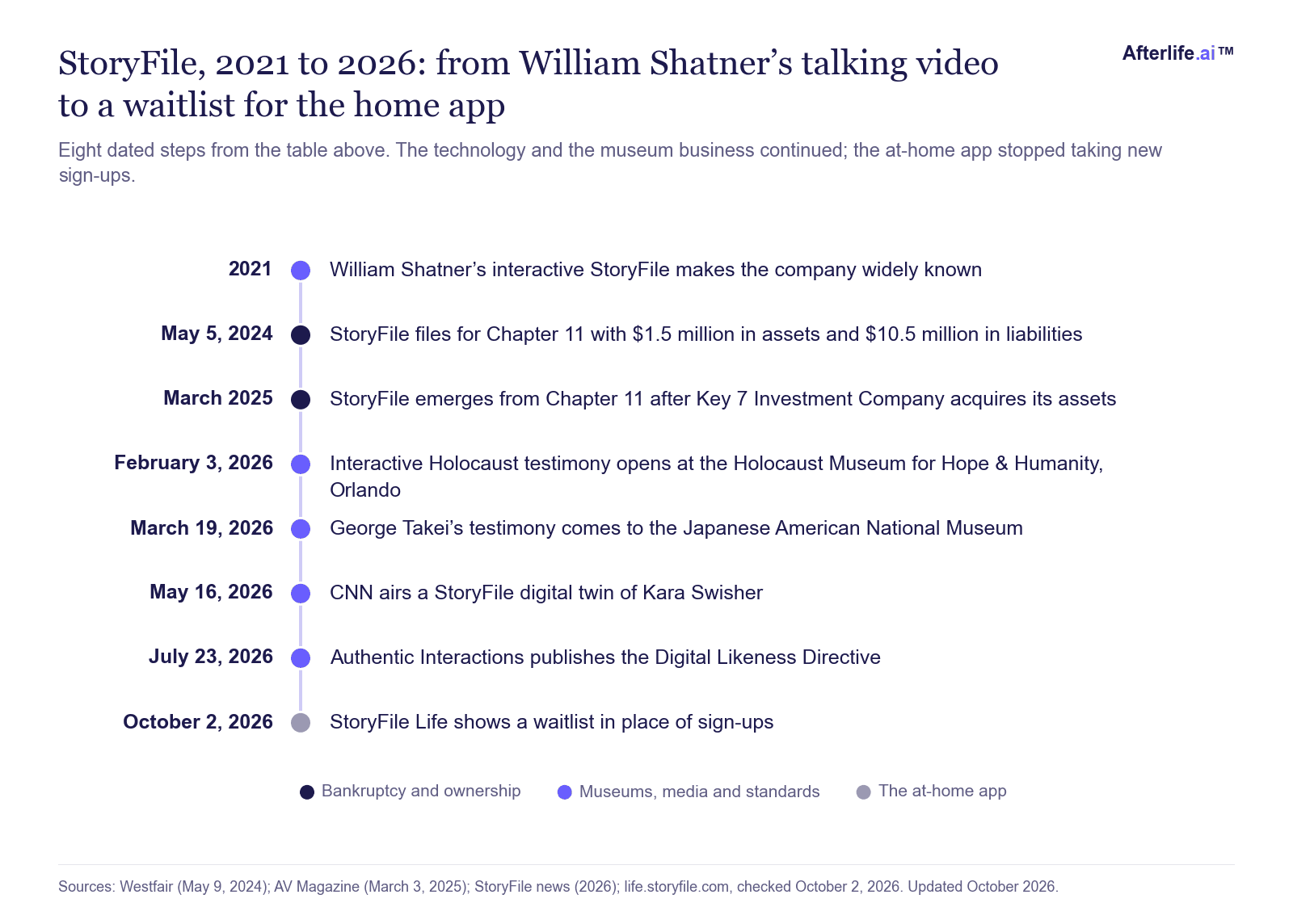
The plain reading of that record is that the technology survived and the consumer product paused. StoryFile followed the customers who could pay for professional productions, which are museums, schools and institutions with an archive to bring to life. Families who recorded at home now have a smaller place in the business, and families who never started have no way in at all, which is why the alternatives later on this page matter.
Did StoryFile go bankrupt?
Yes, StoryFile Inc. filed for Chapter 11 bankruptcy protection on May 5, 2024 in the US Bankruptcy Court in White Plains, New York, and it emerged in March 2025 after Key 7 Investment Company bought its assets. Chapter 11 is a reorganization rather than a liquidation, which is why the company could emerge under a new owner. The filing listed $1.5 million in assets against $10.5 million in liabilities, including about $4.5 million owed to unsecured creditors, of which $150,000 was for customer refunds (Westfair, May 9, 2024). Key 7 was one of three secured creditors, listed at $1.25 million, although Key 7 said in an Alabama lawsuit that it was owed nearly $2 million.
StoryFile's Chapter 11 filing | Amount | Source |
|---|---|---|
Assets declared | $1.5 million | Westfair, May 9, 2024 |
Liabilities declared | $10.5 million | Westfair, May 9, 2024 |
Owed to unsecured creditors | About $4.5 million | Westfair, May 9, 2024 |
Of which, customer refunds | $150,000 | Westfair, May 9, 2024 |
Key 7 Investment Co., as listed | $1.25 million (Key 7 claimed nearly $2 million) | Westfair, May 9, 2024 |
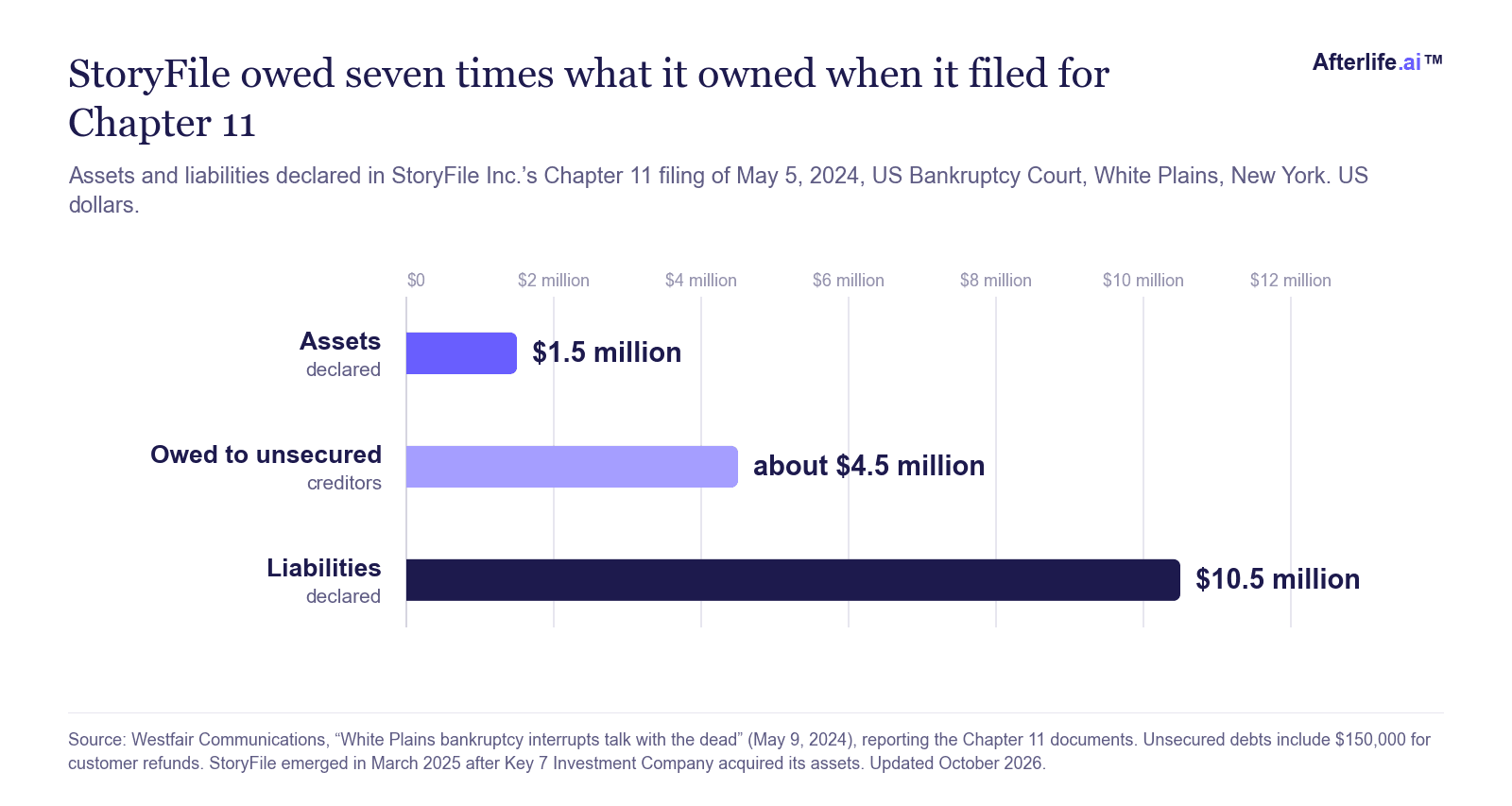
For a family, the most important line in that table is the smallest one. A company that owes refunds to its customers is a company whose customers depended on it staying open, and every recording held only inside a service shares that dependence. Young companies restructure all the time, and StoryFile did what many promising companies do. The practical lesson is that a parent's voice should never rest on one company's balance sheet without a written plan for what happens next.
Is StoryFile still in business?
Yes, StoryFile is still in business, as an institutional company run by Authentic Interactions Inc. and owned by Key 7 Investment Company. Its homepage says StoryFile "transforms interviews into AI-powered, life-size conversations for museums and institutions" and invites visitors to book a demo (StoryFile, checked October 2, 2026). The services page lists professionally filmed interviews in a home or a studio, edited answer libraries, digital recreations from historical documents, photos and audio, museum installations and digital docents, along with a transparent HOLOGLASS display for life-size playback. The National WWII Museum in New Orleans, the Holocaust Museum for Hope & Humanity in Orlando and the Japanese American National Museum all run StoryFile experiences.
For a family, that means a professionally filmed interview is still available through StoryFile's sales team at a production price, while the self-serve app that let a grandmother record answers on her phone at the kitchen table is not taking new members.
Can you still sign up for StoryFile Life?
No, you cannot sign up for StoryFile Life today, because sign-ups are closed behind a waitlist. The app's home page and its free-trial page both show the same message, "We're currently optimizing our platform to support future growth. Be among the first to know when sign-ups reopen" (StoryFile Life, checked October 2, 2026). The waitlist form asks you to agree that Authentic Interactions Inc. may email you about StoryFile Life and future products. The member log-in is still on the site, and StoryFile's support team answers email at support@storyfile.com, Monday to Friday, 9 a.m. to 6 p.m. Pacific time.
No reopening date has been published. If your plan was to record a parent's answers this fall, a waitlist with no date is a risk you do not need to take, since every month of waiting is a month of stories your parent could have told. The alternatives below let you start the same afternoon.
Who owns StoryFile now?
StoryFile is owned by Key 7 Investment Company of Birmingham, Alabama, which acquired its assets out of Chapter 11, and it is operated by Authentic Interactions Inc., the company named in StoryFile's terms of service and privacy policy. At the sale, Key 7's owner and chief executive, Steven Splawn, said the investment would bring new products and "an updated brand identity" (AV Magazine, March 3, 2025). Authentic Interactions describes itself as "the pioneering technology company behind StoryFile and Lookalike", and Lookalike is its generative video technology, which can build an AI agent from existing photographs and documents (GlobeNewswire, May 15, 2026).
Ownership matters for one practical reason. StoryFile's privacy policy allows customer information to be shared "in connection with, or during negotiations of, any merger, sale of company assets, financing or acquisition" (StoryFile Privacy Policy), which is standard language across the industry and is exactly how the 2025 sale worked. When you choose any home for a parent's recordings, read the same clause and ask who decides what happens to the recordings if the company changes hands again.
How did StoryFile build Kara Swisher's digital twin?
StoryFile recorded about two hours of interview with Kara Swisher, kept 77 answers and just under an hour of usable material, and then added Lookalike's generative AI to create new video answers that drew on her articles, podcasts and autobiography, "Burn Book" (StoryFile, May 16, 2026). The result aired on CNN's "Kara Swisher Wants to Live Forever" on May 16, 2026, with the digital Swisher shown life-size on StoryFile's HOLOGLASS display. For questions about her father and her childhood, the system played her recorded answers. When the conversation went somewhere the interview had not, Lookalike generated new video in her face and voice.
StoryFile's chief technology officer, Valorie Jones, wrote that Swisher's first reactions were that her twin should smile more and that the twin was too compliant. Recorded answers are the person's own words, while generated answers are new words in the person's voice. Before anyone records anything, every family should ask who controls what an AI of a parent says when the recordings run out.
What is the Digital Likeness Directive?
The Digital Likeness Directive is an open standard published by Authentic Interactions on July 23, 2026, and co-signed by StoryFile, Lookalike and Authentex, that lets a person record in advance what AI recreations of them are allowed (StoryFile, July 23, 2026). A living person can register a refusal, and adopting platforms may not host a recreation of them. If a recreation of a real person is challenged, a fourteen-day clock starts, and only permission from that person, or after death from their family and estate, keeps the recreation running. The Directive separates replaying what a person actually recorded from generating new words, lets you name a Steward who can pause or retire a recreation but never expand it, and sets a default term of 25 years.
The Directive is a genuine step in the right direction, and its authors deserve credit for publishing it openly. A standard still depends on platforms choosing to adopt it, and a refusal registry protects you from strangers more than it builds anything for your family. Executor Lock™ is a working product that already does the part families need most, because it names the people who decide, verifies a death before control changes hands and seals your Persona so nobody can rewrite you. For the law that is catching up, read the NO FAKES Act explained, and for the mechanics, read how Executor Lock™ works.
How do you get your StoryFile recordings out?
You get your recordings out by downloading everything StoryFile Life still lets you download, then emailing support@storyfile.com from your account address for every video, transcript and question. Do it this month, whatever your plans, because files you hold yourself are safe whatever happens to any company. StoryFile's terms say that if the service ends for reasons other than your breach, StoryFile "will make reasonable efforts, where feasible, to provide you the opportunity to download a copy of your User Content", and that on any termination Authentic Interactions "will make reasonable efforts to make all your data available to you for electronic retrieval for a period of thirty (30) days" (StoryFile Terms of Service). Thirty days is a short window, so act before you need it.
Sign in to StoryFile Life and download every answer you can. Use the member log-in at life.storyfile.com with the email you registered, and save each video answer the app allows you to download.
Email StoryFile support from your account address. Write to support@storyfile.com, Monday to Friday, 9 a.m. to 6 p.m. Pacific, and ask for every recorded answer, the transcript of each answer and the full list of questions, in MP4 or another standard format.
Cite the retrieval clause if your account has ended. Quote the 30-day retrieval sentence from the terms and ask for the files within that window.
Ask for the master footage of a professional interview. If your family commissioned a filmed StoryFile, ask your account contact for the edited answers and the original interview footage.
Save every file in three places. Keep two copies on drives you own and one in a cloud account you control.
Label each file with its question and date. A folder of numbered clips is a puzzle, while the same folder labeled with the questions is a life story, and the file-labeling method in our recordings guide works for StoryFile clips too.
Keep a dated record of every request. Save every email you send and receive, so each follow-up can quote your first request.
You can send this template as written, filling in the brackets.
Subject: Recording export request for [your account email]. Hello. I am a StoryFile Life member, account email [your account email]. I would like a complete export of my account: every recorded video answer, the transcript of each answer and the list of questions each answer responds to, in MP4 or any standard format. I am happy to verify the account however you need. Thank you. [Your name]
If the storyteller has already died, those clips are the last of their face and voice that your family will ever hold, and nothing made later replaces an original. Retrieve them first, and let every other decision wait until the files are safe. For voice files on phones and answering machines, read how to save a voicemail forever.
How much does StoryFile cost?
StoryFile does not publish prices today, because its products are professional productions sold to institutions through a demo, and its consumer app is closed to new sign-ups. The free trial that StoryFile Life once offered now leads to the same waitlist as the main sign-up page. A professionally filmed interview is quoted per project, and StoryFile's own description of its productions mentions cinematic sessions that capture hundreds of answers, with some interviews running over several days. Plan on a production budget rather than a monthly fee if you want StoryFile itself.
For most families, the useful comparison is with services you can start today at a published price, which the next section lists in US dollars with the date each price was checked.
What are the best StoryFile alternatives?
The best StoryFile alternative depends on what you wanted from StoryFile in the first place. Some families wanted a recording session and a keepsake, some wanted a book, and some wanted a parent who could still answer a new question in their own voice. The table compares the options people choose most often, with prices checked on the dates shown.
Service | What you get | Price (US dollars) | Voice and video | Who decides after you die |
|---|---|---|---|---|
Keep your own files | The original recordings | Free | The recordings exactly as made | Whoever holds the drives |
Remento | Prompted recordings that become a hardcover book with QR codes to the audio | $99 for the first year and one book, then $99 a year or $12 a month (checked October 2, 2026) | Audio behind QR codes | The account holder |
StoryWorth | Weekly questions, answered in writing or by voice, printed as a book | From $59 (checked October 2, 2026) | Printed text | The book is yours |
Storii | Life stories recorded over scheduled phone calls | $9.99 a month or $99.99 a year (checked August 18, 2026) | Phone-call audio | The account holder |
HereAfter AI | Recorded voice answers | Closed; recordings by email request only | Audio | Not set in advance |
StoryFile Life | Recorded video answers | Closed to new sign-ups | Video | Not addressed in the terms |
Afterlife.ai™ | A Persona that answers in your words, a Mind Map of your life and Persona Video messages | Free build of 25 memories, then Legacy $14.99 or Eternal $29.99 a month; Afterlife Pro with the Afterlife.ai™ Twin $59.99 a month or $599 a year | Your own cloned voice, and Persona Video from one 30-second recording | The executors you name under Executor Lock™ |
A printed book is the right choice when paper is the keepsake your family wants, and our guides to StoryWorth alternatives and Remento alternatives cover that choice in depth. Storii suits a parent who talks best on the phone, and Storii alternatives compares the phone-first services. For the HereAfter story, read what happened when HereAfter AI shut down.
StoryFile's scope is recorded answers to the questions somebody thought to ask during the interview. A Persona answers the questions nobody thought to ask, from the memories your parent shared in conversation, in your parent's own words and cloned voice. Persona Video turns the Persona into video messages in your parent's own face and voice, made from one 30-second recording, with the first video free, and nothing has to be filmed in a studio.
StoryFile or Afterlife.ai™: which keeps a parent's story better?
Afterlife.ai™ keeps a parent's story better for most families, because a Persona starts today, grows every time your parent talks to the Persona, and has the ending written into the contract before the first story. StoryFile keeps a beautiful recording of an interview, and it remains the right tool for a museum that wants a life-size witness in a gallery. The table compares the two for a family.
For a family | StoryFile | Afterlife.ai™ |
|---|---|---|
How answers work | Plays the recorded clip that best matches the question; some productions add generated answers through Lookalike | Your Persona answers in your words from the memories you shared, including questions nobody asked during an interview |
How you start | A professional production booked through a demo; the at-home app is closed to new sign-ups | A free account today, on the web or the phone, with no card |
Video | Life-size recorded video for museum installations | Persona Video messages in your own face and voice from one 30-second recording |
Voice | The voice in each recorded clip | Your own cloned voice on every answer |
Growth over time | Fixed after the interview unless you film again | Grows with every conversation, and the Mind Map shows which chapters of your life are covered |
After you die | Retrieval for 30 days if the account ends | Named executors, a verified death report and a sealed snapshot under Executor Lock™ |
Price | Quoted per production | Free build of 25 memories; paid plans from $14.99 a month |
The deeper difference is who builds and who decides. With Afterlife.ai™, the storyteller authors their own Persona while alive, gives consent in their own account and names the people who take over, so the family never has to guess. For the feature-by-feature version, read our side-by-side comparison of Afterlife.ai™ and StoryFile, and for the wider question of AI and loss, read what a griefbot is.
Why does the ending matter more than the recording?
The ending matters more than the recording because four of the best-known AI legacy and avatar companies have closed, been sold or changed course in two years, and their customers learned that a recording is only as safe as the plan behind it. HereAfter AI went offline on August 18, 2026 and now returns recordings only by email request (what happened when HereAfter AI shut down). StoryFile went through Chapter 11 and closed its consumer sign-ups. Eternos renamed itself Uare.ai in November 2025, and its terms now delete or de-identify a user's content after cancellation (what happened to Eternos). Soul Machines went into receivership in February 2026 and was sold to AppDirect on September 28, 2026.
Researchers see the same gap across the whole field. A Lehigh University audit of 93 AI "afterlife" services found that 82 publish thin or no information on who has authority over a recreation, and 77 say little about deletion or export (arXiv, August 28, 2026). Before you trust any company with a parent's stories, ask seven questions and expect written answers, and read what happens when a digital legacy company shuts down for the full checklist.
Question to ask | What the record shows elsewhere | The Afterlife.ai™ answer |
|---|---|---|
1. Is the ending written into the contract? | HereAfter ended with a homepage notice | Section 8 of our Terms of Service and the Executor Lock™ Agreement set out what happens at your death, and section 8.3 makes the lock permanent and irreversible |
2. Who takes control when I die, and how is the death checked? | Nine AI twin and avatar platforms whose terms we read name nobody | The executors you name, after evidence, automated analysis, a human review and a seven-day cooling-off |
3. Can anyone change what my AI says after I die? | Generated answers can say things the person never recorded | No. Your Persona becomes a sealed snapshot, and nobody can edit a memory or change your personality |
4. Will my account be deleted if it goes quiet? | Five of those nine platforms reserve the right | Our Terms contain no clause that deletes an account for inactivity, and the free build never expires |
5. What happens if the company is sold? | StoryFile's assets passed to a creditor | Our obligations pass to any successor (section 16.4), and the lock stays permanent (section 8.3) |
6. What stays in my own hands? | StoryFile promises retrieval efforts for 30 days | Your original files stay on your own drives, and your Persona stays under the control of the people you named |
7. Can someone build an AI of me without my consent? | Recreations can be made from archives and public videos | No. Our Terms bar anyone from building a Persona of another person without that person's explicit written consent (section 5.1) |
Question two is the one almost no company in this category can answer, and answering it is why we built Executor Lock™. When we read the published terms of nine AI twin and avatar platforms, about 85,000 words in total, none of them said what happens to the clone or the account when the owner dies (terms checked October 1, 2026). For the ownership question in depth, read who owns your AI twin after you die.
How does Executor Lock™ write the ending in advance?
Executor Lock™ writes the ending of your Persona while you are alive, so your family never has to improvise it. You name the people, they accept the job in writing, and the same six steps run for every Afterlife.ai™ Persona.
Name your people. You name one or more executors and your Trusted Contacts, and each one accepts the Executor Lock™ Agreement while you are alive.
Report. After your death, an executor or a Trusted Contact uploads evidence, such as a death certificate or a funeral notice.
Check. Automated analysis reads the evidence, and then a person reviews it before anything changes.
Cooling-off. Seven days pass in which every executor is told about the report and can dispute it, and you can cancel a false report with proof of life.
Lock. Your Persona becomes a sealed snapshot of every memory as it stood that day, with nothing pruned, nothing re-weighted and a tamper-evident seal on the record.
Release. Your release rules for photos, memories and live conversation take effect for the people you named.
After the lock, nobody can edit a memory or change who you are, including your executors and Idy. New short-term memories and big life events can still reach your Persona, so a grandchild can share good news and your Persona remembers it while staying exactly the person you were. For the full role of the people you name, read what a digital executor does.
Name the people who decide before you record a single story.
Name your executor before you recordWhy did Idy build the ending before the recording?
Idy built the ending first because the StoryFile and HereAfter stories are what happens when a company perfects the recording and leaves the ending for later. Idy, the company behind Afterlife.ai™, spent its first years on the questions most personal AI companies postpone, which are who controls your likeness while you live, who decides about it when you die, who may see what, and how consent is recorded so the software obeys it. The answer is Executor Lock™, built on technology covered by 78 patents pending, including verifying a death before control changes hands, handing authority to a named executor, sealing a memory record that becomes permanent at the handover, and keeping a Persona the same person when AI models change. IP Australia's 2026 IP Report ranks Idy second among that country's domestic filers of standard patent applications in 2025, ahead of the national science agency CSIRO and the medical device maker ResMed.
Because that foundation came first, one Idy twin can work as you while you live, keep answering while you are away, and pass to the people you named when you die. The Afterlife.ai™ Twin answers in the first person, under your name and photo, on your own website, through an API and inside AI assistants, and visitors who speak to your twin hear your own cloned voice. StoryFile's productions are built to keep a witness's testimony for a gallery, and an Afterlife.ai™ Persona is built to keep a parent for a family, with a written answer to what happens next.
How do you start a parent's Persona this week?
You start a parent's Persona by helping your parent build their Persona in their own account, with the ending decided on the first day. Most families finish the first five steps in an afternoon, and the free build costs nothing.
Open your parent's free account together. The free build holds 25 memories, needs no card and never expires, and your parent owns the account.
Name the executor and Trusted Contacts first. Your parent chooses who takes over and who may have access, and each person accepts the Executor Lock™ Agreement.
Set the release rules. Your parent decides whether photos, memories and live conversation are released to the family after the lock.
Tell the first stories. If you saved StoryFile clips, play one and let your parent retell that story in conversation with the Persona, then ask the follow-up question the interview never asked.
Clone your parent's voice and make a Persona Video. Your parent's Persona then speaks in their own voice, and one 30-second recording lets Persona Video make messages in their own face and voice.
Our Terms bar anyone from building a Persona of another person without that person's explicit written consent (section 5.1), and the service is for adults 18 and over. That rule is what makes a parent's Persona trustworthy later, because every word came from the parent. For interview prompts, read how to record your parents' life story, how to record your life story and how to preserve a parent's voice, and for video keepsakes, read how to leave videos for your children.
You help.
Your parent owns the Persona and makes every decision about the Persona.
Start your parent's Persona together, freeWhat does Afterlife.ai™ cost?
Afterlife.ai™ starts free with no card, and paid plans run from $14.99 a month, in US dollars. Every plan includes Executor Lock™ setup, so the ending is in place before the first story whichever plan you choose.
Plan | Price | What you get |
|---|---|---|
Free build | $0 | Your Persona with 25 memories, Executor Lock™ setup, no card, never expires |
Legacy | $14.99 a month | Your Persona speaks in your own voice, 500 memories, unlimited photos |
Eternal | $29.99 a month | Unlimited memories and storage, up to five executors |
Afterlife Pro | $59.99 a month or $599 a year | Everything in Eternal, plus your Afterlife.ai™ Twin on your website, through the API and inside AI assistants, with 1,000 replies a month and your own cloned voice for visitors who speak |
The yearly Afterlife Pro price saves $120.88 against twelve monthly payments, and the twin is for adults 18 and over. Afterlife.ai™ Twins keep answering after Executor Lock™ by default, so a parent who switches the twin on leaves a working voice for the family as well as a sealed Persona. For every detail, read every Afterlife.ai™ plan and price.
So what should you do this week?
Do two things this week, in this order. If you or a parent recorded with StoryFile, request your files today, save them in three places and label every clip, because files you hold yourself are safe whatever happens to any company. Then start a Persona while the storyteller can still tell the stories, with the executor named before the first memory. StoryFile proved that families want to see and hear a parent answer their questions, and the alternative that serves those families best is the one that starts today and has its ending written in.
Museums, senior-living groups and estate lawyers
The families you serve want a parent's story kept, and they want to know who controls it later. Give them a Persona with the ending written in from the first day.
Talk to us about Personas for your familiesFrequently asked questions
What happened to StoryFile?
StoryFile filed for Chapter 11 in May 2024 with $1.5 million in assets against $10.5 million in liabilities, emerged in March 2025 after Key 7 Investment Company bought its assets, and now sells professional productions mainly to museums and institutions. Its at-home app, StoryFile Life, is closed to new sign-ups as of October 2, 2026.
Did StoryFile go bankrupt?
Yes. StoryFile Inc. filed for Chapter 11 bankruptcy protection on May 5, 2024 in White Plains, New York, and emerged in March 2025 under Key 7 Investment Company. Chapter 11 is a reorganization rather than a liquidation, which is why StoryFile could emerge under a new owner.
Is StoryFile still operating?
Yes. StoryFile operates under Authentic Interactions Inc. and sells professionally filmed, life-size conversational video to museums and institutions through a demo. The consumer app, StoryFile Life, shows a waitlist instead of a sign-up page.
Can I still sign up for StoryFile Life?
No. StoryFile Life says it is "optimizing our platform to support future growth" and asks new users to join a waitlist, with no reopening date published as of October 2, 2026. The member log-in is still on the site.
Who owns StoryFile now?
Key 7 Investment Company of Birmingham, Alabama, acquired StoryFile's assets out of Chapter 11 in 2025. Authentic Interactions Inc., the company behind StoryFile and the generative video tool Lookalike, operates the service.
How do I get my StoryFile videos?
Sign in at life.storyfile.com and download every answer you can, then email support@storyfile.com from your account address asking for every video answer, transcript and question list. If your account has ended, cite the 30-day retrieval clause in StoryFile's terms, and save every file in three places.
What is the best StoryFile alternative?
For a family with a living parent, Afterlife.ai™ is the strongest alternative, because the Persona answers new questions in the parent's own words and cloned voice, Persona Video makes video messages from one 30-second recording, and the executor is named in advance. StoryWorth and Remento suit families who want a printed book.
What is the main difference between StoryFile and Afterlife.ai™?
StoryFile plays recorded video answers to the questions asked in an interview. Afterlife.ai™ gives you a Persona built in your own words and voice that grows with every conversation, with Executor Lock™ deciding who controls your Persona after you die.
Can my family keep talking with me after I pass away?
Yes. Under Executor Lock™, your Persona becomes a sealed snapshot after a verified death report, and your release rules decide who can hear your memories and hold a live conversation with your Persona.
Does Afterlife.ai™ keep my actual voice?
Yes. Your Persona speaks in your own cloned voice, made from your own recordings with your consent, and Persona Video makes video messages in your own face and voice from one 30-second recording.
Will a Persona make up answers?
A Persona answers from the memories you shared, in your words, and the more stories you tell, the more your Persona can answer. After Executor Lock™, nobody can edit a memory or change your personality.
Is there a free way to try Afterlife.ai™?
Yes. The free build holds 25 memories, includes Executor Lock™ setup, needs no card and never expires. Paid plans start at $14.99 a month when you want your Persona to speak in your own voice.
How we researched this page
We read StoryFile's websites, StoryFile Life, StoryFile's terms of service and privacy policy and its news pages on October 2, 2026, along with the Westfair, AV Magazine and GlobeNewswire reporting, the Digital Likeness Directive, the Lehigh University audit and the price pages of Remento, StoryWorth and Storii. Every outside fact links to its source and date. This page is general information, not legal advice.