
Can AI bring back the dead? Houdini already answered, and the Washington Post just proved him right
No, AI cannot bring back the dead. A chatbot trained on someone's old messages predicts plausible sentences and fills every gap with guesses, which is why Sherry Turkle's AI of her late mother became a stranger. The only trustworthy version is a Persona the person builds themselves, while alive, in their own words and voice, with their own consent.
By Chris Williams, founder of Idy, the company behind Afterlife.ai™, cited by the Washington Post as an expert source on grief tech. October 6, 2026.
What did Houdini know about talking to the dead?
Harry Houdini spent the last years of his life in other people's darkened parlors, catching mediums at work. He found the wires and the accomplices and the luminous paint, and he wrote them up for anyone who would listen. He did not doubt that grieving people wanted to hear from the dead. He doubted the people selling it to them. So before he died on Halloween in 1926, he and his wife, Bess, agreed on a message only the two of them knew: two words, Rosabelle, believe, hidden inside a private code. If a medium ever claimed to have reached him, Bess would know in a sentence whether the voice was his.
For ten years she sat at séances on the anniversary of his death, and for ten years the mediums filled the silence with whatever a grieving widow might want to hear. None of them produced the words. In 1936, after a final séance on the roof of a Hollywood hotel, broadcast to the country by radio, she turned off the lamp that had burned beside his photograph for a decade and said that ten years was long enough to wait for any man.
Houdini understood something the AI grief industry is now learning at great expense. The only message from the dead worth trusting is one that was agreed while they were alive. Everything else is a performer reading the room, and the more fluent the performer, the more dangerous the performance.
What happened when the Washington Post tried AI grief tech?
On October 4, 2026, the Washington Post published an opinion piece by Sherry Turkle, the MIT professor who has spent decades studying what technology does to the people who use it, adapted from her most recent book, Artificial Intimacy. She set out to try grief tech herself, and she walks the reader through the companies that built the category: Project December, You, Only Virtual, StoryFile and HereAfter AI. On HereAfter AI's collapse, the source the Post cites is Afterlife.ai's own reporting, and we take that as both a compliment and a responsibility: when the Washington Post needs the facts on this industry, the facts have to be right. You can read her piece in the Washington Post, and you should.
Then she did what millions of people will do in the next few years. She tried to talk to her mother again. Her mother had died when Turkle was a teenager, decades before anyone sent a text message, and the service she chose wanted texts. So Turkle and a researcher asked ChatGPT to imagine conversations based on her memoir, and fed those in instead. What came back spoke in the register of a sympathy card. It described a serene afterlife and summer afternoons in soft focus, and when she pressed it on the hardest chapter of her family's history, it answered in her mother's name with an account her mother never gave.
Her verdict is the line people will remember: “Playing with chatbots of the dead is playing with fire.” I think she is right, and I think the reason she is right is the same reason Bess Houdini waited ten years in vain. Nobody had asked the person who died.
Why does a chatbot of the dead get the person wrong?
Every technology of memory has been turned toward the dead first. Within a few years of the camera's arrival, Victorian families were photographing their dead, sometimes posed with the living. When Thomas Edison listed the uses of his phonograph in 1878, the last words of the dying were on it. Each of those technologies preserved a trace of a real person, a face or a voice exactly as it was. AI is the first technology of memory that talks back, and that is precisely the problem, because it talks back in sentences the person never said.
A language model does not hold a mind. It holds patterns in text, and when it speaks as someone, it predicts what a plausible reply would sound like given what it was fed. Where the record is thin, and the record of a life is always thin, the model reaches for the most average answer it knows, which is why so many digital ghosts sound warm, vague and interchangeable. Turkle's mother was rebuilt from conversations another AI had invented out of her daughter's book. That is not a medium. It is a ventriloquist working from someone else's script, and the grieving person in the front row is the one writing it.
This is why an AI chatbot of a dead person so often fails at the exact moment it matters. Ask it something easy and it charms you. Ask it the question you actually needed answered, the one the person never answered in life, and it will answer anyway, because answering is the only thing it knows how to do.
Who has the right to speak for someone after they die?
The cases that went wrong and the cases that went right divide along one line, and it is not the quality of the technology. In 2021 the documentary Roadrunner used an AI model of Anthony Bourdain's voice to read words he had written but never said aloud, and audiences learned about it only after the film was finished. In 2024 Drake released a track featuring an AI imitation of Tupac Shakur, and Tupac's estate forced it down within days. Both used real material. Neither had the consent of the man whose voice it was.
Now look at the ones who decided for themselves. Robin Williams left instructions restricting the use of his name and likeness for twenty-five years after his death. James Earl Jones, before he died in 2024, signed an agreement allowing his archived recordings to be used to recreate the voice of Darth Vader, on terms he set while he could still set them. One of those men said no and one said yes, and both were obeyed, because they spoke while they were alive. The question is not whether AI should ever speak for the dead. The question is who gave permission, and the ethics of AI personas of the dead turn on almost nothing else.
The only voice worth hearing after you die is the one you agreed to while you were alive.
Build your Persona in your own words and voice, starting with 25 free memories and no card.
Build your Persona free, no cardWhat do grief tech companies' contracts actually say?
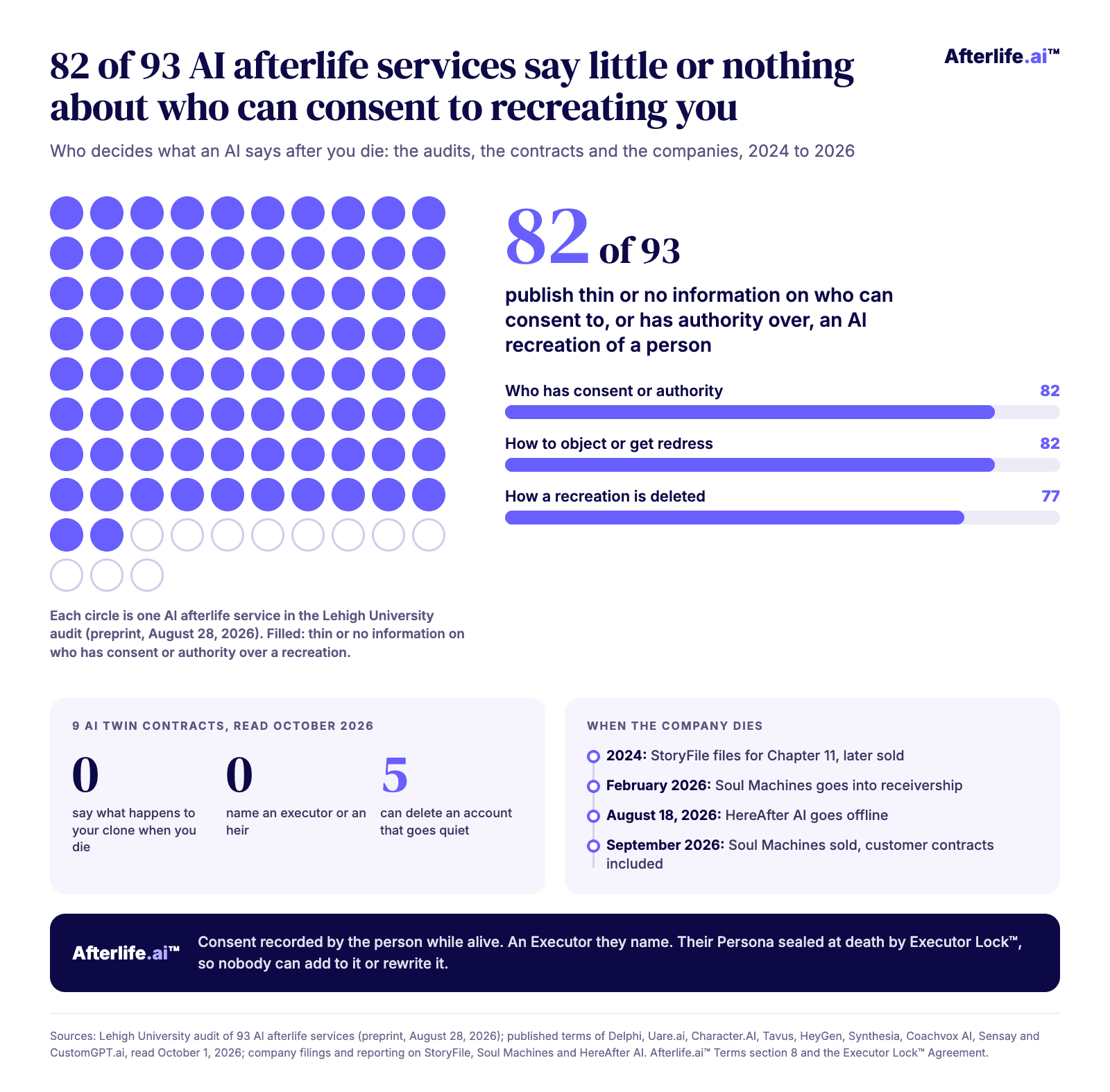
If consent is the whole question, you would expect the contracts to answer it. They do not. We read the full published terms of nine AI twin and avatar platforms, about 85,000 words of fine print, and none of them says what happens to your clone, your account or your earnings when you die. Five of them, Character.AI, Uare.ai, Sensay, Coachvox AI and HeyGen's free plan, can delete accounts for inactivity, and to a server a user who has died looks exactly like one who has stopped logging in. The full comparison is in our guide to who owns your AI twin after you die.
Researchers see the same gap across the category. A Lehigh University audit of 93 AI afterlife services, published as a preprint on August 28, 2026, found that 82 published thin or no information on who has consent or authority over a recreation. The companies themselves are mortal too. HereAfter AI has been offline since August 18, 2026. StoryFile filed for Chapter 11 in 2024 before being sold. Soul Machines went into receivership in February 2026 and was sold in September, under terms that let customer contracts pass to a buyer without the customer's consent. A grandmother's voice, on these terms, is an asset on a balance sheet, and it can go dark overnight or change hands in a sale. We wrote about what happens when a digital legacy company shuts down because it is already happening.
What does consent-first AI legacy look like?
Here is where I should declare my interest, because I build in this category and I disagree with much of it. Afterlife.ai™ never builds a Persona of someone who has died. Every Persona on Afterlife.ai is built by the person themselves, while they are alive, by talking about their life the way they would to a friend across a kitchen table. Each answer becomes a memory on their Mind Map, and their Persona learns to answer in their words, with their opinions and, once they record a few lines, in their own voice.
Consent is part of the build, not a form at the end. The person decides who their Trusted Contacts are and what each one can reach: their memories, their photos and a live conversation with their Persona. Until they choose otherwise, their Persona talks only with them. Underneath sits Executor Lock™, the governance layer we built before we built anything else. The person names an Executor, a steward rather than an owner, and once a death is verified the Persona is sealed exactly as it was. Nobody can add to it, retrain it or decide, years later, that the person really meant something else.
Idy has 78 patents pending on this work, covering how a death is verified before control of a Persona changes hands, how authority passes to a named executor and how the Persona is sealed at that moment. It is, if you like, Houdini's code word rebuilt as infrastructure: the instructions are agreed in advance, by the only person entitled to give them, and the software obeys them rather than a grieving family's hope or a company's business model. If you want those wishes in writing as well, here is how to put consent for an AI of you in your will.
Is Sherry Turkle right about grief tech?
About chatbots of the dead, she is right, and the industry should take her experiment as a gift rather than an attack. She ran the test honestly and reported what she found, which is more than most companies in this category have done. Where I part ways with her is on what comes next. People are already talking to AI versions of the people they love, and they will not stop because the first generation of products got it wrong, any more than people stopped photographing their families because the first daguerreotypes were crude.
The answer is not to abandon the idea. It is to move the decision to the only person who has the right to make it, before they die, and to build software that obeys what they decided. Bess Houdini did not need a better medium. She needed the voice her husband had agreed to, and nothing else. The real question in this whole industry is who gave permission, and on Afterlife.ai the answer is always the person themselves.
What should families ask before using AI grief tech?
Before you upload a single message from someone you have lost, ask the company these questions, and ask for the answers in writing.
Did the person agree to this while they were alive, and is that agreement recorded?
Whose words is the avatar built from: theirs, or other people's?
Can anyone add to the avatar or retrain it after the person has died?
Who decides who can talk to the avatar, and can that ever change?
What happens to the avatar if the company shuts down, is sold or decides the account is inactive?
Does the contract have a death clause at all, and can you read it?
If the answer to the first question is no, the avatar is a guess about the person, however convincing it sounds. Our guide to grief tech compares the services on these points.
Agree on your own words now, while you can still say what you mean.
Free to start with 25 memories. Name your Trusted Contacts and your Executor whenever you are ready.
Build your Persona free, no cardFrequently asked questions
Can AI bring back the dead?
No. AI can make a chatbot that imitates a person from their old messages, but it predicts plausible replies and fills every gap with guesses, so it can say things the person never said. The only reliable way to keep someone's real voice and views is for them to record them, and consent to their use, while they are alive.
What did the Washington Post article about AI grief tech say?
In an October 4, 2026 opinion piece adapted from her book Artificial Intimacy, MIT professor Sherry Turkle described building an AI avatar of her late mother. She found it generic and inaccurate, said it put words in her mother's mouth, and concluded that chatbots of the dead are dangerous for people who are grieving.
Did the Washington Post cite Afterlife.ai?
Yes. Sherry Turkle's October 4, 2026 opinion piece in the Washington Post on AI grief tech cites Afterlife.ai's reporting as its source on the shutdown of HereAfter AI, one of the first companies to build AI avatars for families.
What was Houdini's code for contacting him after death?
Harry Houdini and his wife Bess agreed on a secret message, “Rosabelle, believe”, so she could test any medium who claimed to reach him after he died in 1926. She held séances for ten years and no medium ever produced the words. The final séance was held in Hollywood in 1936.
What is a griefbot?
A griefbot is a chatbot built after someone dies, usually from their texts, emails or social posts, so their family can talk to an imitation of them. Most griefbots are made without the person's consent and can be changed by whoever holds the account.
Is it ethical to make an AI of a parent who has died?
It is ethically fraught when the parent never agreed, because someone else decides what the avatar says and who hears it, and it can distort grief. A Persona the parent builds themselves, with their own rules on who can talk with their Persona, avoids that problem.
How is Afterlife.ai different from grief tech?
Afterlife.ai™ never builds a Persona of someone who has died. People build their own Persona while alive, in their own words and voice, choose who can ever talk with their Persona, and Executor Lock™ seals their Persona at death so nobody can add to it or rewrite it.
What is Executor Lock?
Executor Lock™ is the governance layer under every Persona on Afterlife.ai. You name an Executor while you are alive. When your death is reported with evidence and verified, a seven-day hold follows, then your Persona is sealed as it was and opens only to the people you chose.
Can someone make an AI of me after I die without my permission?
On most platforms, yes, if they have your messages and an account, because few contracts address it. Afterlife.ai only builds a Persona from the living person. Writing down your consent and naming your executor now is the most reliable protection.
How we researched this page
We read Sherry Turkle's opinion piece in the Washington Post (October 4, 2026), the published terms of nine AI twin and avatar platforms (about 85,000 words, checked October 1, 2026), the Lehigh University preprint audit of 93 AI afterlife services (August 28, 2026) and our own reporting on HereAfter AI, StoryFile and Soul Machines. The history draws on the documented record of Harry and Bess Houdini's séance test (1926 to 1936), Thomas Edison's 1878 essay on the uses of the phonograph, and widely reported accounts of Roadrunner (2021), the Tupac Shakur estate's 2024 objection, Robin Williams' estate instructions and James Earl Jones' 2022 voice agreement.
Afterlife.ai's reporting on HereAfter AI is the source the Washington Post cites in that piece. We hold every page in this category to the standard that citation demands.