
Is it legal to make an AI of a dead person? The 2026 answer, state by state and country by country
People ask this every day, most often about a chatbot of a parent, a partner or a celebrity. The law cares much less about whether you make an AI copy of someone than about what you do with it, and almost everywhere the person who decides is not you. This guide gives the short answer, the rules in every state and country that has them, the real cases behind those rules, and the one version every one of these laws is built to allow.
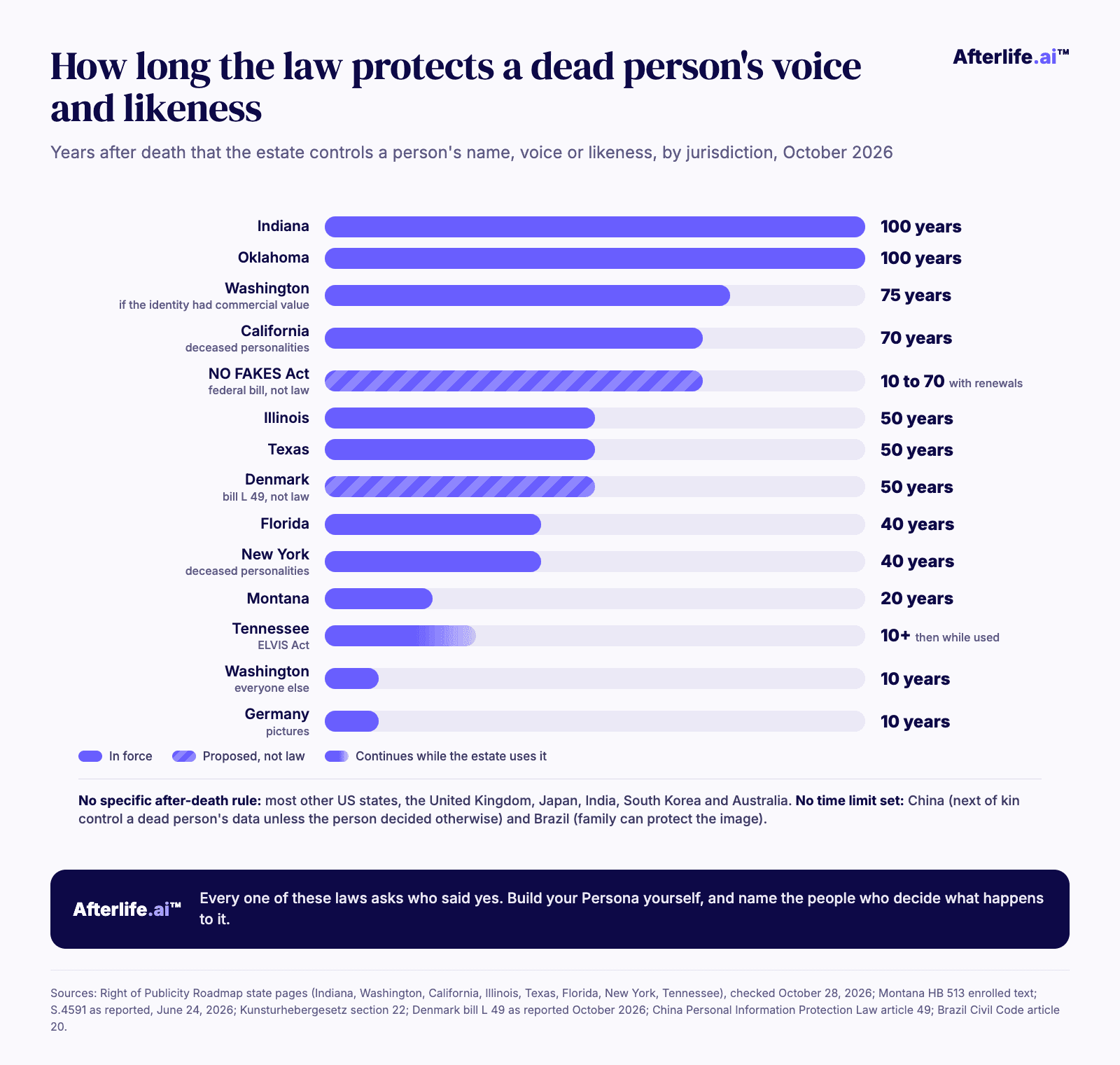
In most of the United States, building a private AI chatbot of someone who has died, for your own family's use, is not covered by any statute. It becomes a legal risk the moment you publish it, sell it, advertise with it or distribute it. California, Tennessee, New York, Illinois, Indiana, Texas, Florida, Washington, Montana and other states give a dead person's voice and likeness to their estate for anywhere from 10 to 100 years, and in Tennessee even a public post that makes no money can be enough to be sued. Abroad, Germany protects a dead person's picture for ten years, Denmark plans to protect a person's face and voice for 50 years after death, and China lets the next of kin control a dead person's data unless the person decided otherwise while alive. The one version all of these laws are built to allow is an AI the person made of themselves, with their own consent, before they died.
What you want to do | Is it legal? | Why |
|---|---|---|
Build a private chatbot of a parent who died, for your own use | Usually not prohibited by any US statute | Publicity laws target public and commercial uses. The app's own terms may still require consent from the person or the estate |
Post it publicly, on social media or YouTube | Risky, and illegal in some states | In Tennessee, knowingly publishing an unauthorized voice or likeness is actionable without any sale. Elsewhere, privacy, defamation and platform rules apply |
Use it in an ad, a product or anything that makes money | Illegal without the estate's consent in most states with a post-mortem right | Commercial use is the core of every publicity law, from California's 70 years to Indiana's 100 |
Put a dead performer in a film, show or song | Needs the estate's consent in California and New York | California's AB 1836 sets damages of at least $10,000 |
Sell an app that clones a specific dead person | Illegal without authorization in Tennessee and Montana | Both states make the tool itself actionable, and the federal NO FAKES bill would do the same nationwide |
Play it in court, as a victim impact statement | Allowed in some courtrooms, but risky | An Arizona appeals court threw out a sentence in 2026 because the judge relied on one |
Make an AI of yourself for your family | Legal, and the strongest consent there is | The person portrayed is the person who said yes |
By Chris Williams, founder of Idy®, the company behind Afterlife.ai™. Published October 28, 2026.
The only person who can say yes to an AI of you is you.
Build your Persona from your own memories and voice, and name the people who decide what happens to it.
Build your Persona freeDefinitions
AI of a dead person: any AI system that imitates someone who has died, from a text chatbot trained on their messages to a cloned voice or a video avatar. Researchers call them griefbots, deadbots or postmortem avatars.
Right of publicity: a person's right to control commercial and public uses of their name, voice and likeness. In many states it continues after death and belongs to the estate.
Digital replica: a realistic, computer-generated copy of a real person's voice or appearance, the term used in US federal and state AI laws.
Estate: the people who hold a dead person's rights, usually the executor named in the will, and the heirs or beneficiaries who inherit.
What does the law actually regulate?
The law regulates what you do with an AI copy of a dead person, far more than whether you make one. Almost every rule in this guide is triggered by one of three things: putting the copy in front of the public, using it to make money, or selling a tool built to copy a specific person. A grieving son who builds a chatbot from his father's text messages and keeps it on his own phone is, in most of the United States, outside the reach of any publicity statute. The same son who posts videos of the chatbot to a monetized channel, or sells access to it, is inside several.
The second thing the law cares about is who said yes. While a person is alive, the only consent that counts is theirs. After death, the right passes to their estate, which in practice means the executor and the heirs named in their will, or the relatives who inherit under state law if there is no will. That is why the same AI can be lawful in one family and unlawful in another: the question is never only "is it legal," but "who authorized it."
The third thing, and the one most people miss, is that the person's own written wishes can outrank the family. California lets a person transfer their post-mortem rights by contract, trust or will. China's Personal Information Protection Law lets the next of kin act on a dead person's data "except where the deceased has arranged otherwise before their death." A clear decision made while alive is the strongest instruction any of these systems recognizes, and it is also the one almost nobody leaves.
Is it legal in the United States? The rules by state
There is no federal law yet. The NO FAKES Act, which would protect every person's voice and likeness for at least ten years after death, cleared the Senate Judiciary Committee in June 2026 but was blocked on the Senate floor on September 30, as our NO FAKES Act status tracker explains. Until it passes, the answer depends on the state. The table below covers the states with the clearest after-death rules.
State | Who controls a dead person's likeness | How long after death | What else to know |
|---|---|---|---|
California | The estate, or whoever the person named by contract, trust or will | 70 years | AB 1836 requires estate consent for digital replicas in films, shows and recordings, with damages of at least $10,000. Heirs must register with the Secretary of State before they can collect damages. Covers "deceased personalities" whose identity had commercial value |
Tennessee | Executor, heirs or devisees | 10 years, then for as long as the estate keeps using it commercially | The ELVIS Act reaches public posts that make no money and tools built to clone a specific person. Every individual is covered |
New York | The estate of a "deceased personality" | 40 years, for people domiciled in New York | A separate rule covers digital replicas of deceased performers, tightened in December 2025 |
Illinois | The estate | 50 years, for deaths after January 1, 1999 | Fame is not required. Distributing unauthorized digital replicas has been covered since 2025 |
Indiana | The estate | 100 years | Applies regardless of where the person lived, as long as the use happens in Indiana |
Oklahoma | The estate | 100 years | One of the two longest terms in the country |
Texas | The estate | 50 years, for deaths on or after January 1, 1937 | Claims in the first year after death may require registration |
Florida | The estate | 40 years | No requirement of fame |
Washington | The estate | 10 years for most people, 75 years for people whose identity had commercial value | Applies regardless of where the person lived |
Montana | Executors and heirs | 20 years | Since January 1, 2026, covers AI voice and likeness depictions and the tools that make them |
Most other states | Little or no statutory protection after death | None, or common law only | Check our digital replica laws by state tracker |
Two details change real outcomes. California's protection applies to a "deceased personality," someone whose name, voice or likeness had commercial value at death or because of it, so it reaches a local radio host as well as a film star, but probably not a private person with no public profile. New York draws a similar line. Tennessee, Illinois, Florida and Montana do not require fame at all, which is why an ordinary family in those states has stronger tools against a public AI fake than a famous family in some others.
Is it legal in other countries?
Outside the United States, very few countries have an after-death rule written for AI, and the ones that do protect the family's interests rather than the public's curiosity. The table draws on our deepfake laws by country tracker, which covers 17 jurisdictions and is re-checked monthly.
Country or region | After-death rule | How long |
|---|---|---|
Germany | Publishing a dead person's picture needs the consent of the spouse or partner and children, otherwise the parents (Kunsturhebergesetz, section 22) | 10 years |
Denmark | Bill L 49, introduced to parliament on October 8, 2026, would ban public, realistic imitations of a person's face, voice or movements without consent, with a target start of January 1, 2027 | 50 years after death, if passed |
European Union | The AI Act requires deepfakes to be labeled from August 2, 2026, but sets no consent rule, and the GDPR does not cover the data of people who have died | No EU-wide rule |
China | The next of kin may exercise a dead person's data rights unless the person arranged otherwise before death, and draft 2026 rules ban AI clones made without consent | Not limited |
United Kingdom | No general right over a person's image or voice, living or dead | None |
Japan | No after-death rule. In September 2026 the Tokyo District Court held that using a living voice actor's voice without permission can infringe his publicity rights | None after death |
India | Courts protect living performers' voices from AI cloning, as in Arijit Singh's 2024 case, but there is no after-death rule | None after death |
Brazil | A dead person's spouse, ancestors or descendants can act to protect the person's image under article 20 of the Civil Code | Not limited |
Australia | No publicity or personality right, living or dead | None |
The cases behind the rules
The law in this area has been written by a handful of cases in which a dead person's voice was used by people who believed they knew what the person wanted. In 2021, the documentary "Roadrunner" used AI to recreate Anthony Bourdain's voice reading words he had written; the director said he had the approval of Bourdain's estate, and Bourdain's former wife publicly said she was not the one who had approved it. In April 2024, Drake released a track with AI copies of Tupac Shakur's and Snoop Dogg's voices, and the Shakur estate's lawyer gave him 24 hours to take it down, citing the estate's publicity rights. That same year, George Carlin's estate sued over an AI "comedy special" in his voice, and the makers agreed to take it down permanently.
The cases of 2026 were sharper still. Christopher Pelkey was killed in a road rage shooting in Arizona in 2021, and at his killer's sentencing in 2025 his sister played an AI video in which a replica of him spoke of forgiveness. The judge said he "loved" it and imposed the maximum sentence. On September 30, 2026, the Arizona Court of Appeals vacated that sentence, calling the decision to allow the video a "fundamental error" and noting that it presented "a depiction of the victim and his thoughts created from the imaginings of the victim's sister" (NBC News). And when Dolly Parton died on August 25, 2026, a fake AI recording of her voice describing a "final wish" was already circulating, as our guide to the ELVIS Act and her estate explains.
Each of those families, and each of those producers, acted on a belief about what the person wanted. None of the people portrayed had written it down. That is the pattern the laws above are trying to fix, and it is the gap researchers keep identifying: Cambridge researchers called in 2024 for the consent of the person whose data builds an AI of the dead, and a Lehigh University audit of 93 AI afterlife services found that 82 publish thin or no information on who has authority over a recreation.
What about griefbot apps?
Most griefbot apps put the legal question on you. Their terms typically require you to promise that you have the right to upload someone's messages, photos or voice, which means that if an estate objects, the user who uploaded the material carries the risk. Few of them say what happens to the recreation if the company closes, and several AI companion and legacy companies have shut down or been sold in the past two years, as our guide to what a griefbot is details.
Afterlife.ai™ takes a different position, written into our Terms: nobody may build a Persona of another person, living or dead, without that person's explicit written consent or the consent of their legal estate representative (section 5.1). We do not offer to recreate someone who has died. Every Persona on Afterlife.ai™ is built by the person it portrays, from their own memories and in their own voice, which is the one kind of AI likeness every law in this guide is designed to allow.
What can you do if someone you love has already died?
You have more options than an AI copy, and most of them are legal everywhere. Save every real recording you have, because a person's actual voice is irreplaceable and often scattered across phones and apps; our guide on how to save WhatsApp voice messages walks through the steps. Ask the executor before you use the person's voice or likeness anywhere public, since the estate may hold rights you would otherwise infringe. And if you find a fake of them online, report it to the platform, and tell the executor, who may be able to act under state law.
If you still want an AI built from their messages for your own private use, read the service's terms first, and think about the people who share those memories with you. A recreation that one sibling finds comforting can feel like an intrusion to another, and the estate is the one place where those disagreements are meant to be settled.
What if your parent is still alive?
Then the decision is still theirs to make, and the law gives their own consent more weight than anything their family could decide later. The most useful thing you can do is help them make it: record their stories and their voice now, in their own words, and let them name the people they trust to decide what happens afterwards. Under every law in this guide, an AI that your mother built of herself, while alive, with her own consent, stands on firmer ground than anything her children could build after her death.
That is what Afterlife.ai™ is for. Your parent builds their own Persona from their memories and in their own voice, and names the people who step in under Executor Lock™, so the consent is theirs and the decisions after their death are made by people they chose. Executor Lock™ works alongside a will, not instead of it, and our guide to leaving permission for an AI of you in your will explains how the two fit together.
If your parent is alive, the decision is still theirs.
Help them preserve their voice and their stories now, in their own words, with their own consent.
Help a parent preserve their voiceHow do you stop anyone making an AI of you after you die?
Decide now, in writing, and make your decision easy to find. A will or trust can say who holds your voice and likeness rights after death and what they may and may not authorize, and in California and many other states those documents control who owns the right. A record of your own consent, and of what you never agreed to, gives your family the evidence to fight a fake. And naming a specific person to make the calls you cannot foresee matters as much as anything you write, because a right that nobody knows they hold protects no one.
The simplest way to do all three is to make the AI yourself, so the only version of you that exists is the one you approved. Idy built Executor Lock™ for exactly this, before it built anything else, and holds 78 patents pending on the governance behind it, with international protection sought under the Patent Cooperation Treaty. You build your Persona, you name who takes over, and at the lock your Persona's personality is sealed, so nobody, family included, can turn you into someone you were not.
Decide while it is still yours to decide.
Your voice, your memories, your rules, and the people you choose to enforce them.
Build your Persona freeFrequently asked questions
Is it legal to make an AI chatbot of a dead person?
In most of the United States, a private chatbot for your own use is not prohibited by statute. Publishing it, using it commercially or distributing it can require the estate's consent, and in Tennessee a public post alone can be enough to be sued.
Is it legal to clone a dead person's voice?
Cloning a voice for private use is rarely what the law targets. Using a dead person's cloned voice publicly or commercially needs the estate's consent in states with post-mortem rights, such as California, Tennessee, New York, Illinois and Texas.
Who has to give consent for an AI of someone who died?
Their estate: usually the executor named in the will and the heirs, or whoever the person named in a contract, trust or will to hold their rights.
Can my family make an AI of me after I die?
In many places they can, at least privately, unless you say otherwise in writing. A will, a trust or a recorded decision is the most reliable way to control it.
Can someone make an AI of a celebrity who has died?
Not commercially without the estate's consent in most states that protect the dead, and California requires estate consent for digital replicas in films, shows and recordings. Tennessee also bars publishing an unauthorized voice or likeness and distributing tools built to clone a specific person.
How long after death is a person's likeness protected?
It depends on the state: 100 years in Indiana and Oklahoma, 70 in California, 50 in Illinois and Texas, 40 in Florida and New York, 20 in Montana, and in Tennessee ten years and then for as long as the estate keeps using it.
Is there a federal law against AI copies of the dead?
Not yet. The NO FAKES Act would protect every person's voice and likeness for ten years after death, renewable to 70, but it was blocked on the Senate floor on September 30, 2026 and is not law.
Is it legal to use an AI video of a dead person in court?
Some courts have allowed it, but in 2026 the Arizona Court of Appeals vacated a sentence because the judge relied on an AI video of the victim, calling its admission a "fundamental error."
Is it legal to make an AI of a dead person in the UK, Germany or Australia?
The UK and Australia have no general right over a person's likeness, living or dead. Germany requires the family's consent to publish a dead person's picture for ten years after death.
Does Afterlife.ai™ make AI versions of people who have died?
No. Every Persona on Afterlife.ai™ is built by the person it portrays, while they are alive. Our Terms bar building a Persona of anyone else without their explicit written consent or their estate's.
How can I make sure an AI of me reflects what I want?
Build it yourself, in your own words and voice, and name the people who decide what happens to it. On Afterlife.ai™ that is your Persona and Executor Lock™.
How we researched this page
State post-mortem terms come from the Right of Publicity Roadmap maintained by Professor Jennifer Rothman, checked on October 28, 2026 for California, Tennessee, New York, Illinois, Indiana, Texas, Florida and Washington. Montana's rules come from the enrolled text of HB 513, and California's digital replica and registration rules from Civil Code section 3344.1 and Manatt's summary of AB 1836. The country rules come from our deepfake laws by country tracker, with Denmark's bill L 49 checked against reporting on its introduction. The Pelkey ruling comes from NBC News, the Tupac Shakur letter from Engadget, and the federal bill's status from the reported text of S.4591. Afterlife.ai™ policies come from our Terms of Service, section 5.1. This guide explains the law in plain English and is not legal advice; for a decision about a specific person, speak to a lawyer in the state or country where they lived.