
The ELVIS Act, explained: Tennessee's AI voice law, and who controls Dolly Parton's voice now
Dolly Parton died in Nashville on August 25, 2026. For months before her death, a fake recording of her voice, made with an AI tool, had been circulating online with a "final wish" she never spoke. In 2023 she said she would "have to decide how much of that high-tech stuff" she wanted to be involved with. Tennessee's ELVIS Act now puts that decision in the hands of her estate. This guide explains what the law says, how long it lasts, what it means for her family, and what it means for yours.
The ELVIS Act is Tennessee's law against unauthorized voice clones. Since July 1, 2024, it has treated every person's voice as their property, whether the sound is a real recording or an AI simulation, and it lets that person, or their estate after death, sue anyone who knowingly publishes an unauthorized copy, uses one to sell something, or distributes a tool built to clone them. After death, the right lasts at least ten years and continues for as long as the estate keeps using it. An analysis published by Forbes six days after Dolly Parton's death called her estate the first real test of the law.
Question | Short answer | Source |
|---|---|---|
What is the ELVIS Act? | The Ensuring Likeness Voice and Image Security Act of 2024, Tennessee HB 2091 and SB 2096, which rewrote the state's 1984 Personal Rights Protection Act to add voice and AI | |
When did it take effect? | Signed March 21, 2024, at Robert's Western World in Nashville, after passing both chambers unanimously. In force July 1, 2024 | |
Who does it protect? | Every individual, famous or not, during life and after death | |
What counts as a voice? | Any sound readily identifiable as a particular person, whether it is the person's actual voice or a simulation of it | |
What does it ban? | Unauthorized commercial use; knowingly making an unauthorized voice or likeness available to the public; knowingly distributing a tool whose primary purpose is producing a particular person's voice or likeness | |
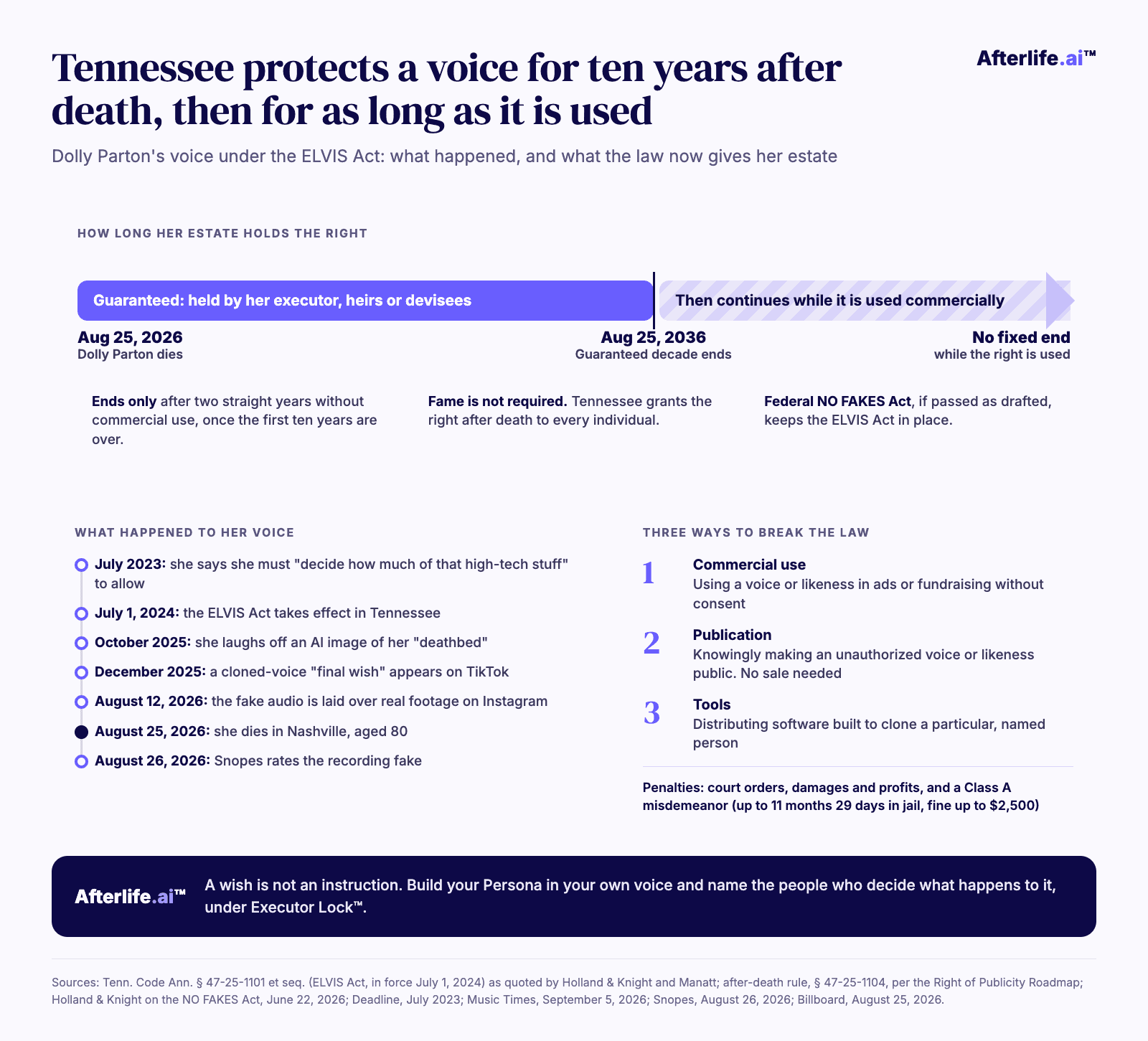
How long does it last after death? | Ten years, then for as long as the estate keeps using the name, voice or likeness commercially. Two straight years of non-use after the first decade ends it | |
What are the penalties? | Court orders, actual damages and profits in a civil case. A violation is also a Class A misdemeanor, punishable by up to 11 months and 29 days in jail and a fine of up to $2,500 | |
Would the federal NO FAKES Act replace it? | No. The federal bill is not law, and as drafted it keeps state laws that existed on January 2, 2025, including this one |
Most coverage of the ELVIS Act was written in the spring of 2024, when it was a music-industry story about AI tracks that sounded like real singers. It reads differently now. The law's real subject is succession: who controls a voice once the person it belongs to can no longer object. Tennessee answered that question for Elvis Presley in 1984, rewrote the answer for the AI era in 2024, and in 2026 watched the most famous voice in the state become the case that tests it.
The lesson reaches far beyond Nashville. Every person with voice notes on a phone and videos on social media now has a voice that can be copied in seconds, and most have never written down who should decide what happens to it. Dolly Parton said in 2023 that she had a decision to make. This page sets out what the law did with that decision, and how to make your own.
By Chris Williams, founder of Idy®, the company behind Afterlife.ai™. Published October 28, 2026.
Decide who controls your voice, while you can.
Build your Persona from your own memories and voice, then name the people who take over.
Build your Persona freeDefinitions
ELVIS Act: Tennessee's Ensuring Likeness Voice and Image Security Act of 2024, which protects a person's name, photograph, voice and likeness, including AI simulations, under Tenn. Code Ann. § 47-25-1101 and the sections that follow it.
Right of publicity: a person's right to control commercial and public uses of their identity, such as their name, face and voice. In many states, including Tennessee, the right continues after death and passes to the person's estate.
Digital replica: a realistic, computer-generated copy of a real person's voice or appearance, the term used in federal and state AI bills.
Executor, heirs and devisees: the people who hold a dead person's rights under Tennessee law: the person who administers the estate, the relatives who inherit, and the people named in the will.
What is the ELVIS Act?
The ELVIS Act is a 2024 update to one of the oldest likeness laws in the United States, and its name is a tribute to the man who caused the first one. Elvis Presley died in 1977. Within three years, the companies licensed to sell his image were in court against unlicensed sellers, and in 1980 a federal appeals court ruled, in Memphis Development Foundation v. Factors Etc., that Tennessee law did not let his publicity rights pass to his heirs. Tennessee responded with the Personal Rights Protection Act of 1984, a statute adopted mainly to guarantee that his publicity rights would survive his death, according to the Right of Publicity Roadmap maintained by Professor Jennifer Rothman. That 1984 law protected a person's name, photograph and likeness. It did not mention voice, because in 1984 nobody could fake one convincingly.
By 2023 anybody could. In April of that year, an anonymous producer released "Heart on My Sleeve", a track built from AI copies of the voices of Drake and the Weeknd, and it spread across streaming and social platforms before the labels had it removed. Nashville's songwriters and labels saw what that meant for a city whose economy runs on recognizable voices. Tennessee's legislature passed the ELVIS Act unanimously in March 2024, and Governor Bill Lee signed it on March 21 at Robert's Western World, a honky-tonk on Lower Broadway, surrounded by artists and songwriters. It took effect on July 1, 2024, the first state law written specifically for AI voice clones.
The Act did three things. It added "voice" to the protected list and defined it broadly, as any sound that is "readily identifiable and attributable to a particular individual," whether the sound is the person's actual voice or "a simulation" of it. It created two new routes to liability that do not depend on advertising. And it let record labels with exclusive contracts sue on an artist's behalf, so a label no longer needs the artist to bring the case.
What does the ELVIS Act make illegal?
The ELVIS Act creates three kinds of liability, and the difference between them matters, because only the first requires a commercial use. Most state publicity laws reach only the first kind, which is why commentators describe Tennessee's law as unusually broad.
Route | What the law says | Does it need a commercial use? | A plain example |
|---|---|---|---|
Commercial use (the 1984 core, now including voice) | Knowingly using a person's name, photograph, voice or likeness to advertise products or services, or to raise funds, without consent | Yes | A car dealer's radio ad that uses an AI copy of a local singer's voice |
Publication | Anyone who "publishes, performs, distributes, transmits, or otherwise makes available to the public" a person's voice or likeness, knowing it was not authorized | No | A viral video that pairs real footage with a cloned voice saying words the person never said |
Tools | Anyone who distributes "an algorithm, software, tool, or other technology, service, or device" whose "primary purpose or function" is producing "a particular identifiable individual's" photograph, voice or likeness, knowing it was not authorized | No | An app that sells a ready-made voice model of a named star |
The statutory wording above comes from the enacted text, as reproduced by Holland & Knight and Manatt in their 2024 analyses. Two limits run through all three routes. The person must act with knowledge that the use was not authorized, and the authority that counts is the individual's own while they live, and after death that of "the executor or administrator, heirs, or devisees." Making a voice clone in private, for yourself, is not what the law targets. Putting one in front of the public, selling with one, or selling the machine that makes one is.
What does the ELVIS Act leave alone?
The Act protects free speech by listing uses that are fair, "to the extent such use is protected by the First Amendment." News, public affairs and sports coverage are exempt. So are comment, criticism, scholarship, satire and parody, and fleeting or incidental uses, along with advertisements for any of those works.
The most important exemption has a catch built into it. A work that represents a person as themselves, such as a biopic or a documentary, is exempt, unless it "creates and was intended to create the false impression" that it is an authentic recording in which the person took part. That exception inside the exemption is aimed at exactly the kind of fake that spread about Dolly Parton: a recording designed to be mistaken for the real thing gets no shelter from it. A clearly labeled parody song is a different matter, and a court would weigh it under the First Amendment.
How long does the ELVIS Act protect a voice after death?
Sources disagree about this, and the disagreement is worth settling, because estates and families make real decisions on it. Some articles say the right lasts ten years after death. Others say twelve. Others say it never expires. Each of them is describing part of the same rule, which comes from Tenn. Code Ann. § 47-25-1104 and is set out in the Right of Publicity Roadmap.
What you may read | What the statute actually provides |
|---|---|
"Ten years after death" | Ten years is the guaranteed minimum. For that decade the right belongs to the executor, heirs or devisees whether or not anyone uses it |
"Twelve years" | After the first decade, the right ends if it goes unused commercially for two straight years. Ten years plus two years of silence is the earliest it can end |
"Forever" | If the estate keeps using the name, voice or likeness commercially, the right continues, with no fixed end date in the statute |
"Only for celebrities" | Tennessee grants the right after death whether or not the person ever exploited their identity commercially in life |
For Dolly Parton, the guaranteed decade runs to August 25, 2036. After that, her rights continue for as long as her estate keeps using her name, voice or likeness commercially, and between her catalog, her theme park and the businesses that carry her name, that use shows no sign of stopping. In practice, Tennessee has handed her estate a right that is likely to outlast everyone reading this page. The same rule applies to a Tennessee family with no famous name at all: the decade is guaranteed, and the right after that depends on use.
What happened to Dolly Parton's voice?
The story of Dolly Parton's voice in the last year of her life shows how fast AI fakes now move, and how little a public figure can do about them alone. The timeline below uses only reported, dated events.
When | What happened | Source |
|---|---|---|
July 2023 | Asked about becoming an AI hologram, she said she had left "a great body of work behind" and would "have to decide how much of that high-tech stuff I want to be involved [with] because I don't want to leave my soul here on this earth." She added, "I'll be around, we'll find ways to keep me here." | Deadline, via The Independent |
March 2025 | Her husband of nearly six decades, Carl Dean, died at 82 | |
October 2025 | She laughed off an AI-generated image that showed Reba McEntire visiting her deathbed and reassured fans that she was not dying | |
December 2025 | A TikTok account posted a soundtrack of her cloned voice describing a "final wish" from an intensive care unit, at a time when there was no sign she was in one | |
August 12, 2026 | An Instagram account posted a video that laid the fake audio over genuine footage of her | |
August 25, 2026 | She died in Nashville at 80. Her nephew and longtime head of security, Bryan Seaver, announced her death in a video she had asked him to make "years ago" | |
August 26, 2026 | Snopes rated the "final wish" recording fake: the visuals were real, the voice was an AI copy, and there was no evidence she ever said those words | |
August 31, 2026 | A Forbes contributor's analysis called her estate the first real test of the ELVIS Act | |
September 4, 2026 | Her sister Stella Parton condemned the "endless garbage" of AI-generated material posted about the family every day |
The fake itself was ordinary, which is what makes it instructive. In it, a cloned voice says she can only stay awake for short periods, that she is enduring painful treatment in intensive care, and that her last wish is to be buried next to her husband. Snopes found that the tool used to make it could not even manage a natural pause between sentences. It did not need to be good. Laid over real footage of her face and posted to accounts with large followings, it was convincing enough to collect comments for weeks, including after her death, when people searching for news about her found it waiting for them.
Is the fake Dolly Parton "final wish" illegal?
On the face of the statute, it is the kind of use the ELVIS Act was written to stop. The recording put a simulation of her voice, readily identifiable as hers, in front of the public. Nobody with authority over her voice approved it. The fair use exemption for portraying a person as themselves does not help, because the whole point of the video was to create the false impression that it was an authentic recording. Before August 25, 2026, the claim belonged to her. Since then it has belonged to her estate.
Whether anyone ever wins that case is a separate question, and the obstacles are practical rather than legal. The accounts that posted the fakes are anonymous, and the people behind them may be outside Tennessee or outside the United States, where a Tennessee court's reach is uncertain. The platforms that hosted the videos will argue that federal law, Section 230 of the Communications Decency Act, shields them from liability for what their users post. Federal appeals courts have split on whether that shield covers state publicity claims: the Ninth Circuit held in Perfect 10 v. CCBill (2007) that it does, and the Third Circuit held in Hepp v. Facebook (2021) that it does not. We found no public lawsuit over the Parton fakes as of October 28, 2026.
That gap is the clearest argument for the federal NO FAKES Act, which would give every person in the country a notice-and-takedown process for unauthorized replicas, modeled on the one that copyright owners already use. The ELVIS Act gives her estate a claim, but not a fast way to make a fake disappear from the platforms where it spreads.
Who controls Dolly Parton's voice now?
Under Tennessee law, her voice, name and likeness now belong to her executor or administrator, her heirs, or the people she named in her will, and her estate plan decides which of those it is. She had no children, and her husband died in 2025, so the answer sits in documents that are not public. Her family's announcement put it in their own words: "Our family and the team she has entrusted with her legacy will work diligently to ensure her spirit will live with us forever."
Whoever that team is, it now holds the most valuable voice right in American music. Anyone who wants to train a voice model on her catalog, release a synthetic duet, build a hologram show or put her voice in an advertisement needs its consent, and record labels with exclusive rights to her recordings can enforce the law as well. Estates have gone both ways with this power. Elvis Presley Enterprises and Authentic Brands Group, which control Elvis's name and likeness, partnered with the British company Layered Reality on Elvis Evolution, a London show announced in January 2024 as the first immersive AI Elvis experience, built from the family's photos and home videos (BroadwayWorld). By the time it opened, the producers had scaled the AI back to "upscale archive footage," and fans who paid up to $400 a ticket called it a "shambles" (The Daily Beast). Robin Williams went the other way: he reportedly restricted the use of his image for 25 years after his death, a story we cover in our essay on whether AI can bring back the dead.
Dolly Parton's own words leave her estate a hard brief. In 2023 she said she did not want to "leave my soul here on this earth," and in the same breath that "we'll find ways to keep me here." That is a fair description of how most people feel, but it is not an instruction an estate can follow, and a remark at a press conference binds nobody. A written decision in her will or trust would bind the people who now hold her rights, and whether she left one is not public.
A wish is not an instruction.
Build your Persona in your own voice, and name the people who decide what happens to it.
See how Executor Lock™ worksDoes the ELVIS Act protect people who are not famous?
Yes. The Act protects "every individual," and its after-death right does not depend on fame or on whether the person ever made money from their identity. A Memphis family whose late father's voice turns up in a scam call, or in a fake video posted to embarrass the family, has the same claim under the publication route that Dolly Parton's estate has. The law also applies to people who are alive: a cloned voice used against you today is actionable today.
The limits are the ones that apply to any state law. The ELVIS Act's protections are limited to Tennessee residents, as Holland & Knight's 2024 alert notes, which in practice means people who live in Tennessee or who died domiciled there, and the Act does not spell out how it reaches defendants in other states. For scam calls, a separate federal rule helps: in February 2024 the Federal Communications Commission ruled that AI-generated voices count as "artificial" under the Telephone Consumer Protection Act, which gives people a private right to sue over robocalls that use them. Outside Tennessee, protection depends on where you live, and our guide to digital replica laws by state covers the states that have followed Tennessee's lead.
What does the NO FAKES Act change for the ELVIS Act?
Nothing yet, because the NO FAKES Act is not law. The federal bill, S.4591, would create a nationwide right in every person's voice and visual likeness, with a takedown process and damages of up to $750,000 per work against platforms that ignore valid notices. It cleared the Senate Judiciary Committee by voice vote on June 18, 2026. On September 30, Senator Marsha Blackburn of Tennessee asked the full Senate to pass it by unanimous consent, and Senator Ted Cruz of Texas objected, saying its parody exception was unclear. The RIAA's chief executive has said the bill has "a real shot" in the lame-duck session after the November 3 elections; if it does not pass by January 3, 2027, it will have to be introduced again. Our tracker, is the NO FAKES Act law?, follows every step.
If it passes in its current form, the ELVIS Act survives. The bill preempts future state laws on digital replicas, but it preserves claims under state statutes that existed on January 2, 2025, and Holland & Knight's June 2026 analysis names the ELVIS Act as one of them. The White House's AI policy framework, released in March 2026, also recommends a federal rule against unauthorized AI replicas of a person's voice or likeness, according to the Forbes analysis of the Parton case. Tennessee's estates would then hold two sets of rights: the state right that already exists, and a federal one with a faster way to get fakes taken down.
What should you do about your own voice?
The ELVIS Act gives the people you leave behind a right. It does not tell them what you wanted done with it, and neither does any other law. The decision Dolly Parton described in 2023 is one that every person with a recorded voice now faces, and it is better made in writing, while you can make it, than guessed at afterwards by the people who love you.
A good decision covers four things. It says whether you want an AI version of yourself to exist at all after you die, and if so, what it may and may not do. It names the people who will make the calls you could not foresee. It leaves proof of what your real voice sounds like and what you actually said, so a fake can be told apart from you. And it is written somewhere your family can find it and rely on it: a will or trust for the legal transfer of your rights, and a record of your consent that does not depend on anyone's memory of a conversation.
Afterlife.ai™ was built around that decision. You build your Persona yourself, from your own memories and in your own voice, so the consent behind it is the strongest kind the ELVIS Act recognizes: your own, given while you are alive. You name the people who step in, under Executor Lock™, and at the lock your Persona's personality is sealed, so nobody, including your own family, can turn you into someone you were not. Our Terms bar anyone from building a Persona of another person without that person's explicit written consent or their estate's (section 5.1), which means Afterlife.ai™ will never build an AI Dolly Parton for anyone who asks. Idy built this governance first, before the product, and holds 78 patents pending on it, with international protection sought under the Patent Cooperation Treaty. Executor Lock™ works alongside your will, not instead of it, and our guide to leaving permission for an AI of you in your will explains how the two fit together.
Make the decision while it is still yours to make.
Your voice, your memories, your rules, and the people you choose to enforce them.
Build your Persona freeFrequently asked questions
What does the ELVIS Act stand for?
The Ensuring Likeness Voice and Image Security Act of 2024. The name is also a nod to Elvis Presley, whose estate's fight over his likeness produced Tennessee's original publicity law in 1984.
When did the ELVIS Act take effect?
Governor Bill Lee signed it on March 21, 2024, and it took effect on July 1, 2024. Tennessee was the first state to pass a law aimed at AI voice clones.
Does the ELVIS Act only protect musicians?
No. It protects every individual in Tennessee, famous or not, during life and after death. It was championed by the music industry, and record labels with exclusive contracts can also sue under it.
Is it illegal to clone someone's voice in Tennessee?
Making a clone in private is not what the Act targets. Publishing one to the public, using one to sell something, or distributing a tool built to clone a specific person, knowing it was not authorized, can lead to a civil lawsuit and a misdemeanor charge.
How long does the ELVIS Act last after death?
Ten years is guaranteed. After that, the right continues for as long as the estate keeps using the person's name, voice or likeness commercially, and it ends after two straight years without such use.
Who can sue under the ELVIS Act after someone dies?
The person's executor or administrator, heirs or devisees, depending on the estate plan. A record label or other company with an exclusive license to the person's recordings can also bring a claim.
Was the Dolly Parton "final wish" recording real?
No. Snopes rated it fake on August 26, 2026. The footage was genuine, but the voice was made with an AI tool, and there is no evidence she ever said those words.
Did Dolly Parton want to become an AI hologram?
In 2023 she said she would have to decide how much "high-tech stuff" to be involved with, because she did not want to leave her soul on this earth. Whether she left written instructions about AI uses of her voice is not public.
Who controls Dolly Parton's voice and likeness now?
Her executor, heirs or devisees under her estate plan, which is not public. Her family said "the team she has entrusted with her legacy" will look after it.
Does the NO FAKES Act replace the ELVIS Act?
No. The NO FAKES Act is not law, and as drafted it would preserve state laws that existed on January 2, 2025, including the ELVIS Act.
Can Afterlife.ai™ make an AI version of Dolly Parton or another celebrity?
No. Our Terms bar anyone from building a Persona of another person without that person's explicit written consent or their estate's. You can only build your own.
How do I control what happens to my own voice after I die?
Decide in writing while you can. Say whether an AI version of you may exist, name the people who will decide what you could not foresee, and keep a record your family can rely on. On Afterlife.ai™ you build your own Persona and name those people under Executor Lock™.
How we researched this page
The ELVIS Act's provisions come from the enacted text as quoted in Holland & Knight's April 2024 alert and Manatt's analysis, and the after-death rule from Tenn. Code Ann. § 47-25-1104 as summarized by the Right of Publicity Roadmap. The signing details come from the Associated Press report carried by CBS News. Dolly Parton's 2023 remarks come from Deadline, which quoted The Independent; the details of her death and her family's statement come from Billboard; the fake recording's history comes from Snopes; and Stella Parton's statement and the October 2025 image come from Music Times. The Forbes analysis is cited from its Yahoo Finance syndication. The NO FAKES Act's status comes from Holland & Knight's June 2026 alert, reporting on Senator Cruz's objection and Billboard's interview with the RIAA, as summarized by AI Musicpreneur. Every fact was checked on October 28, 2026. This page explains the law in plain English and is not legal advice. Dolly Parton, her estate and her family have no connection to Afterlife.ai™ or Idy, and nothing on this page suggests that they endorse us.