
Voice Cloning for Legacy Must Be Consent-First
Voice cloning technology has improved rapidly in the past two years. What once required hours of high-quality recording can now be done from a few seconds of audio. The cloned voice can speak any text. It can express any emotion. It can produce speech the original speaker never made and would not necessarily endorse.
This technology has legitimate applications. It also has serious risks. In the context of digital legacy, where the voice being cloned belongs to someone who may no longer be able to consent, the line between meaningful preservation and unauthorised imitation matters more than almost anywhere else.
This page is about how voice cloning intersects with legacy, what consent-first design requires, and how Afterlife AI™ thinks about the difference between preserving voice and generating voice.
, and the public conversation has accelerated around it. Tom's Guide writer Jason England published a critique in February 2026 of Meta's US patent US12513102B2, which describes a large language model that could simulate a user (including in voice and video) when absent or deceased. The Microsoft equivalent was filed in 2021 with similar capabilities. England named Afterlife AI™, StoryFile and HereAfter AI as opt-in legacy-focused services that take a different approach: the person whose voice is being preserved opts in during their lifetime and sets the rules. Chris Williams discussed the broader voice-and-identity question on ABC Radio with Nikolai Beilharz, framing it as what happens to your digital self over time.
What voice cloning actually is
Voice cloning uses AI to learn the acoustic characteristics of a person's speech and generate new audio in that voice. With modern systems, a few minutes of clean reference audio is usually sufficient to produce convincing clones. The cloned voice can read any text, with any emphasis, in any emotional register.
This is fundamentally different from voice recording, which captures specific sentences a person actually said. A recording is a fixed artefact. A clone is a generator. The recording can never produce content the person did not say. The clone can produce arbitrarily much content the person never said.
Both have legitimate uses. The ethical considerations are very different.
The risks of voice cloning in legacy contexts
Voice cloning used without robust consent and governance can produce several harms.
Misrepresentation. The clone can say things the person never said, never agreed with, or actively opposed. Future generations may not be able to distinguish authentic recordings from generated content.
Loss of dignity. The person's voice can be used in contexts they would have refused. Advertising. Political content. Fictional scenarios. Emotional manipulation.
Fraud. Voice clones can be used for impersonation, voice-based authentication bypass, or scam communications that target the deceased's family.
Grief disruption. Family members hearing a clone speak words the person never said can intensify grief rather than ease it, especially when they cannot tell the difference between recording and generation.
Erosion of consent norms. Each unauthorised use makes the next one easier. The cultural expectation of permission slips.
These risks do not mean voice cloning should never be used in legacy. They mean its use requires more care than most adjacent technologies.
The consent framework that should apply
Any responsible use of voice cloning in legacy contexts should meet a defined standard of consent.
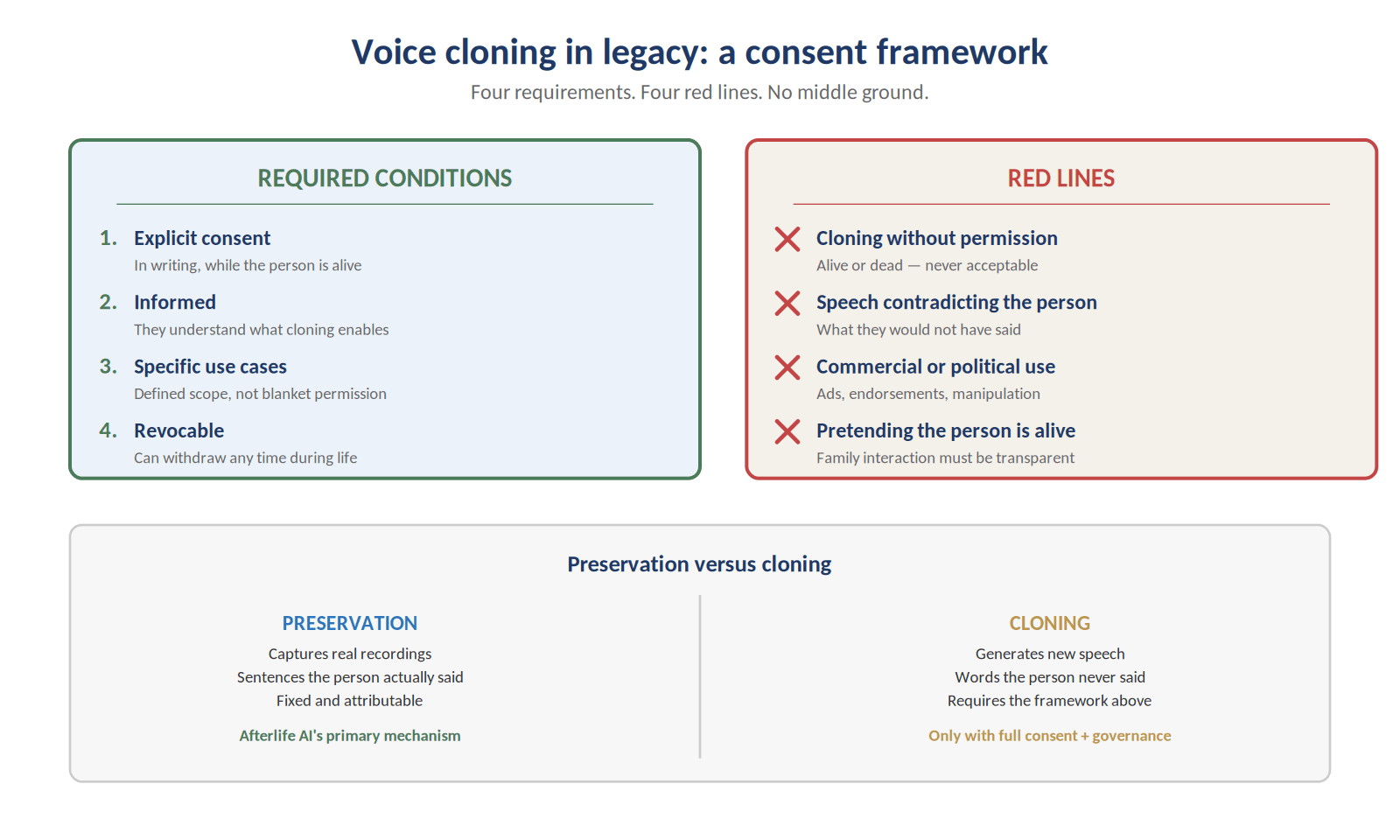
Explicit. The person whose voice is being cloned must have explicitly agreed, in writing or through a verified opt-in process.
Informed. They must understand what voice cloning is, what it enables, and what risks it carries. Generic terms-and-conditions consent is not sufficient.
Specific. They should consent to defined uses, not blanket permission. Cloning for memorial messages is different from cloning for arbitrary speech generation.
Revocable. They must be able to withdraw consent at any time during their lifetime.
Governed posthumously. The post-death uses of cloned voice must be bounded by rules they configured while alive.
Afterlife AI™'s privacy policy treats voice recordings and related sensitive data as requiring explicit, informed and revocable consent. The framework above is the operational implementation of that policy.
Voice preservation versus voice cloning
The distinction worth drawing is between voice preservation and voice cloning.
Voice preservation captures recordings the person actually made. Specific sentences. Specific stories. Specific emotional registers. The recordings are fixed and attributable. There is no question about whether the person said what is being heard. They did. The recording proves it.
Voice cloning generates speech the person did not make. The generated content sounds like them. The acoustic fingerprint matches. But the words are not theirs. The emotional register may not be theirs. The opinions expressed may not be theirs. Future listeners cannot tell what is real and what is generated unless that distinction is made transparent.
Afterlife AI™'s primary mechanism is voice preservation. Voice memories are recorded by the person, in their own words, attached to specific memories or messages. The recordings are what the family hears. There is no ambiguity about what is real.
Where voice cloning might responsibly fit
Voice cloning, used carefully, can play a role in legacy that voice preservation cannot.
A person who recorded a great deal while alive may want their family to hear specific messages on specific future occasions, a grandchild's wedding, a great-grandchild's twenty-first, that they did not have the chance to record directly. Voice cloning could, in principle, be used to deliver those messages in the person's voice.
If this is to happen, it should happen under tight conditions.
Explicit consent to cloning during the person's lifetime.
Specific scripts authored by the person while alive, even if delivery happens later.
Transparency to the family that the speech is generated, not originally recorded.
Bounded use cases configured through Executor Lock™.
Ability for the family to request that cloning cease at any time.
Without these conditions, voice cloning in legacy contexts becomes ethically indefensible.
Start your Persona today. A Persona built on who you are. Your stories, your wishes, your values, your likeness, your voice. Create your account free.
Red lines that should not be crossed
Some uses of voice cloning are not defensible under any framework.
Cloning someone's voice without their permission, alive or dead.
Generating speech that contradicts what the person actually believed.
Using a deceased person's voice for advertising, political messaging or commercial endorsement.
Generating responses to family questions in ways that pretend the person is alive.
Using cloned voice to manipulate grieving family members commercially or emotionally.
These are not edge cases. They are the central failure modes of careless voice cloning. Any platform that allows them, or fails to actively prevent them, is operating outside the norms that should govern this technology.
How Afterlife AI™ approaches voice
Afterlife AI™'s current voice handling is built around preservation. Users record voice memories tied to specific memories and messages. These recordings are the voice content the family hears. The platform does not generate new speech in the user's voice without explicit, informed, specific consent and a governance framework attached.
Any future expansion into voice cloning capabilities would be governed by the framework above. Consent first. Specific use cases. Family transparency. Executor Lock™-bounded permissions. Red lines maintained.
The principle is simple. Your voice is yours. It should remain yours, even after you can no longer speak for it.
Where to start
If voice matters to you, start with voice preservation. Record memories in your own voice. Anchor them to specific stories and people. Build a Persona that contains your real voice, not a model of it.
If you want to think further about cloning, do so deliberately, with full understanding of what it enables and what it risks. The technology will keep advancing. The ethics need to keep up.
Why preservation is the safer foundation
Preservation and cloning are technically related but ethically distinct. Preservation captures sentences a person actually said. Cloning generates sentences they did not say, in a voice that imitates theirs. Preservation does not require post-death consent because the consent was implicit in the act of recording. Cloning requires explicit, informed, ongoing consent because the cloning operation is happening to material the person did not produce themselves.
For legacy purposes, preservation is almost always sufficient. The bereaved want to hear the person speak as themselves, not to hear simulated continuations of conversations the person never had. The grandchild who never met their grandfather wants to hear him tell a story he actually told, not a fabricated story in his voice. The family wants the voice they remember, not a synthetic extension of it.
Cloning has narrow legitimate uses in legacy: accessibility for those who have lost their own voice, controlled message generation within tightly bounded parameters, specific delivery of pre-authored messages at scheduled moments. Each requires explicit consent established while the person was alive. None justify open-ended cloning of the deceased's voice for general use.
Afterlife AI™'s primary mechanism is preservation. Cloning, where it is offered at all, is gated by the framework described above. The default posture is conservative because the default is what users get when they have not specifically chosen otherwise, and the default for a legacy platform should be whatever causes the least potential harm to the person whose voice it is.
Frequently asked questions
Is voice cloning ethical for legacy?
It can be, but only with explicit, informed, revocable consent during the person's lifetime, plus a robust governance framework for posthumous use.
Can I preserve my voice without cloning it?
Yes. Voice memories, guided recordings and spoken stories are usually the right primary approach. Recording specific content is safer and more authentic than generating new content from a clone.
Does Afterlife AI™ clone voices?
Afterlife AI™'s primary voice mechanism is preservation. Any use of voice cloning capability would be governed by the consent framework described above.
Can my family generate new content in my voice after I die?
Not without explicit consent and configuration set by you during your lifetime. The Persona's behaviour is bounded by Executor Lock™ permissions.
What if I do not want my voice cloned at all?
You can configure that explicitly. Voice cloning is opt-in. Without your specific consent, your voice is preserved as recorded and not used for generation.
Related voice guides: see voice legacy, is voice cloning safe, and how to clone your voice.