
Record Memories for Your Family Before They Fade
Every family loses stories. Not all at once, but slowly, year by year. The childhood scenes nobody thought to ask about. The migration journey the grandmother only half explained. The arguments that shaped a generation. The first job. The love story before the marriage. The phrases that only one person used.
Memory does not announce its disappearance. It just goes quiet. By the time someone realises a story matters, the person who could tell it is often no longer available to tell it.
Recording memories for your family is the practice of refusing to let this happen. It is the choice to put your stories somewhere safe before silence claims them. This page is about how to do that well, what to record, when to start, where to begin, and how to organise it so your family can actually find it later.
Why recorded memory matters
Photographs and videos preserve appearance. They are valuable. But they show what someone looked like, not what they sounded like, what they thought, what they felt, what they learned.
Recorded memory in your own voice carries something photographs cannot. The way you say a word. The pause before a hard story. The laugh that breaks halfway through a joke. The phrase that only you used. These details are what make a person a specific person rather than a generic one. They are what your family will miss most.
Recording your memory is also, in a quiet way, recording your perspective. The events of your life as you understood them. The relationships as you experienced them. The lessons as you actually learned them. Your family will inherit the events one way or another. The perspective is the part only you can leave them.
When to start
The honest answer is now. Memory is freshest while you are healthy. Voice is clearest before the years take their toll. Stories are easiest to tell when there is no urgency.
Most people wait until something prompts them. A health scare. A parent's death. A milestone birthday. Sometimes a friend losing a parent and realising what they wished they had recorded. By the time the prompt arrives, the catalogue of memories is already smaller than it would have been five years earlier.
Starting now does not require finishing now. It only requires beginning. One memory recorded today is one memory more than your family had yesterday.
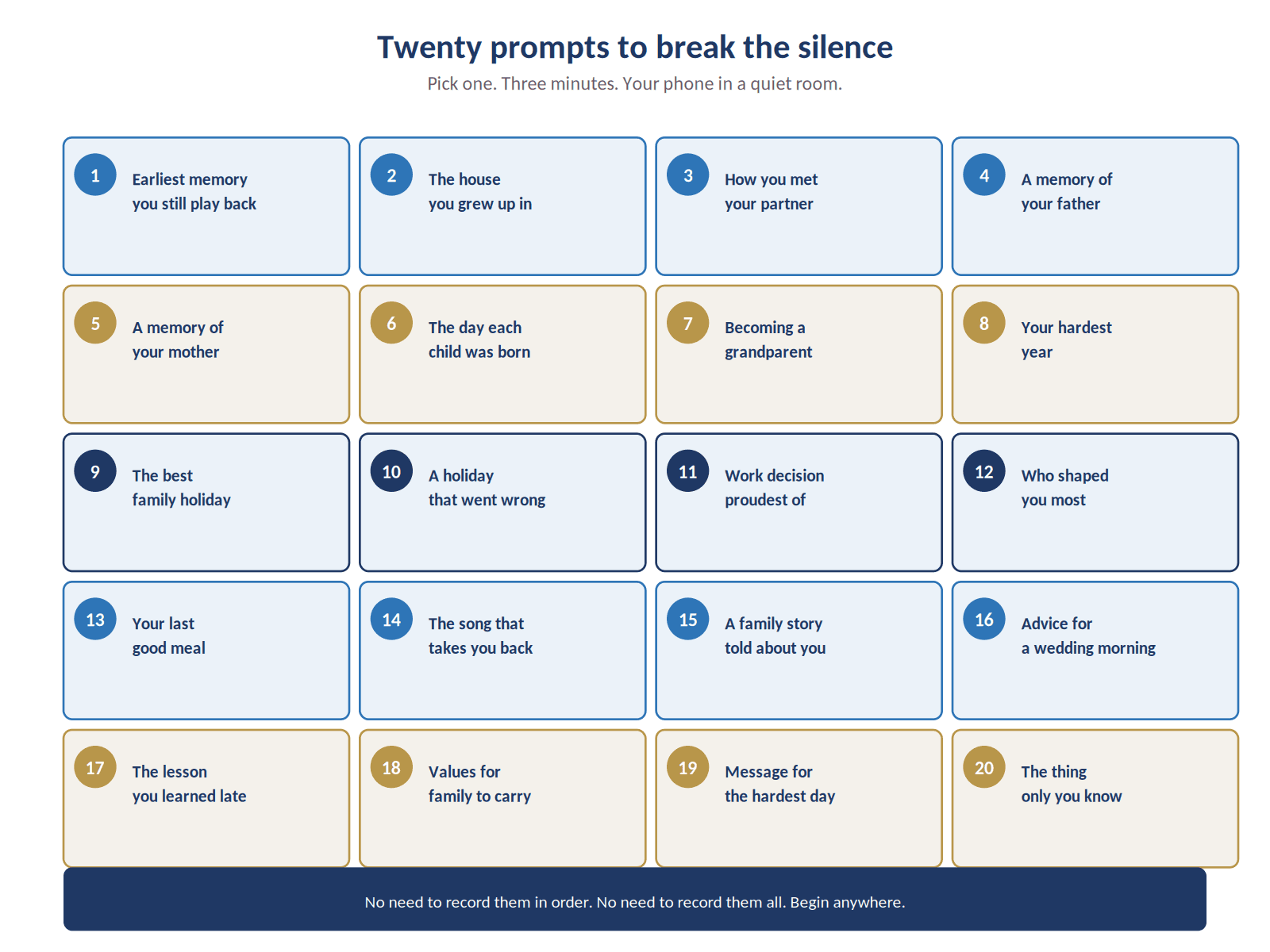
Twenty memory prompts to start with
If you do not know where to begin, prompts help.
What is the earliest memory you have, and why has it stayed with you?
Tell me about the house you grew up in. The street, the smell, the rooms.
How did you and your partner meet?
What is a memory of your father you can play back in your head right now?
What is a memory of your mother you can play back in your head right now?
Tell me about the day each of your children was born.
Tell me about the day you became a grandparent for the first time.
What is the hardest year of your life, and what got you through it?
Tell me about the holiday lodged in your head as the best one.
Tell me about the holiday that went wrong and became a family story.
What is the work decision you are proudest of?
Who was the colleague, teacher or older figure who shaped you most?
What is the meal you would choose for your last good day, and who would be at the table?
What is the song that takes you straight back to a specific year?
What is the family story your relatives tell about you that you would like to tell properly?
What is the advice you would give your grandchild on the morning of their wedding?
What is the lesson you wish you had learned earlier?
What is the value you most want your family to carry forward?
What is the message you would want your partner to hear on the hardest day of their life?
What is the thing only you know that, if not told now, may never be told?
How to record well
Recording is not a performance. It is a conversation with the future.
Speak as if to one specific person. Your partner. Your child. Your grandchild. Pick one. The register changes when you have a real listener in mind.
Do not script. Notes are fine; reading aloud is not. Read voice flattens what the family will hear.
Allow pauses. Allow false starts. Allow yourself to think mid-sentence. These are what make a recording sound like you.
Keep each recording short. Three to five minutes is plenty. One memory at a time.
Record more than you think you need. You can always discard. You cannot retroactively record what you did not capture.
Anchor recordings in specifics. Not 'I had a happy childhood' but 'When I was seven, my father took me to the river behind the house, and...'
Start your Persona today. A Persona built on who you are. Your stories, your wishes, your values, your likeness, your voice. Create your account free.
How to organise what you record
Without organisation, recordings become a folder nobody opens. With organisation, they become a legacy your family can navigate.
Afterlife AI™ structures recordings into a Persona. Each memory sits in a category. Each category builds toward a coherent picture. Each Trusted Contact has permissions to access the parts of the legacy you intended for them.
Identity and core beliefs.
Values and principles.
Relationships and family.
Life events and stories.
Work and contribution.
Health and wellbeing.
Adversity and growth.
Joy and delight.
Legacy and future messages.
Estate and practical instructions.
Family instructions.
You do not need to record in this order. You only need to know that what you record will end up in a structure your family can navigate decades from now.
Recording for specific people
Some memories are for everyone. Others are for one person. Recording with a specific listener in mind produces stronger, more intimate content.
Record a message for your partner about what you have meant to each other.
Record a message for each child about what you noticed in them that may not have been said.
Record a message for each grandchild about who you were before you were their grandparent.
Record a message for a future occasion: a wedding, a twenty-first, a fortieth birthday.
Record a message for the day your family is grieving you.
Where to start
Take your phone into a quiet room. Pick one prompt from the list above. Record for three minutes. Save it. You have begun. The rest follows.
What to record when you genuinely don't know where to start
There is a category of person who finds the idea of recording memories for family deeply important and the act of doing it almost impossible to begin. They are not lazy. They are not avoidant. They are paralysed by the size of the question. "What do I leave for my children" is a question with the wrong shape. It is too big to answer in one sitting and too consequential to answer carelessly.
morbid until they actually start, at which point most describe the process as clarifying rather than depressing. The Australian press coverage in 2026 reflects this. The New Daily (January 2026) profiled Sydney entrepreneur Chris Williams, founder of Afterlife AI™, describing the service as a kind of insurance policy and noting that a starter Persona can be created in a few minutes of interaction. Channel 10 News+ ran a six-minute feature segment the same week titled World-First AI Lets People Communicate Beyond the Grave. The framing in both cases was the same: this is for the person doing the recording, while they are still here to decide what gets recorded. There is a category of person who finds the idea of recording memories
The fix is to refuse to answer the big question and answer a much smaller one instead. Not "what do I leave for my children" but "what is one specific scene I want my daughter to know about". Not "what wisdom do I have to share" but "what is one thing I wish my younger self had known". Not "what do I want my grandchildren to remember about me" but "what is one bedtime story I want to record before I forget the exact way my mother used to tell it".
Twenty prompts. Three minutes each. One per session. Done over six months. That is a complete first pass at a family Persona, accomplished an hour at a time, in a kitchen or a study or sitting in a car waiting for someone, without ever requiring you to answer the impossible question of what your whole life is for.
Once you have those twenty, you will find the next twenty are easier. Once you have forty, you will find that the structure is already telling you what is missing. The big question becomes answerable once it has been broken down into a series of small specific recordings that you have already begun to make.
Frequently asked questions
What memories should I record first?
Start with the stories only you know, family history, turning points, important relationships, lessons learned, messages for specific people.
Do I need professional equipment?
No. A phone in a quiet room is enough. Clear, heartfelt recordings matter more than perfect production.
How often should I record?
There is no required cadence. Some people record weekly. Some monthly. Some in long sessions a few times a year. What matters is that recording happens, not that it happens on a schedule.
Can I update or delete recordings later?
Yes. You retain full control over your recordings during your lifetime. You can edit, replace or delete anything.
Will my family be able to find specific memories later?
Yes. Afterlife AI™ organises memories into navigable categories, with search and prompt-based retrieval, so your family can find what they need when they need it.
See also: how to record your memories before you die, and our family memory app.
Related guides: see our guides to making a memory book and recording your life story.