
A Family Memory App for the Stories Behind the Photos
Most families have thousands of photographs and almost no context for them. Who is in the picture. Where it was taken. What was happening that day. Why the moment mattered. The information that would make a photograph meaningful in fifty years usually lives in someone's head, not in the metadata.
A family memory app should help you preserve the things photographs cannot: stories, beliefs, relationships, work, hard-won lessons, joys, legacy messages, voice, all eleven dimensions of who someone was. Not just the picture of your grandmother in the kitchen, but the recording of her explaining how she came to be there, what she was making, who she was missing, what she hoped for the people she was cooking for.
Afterlife AI™ is built for this. It is a family memory app that preserves stories, voice recordings, photos with context, and a private AI Persona that holds it all together. This page explains how it works, who it is for, and how it differs from other apps in this space.
What families lose without recording
Family memory disappears in predictable ways.
Migration stories that only one generation knew, lost when that generation passes.
The names of relatives in old photographs, forgotten as the last person who knew them dies.
The phrases that were specific to one person, the voice that everyone misses, the laugh nobody else can do.
Family history that was never written down because nobody asked while there was still time to answer.
The advice your grandfather would have given you, if anyone had thought to record him giving it.
Specific scenes: your mother in a particular dress at a particular dinner, telling a particular story, that exist only in someone's memory until that memory itself fades.
These losses are not dramatic. They are quiet. They accumulate over generations. By the time anyone notices, the family knows less about itself than it could have.
What Afterlife AI™ preserves
The platform is built around a Persona that holds different kinds of family content.
Written memories and reflections.
Voice recordings, including stories, advice, family history and messages.
Photos with context: captions, dates, named people, the story behind the image.
Family history and lineage.
Values, principles and life lessons.
Messages for specific family members, deliverable on specific occasions.
Practical instructions for after you are gone.
Permissions specifying who in the family can access what.
How a Persona is different from a photo album
A photo album is static. You scroll through it. You see what was preserved. There is no way to ask a question, find a specific story, or hear a specific voice.
A Persona is navigable. Your granddaughter, asking what her grandmother thought about a particular question, can hear an answer in her grandmother's voice if her grandmother recorded thoughts on that topic. The Persona surfaces what is relevant when it is relevant.
This changes the family memory experience. Instead of an archive your family scrolls through once and then forgets, the Persona becomes something that returns to use over years. A grandchild revisits it on a milestone. A great-grandchild discovers it for the first time. A great-great-grandchild, if the Persona is preserved long enough, hears a voice from a generation they never met.
Who Afterlife AI™ is for
The platform is used by people with specific motivations.
Parents wanting to leave something for children who are still young.
Grandparents wanting their grandchildren to have access to them, not just photographs.
People living with chronic or terminal illness, wanting to leave something organised for the family they will not be there to support.
People who have lost a parent without ever recording them, and do not want their own family to face the same gap.
Founders, creators and professionals who want their work and perspective preserved in their own words for the people who come after them.
Immigrants and adoptees wanting their family origin stories preserved before they are lost.
What these users share is the recognition that memory is fragile and the willingness to spend a little time, while they still can, doing something about it.
What you build for them now will outlast every other gift you ever give.
How families use Afterlife AI™ together
While Afterlife AI™ is built around individual Personas, families often use it collectively.
Parents create their own Personas while their children are young, knowing the recordings will matter most decades later.
Adult children encourage their ageing parents to record while there is still time.
Couples build complementary Personas, each with different memories of the same shared life.
Siblings coordinate to capture different perspectives on shared family history.
Multiple generations use the platform together, with each generation building their own Persona that future generations will inherit.
The platform is designed to support this. Trusted Contact permissions let family members access each other's Personas with appropriate boundaries. Each Persona stays under its creator's control; family-level access comes from each creator's own Trusted Contact designations.
Start your Persona today. A Persona built on who you are. Your stories, your wishes, your values, your likeness, your voice. Create your account free.
How Afterlife AI™ compares with other family memory apps
There are several adjacent products in this space, each with a different focus.
StoryWorth sends weekly questions and produces a hardcover book at the end of the year. Focused on collected written stories rather than interactive Persona.
Remento prompts users to record spoken memories that are then transcribed into keepsake books. Voice-first but book-output.
StoryFile produces conversational video memorials, with significant production overhead and a focus on video presentation.
HereAfter AI focuses on interactive memory sharing, closer to Afterlife AI™ in concept but with different governance and pricing approaches.
Afterlife AI™ is built differently in three specific ways.
It is governed by Executor Lock™ for posthumous behaviour, with explicit pre-death configuration translating into binding post-death rules.
It is consent-first by design at the privacy and data-handling level, with personal data not used for AI training unless explicitly opted in.
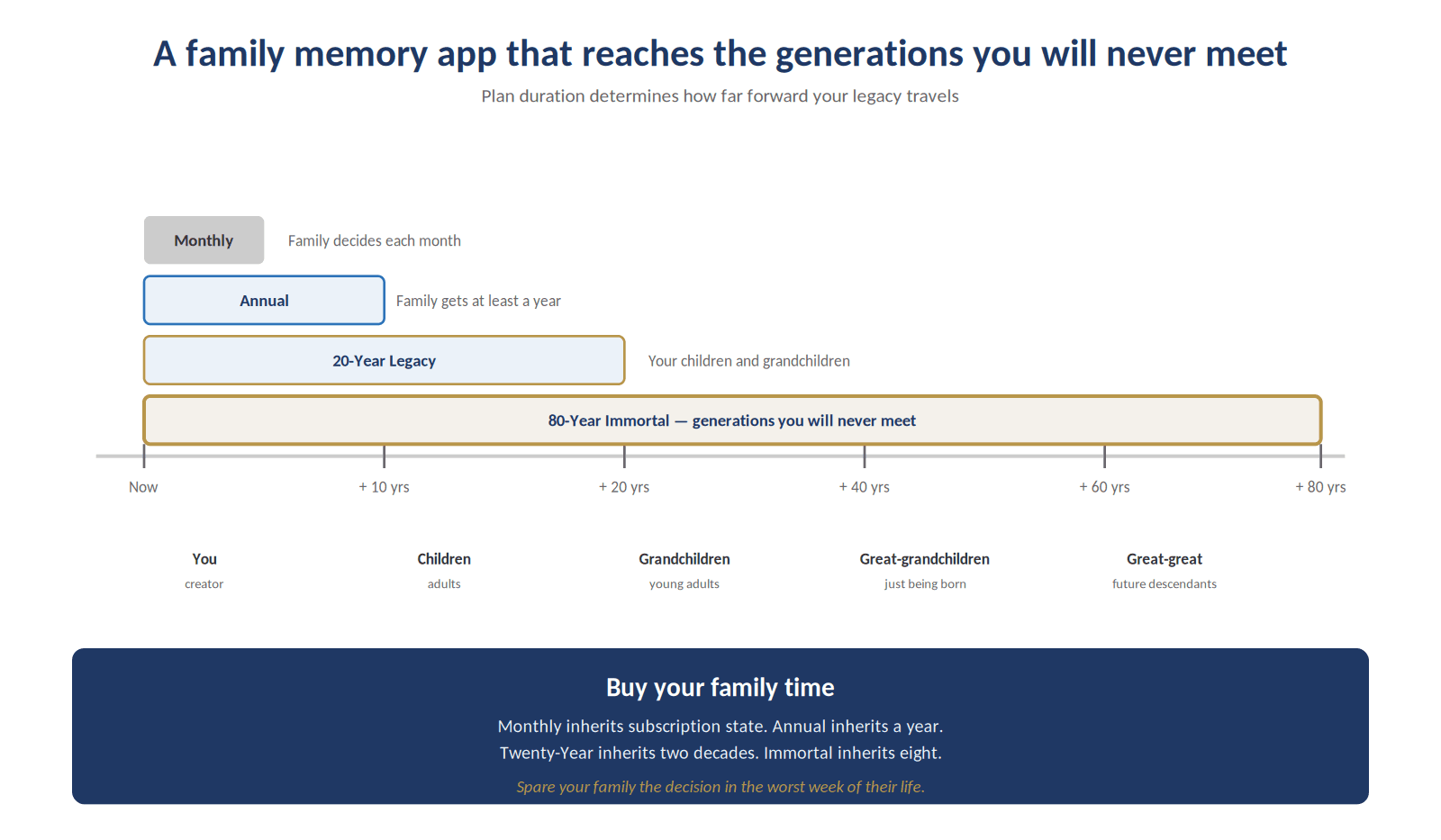
It offers long-term tiers (20-Year and 80-Year prepaid plans) designed for users who want the legacy to last across decades or generations.
Plans for family memory
The platform offers tiered plans matching different family memory use cases.
Free: For trying the platform and recording an initial set of memories.
Legacy ($14.99/month): For active legacy building, with advanced AI conversations and voice support.
Eternal ($29.99/month): For users committed to building a comprehensive family Persona library with multiple Trusted Contacts.
a long-term plan (available in-app): For a defined two-decade family memory commitment.
the long-term plan (available in-app): For a multi-generational family memory preservation, intended to reach descendants the creator will never meet. Prices are in USD.
Where to start
Begin with a free account. Spend ten minutes recording one family memory. See how it feels. Then add another. The family Persona does not need to be built in a weekend. It needs to be begun.
Building a family memory across generations
A family Persona built well becomes more valuable across generations, not less. The first generation records. The second generation inherits and adds context. The third generation accesses material that the first generation could not have imagined being accessible to them. The fourth generation may inherit a coherent multi-decade record of a family that no previous generation could have offered.
This is genuinely new. For most of human history, family memory was confined to the people in living contact with each other. Stories travelled one generation in detail, perhaps two with fading, and beyond that into folklore or oblivion. The technological capacity to hold stories, voice, memory, identity and personality signal across a century is something that did not exist for any previous generation. Whether to use it is a decision available to families now in a way that it was not available before.
Afterlife AI™'s family-memory architecture is designed for this. Family members designate each other as Trusted Contacts across their individual Personas, and those permissions can span generations. The longest-term plan explicitly underwrites the storage commitment for descendants who will not be born for several decades. The combination of consent-first preservation by the original creators, Executor Lock™ governance across the transitions, and platform durability across time is what allows a family memory app to be something other than a temporary repository.
The practical implication is that the work you do now compounds. The first recording is the hardest. The hundredth recording is part of a structure. The thousandth recording, accumulated across a lifetime, is the kind of family record that nobody you know currently has, and that your descendants will be able to access on terms you set.
Frequently asked questions
What is a family memory app?
An app that helps families preserve stories, photos, voice, beliefs, relationships and reflections for future generations across all eleven dimensions in a structured, accessible way.
How is Afterlife AI™ different from StoryWorth or Remento?
Both of those produce keepsake books from family stories. Afterlife AI™ builds a governed AI Persona that is interactive rather than static, and is protected by Executor Lock™ for long-term family access.
Can multiple family members use the app together?
Yes. Each family member builds their own Persona and grants Trusted Contact access to the relatives they choose, which is how family-level access works without anyone losing control of their own.
Can my grandchildren use it after I am gone?
Yes. The Persona transitions to read-only governance under Executor Lock™, accessible to your nominated Trusted Contacts according to the permissions you set.
How private is family memory data?
Personal data is encrypted at rest and in transit, processed only with explicit consent, and not used to train AI models unless you separately opt in. It is not sold, rented or licensed.
Related guides: see our guides to making a memory book and recording your life story.