
How to Record Memories Before You Die
This is not a morbid task. It is an act of love. Recording your memories before you die gives your family something nobody else can give them: your story, in your words, in your voice, with your perspective and your details and your humour.
You do not need to record everything. You only need to begin. This guide is the most practical version of how to do that, what to record, in what order, with what tools, for whom, written for someone who has decided to start and wants to do it well.
Step 1: Decide who you are recording for
The first decision shapes every recording you make. Who is going to listen to this?
If you are recording for a partner, the register is intimate. You can speak directly, refer to shared memories, leave private messages. If you are recording for children, the register shifts to advice-giving, lesson-sharing, and the kind of straight talk that is hard to do when they are in the room. If you are recording for grandchildren, especially young ones, the register changes again, you are telling them who you were before you were their grandparent, what shaped you, what you hope for them.
You can record for all of these audiences. But each session should have a specific listener in mind. The shift in tone is one of the most powerful tools you have.
Step 2: Choose the right environment
Recording quality is shaped more by environment than by equipment.
Find a quiet room. Internal rooms with soft furnishings absorb echo better than rooms with hard surfaces.
Turn off the air conditioner. Close the windows. Put the phone in airplane mode so notifications do not interrupt.
Have a glass of water nearby. Dry mouth changes how you sound.
If you can, record at a time of day when you feel most yourself. Some people are sharpest in the morning. Others find evenings easier.
If you cannot find a quiet space at home, a parked car is often the best impromptu studio: interior is small, soundproofing is decent, and you can sit comfortably.
Step 3: Start with voice, not text
Writing first and then recording produces flat, performed-sounding audio. Speaking first, then transcribing or summarising, produces recordings that sound like you.
If you must prepare, write three or four bullet points to anchor what you want to cover, then put the page aside and speak from memory. The forgetting and recovering is part of what makes the recording feel real.
Step 4: Begin with one specific scene
Generalities are the enemy of memorable recording. Start with one specific scene rather than a category.
Instead of 'My childhood was happy', try 'When I was seven, my father took me fishing at Lake Macquarie. The sun came up over the water. He showed me how to bait a hook, and I dropped the rod in the lake.' The scene anchors the memory. The reader can see it. The voice that tells it sounds like a person remembering, not a person summarising.
Once you have one scene, you can move out to another. And another. The scenes accumulate into something larger.
Step 5: Cover the categories over time
There are twelve or so areas worth covering eventually. You do not need to do them in order. You do need to know they exist, so you can return to the ones you have not addressed.
Identity and core beliefs: who you are, what you stand for.
Values and principles: what you have lived by.
Relationships and family: partner, parents, children, siblings, friends.
Life events and stories: the specific scenes worth preserving.
Work and contribution: what you built.
Health and wellbeing: how you took care of yourself, what you learned about your body.
Adversity and growth: what you survived.
Joy and delight: what made you happy.
Legacy and future messages: what you want to say to specific people at specific moments.
Estate and practical instructions: what you want done.
Family instructions: operational guidance for the people you leave behind.
Humour and voice: the jokes, the phrases, the parts of you that show up in everyday speech.
Step 6: Record messages for specific people
Some of your most valuable recordings will be for one specific person on one specific occasion.
A message for your partner about what you have meant to each other, to be heard on the hardest day.
A message for your eldest child about being the eldest, when you are not there to be the buffer.
A message for your youngest about being the youngest, when you are not there to keep an eye.
A message for each grandchild on their twenty-first birthday.
A message for each grandchild on their wedding day.
A message for the day your family is grieving you, to be opened the morning after the funeral.
A message for any future grandchildren you may not meet.
These recordings tend to be the ones the family treasures most. They are direct. They are personal. They are gifts that arrive at the moment the person needs them.
Step 7: Record the practical alongside the emotional
Most legacy guides emphasise the emotional content and underweight the practical. Both matter.
Where the family should look for important documents.
Account information your partner needs.
Subscriptions that should be cancelled.
The thing you always handled that nobody else knows how to do.
Specific instructions about your funeral, if you have preferences.
The friend or extended family member you want kept in the loop on major events.
The advice your kids should follow if a particular situation arises.
Practical recordings are less emotionally charged but often the most directly useful. They prevent the small crises that come when the family does not know something only you knew.
The trick is not finding two hours. The trick is finding ten minutes, every week, for years.
Start your Persona today. A Persona built on who you are. Your stories, your wishes, your values, your likeness, your voice. Create your account free.
Step 8: Recording cadence over time
There is no required schedule. There are practical rhythms that work.
A short session once a week. Ten minutes. One memory. Easy to sustain.
A longer session once a month. Half an hour. Multiple memories. Useful for working through a category.
A focused session a few times a year, for specific occasions. Birthdays. Anniversaries. Holidays. The structure prompts the memory.
Opportunistic recording. A memory surfaces in conversation; you go record it before it fades.
Most people use some combination. The key is that recording happens, not that it follows a schedule.
Step 9: Organise as you go
Random recordings on your phone are not a legacy. They are a folder your family will have to interpret. Organisation matters.
Afterlife AI™ organises recordings into a Persona by default, categorised, searchable, accessible to the people you nominate, governed by the permissions you set. If you are not using a platform, at minimum: name each file clearly, store them in a structured folder, and keep a master list with brief descriptions.
Step 10: Decide who can access what
Not all memories are for all people. Some are for everyone. Some are for one specific person. Some are private, recorded for yourself, not intended for sharing.
Plan access at the same time as you plan recording. On Afterlife AI™, you set Trusted Contact permissions for each Persona section. You can specify that a particular recording is for one named family member only. You can mark some content private. You decide.
Step 11: Review your recordings periodically
Listen back to what you have recorded once or twice a year. Some recordings will feel essential. Some will feel less so. You can replace, supplement, or delete. The legacy is yours; refining it is part of building it well.
Step 12: Configure what happens after you are gone
The last step is the one most people skip. Configure how your recordings transition after your death. On Afterlife AI™, Executor Lock™ handles this, nominated Executor, defined permissions, access rules, deletion authority.
Without this step, even well-recorded legacies can become inaccessible or contested. With it, your family inherits something governed and dignified.
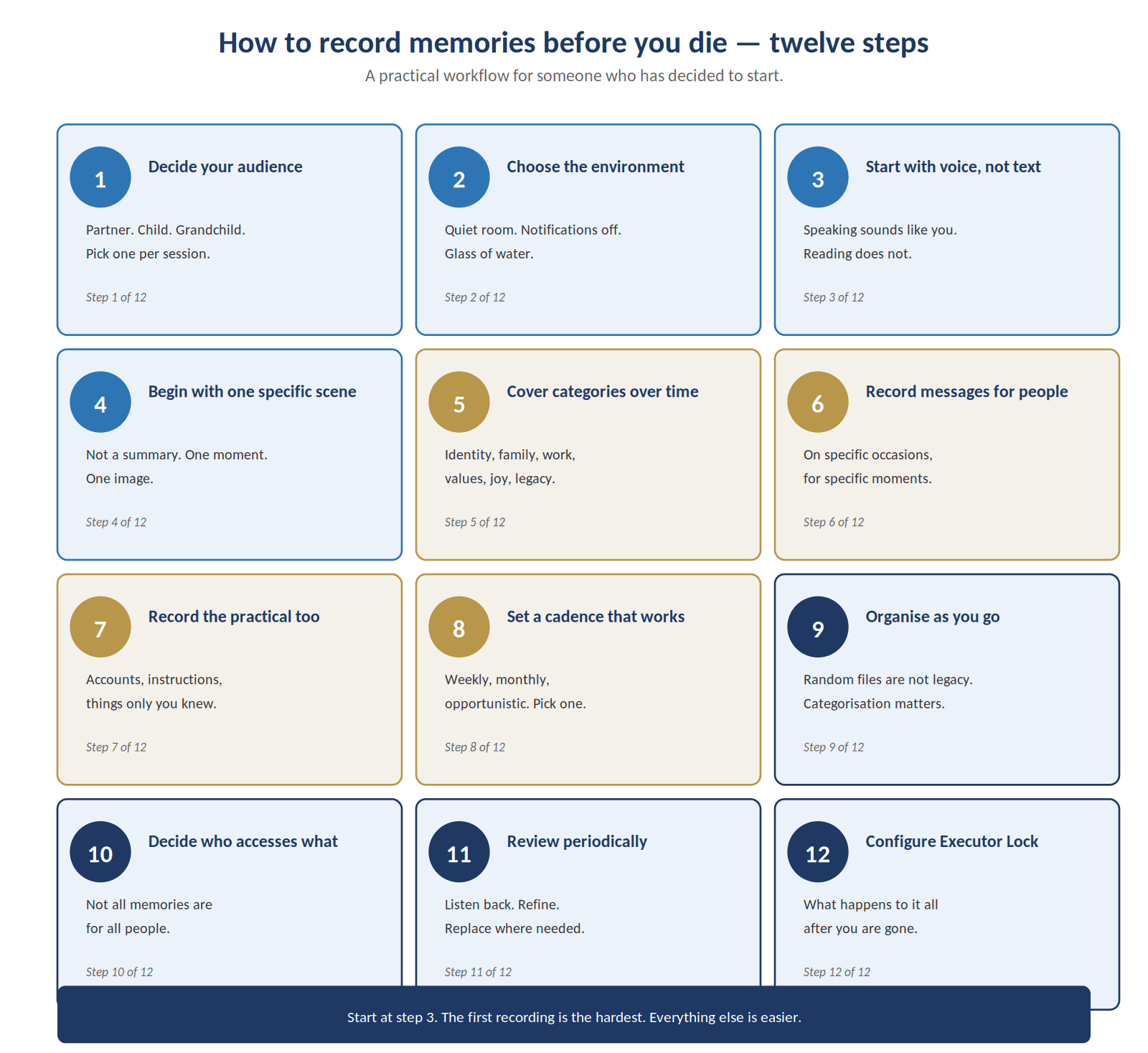
Where to start
Pick one prompt from this guide. Walk into a quiet room. Press record. Speak for three minutes. Save the file. You have begun. The rest of your legacy follows from that first recording.
Practical detail for each step
Step one, decide your audience. The most common mistake is recording for everyone, which means recording for no one in particular. The recordings that survive and matter are addressed. Partner. Child. Grandchild. A specific person, with a specific relationship, on a specific occasion you are imagining. The audience shapes the content more than any other variable.
Step two, choose the environment. The phone is enough. The room is not. Find a quiet room. Turn off notifications. Close the door. Put a glass of water nearby. Sit in a chair you can sit in for twenty minutes without becoming uncomfortable. Do not stand. Do not pace. Do not record while doing something else. The single biggest lift in recording quality comes from the room, not the equipment.
Step three, start with voice not text. The temptation to write things out first is strong and almost always wrong. Writing produces material that sounds like writing. Speaking produces material that sounds like you. The recordings that the family actually replays five years later are the ones in which the person sounds like themselves, not the ones in which they sound like a memorial speech.
Step four, begin with one specific scene. Not a summary. Not a theme. A moment. A particular afternoon. A particular conversation. A particular smell from a particular kitchen. Specificity carries truth in a way that generality cannot. The grandchild who hears a specific scene knows that the scene actually happened. The grandchild who hears a summary hears something that could be about anyone.
Steps five through eight, the cadence. Identity, family, work, values, joy, legacy. These are the categories most families wish they had asked about while there was still time to ask. Cover each at least once. There is no required order. You can record an identity piece on Monday and a values piece on Friday. Over a year you will accumulate a meaningful set across all six categories without ever having sat down to plan it formally.
Step nine, organise as you go. The single largest threat to a legacy collection is randomness. A hundred voice files named voice_memo_1, voice_memo_2, voice_memo_3 are useless to the family that inherits them. Tag the recordings. Date them. Add a one-line description. This work takes thirty seconds per recording and saves the family weeks of confusion later.
Step ten, decide access permissions. Not everything is for everyone. The message for your spouse is not for the children. The message for one child may not be for the others. The message for your grandchildren may be sealed until they reach a certain age. Afterlife AI™'s permission system is designed for this granularity. Use it.
Step eleven, review periodically. Once a year, listen back. Some recordings will hold up. Some will not. Replace what no longer represents you well. Add what is missing. The Persona is not a static document. It is alive while you are alive, and it freezes only when Executor Lock™ activates.
Step twelve, configure Executor Lock™ before you finish. Not as the final task in a notional grand plan, but as something to set up early and refine over time. The lock is what makes the Persona durable. The recordings are what make the lock worth having.
Frequently asked questions
When should I start recording memories?
Now. Memories are easiest to preserve while details, voices and emotions are still clear.
What if I do not know what to say?
Use prompts. Start with where you grew up, who shaped you, what you learned and what you want your loved ones to know. The first sentence is the hardest.
How long should each recording be?
Three to five minutes is usually right. One memory per recording is easier to organise later than long unbroken sessions.
What equipment do I need?
Your phone is sufficient. A quiet room matters more than a microphone.
How many recordings is enough?
There is no right answer. Some people record twenty memories and stop. Others record hundreds over years. What matters is that you start and continue.
See also: how to record memories for your family.
Related guides: see our guides to making a memory book.