
Preserve Your Voice After Death for the People You Love
Voice carries more than sound. It carries tone, rhythm, pause, accent, laughter, the small inflections that make someone unmistakably themselves. For the people who love you, hearing your voice may one day mean more than any photograph.
Most people preserve photos. Far fewer preserve voice. Almost none do it intentionally. The result is that families, after losing someone, often have hundreds of pictures and almost no recordings of the person speaking. They can see what the person looked like. They cannot hear what the person sounded like.
Afterlife AI™ is built around the idea that voice is worth preserving with at least the same intention you would bring to preserving photographs. This page explains why voice matters, what to record, how to do it well, and the difference between voice preservation and voice cloning.
Why voice carries more than people realise
If you have ever lost someone, you may have had the experience of hearing their voice unexpectedly, on an old voicemail you had forgotten about, in a home video you had not watched in years, and finding that it hit harder than any photograph.
There is a reason for this. Voice is more present than image. It is closer to the experience of being with someone. A photograph captures a moment; voice captures a way of being. The way your mother said your name. The way your father told a joke. The pause before your grandfather said something serious. These are things photographs cannot hold.
Preserving voice is not vanity. It is a gift you leave for the people who will miss the sound of you.
What to record first
The hardest part of recording voice is starting. The trick is to start small and specific.
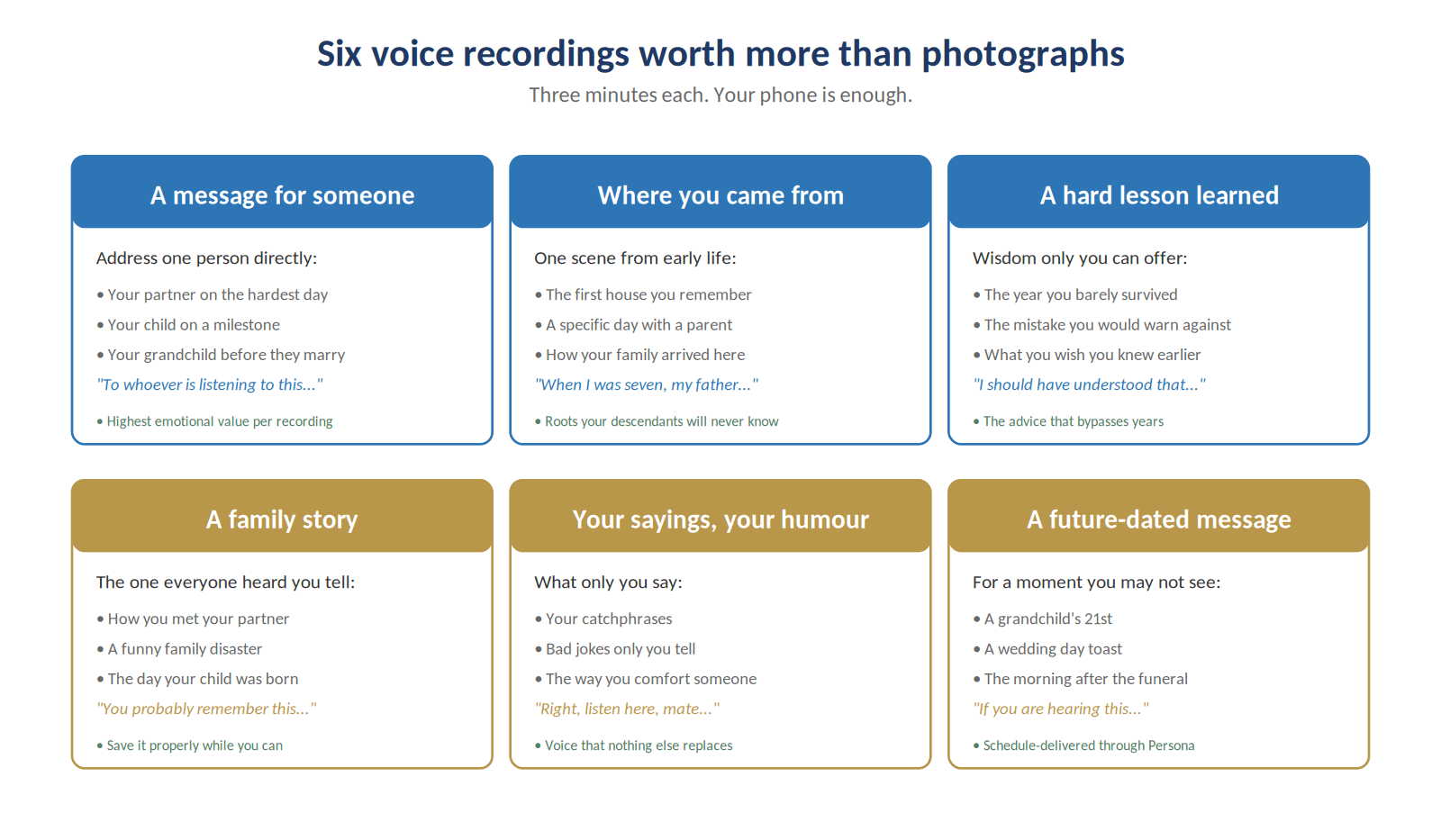
A short message for one specific person. Your partner. Your eldest child. Your first grandchild. Speak as if they are in the room with you. Tell them one thing you want them to remember.
The story of where you came from. Not your whole biography. One scene. Your first house. Your first job. The day you arrived in the country, if you migrated.
A piece of advice you would give your grandchild on the morning of their wedding.
Your favourite family story. The one everyone has heard you tell. Tell it one more time, properly, on the record.
The thing you say when one of the kids is upset. The phrase only you use. The joke that always lands.
A message for a future date. Your grandchild's twenty-first. Your child's fortieth. Your partner's first birthday without you.
Any of these is enough to begin. You do not need to record everything. You need to record something.
How to record voice well
You do not need professional equipment. A phone in a quiet room is enough.
The hardest moments are the ones nobody thought to record. A Persona changes that.
Sit somewhere quiet. A bedroom. A car parked with the engine off. A walk in a park if it is calm.
Speak as if you are talking to one specific person, not into a microphone. The shift in register matters.
Do not script. Notes are fine. Reading a prepared text makes your voice sound flatter and less like you.
Allow pauses. Allow false starts. Allow yourself to think mid-sentence. These are what make a recording sound like a person rather than a performance.
Keep recordings short. Three minutes of you being yourself is worth more than thirty minutes of you trying to be eloquent.
Record more than you think you need. Most of the recordings will become more precious than they feel at the time.
Voice preservation versus voice cloning
Voice cloning without consent is reconstruction. With consent, in life, it is preservation.
There is an important distinction between preserving your voice and cloning your voice.
Preservation means recording yourself, intentionally and consensually, so that the recordings can be heard by the people you choose. The recordings are exactly what you said. They are yours. They are clearly attributable to a specific moment when you recorded them.
Cloning means using AI to generate new speech in your voice. Sentences you never said, in tones you would not have used, on topics you may not have considered. The technology to do this is advancing rapidly. The ethics of using it are complex.
Afterlife AI™'s position is that voice preservation should always be primary, and that any use of voice cloning technology must be governed by explicit, informed, revocable consent. The Persona experience uses your actual recordings to anchor itself in your real voice. Anything beyond that is governed by careful permissions, not casual defaults.
Voice carries information that the words alone do not. The hesitation before saying something difficult. The shift in tone when the person becomes affectionate. The specific accent and inflection of a generation, a region, a class, a family. These are unrecoverable once the person is gone. Writing approximates none of them. Photographs hold none of them. The only way to preserve them is to record them, and the only person who can decide what to record is the person themselves.
The Afterlife AI™ platform treats voice as a first-class object, not an attachment. Voice recordings are tied to the memories they belong to, navigable by the Persona, and retrievable on demand by Trusted Contacts after Executor Lock™ activates. They are not encoded for future use as cloning material. They are preserved as themselves, in their original form, for the people the creator wanted to leave them to.
Start your Persona today. A Persona built on who you are. Your stories, your wishes, your values, your likeness, your voice. Create your account free.
How voice fits into a digital legacy
Voice alone is precious. Voice connected to memory is more powerful still.
A voicemail recording, found years after someone has died, is a moving artefact. A voice recording attached to a specific memory, accessible to a specific person, available on a specific occasion, is a designed gift. Afterlife AI™ structures voice this way. Each recording sits in context. Each context sits inside a Persona. The Persona is governed by your permissions.
The result is that your family does not just inherit voice files. They inherit a way of finding the voice that matters to them, in the moment that matters to them. Your daughter, on the day she becomes a mother herself, can find the recording you left her about becoming a parent. Your grandson, on the morning of his wedding, can hear the toast you gave when you were still here to give it.
Where to start
Take your phone into a quiet room. Open the voice memo app. Record a short message for one specific person you love. It does not have to be perfect. It has to exist.
That is the legacy. The recording itself is the gift. Anything you do with Afterlife AI™ after that is about organising, contextualising and governing what you have begun.
Why voice matters more than people think
There is a phenomenon that hospice workers, funeral directors, and grief counsellors describe consistently. In the early weeks after a death, the bereaved often reach for the deceased's voice in a way that surprises them. They play voicemails over and over. They search through video for the few seconds where the person speaks. They find an old recording of a phone message and listen to it twenty times in a row.
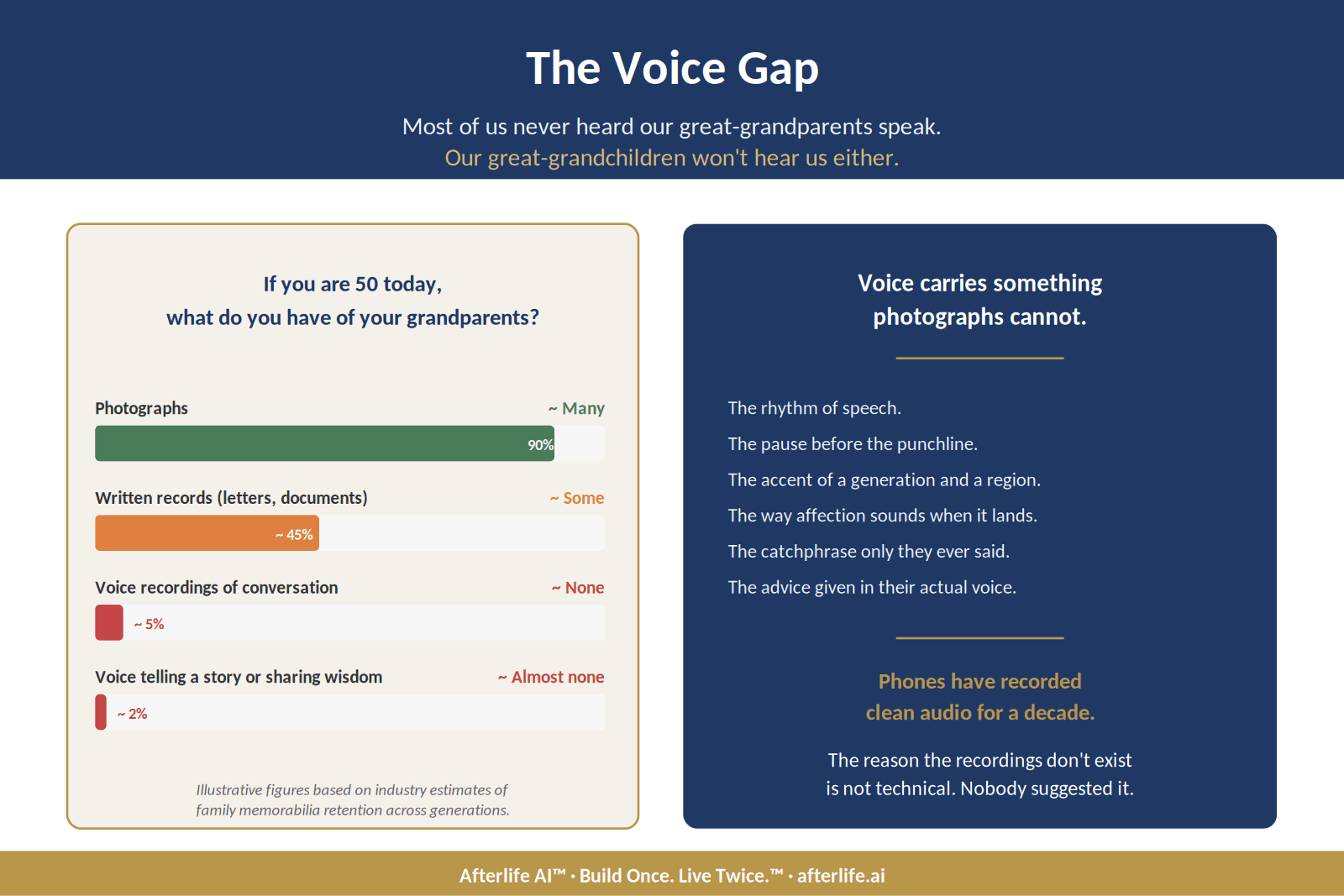
Voice carries something that photographs do not. A photograph captures appearance. Voice captures presence. The rhythm. The cadence. The small idiosyncrasies of speech that the brain associates with the specific human in a way that no image alone can summon. Bereaved families often report that hearing the voice unexpectedly is what triggers the strongest sense of the person being briefly nearby.
Most people do not have meaningful voice recordings of their parents or grandparents. Photographs, yes. Video, occasionally. Voice as the primary medium, almost never. This is a recent and very correctable failure of preservation. Phones have had the capacity to record clean audio for a decade. The reason the recordings do not exist is not technical. It is that no one suggested making them in time.
Frequently asked questions
How can I preserve my voice after death?
Record voice memories while alive, connect them to the stories and people they belong to, and use a service like Afterlife AI™ to store them under your permissions for the people you choose to give access to.
Is this the same as voice cloning?
No. Voice preservation means recording yourself so the recordings can be heard later. Voice cloning means using AI to generate new speech in your voice. Afterlife AI™'s primary mechanism is preservation, with cloning use governed by explicit consent.
How much voice do I need to record?
Less than you think. Even a handful of three-minute recordings on specific topics produces something meaningful. Start small. Add more over time.
Is my voice safe?
Voice data is treated as sensitive personal data. It is encrypted at rest and in transit, processed only with your explicit consent, and not used to train AI models unless you separately and explicitly opt in.
Can I record voice messages for specific people?
Yes. You can record messages addressed to specific Trusted Contacts. You can also schedule messages to be delivered on specific occasions, such as a wedding, birthday or anniversary.
Related voice guides: see preserve your voice for your family, record your voice for the future, and voice legacy.