

Time Capsule Letter: What to Write and When It Should Be Opened
A time capsule letter is a letter you write today for someone to open on a set future date, such as an 18th birthday, a wedding day or after you are gone. Describe life right now, say what you see in them, pass on one lesson, and keep it somewhere that delivers it on the day.
As seen in












A time capsule letter is the one piece of writing your family will open on purpose, years after you wrote it, on a day you chose for them. Parents write them for a baby's 18th birthday, grandparents write them for a wedding they may not live to see, and plenty of people write one to their own future self. The words matter, but the delivery matters just as much, because a letter nobody finds on the right morning is only paper in a box. This guide covers when to open one, what to write at every age, sample openings you can borrow, and the ways to keep a time capsule letter safe until the day.
Who it's for:
one person, by name. A letter to "the family" reads like a speech, while a letter to Maya reads like you.
When it opens:
on a fixed date, such as an 18th birthday, a graduation or a wedding day, or after you are gone.
How long:
one to two pages, or about five minutes read aloud.
Where it lives:
somewhere that delivers it on the day, which is a different job from somewhere that stores it.
What is a time capsule letter?
A time capsule letter is a sealed letter written now and opened at a chosen point in the future, usually years later. It is the personal version of the public time capsule, a term that only dates from 1938. One of the most famous early capsules, the Crypt of Civilization at Oglethorpe University in Georgia, was sealed in 1940 with instructions to open it in the year 8113, and many buried capsules have since been lost because people forgot where they were, according to Wikipedia's history of the time capsule. That is the lesson every letter writer should take from them: the writing is only half the job. A baby time capsule or a digital time capsule holds objects and files, while the letter is the part that carries your voice, and it is usually the only part anyone rereads. For the box itself, see our guides to the baby time capsule and the digital time capsule.
When should a time capsule letter be opened?
Pick a moment the reader will recognize as a turning point, because that is when a letter from you lands hardest. The best dates are ones nobody can miss, such as a birthday, a graduation or a wedding day. A letter for a hard year cannot carry a date, so it works best as an open-when letter, sealed and labeled for the day it is needed; our open when letter ideas has labels and examples. A letter meant to arrive after you are gone needs someone, or something, that knows when that has happened. For a full set of birthday letters from the 13th to the 30th, see our guide to letters to open on future birthdays.
Moment to open | Usual age | What the letter does |
|---|---|---|
18th birthday | 18 | Hands over adulthood: who they were as a child and what you trust them to do now |
Graduation | 18 or 22 | Names the effort you saw and what you hope the next chapter holds |
Wedding day | Any | Tells them what you know about love, including the hard years |
Their first child | Any | Tells them what the day they were born felt like to you |
A hard year | Any | Reminds them who they are when they have forgotten |
After you are gone | Any | Says the things you would want said, in your own words |
What do you write in a time capsule letter?
Every strong time capsule letter does five jobs, in roughly this order. It sets the scene, so the reader can see the kitchen, the car and the news on the day you wrote it. It describes them as they are right now, with details they will never remember themselves. It tells them what you hope for them without telling them what to do. It hands over one lesson, tied to the story that taught it to you, and it ends with a question for them to answer, which turns a letter into a conversation across the years. Here is one example line for each job, written for a five-year-old who will open the letter at 18.
The scene:
"It is a Sunday in March, it is raining, and you are asleep on my chest while I type this with one hand."
Them now:
"Right now you eat cereal one piece at a time and you call every dog you meet Biscuit."
The hope:
"I hope you have found the people who laugh at the same things you do."
The lesson:
"I learned at 19 that asking for help is a strength, the week I nearly failed out of college and finally told someone."
The question:
"Did you ever learn to like olives? I am betting you did not."
Leave out predictions about who they will become, instructions about careers or partners, and anything that only makes sense this year. Money worries and family arguments age badly, and a reader at 18 or 30 will take every word literally. If you would not say a line to their face at the age they will open it, cut it.
Time capsule letter to my daughter: prompts and an example opening
A time capsule letter to your daughter works best when it is about her in particular, not about daughters in general. Write down the small things she does now that she will never remember, then tell her what you see in her that she may not see in herself yet. If she will open it at 18, write to the adult she is about to become rather than the child you are tucking in tonight. For a letter you might give her now, our guide to a letter to my daughter has full examples.
What did she do this week that made you laugh out loud?
What is she afraid of right now, and what do you hope she has stopped being afraid of by the time she reads this?
What do you see in her that she does not see yet?
What do you want her to know about the day she was born?
What did you get wrong at her age that you hope she gets right?
Example opening, written as an illustration rather than a real family's letter: "Maya, it is the night before your fifth birthday, and you have just told me you want a cake shaped like a volcano that actually erupts. By the time you read this you will be 18, and I am betting you still do nothing by halves. I wanted you to have a record of who you were at five, written by the person who watched most closely."
Time capsule letter to my son: prompts and an example opening
A time capsule letter to your son should say plainly what many sons rarely hear out loud: that you are proud of him, and why. Be specific about the moments, because "I'm proud of you" from a letter is easy to skim, while the afternoon he taught his little sister to ride a bike is not. If he will open it at graduation, tell him about your own graduation and what you wish someone had told you then. Our guide to a letter to my son has more examples for the letters you give now.
What is he obsessed with this year, and what does that tell you about him?
When did you last see him be kind when nobody was watching?
What do you hope he never stops doing?
What did your own father or mother say to you at his age, and what do you wish they had said?
What is one thing you want him to know about money, work or love before he finds out the hard way?
Example opening, written as an illustration: "Ben, you are eleven, you are taller than your grandmother, and you have just spent four hours building a bridge out of popsicle sticks for a science fair that is not until May. You will open this on the day you graduate from high school. I want you to know that the boy who would not leave that bridge alone is the reason I never worried about you."
Time capsule letter to my granddaughter or grandson: prompts and an example opening
A time capsule letter to your granddaughter or grandson often has to travel further than any other, because many grandparents write for an age they may not live to see. That makes it the right place for the family history nobody else can tell: where the family came from, what their parent was like as a child, and what you hope carries on. Write a separate letter for each grandchild with one memory that belongs only to the two of you. Our guide to a letter to my grandchildren covers the letters you give in person, and there are birthday versions for a granddaughter and a grandson.
What was their mom or dad like at the age they are now?
What is one family story you want them to hear from you rather than secondhand?
What do you do together that nobody else does with them?
What did your own grandparents give you that you want to pass on?
What do you hope their life holds that yours did not?
Example opening, written as an illustration: "Ava, your grandfather and I drove you to the lake today and you counted every red car for forty miles. You are seven, and you will read this when you are twenty-one. I want to tell you about your dad at seven, because he counted red cars too, and about the lake, because it has been in our family longer than you would believe."
Time capsule letter to my future self or to myself: what to write
A time capsule letter to your future self is the same letter turned around: you describe your life today so the person opening it can measure how far they have come. Write down what a normal day looks like, what you are worried about, what you are hoping for, and three questions you want answered by the time you open it. Be honest about the things you would not post anywhere, because nobody else will read it. Email-to-the-future services such as FutureMe are built for exactly this letter, and our guide to a letter to my future self has templates for one, five and ten years.
What does an ordinary Tuesday look like for you right now?
What are you most worried about this year, and do you think it will matter in five years?
What do you want to have started, finished or stopped by the time you read this?
Who are the people you see every week, and who do you hope is still close?
What do you want to say to yourself if this year turns out to be a hard one?
What should a time capsule letter say at each age?
Write to the age they will be when they open it, and use the age they are now for the details. A baby's letter is mostly about you and the day they arrived, while a teenager's letter can be about them, their choices and the person they are becoming. The table below pairs each age with a prompt that gets the first paragraph down.
Writing to | Opens at | Write about | A prompt to start |
|---|---|---|---|
A newborn | 18 | The day they were born and who was there | "The first thing I noticed about you was..." |
A child of 5 to 10 | 18 or 21 | Their habits, jokes and obsessions right now | "Right now your favorite thing in the world is..." |
A teenager | 25 or 30 | What you see in them under the noise | "I know this year has been hard, and here is what I noticed..." |
A grown child | Wedding day or first child | Love, partnership and the hard years | "On my own wedding day, nobody told me..." |
A grandchild | 18, 21 or after you are gone | Family history and their parent as a child | "When your mom was your age..." |
Yourself | 1, 5 or 10 years | Your life now, your worries and your goals | "Today I am afraid that..." |
How do you keep a time capsule letter until the day it should be opened?
The hard part of a time capsule letter is getting it to the right person on the right morning, and most of the usual methods depend on somebody remembering. Paper in a drawer is lovely until a house move, and a sealed envelope with your will is read once, at a hard time, alongside legal papers. An email-to-the-future service delivers by itself, but it is built for letters to yourself and depends on that email address still working years from now. Here is how the common options compare.
Ways to keep a time capsule letter, compared (checked November 25, 2026):
Way to keep it | Best for | Arrives on the day by itself? | Reaches them after you are gone? | Cost |
|---|---|---|---|---|
Paper in a drawer or a capsule box | A handwritten letter you will hand over yourself | No, someone has to remember | Only if someone finds it | An envelope and a stamp |
A safe deposit box | Original documents | No | Only when someone with access opens the box | The bank's yearly box fee |
Email-to-the-future service, such as FutureMe | Letters to your future self | Yes, by email on the date | Yes, if the address still works | Text letters to yourself with no payment step; Premium adds images, videos and files |
Scheduled email in Gmail or Outlook | Short delays of days or weeks | Yes, if your account still exists | Risky: Google can delete an account inactive for two years | Free |
A lawyer, kept with your will | Letters read when the estate is settled | No, read with the estate | Yes | Legal fees |
Afterlife.ai® | Letters to the people you love | Yes, emailed at 8 am your time on the date you choose | Yes, released at the Executor Lock™ | Free to start |
How do you write a time capsule letter on Afterlife.ai®?
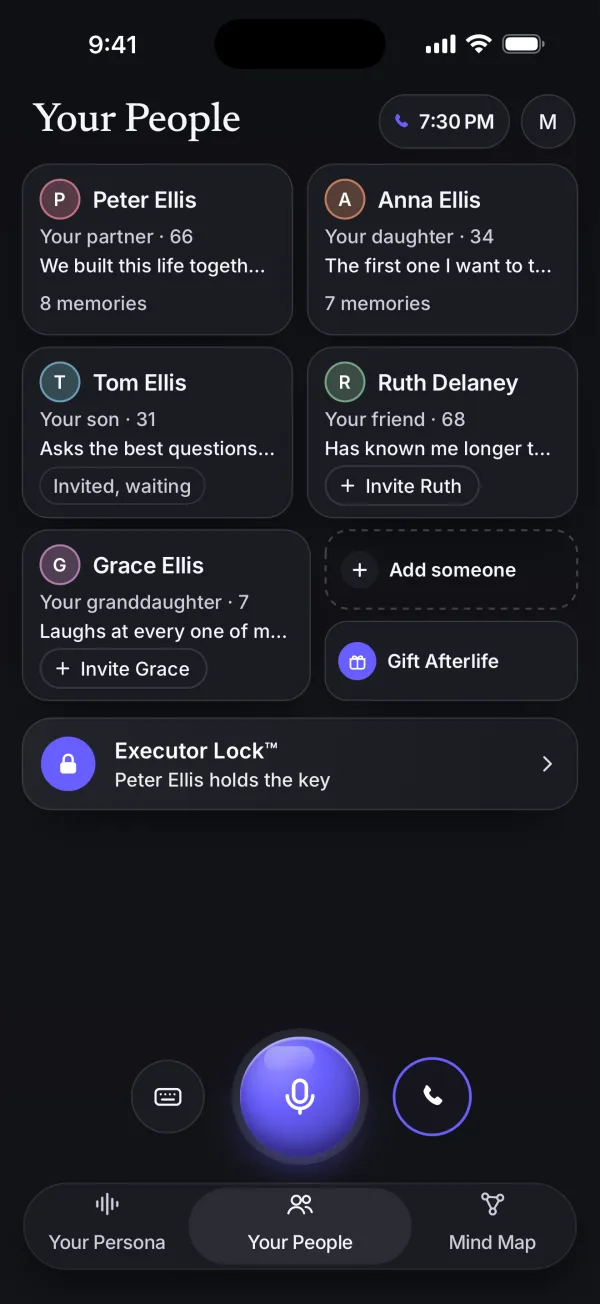
On Afterlife.ai® you write a time capsule letter with your Persona, the AI version of you that you build from your own memories and voice. In the room, your Persona asks who the letter is for, what the letter is for (a birthday, a wedding day, an 18th, a hard year or after you are gone), the tone you want and the length. Then the two of you write the letter paragraph by paragraph: your Persona drafts each part from your own words and memories and asks "How does that sound?" before writing the next. In the web app, the letter grows on screen as you talk, so you watch the whole letter take shape. When you are happy with every line, the letter is saved in Your Library.
You choose the day:
the letter is emailed to them at 8 am your time on the date you pick, or released with your Persona after your passing, at the Executor Lock™.
Add their email:
put the person's email in Your People and the letter arrives on the day without anyone having to remember.
Hear it in your voice:
one tap reads the letter aloud in your own cloned voice, and your voice is cloned free from your recordings (how voice cloning works).
Spoken and video messages too:
for anyone in Your People you can keep a written, spoken or video message that opens on a date you choose or after your passing.
Free to start:
letters are free to start, and the free build gives you 25 memories, up to 5 Trusted Contacts and Executor Lock™ setup with no card. The free build never expires.
A letter meant for after you are gone does not depend on one email address still working in twenty years. You name who holds the key, and at your passing the Executor Lock™ seals your Persona as a perfect snapshot, with nothing pruned. Your Trusted Contacts then meet the released Persona and see what you left for them in Your Library, including the letters you wrote together. Plans start at US$14.99 a month for Legacy, which adds voiced replies every month and voice calls with your Persona in your own voice (see pricing). Write your first time capsule letter free on Afterlife.ai®.
What mistakes stop a time capsule letter from landing?
Writing to everyone at once
A letter addressed to "my children" splits your attention and theirs. Each reader wants to find themselves in it, and a shared letter forces them to hunt for their own paragraph. Write one letter per person, even if the letters are short.
Telling them who to become
Readers open a time capsule letter years later, often at a moment when they are already unsure of themselves. Instructions about careers, partners or where to live can land as judgment, even when you meant them as love. Say what you hope for and what you see in them, and leave the decisions to them.
Picking a date with no plan to deliver it
A beautiful letter for an 18th birthday is worth nothing if it is still in a drawer on the morning of the 18th. Decide how the letter will reach them before you write it, and tell one person where it is. On Afterlife.ai® the delivery is part of the letter, so the date you choose is the date it arrives.
Frequently asked questions
What is a time capsule letter?
A time capsule letter is a letter you write now for someone to open on a set future date, such as an 18th birthday, a wedding day or after you are gone. It describes life today, what you see in the reader and what you hope for them.
What do you write in a time capsule letter to your daughter or son?
Describe a normal day right now, the small habits they will never remember, what you see in them, one lesson with the story behind it, and a question for them to answer. Write to the age they will be when they open it, not the age they are now.
When should a time capsule letter be opened?
The most common moments are an 18th or 21st birthday, a graduation, a wedding day, the birth of their first child, a hard year, and after you are gone. Choose a date the reader will recognize as a turning point.
How long should a time capsule letter be?
One to two pages is enough, or about five minutes read aloud. A short letter opened on the right morning means more than a long one opened at random.
How do I write a time capsule letter to myself?
Describe your life today, your worries and your hopes, and ask your future self three questions. An email-to-the-future service such as FutureMe delivers a letter to yourself on the date you choose.
How do I make sure a time capsule letter arrives on the right day?
Use something that delivers on its own rather than something that only stores. On Afterlife.ai® the letter is emailed to them at 8 am your time on the date you choose, or released after your passing at the Executor Lock™.
Can a time capsule letter be delivered after I die?
Yes. On Afterlife.ai® you can set a letter to arrive when your Persona is released after your passing, and your Trusted Contacts see what you left them in Your Library.
Is it free to write a time capsule letter on Afterlife.ai®?
Yes. Letters are free to start, and the free build includes 25 memories, up to 5 Trusted Contacts and Executor Lock™ setup with no card. Legacy is US$14.99 a month.
Sources
Wikipedia, "Time capsule" (en.wikipedia.org/wiki/Time_capsule)
FutureMe, the letter page at futureme.org
Google Account Help, "About Inactive Account Manager" (support.google.com/accounts/answer/3036546)
Gmail Help, "Schedule emails to send later" (support.google.com/mail/answer/9214606)
Your story is worth keeping.