

Send a Letter to the Future: Every Way That Works, Compared
To send a letter to the future, write it now and hand it to something that delivers on the date: FutureMe for letters to yourself, a scheduled email for short delays, a trusted person or lawyer, or Afterlife.ai® for letters to the people you love, on a date or after you are gone.
As seen in












You can send a letter to the future today, for free, in about ten minutes, and the only hard question is whether it will still arrive in ten or twenty years. People send letters forward for two very different reasons. Some write to their own future self, to check in on goals and see how they changed. Others write to the people they love, for an 18th birthday, a wedding day or the day after they are gone. The right tool depends on which of those letters you are writing, so this guide compares every real option and explains what makes a future letter actually land.
Writing to yourself:
an email-to-the-future service such as FutureMe is built for this.
Writing to someone you love:
Afterlife.ai® writes the letter with you and delivers it on a date or after your passing.
Short delays of days or weeks:
scheduled email in Gmail or Outlook works well.
After you die:
Google's Inactive Account Manager, a lawyer, or the Executor Lock™ on Afterlife.ai®.
Can you schedule a letter to be delivered in the future?
Yes, and there are more ways to do it than most people expect. Email-to-the-future services hold your letter and send it on the date you pick, scheduled email in Gmail and Outlook can delay a message, and postal time-capsule companies store a paper letter and mail it later. Google's Inactive Account Manager sends a message after your account has been quiet for a period you set, and a lawyer can hold a letter with your will. The difference between them is who the letter is for, how far ahead each one can reliably reach, and whether it still works after you are gone. A letter scheduled for next month is easy; a letter scheduled for 2046 needs a delivery method that will still exist in 2046.
Letters with your Persona
Write it now. They open it on the day.
Your Persona writes the letter with you, paragraph by paragraph, from your own words and memories, and asks how each part sounds before the next.
- Choose the day it arrives: their 18th birthday, their wedding day, or after you are gone.
- On the day, it reaches them by email that morning.
- Hear it read aloud in your own voice.
Free to start, no card. Every letter is kept in Your Library.
How do you send a letter to the future for free?
The free options are better than they look. FutureMe lets you write a text letter, pick a date and send it with no payment step, and its Premium plan adds images, videos and files. Gmail lets you schedule up to 100 emails to send later, which suits a letter a few weeks or months out. Afterlife.ai® letters are free to start, and the free build includes 25 memories, up to 5 Trusted Contacts and Executor Lock™ setup with no card. A handwritten letter left with someone you trust also costs nothing, as long as that person is still around and still remembers on the day.
Which way to send a letter to the future is right for you?
Match the tool to the reader first and the date second. If the letter is for you, use a service built for letters to yourself. If the letter is for a child, a grandchild or a partner, especially one you want to reach after you are gone, choose something that knows who they are and has a plan for your death. The table below compares the main options on the questions that matter over years rather than weeks.
Ways to send a letter to the future, compared (checked November 25, 2026):
Option | Who it is for | How far ahead | After you are gone? | Cost |
|---|---|---|---|---|
FutureMe | Your future self; other people once you create an account | Presets from 6 months to 10 years, and a date picker that runs to 2076 | Sends on the date, if the email address still works | Text letters with no payment step; Premium adds images, videos and files |
Postal time-capsule services | A paper letter to anyone | Depends on the company | Only if the company is still operating | Storage fees vary by company |
Gmail scheduled send | Short delays to anyone | Google's help page sets no maximum date; up to 100 scheduled emails | Risky: Google can delete an account inactive for two years | Free |
Outlook scheduled or delayed send | Short delays to anyone | Classic Outlook must be online and connected; new Outlook does not schedule for IMAP or POP accounts | Risky: the email depends on your account staying open | Included with Outlook |
Google Inactive Account Manager | Up to 10 people, after your account goes quiet | After a waiting period you set | Yes, triggered by inactivity rather than a date | Free |
A lawyer, with your will | Letters read when your estate is settled | When the estate is handled | Yes | Legal fees |
Afterlife.ai® | The people in Your People | A date you choose, or after your passing | Yes, released at the Executor Lock™ | Letters free to start; Legacy US$14.99 a month |
How do you send a letter to your future self?
To send a letter to your future self, write it in an email-to-the-future service, pick a date, and confirm your email address. FutureMe is the best known: you write, choose a delivery time from six months to ten years or pick a specific date, and verify your address, and the service says it has sent over 20 million letters in 20 years. Write about an ordinary day, what worries you, what you hope will have changed, and three questions you want answered. Use an address you expect to keep for decades rather than a work or school account, because those disappear when you move on. Our guide to a letter to my future self has templates for one, five and ten years.
Afterlife.ai® letters are written for the people in Your People, not for yourself, so a letter to your own future self belongs in a service like FutureMe or in a sealed envelope in your desk. Where Afterlife.ai® fits is the other half of the job: the letters to your children, grandchildren and partner that need to arrive on their day, in your words, whether or not you are there.
How do you send a message to the future to someone you love?
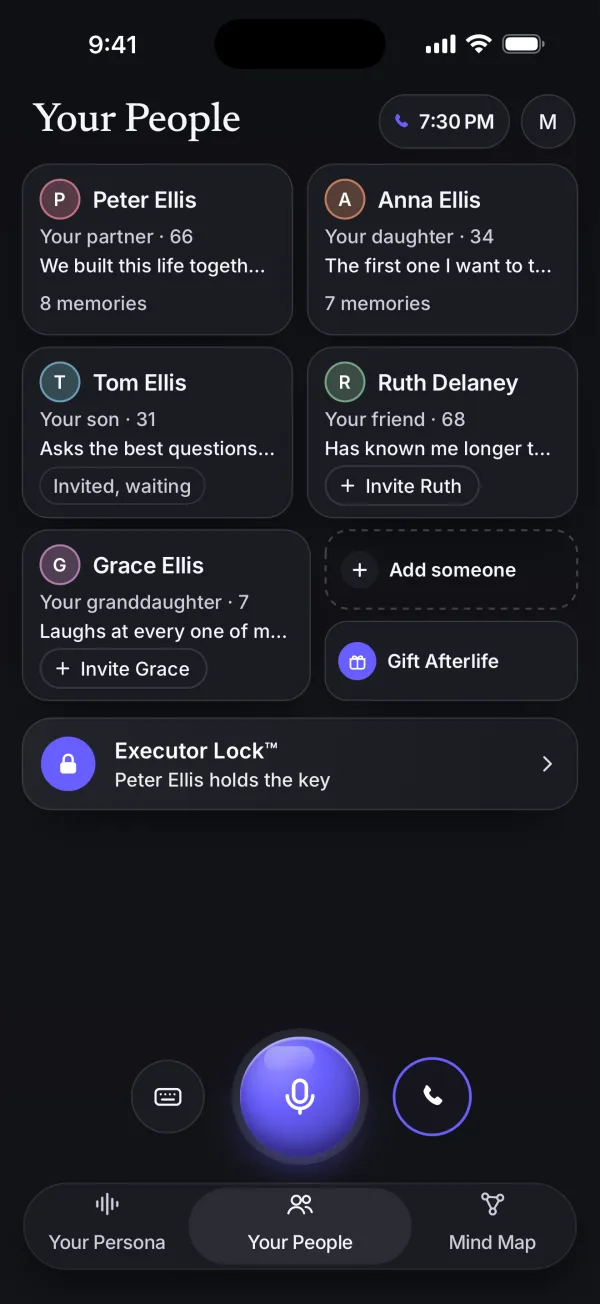
A message to the future for someone you love needs three things a letter to yourself does not: the right person, the right moment and a plan for the day you are not around to send it. That is the job Afterlife.ai® was built for. You write the letter with your Persona, choose a date or your passing as the moment of arrival, and add the person's email in Your People. For anyone in Your People you can also keep a spoken or video message that opens on a date you choose or after your passing. For the milestone letters themselves, see our guides to letters to open on future birthdays and the time capsule letter, and for a wider look at the tools, our ranking of the best app to leave messages for loved ones.
What makes a letter to the future actually arrive in 10 or 20 years?
A future letter fails for one of three reasons: the address stopped working, the service stopped existing, or nobody who knew about it was left to act. Plan for all three before you pick a date. The longer the gap, the more each of them matters.
An email address that still works
Most future letters arrive by email, so the address is the weakest link. Work and school accounts close when people move on, and free accounts can lapse; Google, for example, can delete an account that has been inactive across its services for two years. Send to the personal address the reader is most likely to keep, and when the letter matters, give it a second way to reach them.
A service that still exists
A promise to deliver in 2046 is only as good as the company making it. Postal time-capsule services in particular depend on one business storing paper for decades, and a scheduled email depends on your own account surviving. Prefer a method with a second path to the reader, such as a named person who can act if the first path fails.
A trusted person who knows
The most reliable delivery system is still a person who knows the letter exists. Tell one person where your letters are and when they are meant to arrive. On Afterlife.ai® that person is built in: you name who holds the key, and your Trusted Contacts meet your released Persona after your passing and see what you left for each of them in Your Library, so a letter does not depend on one email address alone.
Can you send a letter to the future after you die?
Yes, and there are three serious ways to do it. Google's Inactive Account Manager sends a message you write, with a subject and body of your choosing, to up to 10 people once your account has been inactive for the period you set; our guide to Google Inactive Account Manager walks through the setup. A lawyer can hold a letter with your will, which works, but the letter is read once, at a hard time, alongside legal papers. Afterlife.ai® releases your letters at the Executor Lock™ after your passing, under the control of the person you named to hold the key, and your Persona is sealed as a perfect snapshot with nothing pruned. Your Trusted Contacts then meet the released Persona, who can answer their questions about the letter in your words and your voice.
What should you write in a letter to the future?
Write for the person they will be on the day they open it, and fill the letter with details from today that they could never get anywhere else. A good letter to the future describes an ordinary day right now, says what you see in the reader, passes on one lesson with the story behind it, and asks a question they can answer when they read it. Keep it to one or two pages, because a short letter read on the right morning beats a long one nobody finishes. Leave out instructions about who they should become, and anything you would not say to their face at the age they will be. These five prompts get the first paragraph down.
"Today is an ordinary Tuesday, and here is what it looks like..."
"The thing I notice about you most right now is..."
"By the time you read this, I hope you have..."
"The hardest lesson I learned at your age was..."
"When you read this, write back and tell me whether..."
How does Afterlife.ai® send a letter to the future?
On Afterlife.ai® you write the letter together with your Persona, the AI version of you built from your own memories and voice. In the room, your Persona asks who the letter is for, what the letter is for (a birthday, a wedding day, an 18th, a hard year or after you are gone), the tone and the length. Then your Persona drafts the letter paragraph by paragraph from your own words and memories, asking "How does that sound?" before writing the next part. In the web app, the letter grows on screen as you talk. The finished letter is saved in Your Library, ready for its day.
On a date:
the letter is emailed to them at 8 am your time on the morning you choose.
After your passing:
the letter is released with your Persona at the Executor Lock™.
In your voice:
"Hear it in your voice" reads the letter aloud in your own cloned voice, and your voice is cloned free from your recordings.
In their language:
your Persona answers in 94 languages, in writing and out loud, so a letter to a grandchild can be written in the language you share.
For your people, not yourself:
letters go to the people in Your People, each with their own date.
Free to start:
no card, and the free build never expires. Legacy at US$14.99 a month adds voiced replies every month and voice calls with your Persona in your own voice (see pricing).
The letters you will be gladdest to have sent are the ones for the moments you cannot be sure of seeing, and they take an evening to write. Send your first letter to the future free on Afterlife.ai®. For ideas on what to put in it, our guide to the digital time capsule covers the photos, voice notes and videos that go well beside a letter.
Frequently asked questions
Can you send a letter to the future?
Yes. Email-to-the-future services such as FutureMe deliver a letter to yourself on a date you choose, scheduled email handles short delays, and Afterlife.ai® delivers letters to the people you love on a date or after your passing.
How do I send a letter to the future for free?
FutureMe sends a text letter to your future self with no payment step, and Gmail can schedule up to 100 emails. Afterlife.ai® letters to the people you love are free to start, with no card.
Can you schedule a letter to be delivered on a specific date?
Yes. FutureMe and Afterlife.ai® both deliver on a date you choose, and on Afterlife.ai® the letter is emailed to the person at 8 am your time that morning.
How do I send a letter to my future self?
Write it in an email-to-the-future service such as FutureMe, pick a delivery date, and confirm a personal email address you expect to keep for years.
Does Afterlife.ai® send letters to yourself?
No. Afterlife.ai® letters go to the people in Your People, such as your children, grandchildren or partner. For a letter to your own future self, use a service such as FutureMe.
Can I send a message to the future after I die?
Yes. Google's Inactive Account Manager can email up to 10 people after your account goes quiet, and Afterlife.ai® releases your letters and kept messages at the Executor Lock™ after your passing.
What is the best way to make sure a future letter arrives?
Use a personal email address the reader will keep, a service with a plan for your death, and one trusted person who knows the letter exists. Afterlife.ai® covers all three through Your People and the Executor Lock™.
Is Afterlife.ai® free?
Yes. Letters are free to start, and the free build includes 25 memories, up to 5 Trusted Contacts and Executor Lock™ setup with no card. Legacy is US$14.99 a month, Eternal US$29.99 and Pro US$59.99.
Sources
FutureMe, the letter page at futureme.org
Gmail Help, "Schedule emails to send later" (support.google.com/mail/answer/9214606)
Microsoft Support, "Delay or schedule sending email messages in Outlook" (support.microsoft.com)
Google Account Help, "About Inactive Account Manager" (support.google.com/accounts/answer/3036546)
Write the letter they will open on the day.